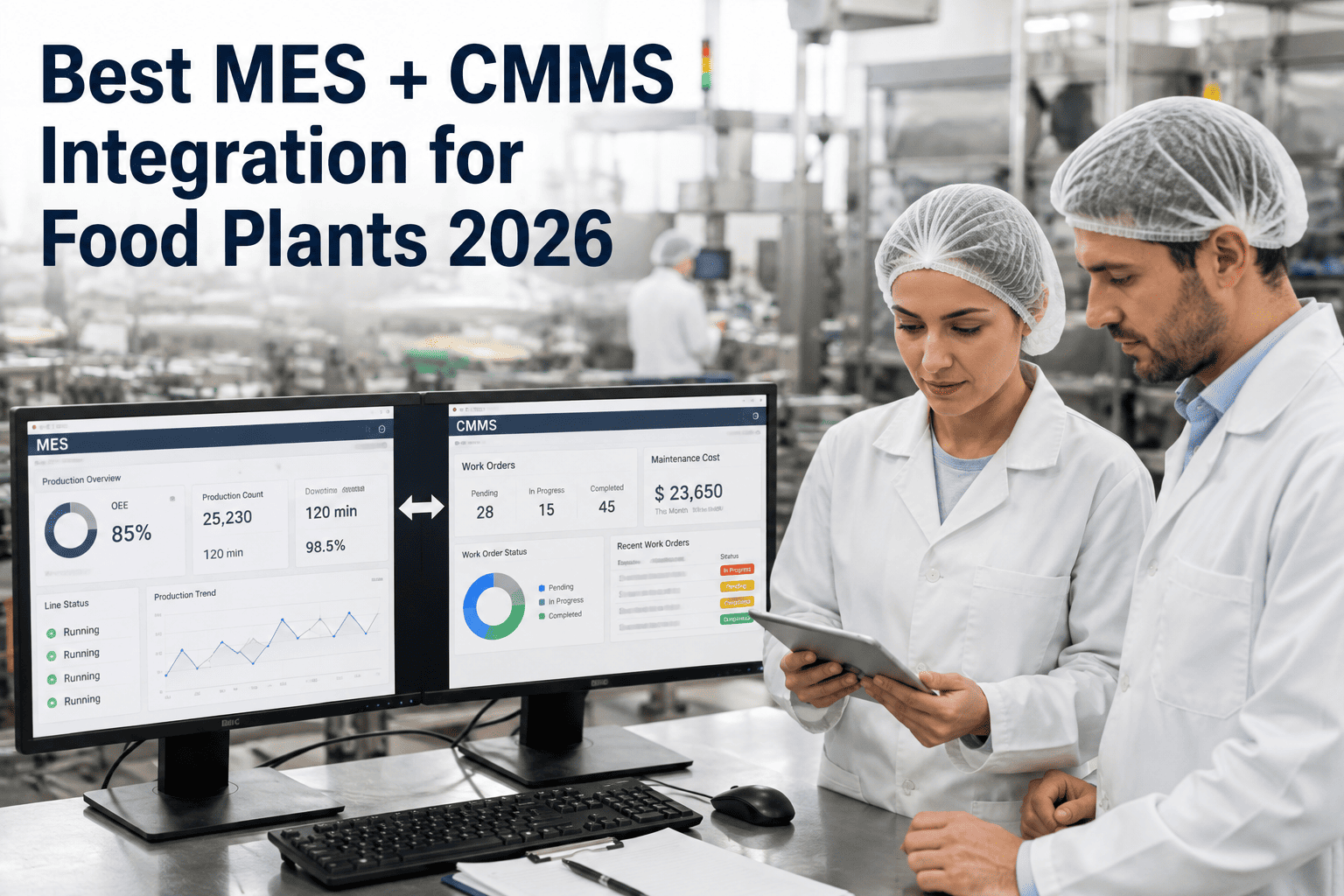
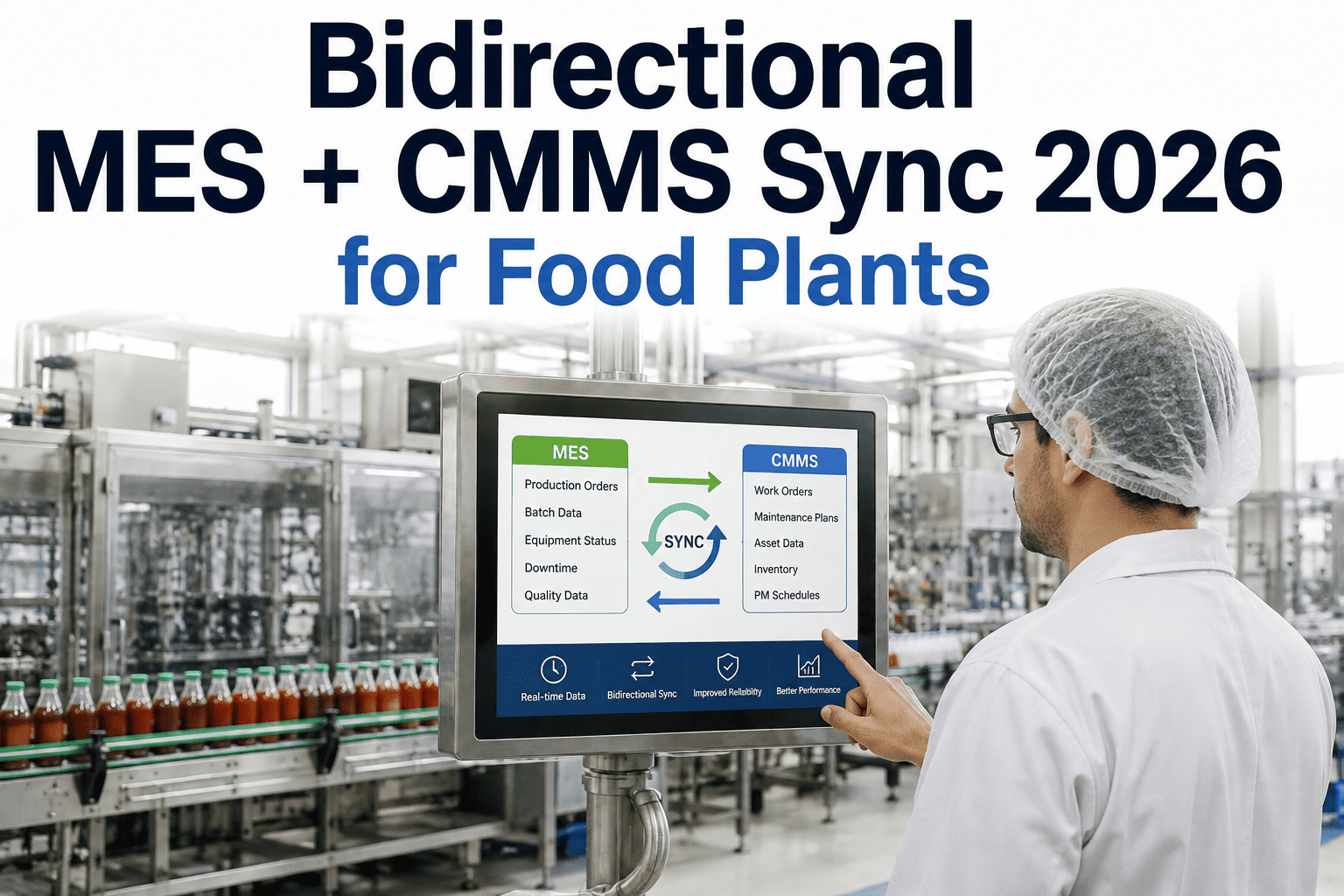
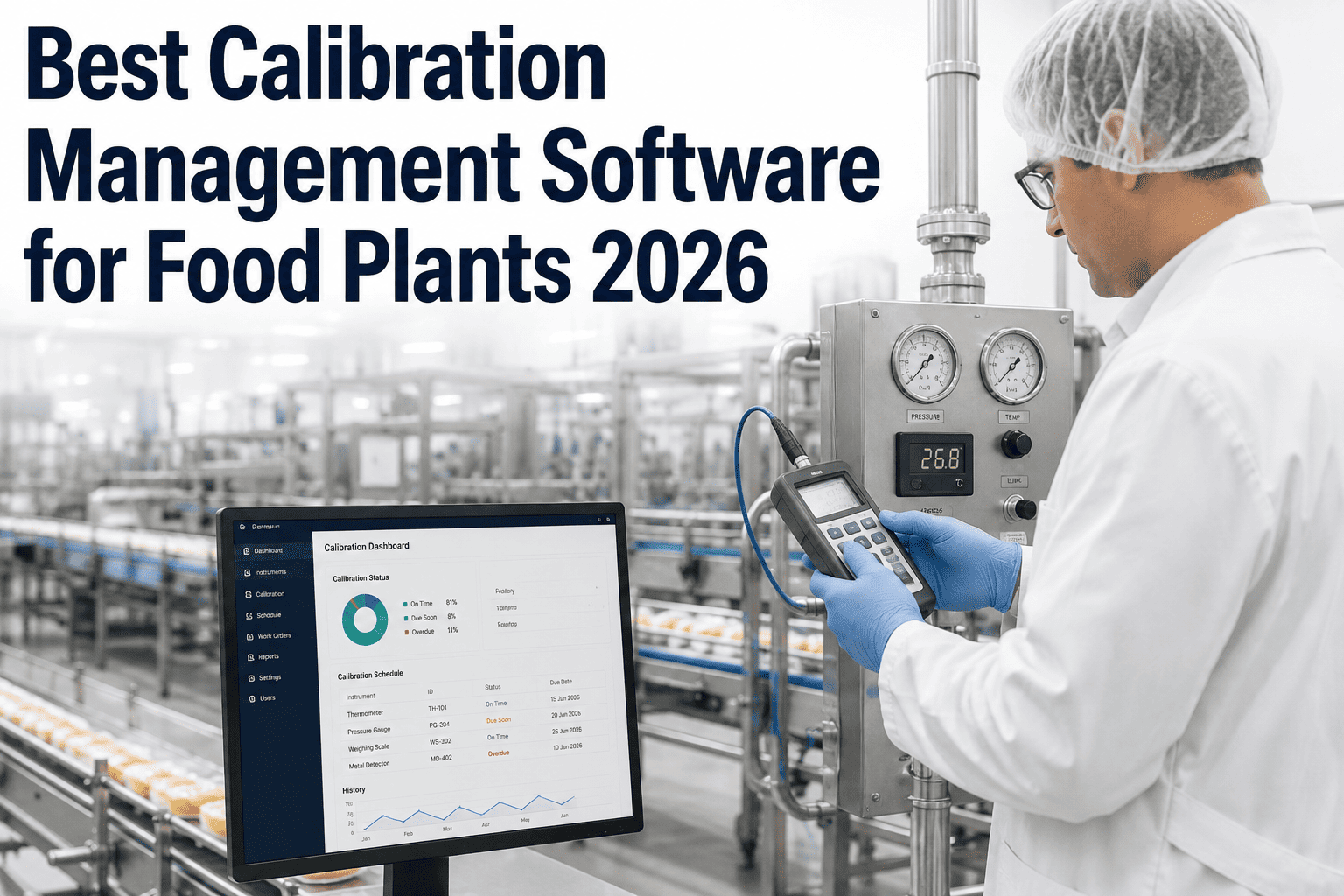
Most food plants running both an MES and a CMMS eventually hit the same wall — the two systems know things about the same piece of equipment that neither one shares with the other. MES knows a filler has been running at reduced speed for the last six hours. CMMS knows that same filler is three days overdue for a bearing inspection. Neither system connects those two facts, so the plant runs degraded for another shift before someone manually notices the pattern and opens a work order. See how the strongest MES-CMMS integration architectures for food plants in 2026 close that gap and what actually separates a working integration from a superficial one.
Digital Operations · 2026 Integration Guide
Your MES and CMMS Both Know Something the Other One Doesn't
Reference architectures, integration seams, and outcome benchmarks for connecting MES and CMMS in food plants — evaluated against what actually determines whether the integration delivers real value in 2026.
The Silo Problem
What Stays Invisible When MES and CMMS Don't Talk
MES and CMMS are each excellent at what they were built for, and that's exactly why the gap between them is so costly. MES tracks production performance — speed, downtime, quality events, OEE — in near real time. CMMS tracks maintenance history, work orders, and asset condition on its own separate timeline. When these systems run independently, a production trend that should trigger a maintenance response has to be noticed by a person crossing between two separate dashboards, and a maintenance schedule that should account for actual production stress on an asset instead runs on a fixed calendar interval that doesn't reflect what the asset has actually been through.
Downtime Without Context
MES logs a downtime event but doesn't automatically know whether it matches a pattern CMMS has already seen on that same asset's failure history.
Maintenance Without Production Awareness
CMMS schedules preventive maintenance on a fixed calendar without knowing the asset has been running at unusually high load or reduced speed for weeks.
Manual Bridging
Someone — usually a maintenance planner or production supervisor — ends up manually cross-referencing both systems to catch patterns neither one surfaces alone.
Delayed Response
By the time a manual cross-reference catches a developing issue, the asset has often already cost several additional hours or shifts of degraded performance.
Reference Architectures
Three Common Integration Approaches, Compared
| Architecture | How Data Flows | Where It Falls Short |
|---|
| Manual Export/Import | Periodic file exports moved between systems by hand | Data is always stale by the time it's cross-referenced |
| Point-to-Point API | Direct API connection between the two specific platforms | Brittle to version changes, hard to extend to a third system |
| Middleware/Integration Layer | A shared layer normalizes and routes data between systems | Requires upfront investment but scales across future systems |
The middleware approach is increasingly the standard for plants planning beyond a single MES-CMMS pairing, since it avoids rebuilding a point-to-point connection every time a plant adds a new system to the stack — an ERP, a quality management platform, or a second CMMS instance after an acquisition. The upfront cost is real, but it's a cost paid once rather than repeatedly as the plant's software footprint grows.
Connect the Systems That Already Know the Answer
Turn Two Separate Dashboards Into One Actionable View
iFactory connects MES production data with CMMS maintenance history so downtime patterns and asset condition inform each other automatically.
The Integration Seams That Matter Most
Where the Data Connection Actually Needs to Happen
1
Downtime event to work order trigger — a downtime event of a defined type or duration on a specific asset automatically creates or pre-populates a CMMS work order with the relevant failure context already attached.
2
Production load to maintenance scheduling — CMMS preventive maintenance intervals adjust based on actual production hours and load intensity reported by MES, rather than running on a pure calendar basis regardless of usage.
3
Asset history to production planning — production scheduling in MES can account for an asset's upcoming maintenance window or recent repair history when planning which line to run a given order on.
4
Quality event to asset condition correlation — a quality deviation traced back to a specific asset feeds into that asset's maintenance history, helping distinguish a process issue from an equipment condition issue over time.
Outcome Benchmarks
What a Working Integration Should Actually Deliver
01
Faster Work Order Creation
A downtime event should generate a relevant, pre-populated work order automatically rather than requiring a maintenance planner to manually translate a production log into a ticket.
02
Condition-Aware Maintenance Scheduling
Preventive maintenance intervals should reflect actual asset usage and stress, not just elapsed calendar time since the last service.
03
Fewer Repeat Failures
Cross-referencing downtime patterns against maintenance history should catch a recurring failure mode faster than a human noticing the same complaint several work orders in a row.
04
One Source of Truth for Asset Status
A production supervisor and a maintenance planner should be looking at the same current status for a given asset, not two systems that disagree because one hasn't synced recently.
Common Questions
Frequently Asked Questions
Do we need to replace our current MES or CMMS to integrate them?
No — in most cases, integration works with the MES and CMMS a plant already has in place, connecting them through an API or middleware layer rather than requiring either platform to be replaced. Replacement only becomes a consideration if the existing systems genuinely lack the data or connectivity needed to support integration, which is uncommon for modern platforms.
Talk to support about your current MES and CMMS setup.
How long does a typical MES-CMMS integration project take?
Timelines vary significantly based on the integration architecture chosen and how many of the seams described above are in scope, but a point-to-point integration covering the core downtime-to-work-order seam is typically faster to stand up than a full middleware layer connecting multiple systems and data flows.
Which integration seam should we prioritize first?
Most plants see the fastest return from the downtime-to-work-order trigger, since it directly reduces the manual translation work a maintenance planner currently does, and it's usually the seam with the clearest, most measurable before-and-after comparison.
Book a demo to discuss which seam matters most for your specific operation.
Does this integration require IT resources we don't have in-house?
It depends on the chosen architecture — a middleware-based integration typically requires less ongoing internal IT involvement once configured, since the integration platform handles the data routing, while a custom point-to-point build usually needs more in-house or vendor development support to maintain over time.
Can this scale to a multi-plant operation with different MES or CMMS versions per site?
Yes, though it requires planning for version differences across sites — a middleware layer is generally better suited to this scenario than point-to-point connections, since it can normalize data from slightly different system versions into a consistent format for cross-plant reporting and comparison.
Stop Bridging Systems Manually
Give Production and Maintenance the Same View of Every Asset
iFactory connects MES and CMMS so downtime, maintenance history, and asset condition inform every decision automatically, not after a manual cross-check.