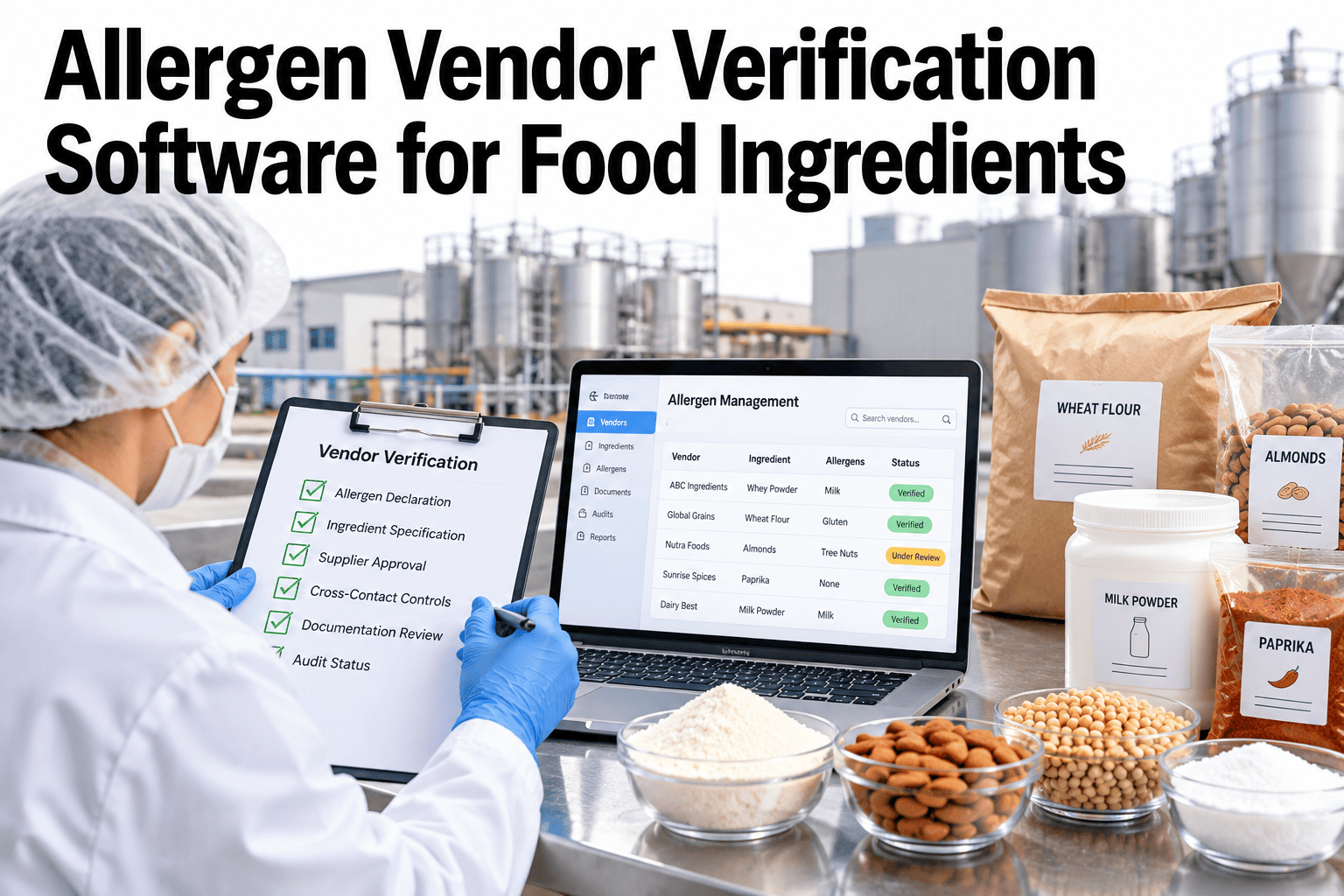
A supplier can change a facility, a formulation or a shared production line without ever telling the food plant that receives their ingredient. Unless someone is actively checking supplier statements and certificates of analysis against what was promised, that change arrives at the plant invisible, hidden inside a shipment that looks exactly like the last one. Allergen vendor verification software closes that gap by keeping every supplier statement current and flagging the moment something changes, which is why QA teams want it in place before the next ingredient delivery rather than reviewing it alongside their current supplier list on iFactory AI.
Incoming Risk Should Never Be a Surprise
iFactory AI tracks supplier allergen statements, COAs and facility change notices in one place, so QA sees a risk before it becomes a finding.
Why Incoming Ingredient Risk Is Easy to Miss
Supplier allergen management often lives in a shared drive full of PDFs, each collected at onboarding and rarely revisited. The documents age quietly, and nobody notices until a complaint or an audit forces a review.
A statement collected two years ago may no longer reflect the supplier's current facility.
Some suppliers send a certificate every lot, others only when asked.
A new co-packer or shared line rarely triggers a proactive notice.
Purchasing, QA and receiving each hold a piece of the picture.
What a Verification Record Should Actually Contain
A complete supplier allergen record is more than a signed form. It is a living file that captures what was promised, what has been tested, and what has changed since.
| Record Type | Purpose | Refresh Cadence |
|---|---|---|
| Allergen statement | Confirms which of the major allergens are present or absent | Annually or on facility change |
| Certificate of analysis | Confirms the specific lot meets agreed specification | Every lot or shipment |
| Facility audit summary | Shows how the supplier controls cross-contact on site | Annually |
| Change notification log | Tracks any reported shift in facility, formula or line sharing | As events occur |
| Corrective action history | Shows how the supplier responded to past deviations | Ongoing |
Map Your Current Supplier Records to This Structure
Bring your supplier list to a 30-minute session and see what is missing.
Manual Tracking vs Automated Verification
How the Verification Flow Works
Supplier statements and COAs are logged against each ingredient.
Each record carries a refresh date based on its type.
New documents are compared against the prior statement on file.
QA sees flagged suppliers before the next receiving event.
Why Expiration Tracking Matters More Than It Seems
An allergen statement does not expire because a date on a form says so, it expires because the facility, formulation or process it describes may no longer be accurate. The date is simply a reminder to go check.
Plants that skip this step often discover during an audit that a meaningful share of their supplier statements are years out of date, not because anyone decided that was acceptable, but because no one owned the job of chasing a refresh. A system that tracks expiration automatically removes the dependency on any one person remembering.
A Scenario: The Co-Packer Nobody Was Told About
Picture a mid-size spice supplier that begins outsourcing part of its blending to a co-packer during a busy season, without updating the allergen statement on file with its customers.
The next shipment looks identical to the last one, same packaging, same label, same specification sheet. Without a system actively comparing the current statement against the one on record, there is nothing prompting anyone to ask whether the facility behind that shipment has changed. A verification system that flags an aging or unconfirmed statement at the point of the next order catches exactly this kind of silent shift before it becomes a finding on the plant floor.
Why This Matters More as Supplier Networks Grow
A plant sourcing from a handful of long-term, local suppliers can sometimes get away with an informal process, because familiarity fills in the gaps a system would otherwise cover. That stops being true as the supplier network grows across regions and tiers.
A larger network means more facilities, more sub-suppliers, more chances for a change to happen somewhere in the chain without a direct line of communication back to the plant. The further removed a supplier is from daily contact, the more a structured verification process matters, not less.
Signs Your Current Process Has a Gap
What Changes When Verification Becomes Routine
Plants that move from occasional supplier checks to continuous verification tend to notice the shift less in dramatic saves and more in the absence of surprises. Fewer emergency holds, fewer scrambles during an audit, fewer moments where a shipment is accepted on faith because nobody had time to check.
The value compounds over time as well, since a supplier with a long, clean verification history becomes lower effort to review on each cycle, while a supplier with a thin or inconsistent record earns closer attention automatically.
What to Ask a New Supplier Before Onboarding
The strongest verification record starts with the right questions at onboarding, before the first shipment ever arrives on the dock.
Which allergens run on the same equipment as this ingredient.
What verification method confirms a line is clear between runs.
Whether any part of the process is outsourced to a third party.
How and when the supplier agrees to report a facility change.
Scoring Supplier Risk Instead of Treating Every Supplier the Same
Not every ingredient carries the same allergen exposure, and treating a single-ingredient dry goods supplier the same as a multi-line co-packer wastes review time on the low-risk accounts while the high-risk ones get the same light touch.
Highest scrutiny, since cross-contact risk exists even with a clean formulation.
Elevated review, especially where cleaning validation data is thin.
Lower baseline risk, still reviewed on the standard refresh cycle.
Treated as elevated risk until a full verification cycle is complete.
A simple scoring model lets QA spend review time where it actually changes the outcome, rather than spreading equal attention across every supplier regardless of their real exposure.
Connecting Verification to the Receiving Dock
A verification system only closes the loop when its output reaches the people physically accepting a shipment. A flagged supplier sitting unread in a QA inbox does nothing to stop a truck from being unloaded.
Where iFactory AI Fits
Centralizes documents
Keeps statements, COAs and audits tied to each supplier and ingredient.
Tracks expiration
Flags records approaching their refresh date automatically.
Detects change
Compares new statements against what was previously on file.
Builds the audit file
Produces a complete supplier record on demand, not from scratch.
Expert Review
A food safety sourcing perspective, reviewed for accuracy before publication: most allergen failures traced back to suppliers are not caused by a supplier lying, but by a plant never asking again after the first onboarding. Verification is not a one-time gate, it is a maintained relationship, and the plants that treat it that way catch changes months before they show up in a complaint. Reviewing your current supplier file against this structure usually surfaces a handful of gaps quickly. Confirm specific regulatory requirements with your own compliance team before relying on any workflow.
Frequently Asked Questions
How often should an allergen statement really be refreshed?
Most plants target an annual refresh at minimum, with an immediate update required whenever a supplier reports a facility or formulation change. Waiting longer than a year leaves a wide window for an unreported change to go unnoticed. See a recommended refresh cadence for your supplier list.
What if a supplier refuses to share facility details?
A supplier unwilling to share basic facility and cross-contact information is a risk signal on its own, and many plants treat that refusal as grounds to require additional testing or to source elsewhere. Ask about how to flag suppliers with incomplete disclosure.
Can this replace incoming ingredient testing?
No, verification and testing serve different purposes, since a statement confirms what the supplier reports while testing confirms what actually arrived. The two work best together, with verification narrowing where testing attention should focus. Explore how verification and testing fit together.
How many suppliers can realistically be tracked this way?
The structure scales from a handful of key suppliers to a full ingredient list, since the record format stays the same regardless of count. Plants usually start with their highest-risk allergen-containing ingredients first. Try a pilot across your top supplier accounts.
Does this help during a customer or regulatory audit?
Yes, having a complete, dated supplier record available on demand is one of the more common audit requests, and assembling it in advance saves significant time during the audit itself. Talk through what an audit-ready supplier file looks like.
Know About a Supplier Change Before It Reaches Your Line
iFactory AI keeps every allergen statement, COA and change notice current and visible. Book a walkthrough with your own supplier list.