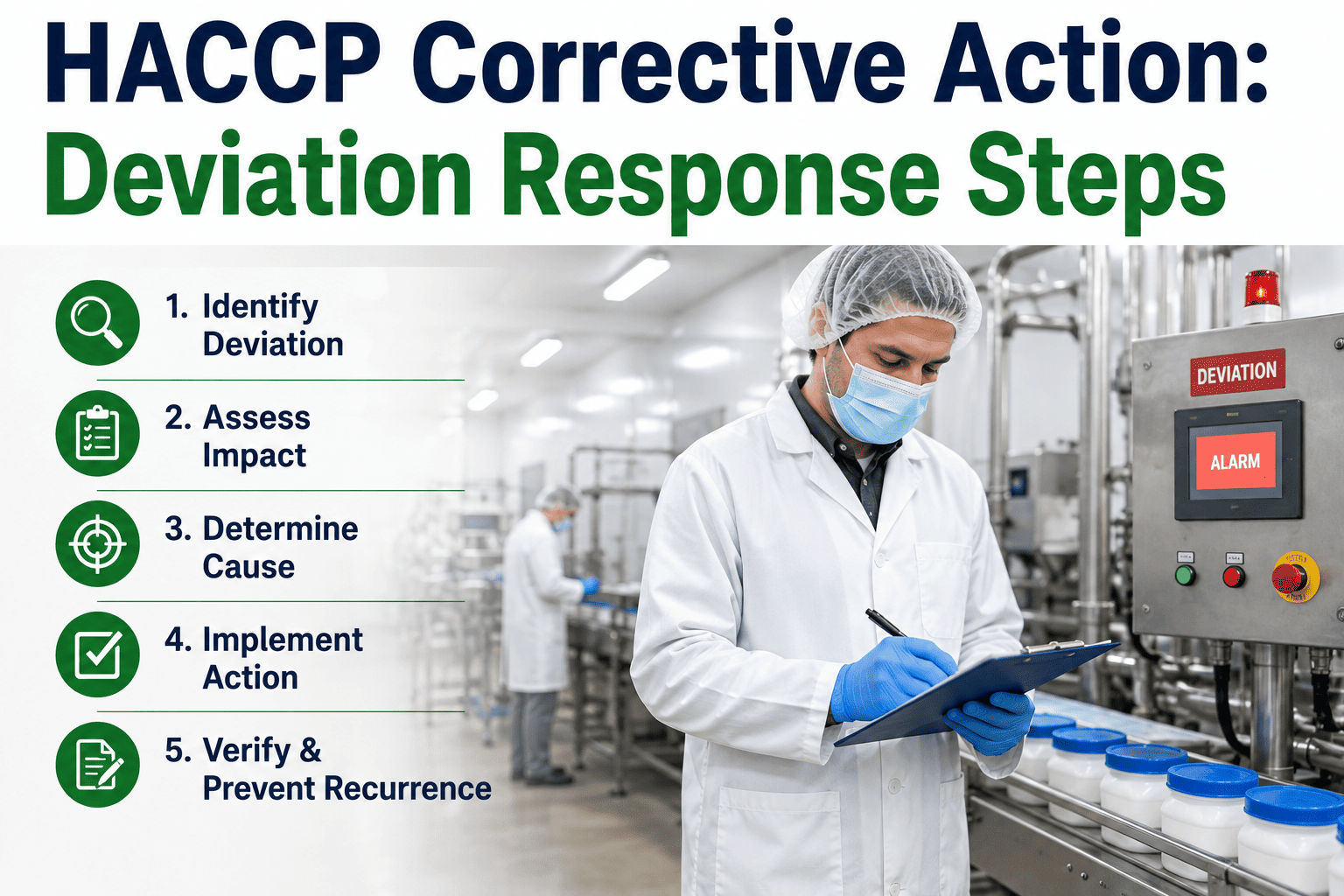
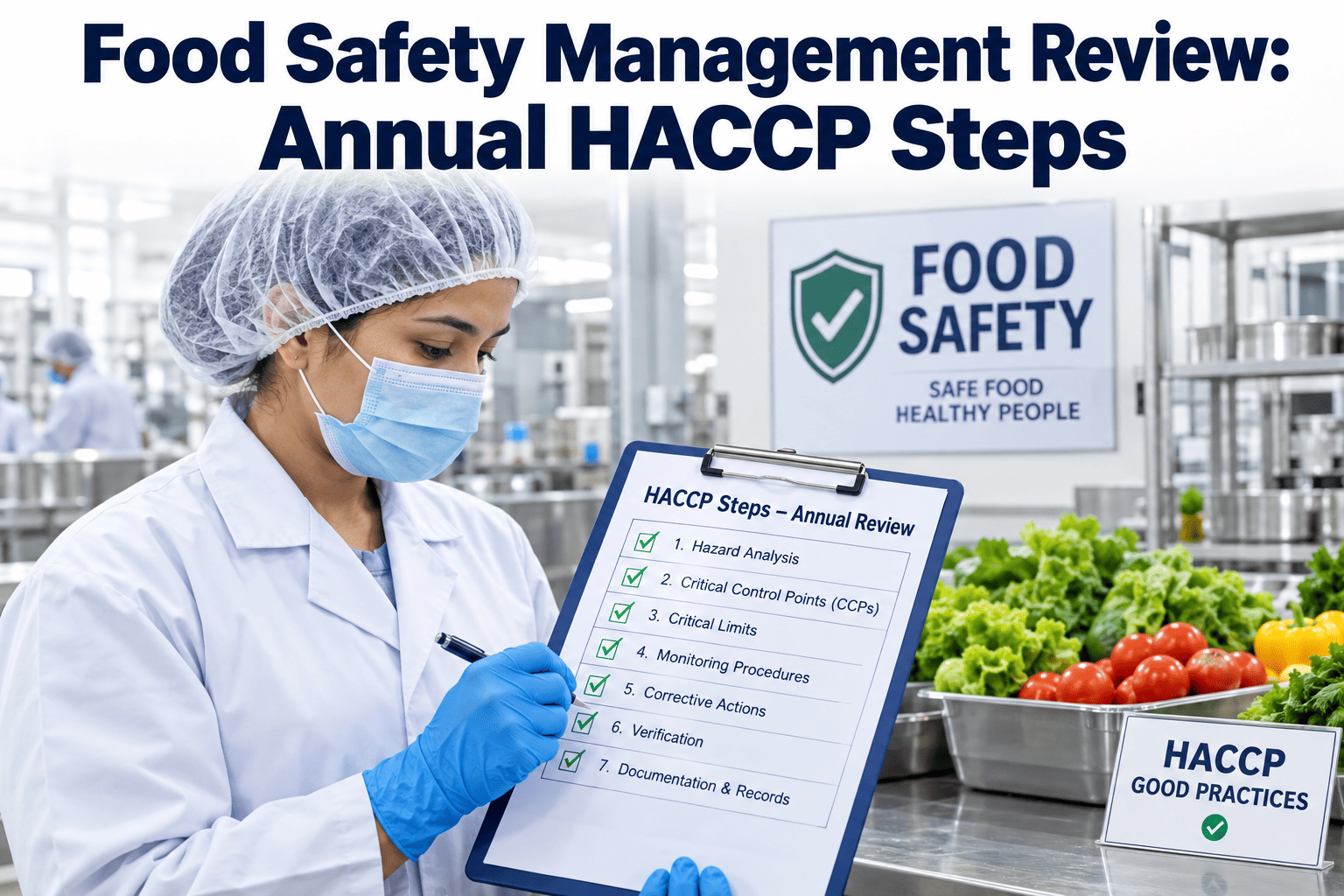
The moment a critical limit is breached at a CCP, the clock starts on a decision sequence that most operators only get to practice during an actual deviation, which is exactly the wrong time to be figuring out the steps for the first time. A HACCP deviation isn't a sign the food safety plan has failed — plans are built expecting that critical limits will occasionally be missed, and the corrective action procedure exists precisely to handle that moment correctly. What actually causes problems during an audit or, worse, a real safety incident, is a corrective action response that was improvised, undocumented, or inconsistent with what the written HACCP plan says should happen, and a free HACCP plan review can confirm your corrective action procedures are ready before you need them.
Food & Beverage · HACCP Compliance
HACCP Corrective Action: What to Do the Moment a Critical Limit Is Breached
A deviation at a CCP demands a specific, documented sequence, not improvisation. Here's how to build a corrective action procedure that holds up under real conditions and audit review.
The Three Elements Every Corrective Action Needs
Regulatory guidance is consistent on this point: a proper HACCP corrective action addresses three distinct things, and skipping any one of them leaves the response incomplete even if the other two were handled well. Fix the immediate cause so the process is back under control, determine what to do with any product that was made while the process was out of control, and take steps to prevent the same deviation from recurring.
1
Correct the Cause
Identify and fix whatever specifically caused the critical limit to be breached, and confirm the process is back under control before resuming normal operation at that CCP.
2
Address Affected Product
Determine the disposition of any product made during the period the process was out of control — hold, evaluate, and decide whether it can be released, reworked, or must be destroyed.
3
Prevent Recurrence
Identify the root cause behind the deviation and implement a change — equipment, training, or procedure — that reduces the likelihood of the same deviation happening again.
Immediate Response Timeline
Minute 0
Deviation detected — monitoring reveals critical limit breached at the CCP
Minute 1-5
Process stopped or isolated, affected product segregated and held
Minute 5-15
Supervisor or QA notified, immediate cause identified where possible
Same shift
Corrective action implemented, process re-verified before restart
Within 24 hours
Product disposition decision made and documented
Follow-up
Root cause investigation and preventive measure finalized and logged
Would Your Team Know Exactly What to Do at Minute Zero?
Our team can help you build and drill a corrective action procedure specific to each of your CCPs, at no cost.
Deciding Product Disposition
Product disposition is often the hardest decision in a corrective action sequence because it directly affects yield and cost, which creates real pressure to lean toward release even when the evidence doesn't clearly support it. A defensible disposition decision separates the emotional and financial pressure from the food safety evaluation, relying on objective evidence — additional testing, review of the actual severity and duration of the deviation, and comparison against what's actually required to ensure safety — rather than defaulting to whichever outcome is most convenient.
| Disposition Option | When Appropriate | Documentation Needed |
|---|
| Release | Evidence confirms safety was not compromised | Evaluation basis and sign-off from authorized reviewer |
| Rework | Product can be reprocessed to meet the critical limit | Rework procedure followed, re-verification result |
| Hold for further evaluation | Evidence is inconclusive, more testing needed | Hold log with time, location, and quantity |
| Destroy | Safety cannot be confirmed or deviation was severe | Destruction record with witness and date |
Root Cause Investigation: Going Beyond the Symptom
Fixing the immediate cause of a deviation — resetting a thermostat, replacing a faulty sensor, retraining an operator on a single occasion — addresses the symptom but not necessarily the underlying reason that symptom appeared in the first place. A thorough root cause investigation asks why the equipment failed, why the sensor drifted, or why the operator deviated from procedure, tracing the chain back until it reaches something genuinely preventable, such as a maintenance interval that's too long, a calibration schedule that isn't being followed, or a training gap that affects more than just the one operator involved in this specific incident.
Preventive Measures That Actually Reduce Recurrence
Equipment-Related
Adjust preventive maintenance intervals, upgrade aging equipment, or add redundant monitoring for CCPs with a history of drift.
Procedure-Related
Revise the written procedure if it's ambiguous or difficult to follow correctly under normal production conditions.
Training-Related
Expand retraining beyond the individual involved if the same gap likely exists across the wider team or shift.
Monitoring-Related
Increase monitoring frequency at a CCP that has shown repeated near-misses, even if it hasn't yet triggered a full deviation.
Documenting the Full Corrective Action Record
A complete corrective action record connects every piece of the response into a single traceable trail: the date and time of the deviation, the specific critical limit and CCP involved, the immediate corrective action taken, the product disposition decision and its basis, the root cause identified, and the preventive measure implemented, along with the names of everyone involved in the decision. Gaps in this chain are exactly what auditors and investigators look for, since a record that's strong on the immediate fix but silent on disposition or prevention reads as an incomplete response even when the actual handling in the moment was sound.
Frequently Asked Questions
Who has the authority to make a product disposition decision after a deviation?
This should be defined explicitly in your HACCP plan, typically a qualified individual such as a quality manager or trained HACCP team member, not a production supervisor under pressure to keep the line moving. Having this authority clearly assigned in advance removes ambiguity and pressure from the moment a real deviation occurs.
What if we can't determine a root cause immediately?
It's acceptable to implement an immediate corrective action to restore control while a root cause investigation continues over the following days, but the investigation should still be completed and documented rather than left open indefinitely. A corrective action record that stops at the immediate fix without a documented root cause and preventive measure is generally considered incomplete during an audit.
Does every deviation require destroying the affected product?
No — destruction is only one of several possible disposition outcomes, and it's appropriate specifically when safety cannot be confirmed through evaluation or additional testing, or when the deviation was severe enough that no amount of evaluation can adequately address the risk. Many deviations, properly evaluated, can be released or reworked without compromising safety.
How specific does our written corrective action plan need to be for each CCP?
Specific enough that an operator or supervisor unfamiliar with the exact incident could follow the plan and arrive at a consistent, appropriate response. Generic language like "take appropriate action" doesn't meet this bar — the plan should specify who is notified, what immediate steps are taken, and how product disposition decisions get made for each CCP.
Can corrective action tracking be automated to catch trends across multiple deviations?
Yes, and tracking deviations digitally across time makes it much easier to spot whether the same CCP, shift, or root cause category keeps recurring, which is exactly the pattern that points toward a more durable systemic fix. Book a
free consultation to see how this could strengthen your current HACCP program.
Be Ready for the Deviation Before It Happens
Let our team help you build a corrective action procedure for every CCP that holds up under real conditions and audit review, at no cost.