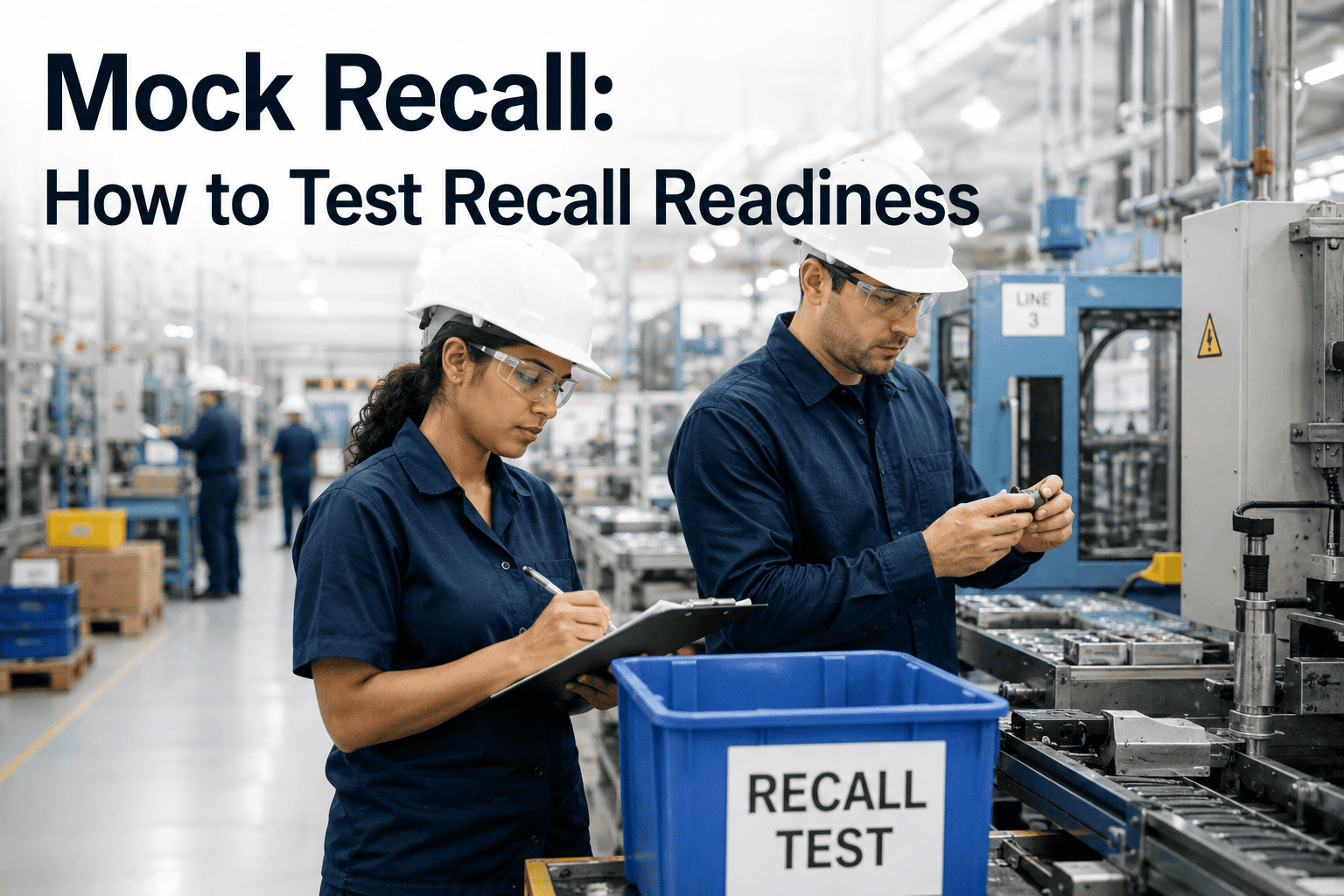
The plants that handle a real recall well are never the ones improvising a plan on the day it happens — they are the ones who have already run the exercise as a drill, found the gaps in their traceability records, and fixed them before a regulator or a customer ever asked. A recall plan that exists only as a document in a binder is not a plan; it is a hope. Mock recalls, run on a real schedule against real lot data, are what actually reveal whether a plant can trace a compromised ingredient from receiving to a specific customer shipment within the hours a real event demands, not the days a broken process quietly allows. Book a mock recall readiness review to find out how fast your current traceability actually is.
A Recall Plan Is Only as Good as Its Last Drill
Structured mock recalls with AI-driven lot tracking reveal exactly how fast your plant can trace product from ingredient to customer — before a real event forces you to find out.
Why Recall Readiness Cannot Wait for a Real Event
Regulators expect a documented mock recall on a regular cadence for good reason — the gaps in traceability that a drill reveals are exactly the gaps that turn a contained recall into a national news story.
the regulatory expectation for how quickly a plant should trace affected product once a recall begins
mock recalls uncover a traceability gap significant enough to require corrective action
minimum recommended frequency for a full mock recall exercise across product lines
average direct cost of a class I recall once product has already reached the market
Building a Recall Team That Can Act Without a Meeting
A recall unfolds in hours, not days. The team structure that works is defined and rehearsed before the event, not assembled after the first phone call comes in.
Recall coordinator
Single point of authority who declares the recall level, owns the timeline, and is the one voice communicating externally so the message stays consistent.
Quality and food safety lead
Confirms the scope of affected product, the hazard classification, and signs off on which lots are included or excluded from the recall.
Traceability and operations lead
Pulls lot genealogy, production records, and distribution data to identify exactly which customers received affected product.
Regulatory and legal lead
Manages required notifications to regulatory bodies and ensures documentation meets the standard a post-recall audit will expect.
Communications lead
Drafts and issues customer, retailer, and public notifications, keeping message consistency across every channel the recall touches.
Executive sponsor
Authorizes resource allocation and major decisions the coordinator cannot make alone, available on call for the duration of the event.
The Five Phases of a Mock Recall Exercise
A credible mock recall follows the same phases a real event would, timed and documented so gaps become visible before they matter.
Scenario selection
A specific lot and hazard scenario is chosen, ideally one the team has not rehearsed recently, to avoid the exercise becoming rote memorization.
Backward trace
The team traces the affected lot back to its raw material sources and supplier lot numbers, timing exactly how long full backward traceability takes.
Forward trace
The team identifies every customer, distribution point, and shipment that received product from the affected lot, down to case and pallet level.
Mock notification drafting
Draft customer and regulatory notifications are prepared as they would be in a real event, tested against the templates the team would actually use.
Reconciliation and debrief
Quantities traced are reconciled against production records to confirm 100% accountability, and every gap found becomes a documented corrective action.
Find Out How Fast Your Traceability Really Is
iFactory runs a live mock recall against one of your actual lots, timing backward and forward trace against your current systems and showing where the gaps sit.
Recall Classification and What Each Level Demands
The classification of a recall determines the urgency and scope of the response. Knowing which class a scenario falls under before the event happens is part of the readiness itself.
Where AI Lot Tracking Cuts Hours Off a Trace
Backward and forward traceability across paper or fragmented spreadsheet systems is the single biggest source of delay in a real recall. AI-driven lot tracking closes that gap directly.
- Lot genealogy reconstructed by hand across production, receiving, and shipping records
- Forward trace often stops at distributor level with no visibility to end customer
- Reconciliation against production quantities is a manual spreadsheet exercise
- Full trace commonly takes 8 to 24 hours depending on record quality
- Lot genealogy maintained automatically as production events occur, always current
- Forward trace extends through distribution to the specific shipment level
- Reconciliation runs automatically against production and shipping quantities
- Full trace typically completes in under 30 minutes from query to result
An Operations Director's View on Mock Recall Discipline
Our first mock recall took nineteen hours to complete a full forward trace, and half of that was spent reconciling spreadsheets from three different systems that did not talk to each other. We treated that result as a gift, not a failure — it showed us exactly where to invest before a real event forced the same discovery under actual pressure. Our most recent drill finished in under two hours.
reduction in full trace time after implementing automated lot tracking
quantity reconciliation achieved on the most recent mock recall exercise
corrective actions identified and closed following the program redesign
Frequently Asked Questions
How often should a mock recall be conducted?
Most food safety certification standards and regulatory guidance expect at least one full mock recall annually, though a twice-yearly cadence is common practice for plants running multiple product lines or complex supply chains. Rotating the scenario each time, rather than repeating the same lot, is what actually tests the system rather than the team's memory. Book a readiness review to set a cadence appropriate to your risk profile.
What percentage reconciliation is considered a passing result?
Regulatory guidance generally expects reconciliation of traced product quantities within a small percentage of total production for the lot, commonly cited around 95 percent or better. A result meaningfully below that threshold indicates a traceability gap that should trigger corrective action before the next drill, not just a note in the debrief.
Does a mock recall need to involve actual customers or distributors?
No — a mock recall is an internal exercise using real historical shipment data, and customers or distributors are not contacted. The exercise validates that your internal systems can identify the correct destinations and quantities; the notification step is drafted but not sent.
How does AI lot tracking integrate with our existing ERP and warehouse systems?
Lot tracking connects to your existing ERP, warehouse management, and production systems through standard data integrations, pulling lot assignment and movement data automatically rather than requiring a separate manual tracking process layered on top of what you already run.
What is the biggest gap mock recalls typically reveal?
The most common gap is forward traceability past the first distribution point — many plants can trace product to a distributor easily but lose visibility once it moves further downstream. Closing that gap usually requires better data-sharing agreements with distribution partners as much as an internal system fix. Talk to a specialist about your current distribution visibility.
The Bottom Line on Recall Readiness
A recall plan that has never been tested is a plan built on assumptions. Mock recalls, run on a real cadence against real lot data, replace those assumptions with a measured number — how many hours a full trace actually takes today, and exactly where the gap sits. Fixing that gap in a drill costs nothing but time. Discovering it during a real event costs a great deal more.
Time Your Own Traceability Before You Need To
Book a 30-minute review. iFactory runs a mock trace against one of your real lots and shows exactly how fast — or how slow — your current system actually is.