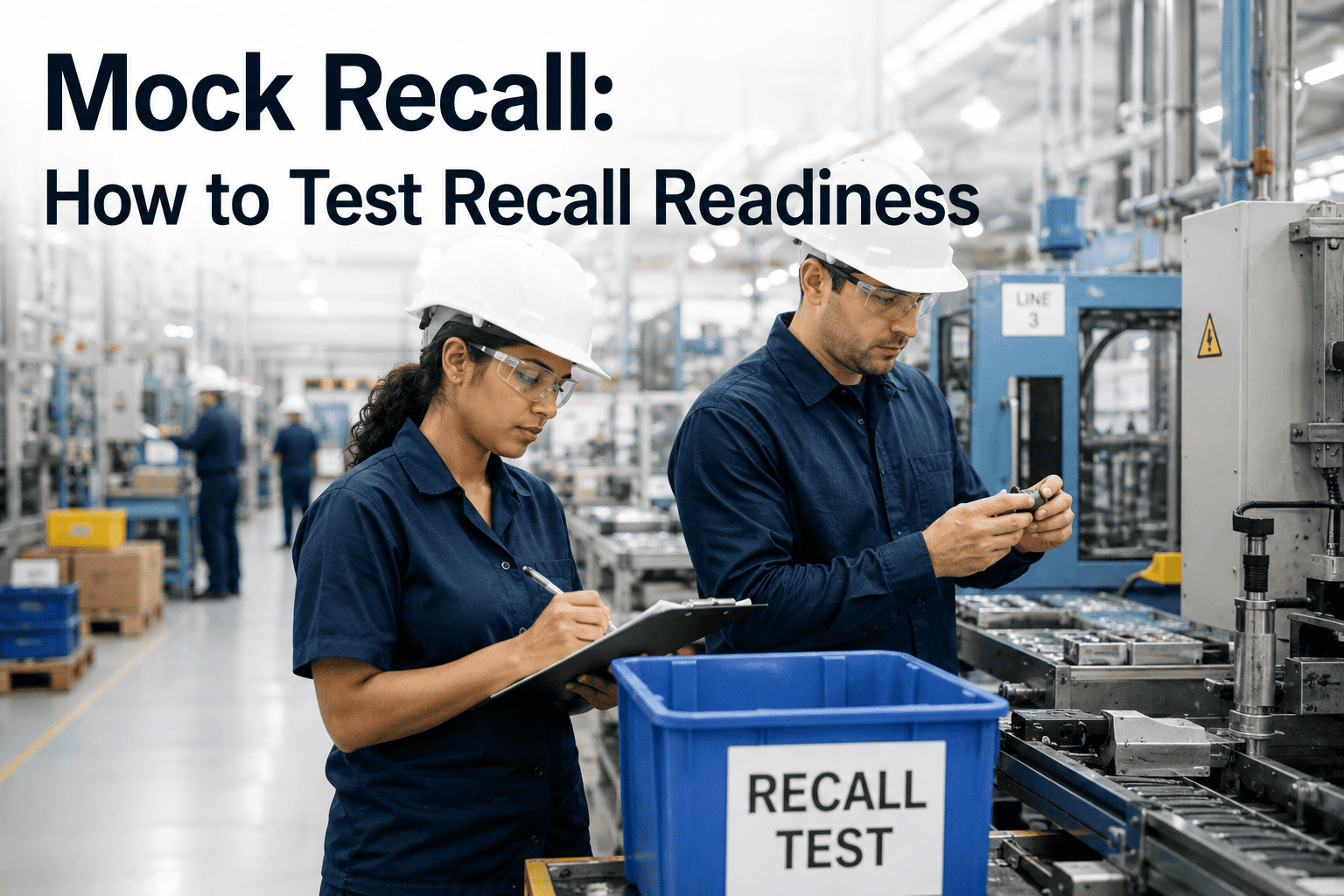
A food safety manager gets the call at 09:47 on a Tuesday — a finished-goods sample from Line 3 tests positive for undeclared allergen, product has been shipping 48 hours to twelve distribution centers, and the FDA is asking for a full one-up-one-back trace within four hours. The mock recall the plant ran last year is the only thing between an orderly withdrawal and a public crisis. Mock recalls prove that when the call comes, the plant can find every affected lot inside the FDA's window. Book a demo to walk through a modern mock recall procedure.
FOOD QUALITY INSPECTION · MOCK RECALL & RECALL READINESS
How to Run a Mock Recall That Proves Your Food Plant Can Actually Meet the FDA's 24-Hour Traceability Deadline
A working mock recall procedure captures the 4-hour internal target used as a buffer against the FDA's 24-hour submission deadline, verifies one-up-one-back traceability, measures accuracy against shipped quantity, and surfaces the gaps you fix before a real recall becomes public.
4 Hr
Internal Traceability Target for a Passing Mock Recall
24 Hr
FDA Records Submission Deadline Under FSMA 204
68%
Manual Traceability Processes Miss the 4-Hour Target
WHY MOCK RECALLS MATTER
The Regulatory and Business Reality Every Food Plant Now Plans Against
A written recall plan is required under 21 CFR Part 7 and 21 CFR 117.139, and under 9 CFR Part 418 for FSIS-regulated establishments. FSMA Section 204 adds a 24-hour submission requirement for Key Data Elements tied to Critical Tracking Events on FTL products, with enforcement extended to July 2028. The FDA does not require a mock recall itself — it judges whether your recall plan actually works when tested, and the only credible way to prove that is a documented, timed mock recall.
The business case is louder than the regulatory case. Hospitalizations from recalled food doubled to 487 in 2024, deaths rose to 19, and average direct cost per recall event sits near $10 million. Speed in the first 24 hours decides whether a contamination event is a manageable withdrawal or a brand-defining crisis.
THE 4-HOUR MOCK RECALL CLOCK
Hour by Hour — What a Passing Mock Recall Procedure Looks Like on the Day of the Exercise
The 4-hour target does not just mean "finish in four hours." Each of four distinct traceability tasks completes inside its own window with a documented handover. If any window slips, the exercise fails and corrective action begins.
Hour 0
Simulated Notification & Recall Team Activation
Recall coordinator receives a scripted scenario — one contaminated raw material lot, one finished SKU, one shipping window. The recall team is paged, the conference bridge opens, and the timer starts. Team assembly within 30 minutes.
Hour 1
Backward Trace — Raw Material to Finished Product
Using the contaminated raw material lot number, the team identifies every production run that consumed it, every finished lot that resulted, and every WIP record. Complete within 60 minutes on a single-batch trace.
Hour 2
Forward Trace — Finished Product to First Consignee
For each finished lot from Hour 1, the team pulls shipping manifests, bills of lading, and first-consignee records — the "one-up" side of one-up-one-back. Every customer that received affected product is named with quantity shipped.
Hour 3
Quantity Reconciliation & Accountability
Quantity produced, on-site, shipped, and accounted for at first consignees must reconcile within 2% variance. Any gap turns into unaccounted product at the FDA review.
Hour 4
Communication Package & Post-Exercise Debrief
Customer notification templates, FDA record extract, and internal escalation package are drafted and reviewed. The team walks the timeline, flags every missed window, and hands the debrief to quality management.
WHAT YOU ARE ACTUALLY MEASURING
The Six Traceability Accuracy Metrics That Turn a Mock Recall Into a Real Test
A mock recall that only measures elapsed time is not a real test. GFSI-aligned schemes — BRC Issue 9, SQF Edition 9, FSSC 22000 Version 6 — expect six accuracy dimensions measured and documented.
| Metric |
Passing Threshold |
Common Failure Mode |
| Elapsed Time |
Complete within 4 hours |
Manual spreadsheet lookup delays |
| Quantity Reconciliation |
≥ 98% of produced quantity |
Broken lot links at packaging step |
| Customer Identification |
100% first consignees named |
Missing distributor SKU mapping |
| Raw Material Trace |
100% ingredient lots identified |
Blended lot codes not preserved |
| WIP Accountability |
≥ 98% work-in-process traced |
Rework not recorded to source lot |
| Documentation Retrieval |
All KDE/CTE records available |
Paper records not indexed for search |
The Plants That Pass the Actual Recall Call Are the Plants That Failed the First Mock Recall — and Fixed It
A mock recall that never surfaces a gap never tested anything. The value is in the debrief and corrective action, not the pass certificate.
THE RECALL TEAM
The Six Roles That Have to Be in the Room for a Mock Recall to Simulate a Real One
A mock recall run by the quality department alone fails the way a real recall does — the actual event requires plant floor, warehouse, sales, and regulatory input inside the same clock. The six roles below are the minimum team for both mock and actual recalls.
Recall Coordinator
Named in the recall plan and empowered to activate the team. Owns the timer, the scenario, and the debrief. In an actual recall, this is the person on the phone with the FDA district office.
Quality Assurance Lead
Owns traceability records — raw material lots, production runs, finished lot codes. Signs off backward and forward trace outputs against passing thresholds.
Warehouse & Shipping Manager
Pulls bills of lading, shipping manifests, and inventory-on-hand data. Confirms the first-consignee list is complete and quantities reconcile against output.
Production Supervisor
Walks shop-floor records for the implicated line and shift. Confirms WIP accountability, rework routing, and any changeover events that could create cross-lot exposure.
Customer Service or Sales Contact
Executes customer notification against the drafted package. In a real recall, this is the person who calls each affected customer with quantity and disposition instructions.
Regulatory & Documentation Lead
Assembles the KDE/CTE record extract in the sortable electronic format FDA expects, and packages the audit trail for the debrief.
COMMON FAILURE MODES
The Five Gaps Mock Recalls Consistently Expose in Food Plant Traceability Systems
Every mock recall debrief in the industry surfaces variations of the same five failure modes. None are about intent — they are structural gaps in how lot data is captured, stored, and linked across production and distribution. Catching them in a drill is cheap.
F1
Broken Ingredient-to-Finished-Product Links
Raw material lot number is captured at receiving but not preserved through the mixer or blender. When the backward trace tries to identify which finished lots consumed a specific ingredient lot, the link stops at the batch record.
F2
Inconsistent Lot Coding Across Facilities
A multi-plant operation uses one lot-code convention at Plant A and a different one at Plant B. When product moves between sites for packaging, the trace has to be manually mapped — and the mapping is what fails at 03:00.
F3
Trace Records That Stop at the Dock
Distributor renames the SKU or drops the lot number in their own system. The one-up trace has the shipping manifest but no visibility past the first consignee. FSMA 204's Key Data Element requirement is designed to close this gap.
F4
Rework Not Recorded Back to Source Lot
Product going through rework is entered as a new lot without a link to original ingredient lots. The rework quantity becomes a hole in the reconciliation, and no one can prove which raw material lots the reworked product contains.
F5
Paper Records Not Indexed for Search
Batch sheets, shipping logs, and QA records exist — on paper, in three different rooms. Retrieval time alone consumes the 4-hour window before any trace begins. FDA electronic sortable format cannot be produced.
CORRECTIVE ACTIONS
The Four-Stage Corrective Action Cycle Every Mock Recall Debrief Should Drive
A mock recall that ends at "we passed" or "we failed" wastes the exercise. The value is in the corrective action cycle the debrief triggers. The four stages below turn a mock recall from a check-the-box drill into a live readiness engine.
Stage 1
Debrief Documentation
Within one week of the exercise, every missed window, failed threshold, and manual workaround is documented with the specific data source, person, and time it occurred.
Stage 2
Root Cause & Owner Assignment
Each documented gap gets a root cause — data, system, procedure, or training gap — and a single named owner. Deadlines follow the standard corrective action programme, not an aspirational plan.
Stage 3
Verification Mini-Drill
Once corrective actions close, a targeted mini-drill tests just the previously failed windows. Not the full annual exercise — a focused verification that the fix holds under time pressure.
Stage 4
Annual Scenario Refresh
Next annual mock recall uses a new scenario — different SKU, different raw material lot, different distribution pattern. Repeating the same scenario tests memory, not readiness.
FREQUENTLY ASKED QUESTIONS
Food Safety Managers' Questions About Mock Recall Procedures
How often does the FDA expect a food plant to run a mock recall exercise?
The FDA does not publish a specific mock recall frequency. What is required, under 21 CFR Part 7 and 21 CFR 117.139, is a working recall plan — the mock recall is the industry-standard way to demonstrate the plan functions. GFSI-aligned schemes including BRC Issue 9, SQF Edition 9, and FSSC 22000 Version 6 require a documented mock recall at minimum every 12 months.
Book a demo to walk through a cadence for your facility.
Why is the internal mock recall target 4 hours if the FDA deadline is 24 hours under FSMA 204?
The 4-hour internal target creates a deliberate buffer against the FDA's 24-hour deadline. Actual recall events involve multiple SKUs, multiple raw material lots, and often multiple facilities — the Grocery Manufacturers Association found this extends manual traceability to 18-24 hours on multi-batch events. If your single-batch mock recall consumes eight hours, a real multi-batch event will not close inside 24. The 4-hour target proves the system is fast enough to survive real amplification.
Contact food safety support to review your traceability speed.
Does FSMA 204 apply to us if our finished product is not on the FDA Food Traceability List?
Possibly yes. FSMA 204 recordkeeping applies when an FTL ingredient stays in the same form in your final food — fresh leafy greens in a salad kit is the FDA's own example. The Critical Tracking Events for that ingredient — growing, receiving, transforming, creating, shipping — must have Key Data Elements captured and retrievable within 24 hours regardless of whether the finished good carries an FTL designation. Any doubt should be settled by reviewing the current Food Traceability List against your ingredient portfolio.
Book a session to map FSMA 204 scope to your ingredients.
Can a mock recall be run without disrupting production, or does the plant need to pause the line?
A well-designed mock recall does not require pausing the line. The exercise is a documentation and traceability drill — pulling records, running backward and forward trace, reconciling quantities, drafting notifications — none of which stops production. It requires shift leadership, warehouse, and quality personnel available for a scheduled window. The scenario is scripted as a drill, so no actual customer contact or product hold occurs.
Talk to food safety support to structure a non-disruptive drill.
What does a passing mock recall look like when we present it to a certification auditor?
A passing mock recall presented to a BRC, SQF, or FSSC auditor includes the scenario, timestamped log of each step, reconciled quantity numbers against thresholds, identified gaps with root cause and owner, and corrective action evidence closing prior-year gaps. Auditors look for two things: the exercise happened within the required interval, and the corrective action cycle is real — not a stack of unchanged debriefs year over year.
Book a session to structure a mock recall package for audit.
READY FOR THE CALL THAT ACTUALLY COMES
Give Your Food Plant a Mock Recall Procedure That Proves Readiness — Not Just Compliance
A working mock recall captures the 4-hour target, measures six accuracy dimensions, assembles the six-role team, and drives real corrective action. Book a session to map a modern mock recall procedure onto your plant.