When the same conveyor motor fails for the third time in six months and the work order each time just says "replaced motor," a food plant hasn't actually investigated anything — it's treated a symptom three separate times and never asked why the symptom keeps recurring. Root cause analysis exists specifically to interrupt that pattern, but it only works if it's actually structured and actually repeatable, which is exactly where most plants fall down, since a good investigation done once in a notebook rarely gets used the same way twice. Pre-built RCA templates inside the work order itself — 5 Whys, fishbone, fault tree — turn root cause analysis from an occasional heroic effort into a routine part of how repeat failures get handled. Book a session with iFactory to see RCA templates built into an actual work order.
Food & Beverage · Root Cause Analysis
Root Cause Analysis Templates for Food Plant Maintenance
5 Whys, fishbone, and fault tree analysis, pre-built inside CMMS work orders so repeat failure investigations become routine, not occasional.
Three Core Templates
Which RCA Method Fits Which Failure
Simple Failures
5 Whys
A structured sequence of asking "why" repeatedly against a specific failure, quick to run and well-suited to straightforward mechanical or process failures with a single clear chain of causation.
Multi-Factor Failures
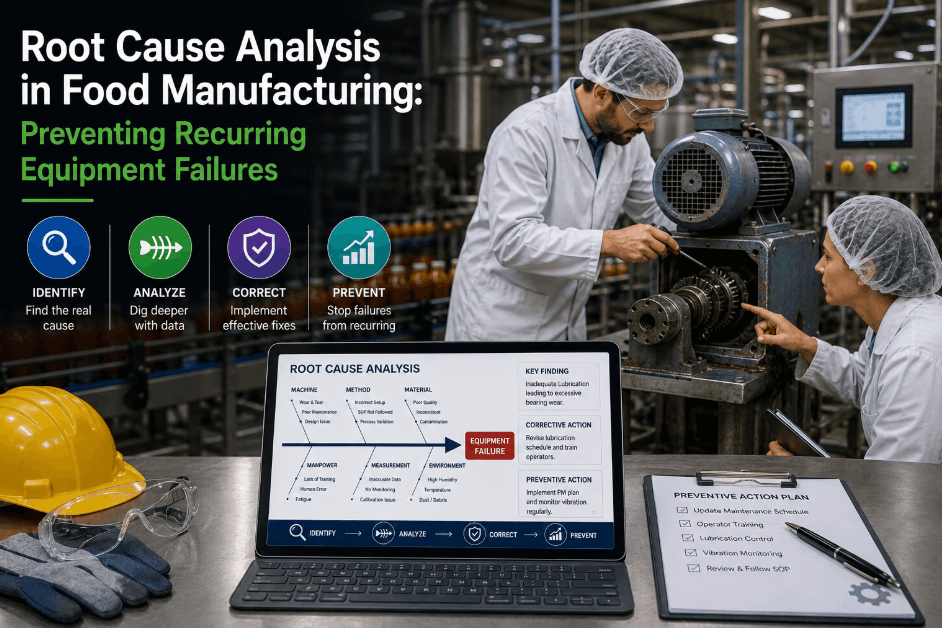
Fishbone (Ishikawa)
A visual diagram organizing potential causes into categories — equipment, method, material, people, environment — useful when a failure likely has several contributing factors rather than one linear cause.
Critical/Complex Failures
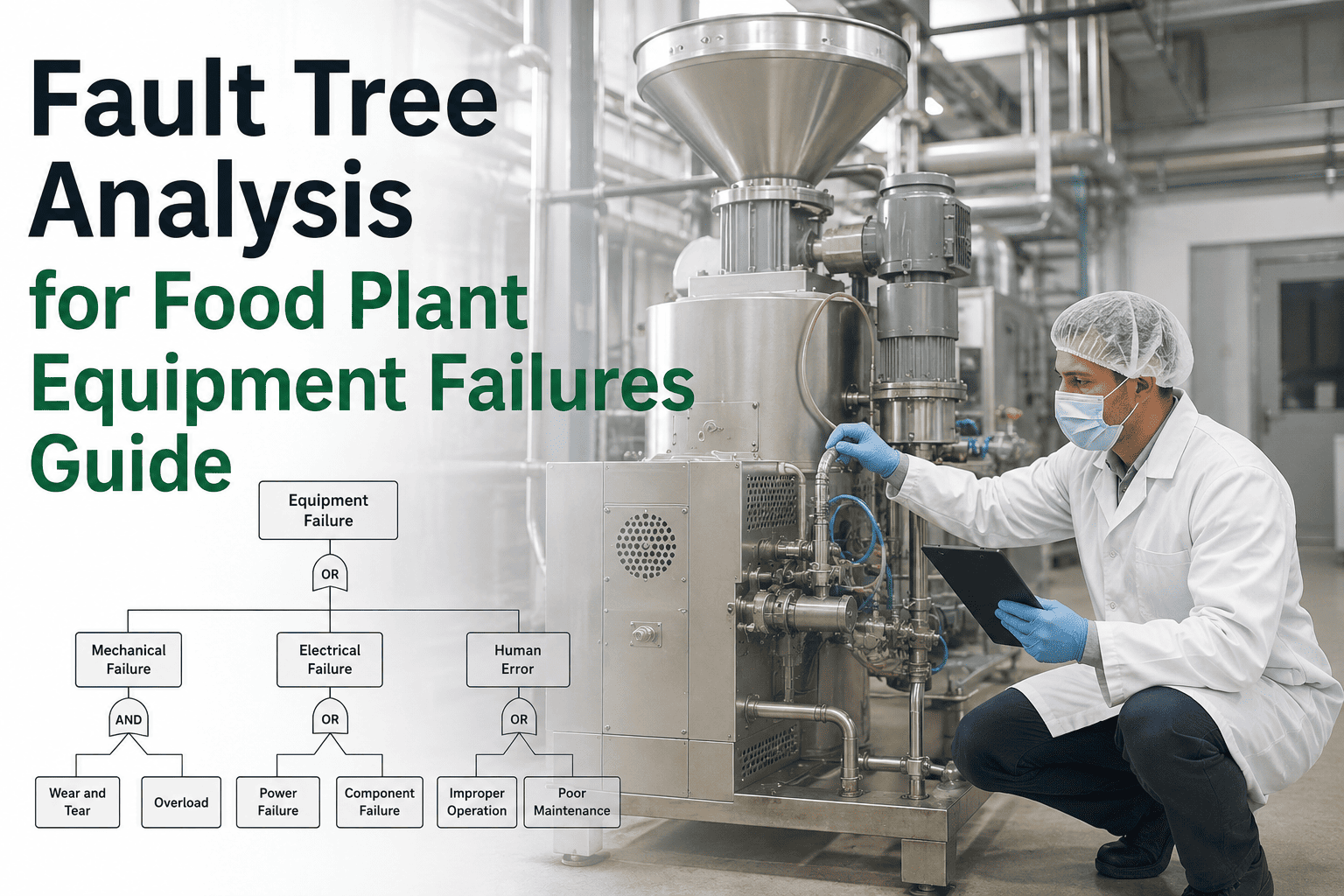
Fault Tree Analysis
A logic-based breakdown mapping how combinations of lower-level events can lead to a top-level failure, best suited to safety-critical or highly complex equipment failures worth a deeper investigation.
Run a Real Investigation Together
Bring a Repeat Failure to a Live RCA Walkthrough
iFactory will run through one of your actual repeat failure patterns using the appropriate RCA template, so you see the process applied to a real problem.
How It Runs Inside a Work Order
From Repeat Failure Flag to Documented Root Cause
01
Repeat Failure Detected
A work order pattern on the same asset triggers a suggestion to launch a structured RCA rather than closing the ticket as another routine repair.
02
Template Selected and Launched
The appropriate template opens directly attached to the work order, pre-populated with the asset's recent failure history for context.
03
Investigation Completed and Documented
The completed analysis, along with any identified corrective action, becomes a permanent, searchable part of that asset's history.
Field Perspective
The biggest predictor of whether a plant actually does root cause analysis consistently isn't whether the team knows the methods — most experienced maintenance teams know what a fishbone diagram is. It's whether doing the analysis is easier than skipping it. If launching an RCA means finding a template somewhere, printing it, and manually attaching notes to a physical file, it gets skipped every time production pressure is high, which is most of the time. When the template is one click from the repeat work order itself, it actually gets used, and that's the entire difference between a plant that keeps replacing the same motor and one that eventually stops.
Nikoletta Van Der Berg
Reliability and Root Cause Analysis Consultant · 13 years running RCA programs in food and beverage manufacturing · Former Reliability Engineer, food processing operations
Common Questions
Root Cause Analysis Templates — Frequently Asked
How do we decide which RCA template to use for a specific failure?
A simple, single-cause failure is usually a good fit for 5 Whys, a failure with several plausible contributing factors suits a fishbone diagram, and safety-critical or highly complex failures benefit from fault tree analysis — the right choice often becomes clear once you outline what you already know about the failure. Book a demo to review template selection guidance for your specific failure types.
Does the system automatically flag which assets need a root cause investigation?
Yes — repeat failure patterns on the same asset can trigger an automatic suggestion to launch an RCA rather than relying on someone manually noticing the pattern across multiple separate work orders. Book a demo to see repeat-failure detection configured for your asset base.
Who on the maintenance team should be conducting RCA investigations?
Most plants involve the technician most familiar with the specific failure alongside a supervisor or reliability engineer, since combining hands-on equipment knowledge with structured investigation experience produces the most useful root cause findings. Book a demo to discuss RCA ownership models that fit your team structure.
How long does a typical RCA investigation take using these templates?
A focused 5 Whys investigation can often be completed in under an hour, while a fishbone or fault tree analysis for a more complex failure may take a few hours spread across a short investigation period. Book a demo to see realistic time expectations for each template type.
Can completed RCA findings be searched later when a similar failure happens on a different asset?
Yes — completed root cause investigations are stored as searchable records, so a technician facing a similar failure on a different but comparable asset can check whether the pattern and root cause have already been identified elsewhere in the plant. Book a demo to review RCA search and knowledge-sharing features.
Stop Replacing the Same Part for the Same Reason
Make Root Cause Analysis Routine, Not Occasional
iFactory builds 5 Whys, fishbone, and fault tree templates directly into your work orders, so repeat failures get properly investigated every time.