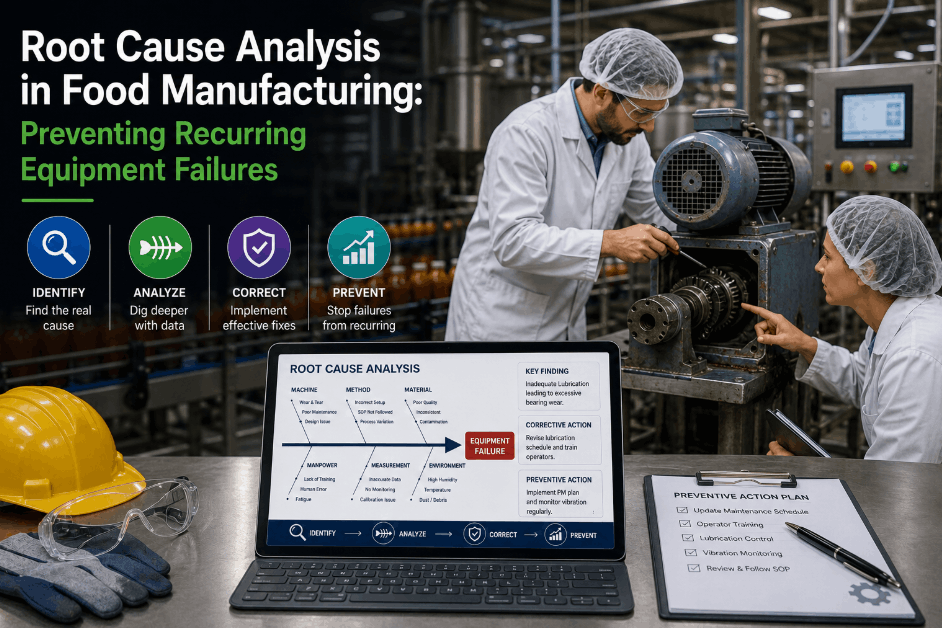
A root cause investigation usually starts with a whiteboard, a fishbone diagram, and a handful of people trying to remember what was different the day a line went down. The data that could actually answer the question, sensor readings, PLC logs, work order history, exists somewhere in the plant, but rarely in a form anyone can read together in the room. An AI root cause copilot reads those sources at once and proposes the most likely causes with the evidence attached, turning a meeting that relies on memory into one that starts from data. Reliability leaders can see this applied to a real past investigation on iFactory AI before the next whiteboard session.
Start the Investigation With Evidence, Not Memory
iFactory AI reads sensor, PLC and work order data together and suggests the three most likely causes, each with its supporting evidence.
Why Whiteboard RCA Struggles to Agree With Itself
A fishbone diagram built from memory reflects what the room remembers, not necessarily what happened. Two different teams investigating the same fault a week apart can reasonably land on two different conclusions.
Details from a shift three days ago are already getting fuzzy by the investigation meeting.
Sensor logs, PLC history and work orders each live in a different system nobody cross-references.
The team defaults to the cause they have seen before, even when the evidence points elsewhere.
The final cause gets written down, but the reasoning behind it does not.
Teams under pressure settle on the first plausible answer rather than the most supported one.
A wrong root cause means the CAPA fixes the wrong thing, and the fault returns.
What the Copilot Reads Before It Suggests a Cause
| Data Source | What It Reveals |
|---|---|
| Sensor history | Readings leading up to the failure, not just at the moment of it |
| PLC logs | Sequence of events and interlocks triggered around the fault |
| Work order history | Prior maintenance, parts replaced, and past similar faults |
| Operator notes | Context that never made it into a structured field |
Run This Against a Fault You Already Investigated
Bring a past RCA to a 30-minute session and compare the suggested causes.
From Fault to Three Ranked Causes
The event is captured with its timestamp and affected asset.
Sensor, PLC and work order records around the event are gathered.
The data is compared against similar past failures on this and related assets.
The three most likely causes are presented with their supporting evidence.
Why Pattern Matching Across Time Matters
A single investigation looks at one event in isolation, but most recurring faults leave a trail across many events that only becomes visible when those events are compared side by side rather than examined one at a time.
A copilot that holds the full history of an asset, and of similar assets elsewhere in the plant, can spot a pattern spanning months that no single investigation would ever have the full picture to notice. That shift from isolated incident review to pattern recognition across time is often where the most valuable, previously hidden causes get found.
A Scenario: The Fault That Kept Coming Back
Picture a filler that stops intermittently, roughly once a week, and three separate whiteboard investigations have each landed on a different cause: a worn seal, an operator error, and a sensor fault.
None of those investigations were necessarily wrong about what they found, but each only looked at the evidence available in that particular meeting. A copilot reviewing sensor trends across all three incidents together can show a consistent voltage dip just before each stop, a pattern invisible to any single investigation looking at only its own event in isolation. The real cause turns out to be an upstream electrical issue that none of the three separate meetings had enough data in the room to catch.
Whiteboard RCA vs an AI-Assisted Investigation
Why 2027 Changes What Is Realistic Here
Pattern matching across months of sensor, PLC and work order data at the depth an AI copilot can manage would have been a significant manual undertaking even a few years ago, requiring a data analyst to pull and cross-reference each source by hand.
That manual effort rarely happened for anything short of a major incident, which meant most recurring minor faults never got the cross-event analysis that might have found their real cause. Automating that comparison makes it practical to apply the same rigor to routine faults, not just the ones serious enough to justify a dedicated investigation team.
Where a Copilot Supports the Team, Not Replaces It
Building Confidence in the Suggested Causes
A ranked list of causes is only useful if the team trusts the ranking enough to act on it. Trust comes from the copilot showing its reasoning clearly rather than simply presenting a conclusion.
Each cause links to the specific data that supports it.
A clear indication of how strong the supporting evidence actually is.
The second and third possibilities stay visible, not hidden behind the top pick.
If the team picks a different cause, that choice and its reasoning get recorded too.
Whether the CAPA actually resolved the fault feeds back into future suggestions.
Similar faults on related equipment inform the ranking too.
What Happens to a CAPA Built on the Wrong Cause
A corrective action is only as good as the root cause it targets. When the cause is wrong, the CAPA fixes something that was never actually broken, and the real problem keeps producing the same fault, often with a growing sense of frustration that "the fix didn't work."
Effort spent on a part or process that was not the actual source of failure.
The fault returns on a similar schedule, undermining confidence in the RCA process itself.
Teams start treating RCA as a formality rather than a genuine investigation.
How This Changes the Investigation Meeting Itself
When the team walks into an RCA meeting with ranked causes and evidence already assembled, the conversation shifts from reconstructing what happened to evaluating what the data actually shows.
Where iFactory AI Fits
Reads data together
Combines sensor, PLC and work order history into one view.
Suggests ranked causes
Presents the three most likely causes with supporting evidence.
Matches past failures
Compares the current fault against similar historical events.
Documents the trail
Keeps the evidence and decision together for CAPA and audit review.
Expert Review
A reliability engineering perspective, reviewed for accuracy before publication: most failed CAPAs trace back not to a bad corrective action, but to a root cause that was never actually confirmed, just agreed upon in a meeting under time pressure. An AI copilot does not remove the need for engineering judgment, it gives that judgment more complete evidence to work from. Running this against a fault your team has investigated before is a fast way to see whether the suggested causes hold up. Confirm specific equipment procedures with your OEM documentation before relying on any workflow.
Frequently Asked Questions
Does an AI copilot replace a formal RCA method like 5 Whys?
No, it complements those methods by supplying the evidence the team works through, rather than replacing the structured thinking a method like 5 Whys or a fishbone diagram provides. See how this fits alongside your current RCA method.
How confident should we be in the top suggested cause?
Confidence depends entirely on how much relevant data is available for that specific fault, which is why a clear confidence indicator matters more than the ranking itself. Ask about how confidence levels are calculated for your data.
What if the team disagrees with the suggested cause?
The team's judgment still decides the final root cause and CAPA, and a disagreement gets logged alongside the suggestion so the reasoning on both sides is preserved for future reference. Explore how team overrides are tracked over time.
Does this work for faults with limited sensor data?
It still provides value from work order history and operator notes alone, though suggestions grow stronger as more sensor coverage becomes available on a given asset. Talk through what level of data coverage you currently have.
Can this help connect faults across different lines or plants?
Yes, pattern matching across a wider data set often surfaces a shared cause behind faults that looked unrelated when each line investigated its own events separately. See how cross-line pattern matching would work for you.
Start Your Next Investigation With Evidence, Not a Blank Whiteboard
iFactory AI reads your sensor, PLC and work order data together to suggest ranked, evidence-backed causes. Book a walkthrough with a real past investigation.