Ask "why did the line go down" five times and you'll usually get an answer by the third or fourth question — the trouble is that most teams stop at the first plausible-sounding answer instead of continuing until they reach something they can actually fix. A team that stops at "the seal failed" walks away with a part replacement and no explanation for why that seal failed when the last three lasted their full service life. A team that keeps asking reaches something like an undocumented process change in the CIP cycle that's been quietly degrading seal life across the whole line — a finding that changes what gets fixed and prevents the failure from simply recurring on the next seal. iFactory's reliability engineering team uses the method below with food and beverage clients specifically because it's simple enough for any shift team to run correctly.
Food & Beverage · Root Cause Method
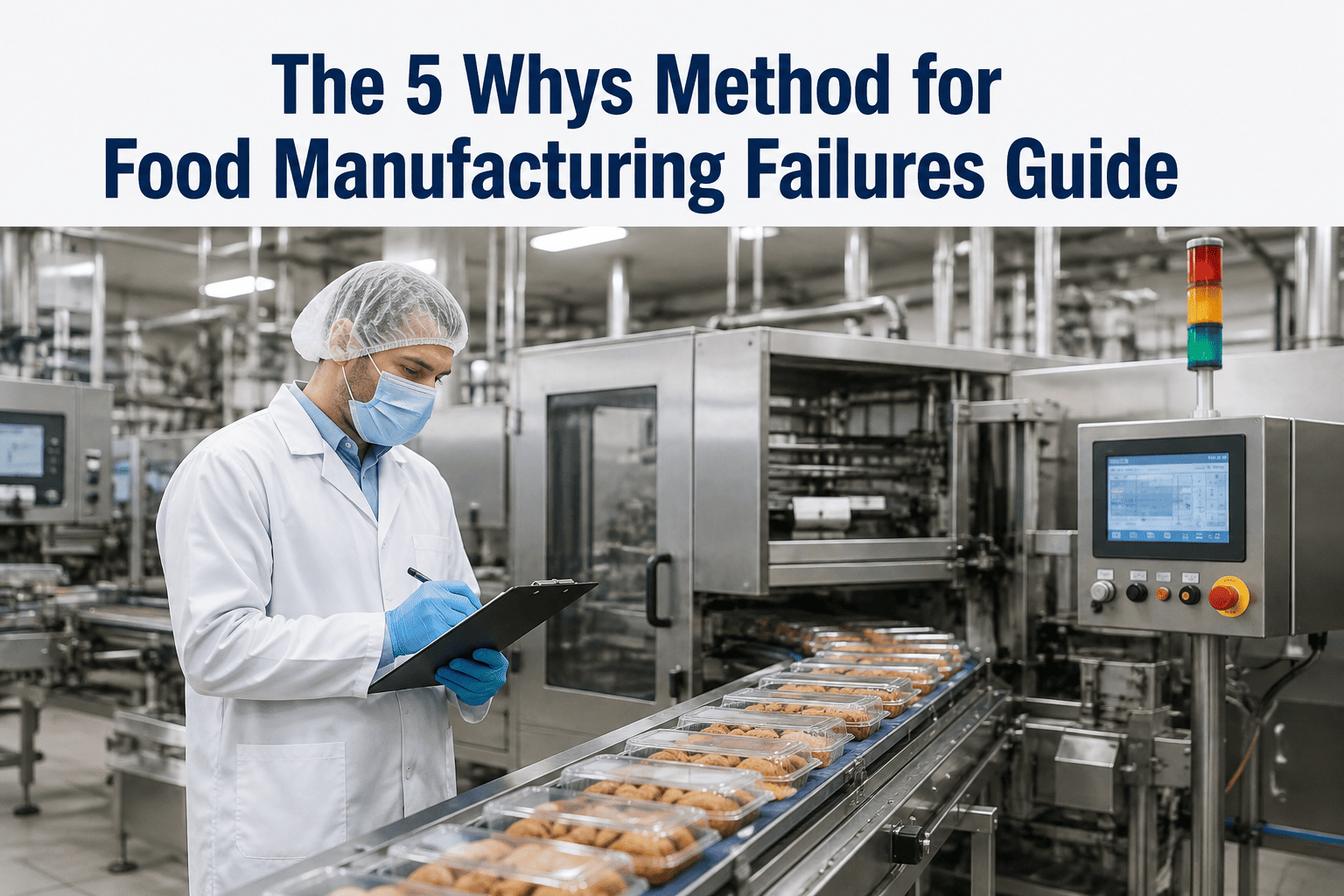
The 5 Whys Method for Food Manufacturing Failures
How to ask each level of "why" correctly, when to branch into multiple causal paths, and how to recognize the point where you should stop before you start inventing causes that were never actually there.
Why 5 Whys Goes Wrong
The Method Is Simple — Which Is Exactly the Risk
The 5 Whys technique gets criticized more than it deserves, and most of that criticism is really aimed at how badly it's usually executed rather than a flaw in the method itself. Five sequential "why" questions sound simple enough that teams run them without training, without evidence discipline, and without anyone checking whether each answer is actually supported by something observable rather than someone's best guess in the moment. That's how a food plant ends up with an investigation record that says the root cause of a filling line jam was "operator error," when the actual chain — if anyone had kept asking — traced back to a changeover procedure that made the specific error nearly inevitable regardless of which operator ran it.
The number five itself is also frequently misunderstood. Five isn't a rule that must be satisfied exactly — some failures reach a genuinely actionable root cause after three whys, and forcing two more questions past that point produces speculation rather than insight. Other failures need six or seven whys before reaching something fixable, and stopping rigidly at five leaves the investigation short of the actual cause. The number is a guideline for how deep these investigations typically need to go, not a checklist item to satisfy.
The other common failure mode is treating 5 Whys as a strictly linear chain when the real causal structure is often a tree. A single symptom can have two or three independent contributing factors, each of which deserves its own chain of whys rather than being forced into a single sequential path that arbitrarily picks one branch and ignores the others.
Running It Correctly
Asking Each Level of Why the Right Way
Why 1
State the Observable Problem
Start from what was actually observed, not an interpretation of it — "the filler stopped at 2:14pm" rather than "the filler broke," which already assumes a conclusion before any investigation has happened.
↓
Why 2
Answer With Evidence, Not Assumption
Each "why" answer should be backed by something checkable — a sensor log, a visual inspection, a maintenance record — rather than the first plausible explanation that comes to mind in the room.
↓
Why 3
Watch for Multiple Contributing Factors
If the answer to a why genuinely has more than one independent cause, branch into separate chains rather than picking the one that seems most convenient to investigate.
↓
Why 4
Keep Going Until It's Actionable
A root cause is actionable when the corrective action addresses something within your control to change — a procedure, a spec, a training gap — not simply the deepest possible answer for its own sake.
↓
Why 5
Stop When Evidence Runs Out
If you reach a point where the next "why" can't be answered with evidence you actually have, that's the signal to stop and gather more data rather than manufacture a plausible-sounding but unverified answer.
See a Real Investigation Chain
Watch a 5 Whys Investigation Built With Evidence at Every Step
iFactory's reliability engineering team will walk through an actual food plant investigation, showing exactly where evidence supported each answer and where the team had to branch into multiple causal paths.
Worked Example
A Good Chain vs. a Chain That Stopped Too Early
The table below contrasts the same starting symptom — a filling line jam — investigated well and investigated poorly, to make the practical difference concrete.
| Level | Stopped-Too-Early Chain | Evidence-Based Chain |
|---|
| Why 1 | Filler jammed | Filler jammed on cap seating |
| Why 2 | Operator error | Cap dimension was out of spec, confirmed by QC log |
| Why 3 | (stopped here) | Supplier changed cap material lot without notification |
| Why 4 | — | Incoming inspection spec didn't include the changed dimension |
| Corrective action | Retrain operator | Update incoming inspection spec and supplier change-notification requirement |
Common Mistakes
What to Watch For in Your Own Investigations
Blaming the Person Instead of the System
Landing on "operator error" as a final answer almost always means the investigation stopped one or two whys short of the process or design condition that made the error likely for anyone in that role.
Running It Alone Instead of With the Team
A single person's 5 Whys reflects one person's knowledge gaps; involving operators, technicians, and engineers who each saw a different part of the failure produces answers none of them would have reached individually.
Treating a Tree as a Straight Line
Forcing a single linear chain when a symptom actually has two or three independent contributing causes means the investigation only ever fixes one of them.
Not Verifying the Fix Actually Worked
A corrective action implemented but never checked against a follow-up observation period leaves the investigation's real conclusion — did this actually stop the failure — permanently unanswered.
Where This Fits With iFactory
Structuring 5 Whys Investigations So They Actually Get Used Later
A 5 Whys investigation run on a whiteboard is valuable in the moment and mostly lost afterward — the chain of reasoning, the evidence behind each answer, and the corrective action rarely end up connected in a record anyone can search six months later. iFactory's reliability platform structures each 5 Whys investigation as a searchable record with evidence attached at each level, so a recurring cap-dimension issue on one line surfaces automatically if a similar symptom shows up on a different line, rather than requiring someone to remember the earlier investigation existed at all. Corrective actions carry through to closed-loop tracking with a defined verification step, so "retrain the operator" — the answer a rushed investigation tends to land on — gets flagged as insufficient against a root cause that traces back to a specification gap.
Common Questions
Frequently Asked Questions
Does the chain always have to stop at exactly five whys?
No — five is a typical depth for many manufacturing failures, not a fixed rule the investigation must satisfy. Some root causes are reached after three questions, and forcing additional questions past a genuinely actionable cause tends to produce speculation dressed up as depth. Other investigations legitimately need six or seven levels before reaching something fixable, particularly when a supplier or upstream process is involved. The right stopping point is when the answer is both evidence-supported and something your team can actually act on, whichever "why" number that happens to land on.
What if we genuinely can't find evidence to support the next why?
That's a legitimate stopping point, and it's a better outcome than continuing with an unverified guess dressed up as a conclusion. The right response is to document what's known, flag the specific evidence gap that's blocking further investigation, and either gather the missing data — additional sensor logging, a longer observation window — or accept the investigation as inconclusive at that level rather than closing it out with a fabricated final answer that will mislead whoever reads the record later.
How do we know when a symptom needs branching into multiple chains instead of one?
The signal is usually that the answer to a given "why" genuinely has more than one independent explanation, each supported by its own separate piece of evidence, rather than one explanation that simply has multiple contributing details. If two people on the investigation team each have a different, evidence-backed answer to the same why question, that's usually the point to branch into parallel chains rather than force a single-vote consensus that discards one person's legitimate observation.
Can 5 Whys replace a fishbone diagram, or should we use both?
They serve different purposes and work well together rather than as substitutes — a fishbone diagram is useful for broadly surveying possible cause categories (man, machine, method, material, measurement, environment) before you know which branch is worth investigating deeply, while 5 Whys is the tool for drilling down once a specific branch has been identified as the likely path. Many food plant investigations start with a quick fishbone to narrow the field, then run 5 Whys on the most promising branch.
How do we make sure the corrective action from a 5 Whys investigation actually gets implemented?
Assigning a specific owner, a due date, and a defined verification check at the time the investigation concludes is what separates corrective actions that get implemented from ones that quietly disappear into a meeting summary nobody revisits. A structured tracking system that flags overdue actions and requires evidence of verification before closing the record removes the dependency on someone remembering to follow up manually.
Booking a demo is a good way to see how closed-loop tracking works for investigations your team already runs.
Turn Investigations Into Prevented Failures
Structure Your 5 Whys Investigations So They Actually Stick
iFactory's reliability platform gives your team evidence-linked 5 Whys templates, cross-investigation pattern detection, and closed-loop corrective action tracking with verification built in.