A single mislabeled allergen statement can trigger a nationwide recall, and the FDA issues hundreds of food labeling warning letters every year for issues as small as an incorrectly formatted Nutrition Facts panel. Compliance officers know the regulations exist, but keeping every SKU's label current against FDA rule changes, added ingredients, and reformulations is a moving target that spreadsheets were never built to track. iFactory AI gives compliance teams a single system for label version control, allergen verification, and claims review, so a missed update never reaches FDA labeling compliance review as a surprise.
The Anatomy of a Compliant Food Label
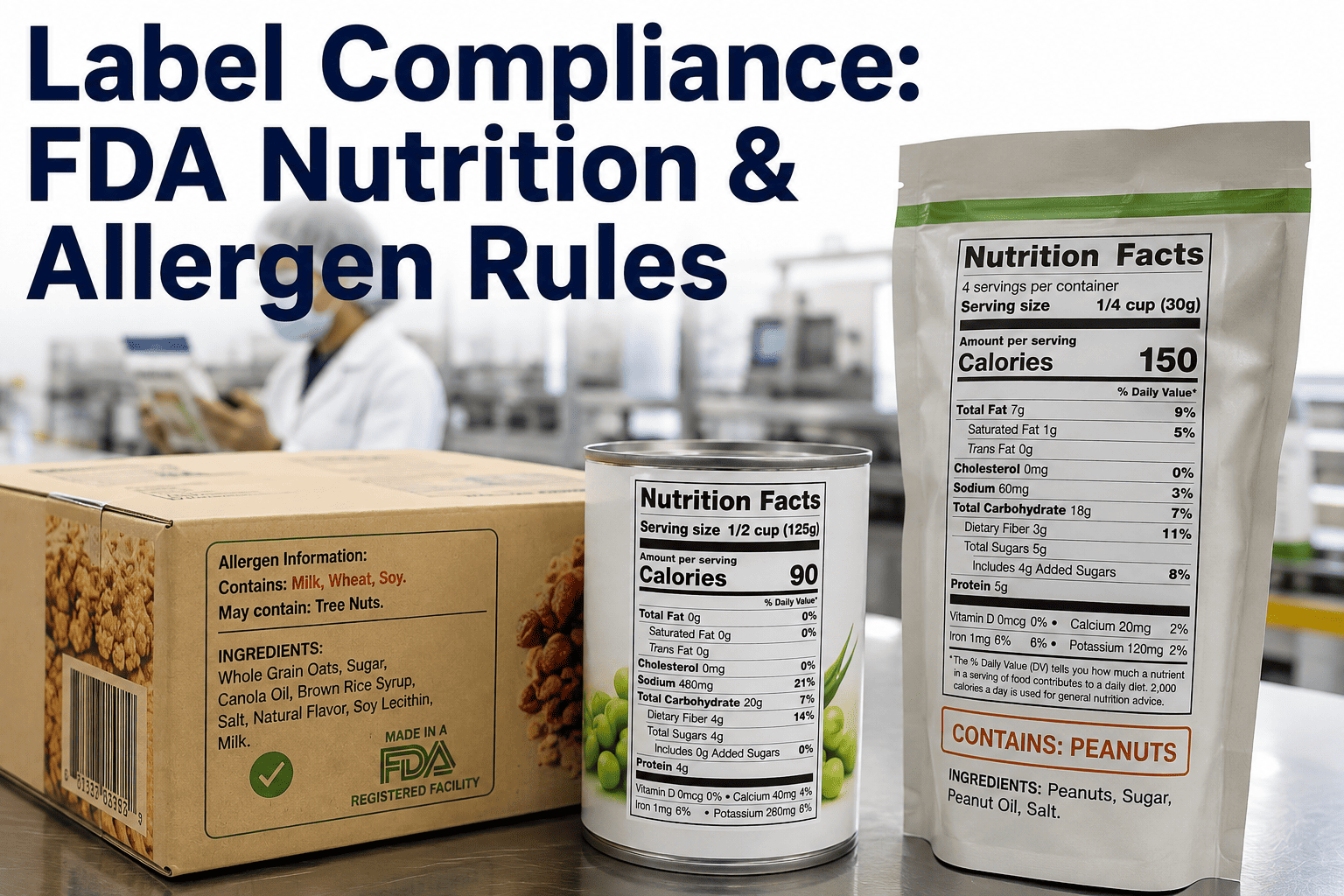
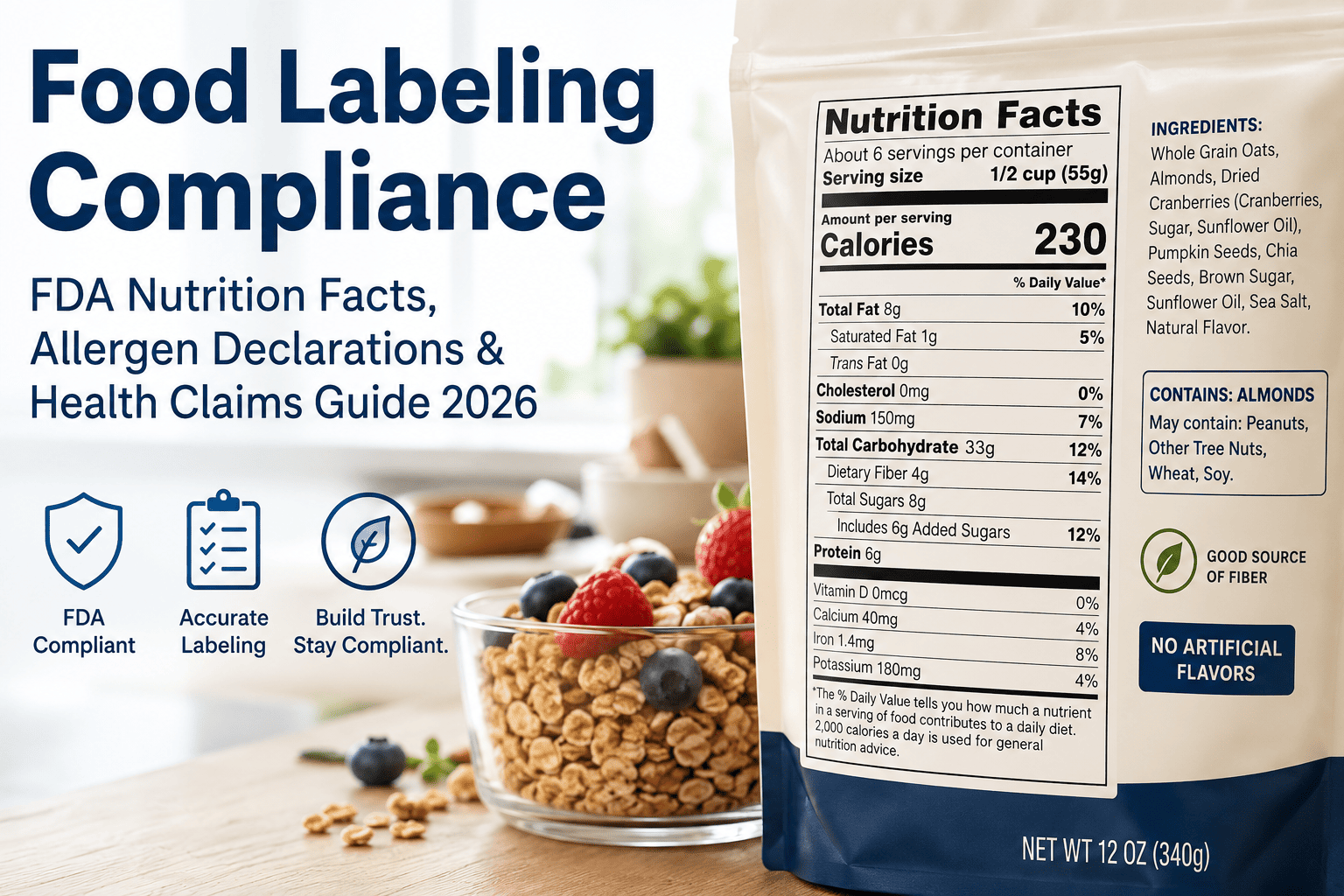
A compliant label is really five separate regulatory requirements presented as one panel, and compliance officers who review labels holistically rather than field-by-field are the ones who catch cross-referencing errors, such as an ingredient added to a recipe but never added to the allergen statement below it.
The common or usual name of the food, displayed prominently on the principal display panel in a type size proportional to the package.
Serving size, calories, and nutrient values formatted to the current FDA layout, including updated daily values and dual-column rules where applicable.
Every ingredient listed in descending order by weight, with sub-ingredients of compound ingredients declared or exempted correctly.
A "Contains" statement or bracketed ingredient callouts covering all nine major allergens present in the formulation, including sesame.
Any nutrient content, health, or structure-function claim, each governed by its own substantiation and wording requirements.
Three Types of Claims — and Why Mixing Them Up Gets Labels Rejected
Compliance officers most often run into trouble not because a claim is untrue, but because it is worded as the wrong category of claim. Each type carries its own substantiation standard and its own regulatory risk if used incorrectly.
Governed by specific numeric thresholds per serving defined in FDA regulations — using "low" or "high" outside the defined threshold is a direct violation, not a gray area.
Require either FDA pre-authorization through the regulatory process or qualification as an authoritative-statement claim, both with strict wording requirements that cannot be paraphrased freely.
Do not require FDA pre-approval but must be truthful, not disease-specific, and are subject to enforcement if they imply treatment or prevention of a disease.
The Label Review Workflow That Catches Errors Early
Recipe and Formulation Lock
Final ingredient percentages are confirmed and locked before any label copy is drafted, since every downstream field depends on this data being final.
Nutrition Panel Generation and Verification
Nutrient values are calculated or lab-verified and formatted against the current FDA panel layout, including rounding rules that vary by nutrient.
Allergen Cross-Check Against Final Formulation
Every ingredient and sub-ingredient is checked against the nine major allergens, catching hidden allergens in flavorings, starches, and processing aids.
Claims Substantiation Review
Every marketing claim on the package is matched to its required substantiation category before the label is approved for print.
Final Compliance Sign-Off and Version Lock
A designated compliance officer signs off on the final artwork, and the approved version is locked so future edits require a documented change request.
The Nine Major Food Allergens Requiring Declaration
US law requires declaration of nine major food allergens, and missing even one — often hidden inside a spice blend, flavoring, or processing aid — is the leading cause of food recalls year after year.
| Allergen | Common Hidden Sources | Declaration Requirement |
|---|---|---|
| Milk | Caseinates, whey, natural flavors | "Contains" statement or ingredient callout |
| Eggs | Lecithin, albumin, some emulsifiers | "Contains" statement or ingredient callout |
| Fish | Worcestershire sauce, fish-derived gelatin | Species-specific declaration required |
| Crustacean Shellfish | Flavor bases, surimi products | Species-specific declaration required |
| Tree Nuts | Natural flavorings, shared-line cross-contact | Species-specific declaration required |
| Peanuts | Processed flavorings, baked goods | "Contains" statement or ingredient callout |
| Wheat | Modified food starch, hydrolyzed proteins | "Contains" statement or ingredient callout |
| Soybeans | Lecithin, vegetable oil, protein isolates | "Contains" statement or ingredient callout |
| Sesame | Spice blends, tahini, processing aids | Mandatory declaration added under the FASTER Act |
Compliance Officer Perspective
I review labels for a multi-brand snack and beverage manufacturer, and the sesame declaration requirement that took effect a few years ago exposed how many of our spice blend suppliers had never disclosed trace sesame in their formulations. We went back through every active label across roughly 60 SKUs and found sesame exposure buried in six products nobody had flagged. That process convinced me that formulation changes and label review cannot live in separate systems — by the time a reformulation reaches my desk as a finished label request, I need to already know what changed at the ingredient level, not discover it during final proofing.
— Compliance Officer, Multi-Brand Snack and Beverage ManufacturerConclusion
Food labeling compliance is unforgiving of small errors precisely because the stakes attached to them are large — an undeclared allergen or a misused claim can trigger a recall regardless of intent. Compliance officers who build a repeatable review workflow tied directly to formulation changes catch these errors before print instead of after a customer complaint. Book a demo to see how iFactory AI keeps label accuracy synchronized with every recipe change.
Frequently Asked Questions
Undeclared allergens are consistently the leading cause of food recalls and warning letters, followed by improperly substantiated nutrient content or health claims and Nutrition Facts panels that do not match the current required format. Most of these errors trace back to a formulation change that was not reflected on the label rather than a fundamental misunderstanding of the rules. Contact support for a label audit checklist.
Yes, with limited exemptions for very small businesses under specific revenue and unit-volume thresholds that primarily affect Nutrition Facts panel requirements, not allergen declaration, which applies universally. Allergen declaration rules apply to every manufacturer regardless of size, since they exist for consumer safety rather than as a competitive requirement.
The core panel format was substantially revised in 2016 with a compliance deadline that followed in subsequent years, and updates since then have addressed specific issues like added sugars declarations and daily value revisions rather than a full redesign. Manufacturers should still review panels periodically since daily value and serving size reference tables are updated on their own schedule. Book a demo to see how label version tracking flags outdated formats automatically.
Precautionary "may contain" statements are voluntary and address cross-contact risk from shared equipment, but they cannot substitute for a mandatory declaration of an allergen that is intentionally used as an ingredient. Overuse of precautionary statements without a documented risk assessment is itself viewed unfavorably by regulators as a way of avoiding rather than managing allergen risk.
A health claim describes a relationship between a food or nutrient and reduced disease risk and generally requires FDA authorization or qualification through a defined regulatory pathway. A structure-function claim describes how a nutrient affects normal body structure or function, such as supporting bone health, and does not require pre-approval but cannot imply disease treatment or prevention. Mislabeling one as the other is one of the most common claims errors compliance officers catch during review.