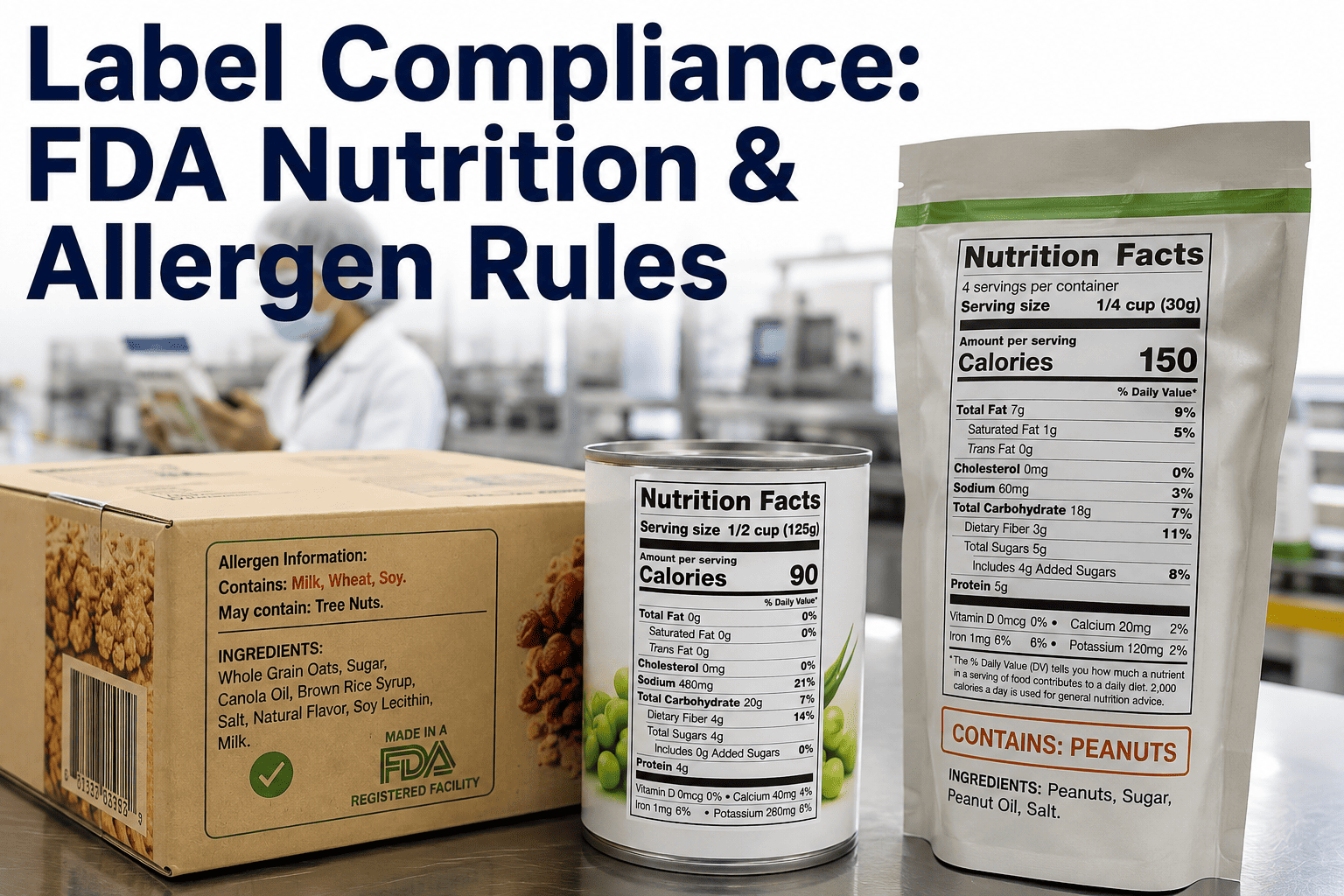
A food label looks simple from the outside: a product name, a nutrition panel, a list of ingredients. Underneath that simplicity sits one of the most heavily enforced areas of food regulation in the country, where a single missing allergen or a formatting error on the Nutrition Facts panel can trigger a recall that costs far more than the label review would have. Quality teams who treat label sign-off as a genuine verification step, not a rubber stamp on artwork someone else already approved, are the ones who avoid finding out about a gap from a warning letter. Teams building that verification discipline into their workflow can book a demo to see how it fits existing label review processes.
LABEL COMPLIANCE · 21 CFR PART 101 · FALCPA
Catch Label Errors Before They Become a Recall
A structured verification pass against FDA nutrition, allergen, and net weight requirements turns label review from a final rubber stamp into a real compliance control point.
The Five Elements Every Label Verification Must Confirm
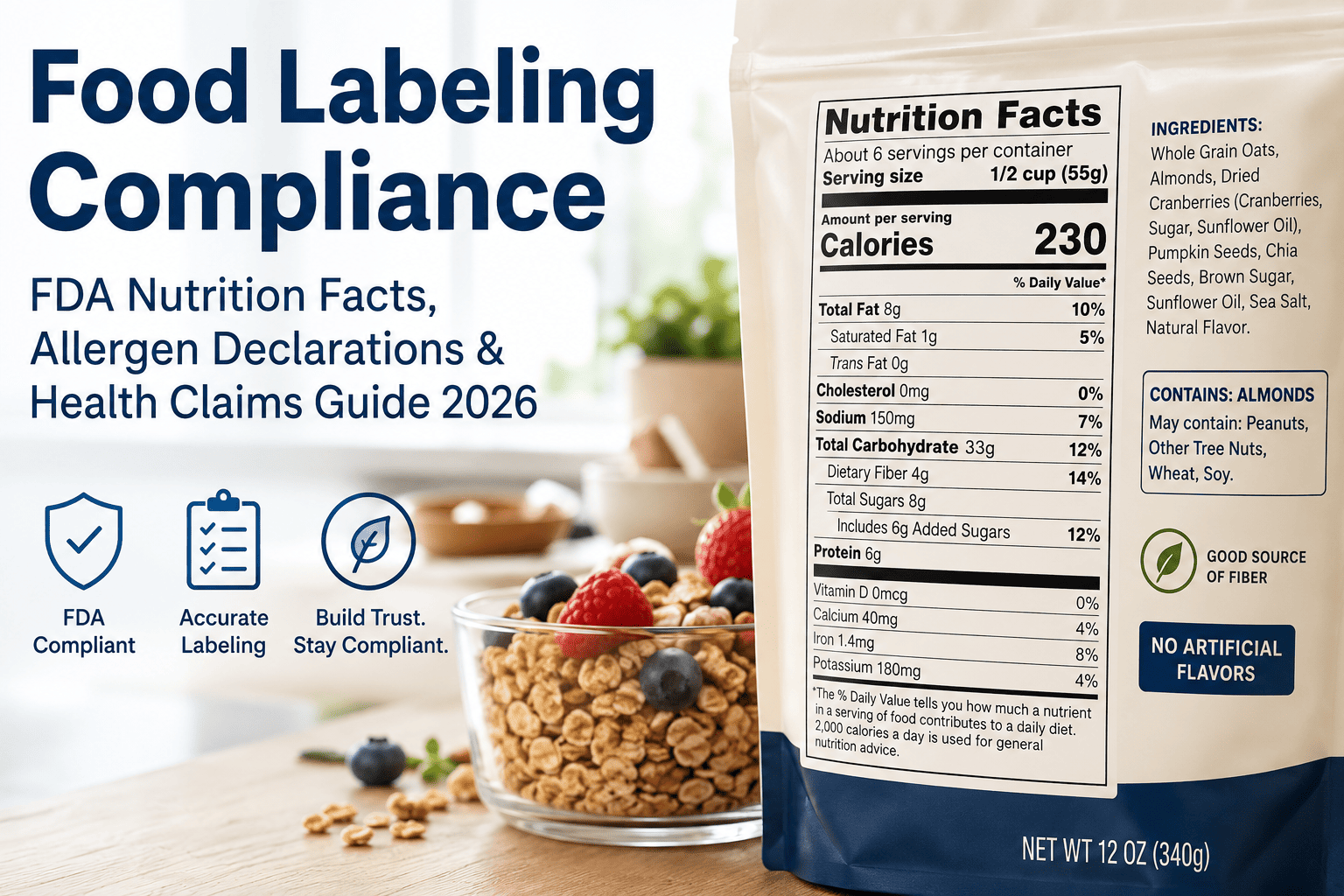
Every packaged food product sold in the United States is required to carry five principal display panel elements, and a verification pass that only checks one or two of them is not really a verification pass at all. The statement of identity, net quantity of contents, the Nutrition Facts panel, the ingredient list, and manufacturer or distributor information all have their own formatting rules, and each one shows up separately in FDA warning letters when it goes wrong.
What makes these five elements tricky in practice is that they rarely fail in isolation. A formulation change on the production floor that adjusts one ingredient percentage can simultaneously shift the correct descending-weight order on the ingredient list, change whether a nutrient content claim like "good source of fiber" still meets its threshold, and alter the values printed on the Nutrition Facts panel. A verification process that checks each element as a standalone item, rather than tracing how a single upstream change ripples across all five, will consistently miss the second and third-order effects of routine formulation work.
The 2016 update to the Nutrition Facts format is a useful reminder of how long a transition period can quietly persist inside a large label library. Manufacturers were given a compliance deadline to move every label to the new format, adding a distinct added sugars line and updating the daily values referenced for several nutrients, yet plants with large SKU counts sometimes still find a handful of legacy labels that were never migrated, usually on lower-volume or private-label items that received less scrutiny during the original transition project.
01
Statement of Identity
Must use the exact standardized name where one exists, and reflect the visible form of the product such as sliced, diced, or whole.
02
Net Quantity of Contents
Declared in both metric and U.S. customary units, positioned in the bottom third of the principal display panel.
03
Nutrition Facts Panel
Must follow the current mandatory format, including added sugars and updated daily values for vitamin D, calcium, iron, and potassium.
04
Ingredient List
Listed in descending order by weight, with sub-ingredients shown in parentheses and no substitutions from the approved formulation.
05
Manufacturer Information
Name and address of the manufacturer, packer, or distributor, with a U.S. address required for imported products.
The Nine Major Allergens, and Where Declarations Go Wrong
The Food Allergen Labeling and Consumer Protection Act originally required eight allergens to be declared, and the FASTER Act added sesame as the ninth beginning in 2023. Verification teams reviewing labels that predate that update are the ones most likely to find a gap, since a label last revised before the change almost certainly does not carry a sesame declaration even if every other ingredient is listed correctly.
Milk
Eggs
Fish
Shellfish
Tree Nuts
Peanuts
Wheat
Soybeans
Sesame
A single-ingredient food that is itself a major allergen, such as an all-purpose wheat flour, is not exempt from declaration; it must either identify the allergen source directly in its name or carry a separate "Contains" statement positioned immediately above the manufacturer information. Highly refined oils derived from a major allergen source are the one narrow exemption, since the refining process removes the allergenic protein to a level regulators consider low risk, but any oil that retains residual protein still requires a declaration.
Compliance teams often assume that a "Contains" statement is optional as long as the allergen appears somewhere in the parenthetical ingredient breakdown. That assumption is where a surprising number of gaps originate. Regulators expect the allergen source to be clear to an ordinary consumer scanning the label quickly, not buried three levels deep inside a sub-ingredient parenthetical that requires careful reading to decode. A verification pass should ask not only whether the allergen technically appears on the label, but whether an average shopper would actually see it in time to make an informed decision.
Multi-packaged products introduce a second layer of complexity that is frequently missed. When individual units inside a larger case or multipack are labeled "not for individual sale," those inner units can be exempt from certain requirements such as a full ingredient statement, but they are never exempt from allergen labeling. Any inner package containing a major allergen still needs its own "Contains" statement, even when the outer case carries the full label. Verification checklists that only look at the outer carton risk missing this inner-package requirement entirely.
Reading the Table Correctly: Pattern, Not Just Checklist
The five violation types above are not a random sample of unrelated mistakes. Read together, they describe a single underlying pattern: a label was correct at some point in the past, and something downstream of that original approval changed without the label being brought back into alignment. A regulation changed, a formulation changed, a supplier changed, or a marketing team added a claim without checking it against the underlying nutrition data. In every case, the label itself did not fail on its own; the process for keeping it synchronized with reality failed first.
That reframing matters because it changes what a verification program should actually be optimized to catch. A checklist approach asks "does this label currently meet every requirement," which is a valid but limited question, because it only tests the label at a single point in time. A synchronization approach asks "what changed since this label was last verified, and does the label still reflect it," which catches the drift that a point-in-time checklist misses entirely. The strongest verification programs run both checks together: a full requirements checklist at each scheduled review, and a change-triggered spot check whenever something upstream moves.
VERIFICATION WORKFLOW
Turn Label Review Into a Documented Control Point
See how a structured verification pass against every panel element fits into your current artwork approval process.
Common Violations and How Verification Catches Them
| Violation Type | What Typically Happens | What Verification Should Confirm |
|---|---|---|
| Sesame Not Declared | Older artwork reused without an allergen refresh after the 2023 rule change | Every active label checked against the current nine-allergen list, not the eight-allergen legacy list |
| Unauthorized Nutrient Claims | Marketing copy uses terms like "low fat" or "high protein" without meeting the defined threshold | Every nutrient content claim matched against its specific regulatory definition before print |
| Missing U.S. Address | Imported product labels carry only a foreign manufacturer address | A U.S. distributor or importer address present on every imported SKU |
| Ingredient Order Errors | Formulation changes on the production floor are not reflected back in the printed ingredient list | Ingredient list weight order matched against the current, not historical, formulation |
| Contradictory Allergen Copy | A "Contains" statement and a "may contain" advisory list different allergens on the same label | Allergen statements checked for internal consistency across every panel on the package |
A Five-Step Verification Pass Before Any Label Goes to Print
STEP 1
Pull the Current Formulation
Confirm the ingredient list on the artwork matches the active production formulation, not an earlier version.
STEP 2
Check All Nine Allergens
Cross-reference every ingredient and sub-ingredient against the full nine-allergen list, including hidden derivatives.
STEP 3
Verify Nutrition Facts Format
Confirm the panel uses the current mandatory format with added sugars and updated daily values.
STEP 4
Validate Nutrient Claims
Match every marketing claim on the package against its specific regulatory threshold before approval.
STEP 5
Confirm Net Weight Declaration
Check declared net quantity against the packaging line's actual target fill and unit conversion.
Who Should Own Label Verification, and Who Should Not
A recurring structural mistake is letting the same team that designs and approves marketing artwork also serve as the final regulatory check on that artwork. Marketing and design teams are optimized to ship an attractive, on-brand package on a launch deadline, and that incentive naturally pulls against slowing down to re-verify allergen declarations or nutrient claim thresholds one more time before print. This is not a criticism of marketing teams; it is simply a mismatch between what they are measured on and what a genuine regulatory check requires.
The plants with the fewest label-related findings tend to separate these two functions clearly. Quality assurance or regulatory affairs owns the final sign-off on every label element, with the authority to hold a launch date if a verification check fails, and that authority is exercised independently of the marketing timeline. This does not need to slow products down in practice, because a verification process that runs in parallel with artwork development, rather than as a final gate at the end, catches problems early enough that they rarely threaten the launch date at all.
Training also plays a quiet but significant role here. A verification checklist is only as good as the person applying it, and allergen regulation, nutrient claim thresholds, and formatting rules all change often enough that a checklist written two years ago may no longer reflect the current standard. Plants that pair a written verification procedure with periodic refresher training for whoever performs the check tend to catch regulatory updates, like the sesame requirement, months earlier than plants relying on a static document that nobody revisits until something goes wrong.
5
Required Panel Elements
9
Major Allergens Regulated
~300
FDA Warning Letters Issued Yearly
2023
Year Sesame Became the 9th Allergen
Why Overlabeling Is Not a Safe Default
Some plants respond to allergen risk by declaring an allergen on every product that might possibly cross paths with it, treating overlabeling as the cautious option. Regulators do not see it that way. Declaring allergens that are not genuinely present is itself a compliance issue, because it misleads consumers who rely on the label to make a real safety decision, and it can mask the specific products that carry a genuine allergen risk. A verification process built around accuracy, not blanket caution, produces labels that protect consumers without becoming meaningless through overuse.
This is where a documented review trail matters as much as the label itself. When an auditor or an inspector asks how a specific allergen declaration was determined, "someone checked it" is not an answer that holds up. A dated, structured verification record showing which formulation was checked, against which allergen list, and who signed off, is the difference between a defensible label and a guess that happened to be correct.
There is also a supplier dimension to this that plants often underestimate. Ingredient specifications from suppliers change more often than most quality teams expect, sometimes without a formal notification, particularly when a supplier reformulates for cost or availability reasons. An allergen verification program that only checks the label against the formulation on file, without periodically re-confirming that supplier ingredient specifications still match what was originally declared, can carry an invisible gap for months before it surfaces during an audit or, worse, a customer complaint.
Seasonal and promotional packaging adds a third failure mode that is easy to overlook in a verification schedule built only around core SKUs. Limited-time flavors, holiday packaging, and private-label variants often get expedited through artwork approval because of tight launch timelines, and that speed is exactly what creates risk. A verification process that applies a lighter check to promotional SKUs because they are temporary is applying the wrong logic; a mislabeled allergen on a limited-run product creates the same consumer risk and the same regulatory exposure as one on a flagship item, regardless of how long it stays on shelf.
We assumed our labels were current because nothing had changed on the packaging design. What had changed was the regulation itself, and nobody had gone back to check every SKU against the new allergen list until an audit flagged it.
Quality Assurance Manager, Packaged Foods Manufacturer
Building a Verification Schedule That Doesn't Rely on Memory
Most label compliance gaps do not come from a single careless review. They come from a verification process that depends on someone remembering to re-check a label years after it was originally approved. A plant that certifies a label as compliant at launch and never revisits it again is effectively assuming that nothing regulatory or formulation-related will change for the entire life of that SKU, which is rarely true across a multi-year product run.
A more durable approach treats label verification the same way a plant treats calibration or preventive maintenance: as a scheduled activity with a defined interval, an assigned owner, and a record that proves it happened. An annual full-library sweep catches regulatory changes like the sesame requirement before they become a warning letter. A triggered review tied directly to any formulation change, supplier substitution, or new customer-specific labeling request catches the gaps that happen between scheduled sweeps, which is where the majority of real-world violations tend to originate.
The plants that manage this well typically maintain a single source of truth for the current formulation, current allergen status, and current label artwork for every active SKU, rather than treating these as three separate documents maintained by three separate teams. When a change happens in any one of the three, it becomes far more visible whether the other two have been updated to match, which is precisely the kind of cross-check that catches label errors before they reach a customer or an inspector rather than after.
Recall costs make the case for this investment clearly enough on their own. A single undeclared allergen recall routinely runs into six or seven figures once destroyed inventory, retailer chargebacks, corrective communication, and reputational cleanup are counted together, and that is before accounting for any regulatory penalty. Measured against that exposure, a structured, scheduled verification process is a modest and predictable cost, while an ad hoc review that depends on someone happening to notice a problem is a real, ongoing liability sitting quietly on the books.
Retailer requirements add another layer of pressure that plants cannot always control on their own timeline. Many major retailers now run their own label compliance screening before accepting a new SKU into distribution, and a rejected label at that stage costs a plant a delayed launch window on top of the original compliance risk. Building verification early into the artwork process, rather than treating it as a final check right before a retailer submission, gives a plant enough runway to fix a gap without losing a shelf placement date it worked months to secure.
Frequently Asked Questions
What is the difference between food packaging and food labeling under FDA rules?
Food packaging refers to the physical container or wrapper that protects the product, while food labeling refers to the written, printed, or graphic information displayed on that packaging. The FDA regulates the content of labeling under 21 CFR Part 101, covering nutrition facts, ingredient lists, allergen declarations, and any health or nutrient claims, while packaging materials themselves are regulated separately for food contact safety. Understanding this distinction matters for verification because a packaging material change, such as switching supplier for a container, does not usually require relabeling, but it should still trigger a check that nothing on the printed content has drifted.
Are cross-contact statements like "may contain" legally required?
No, precautionary cross-contact statements such as "may contain traces of peanuts" are voluntary and are not directly regulated by the FDA in the way that intentional allergen declarations are. They should only be used when there is a genuine, assessed risk of cross-contact, since using them broadly across every product can dilute their meaning for consumers who rely on them to make real decisions. A verification process should confirm that any cross-contact statement used reflects an actual, documented risk assessment on the production line rather than a blanket precaution copied across the entire product portfolio.
Do single-ingredient allergen foods need a "Contains" statement?
Single-ingredient foods that are themselves a major allergen or contain proteins derived from one are not exempt from declaration. They must either identify the allergen source directly in the food name, such as "all-purpose wheat flour," or carry a separate "Contains" statement positioned immediately above the manufacturer, packer, or distributor information on the label. If the product is intended for further manufacturing rather than direct retail sale, the "Contains" statement should still appear on the principal display panel where it remains visible to the next processor in the supply chain.
How often should an active label library be re-verified against current rules?
Best practice is an annual full-library review at minimum, plus an immediate targeted review whenever a regulation changes, such as the 2023 sesame requirement, or whenever a formulation changes on the production floor. Teams building this into a recurring schedule rather than a reactive one can review their current process through support to identify gaps before an inspector does.
What triggers most FDA food labeling warning letters?
The most frequent findings involve missing sesame declarations on labels that predate the 2023 rule change, unauthorized nutrient content claims that do not meet the specific regulatory definition, and missing U.S. addresses on imported products. Ingredient list formatting errors, where sub-ingredients are not properly parenthesized or the descending weight order does not match the actual formulation, are also a recurring and avoidable finding.
FDA LABEL COMPLIANCE
Make Label Verification a Documented Control Point
Talk to the team about building a repeatable label verification process across your active SKU library.