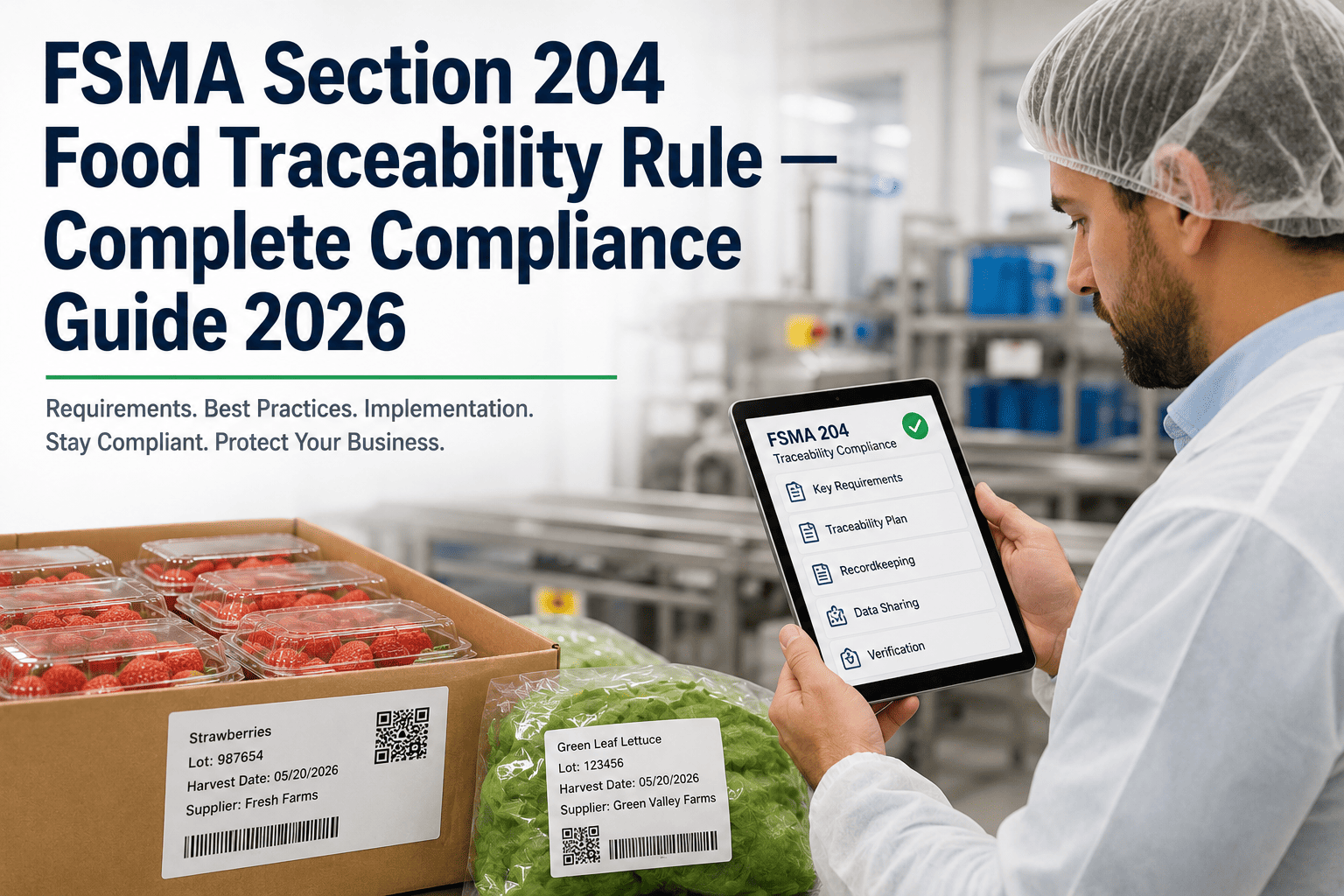
FSMA Section 204 is the FDA rule that redefines how food manufacturers prove where every high-risk ingredient came from and where it went. It requires covered entities to maintain Key Data Elements at each Critical Tracking Event and hand records to the FDA in an electronic, sortable format within 24 hours. The enforcement date has shifted, but the requirements have not, and compliance officers who treat the delay as a pause fall behind fast. This guide breaks down exactly what the rule demands, event by event, so you can build an audit-ready traceability program with AI-driven recordkeeping that meets FDA timelines.
FSMA Section 204 Food Traceability RuleThe complete compliance playbook for food manufacturers
From Key Data Elements and Critical Tracking Events to the 24-hour sortable-spreadsheet demand — everything a compliance officer needs to pass an FDA traceability audit.
Maximum time to produce an electronic, sortable traceability record after an FDA request during a recall or outbreak.
The Deadline Moved. The Rule Did Not.
Older guidance still cites January 2026. That date is outdated — but the substance of the rule is fully intact, and the supply-chain coordination it demands takes far longer than the calendar suggests.
Rule Took Effect
The Food Traceability Final Rule became effective, opening a three-year compliance window for all covered entities.
Congress Directs Delay
The Continuing Appropriations Act of 2026 directed the FDA not to enforce the rule before the new date. Requirements themselves were left untouched.
Enforcement Begins
The current compliance and enforcement date. Every covered entity across the supply chain must be able to produce records by this point — together.
Does FSMA 204 Apply to Your Operation?
The rule covers anyone who manufactures, processes, packs, or holds a food on the Food Traceability List — or a food that contains a listed item as an ingredient in the same form.
Covered Entities
Manufacturers, processors, packers, and holders of FTL foods — domestic and foreign suppliers shipping to the U.S. market. Size is not an exemption; small brands are covered just like large corporations if their product is listed.
Food Traceability List
Higher-risk foods identified by public-health history: leafy greens, fresh-cut fruits and vegetables, tomatoes, melons, sprouts, shell eggs, nut butters, certain soft cheeses, deli salads, and a range of seafood.
Along the Whole Chain
The rule links every point where FTL food changes hands, is transformed, or moves. Foreign competent authorities do not verify compliance — the responsibility sits directly with the business itself.
24-Month Retention
Records must be kept as original paper, electronic records, or true copies for 24 months — and be legible, retrievable, and producible to the FDA within 24 hours of a request.
Critical Tracking Events: Where Data Must Be Captured
CTEs are the moments in a food's journey where enhanced records are mandatory. At each one, you record and link the required Key Data Elements to a Traceability Lot Code.
Farm or growing-area data is captured for raw agricultural commodities before they enter the packing chain.
Pre-packing cooling of RACs is logged, linked to location and the eventual lot code.
The pivotal event — the Traceability Lot Code is assigned here, making this the anchor for all downstream traceability.
Mixing, repackaging, or relabeling. A new lot code and full KDE set are generated for the resulting product.
Records travel with the food and are shared with the next trading partner in the chain.
The receiver links incoming shipping KDEs to its own records, keeping the chain unbroken.
Key Data Elements Required at Each Critical Tracking Event
KDEs are the specific pieces of information that must live in each record. The exact set depends on which supply-chain activity you perform.
| Critical Tracking Event | Core Key Data Elements Required | New Lot Code? |
|---|---|---|
| Harvesting | Commodity and variety, location of harvest, quantity and unit, date of harvest, and the business that harvested the food. | No |
| Cooling (pre-pack) | Location description for cooling, date of cooling, quantity and unit, plus the harvest location reference. | No |
| Initial Packing | Traceability Lot Code, TLC source and source reference, product description, quantity and unit, date of packing, and harvest/cooling references. | Yes — assigned |
| Transformation | New TLC for the output, input TLCs, product description, quantity and unit, location, and date of transformation. | Yes — new |
| Shipping | TLC, product description, quantity and unit, ship-from and ship-to locations, ship date, and reference to receiving. Shared with the next partner. | No |
| Receiving | TLC, product description, quantity and unit, location of receipt, immediate previous source, and date received. | No |
How the Traceability Lot Code Ties the Chain Together
The TLC is a unique alphanumeric descriptor assigned once — at initial packing or transformation — and carried forward through every subsequent record.
Assigned at the Right Event
A TLC is created at initial packing of a raw agricultural commodity, at the first land-based receipt of food from a fishing vessel, or when food is transformed. Shipping alone does not create a new code.
Built to Be Unique
Industry workgroups recommend combining a GTIN with the product lot number to form a code that cannot be duplicated across the supply chain, keeping every batch distinctly identifiable.
Linked to Every KDE
The code must connect to all Key Data Elements at each Critical Tracking Event, so a single traceback query can surface the full history of any lot in seconds rather than days.
Carried and Updated
When food is repackaged or transformed, the new packaging must reflect the correct code and the TLC source must update to the location where that event occurred.
Turn 24-Hour Panic Into a 24-Second Query
Manual traceability logs collapse under an FDA request. iFactory captures Key Data Elements at every Critical Tracking Event, links them to lot codes automatically, and produces the electronic sortable spreadsheet the rule demands — on time, every time.
Building an Audit-Ready Traceability Plan
Beyond event records, every covered entity must maintain a written traceability plan — the document an FDA investigator will ask for first.
Recordkeeping Procedures
A description of how you capture, store, and maintain records, including the format — paper or electronic — and the physical or digital location where they live.
FTL Identification Method
How you identify which foods you handle appear on the Food Traceability List, so nothing covered slips through your recordkeeping unnoticed.
Lot Code Assignment Logic
A clear description of how you assign Traceability Lot Codes to FTL foods, including the structure and the events that trigger a new code.
Designated Point of Contact
A named person responsible for the plan and for answering FDA and partner questions about records, codes, and compliance.
Farm Maps (if growing)
Growers of listed foods include maps showing growing areas with field names and geographic coordinates; aquaculture farms provide container details instead.
Version Control
Update the plan as practices change and retain each prior version for two years — investigators may ask to see how your program evolved.
Why Paper-Based Traceability Fails the 24-Hour Test
The rule's real pressure point is speed. When an outbreak hits, the gap between a spreadsheet you can sort in seconds and a filing cabinet you search for days is the gap between compliance and a warning letter.
| Capability | Manual / Paper | AI-Driven System |
|---|---|---|
| Record production time | Days of manual searching | Sortable export in seconds |
| KDE capture | Hand-keyed, gaps common | Captured automatically at each CTE |
| Lot code linking | Manual cross-reference | Linked and traceable end to end |
| Partner data exchange | Email, PDFs, phone calls | GS1 / EDI standardized transfer |
| Audit readiness | Reactive scramble | Continuously audit-ready |
| Error and duplication risk | High under time pressure | Validated at point of capture |
A Six-Step Path to FSMA 204 Readiness
A structured program turns a sprawling regulation into a sequence of clear, assignable tasks your team can execute before enforcement arrives.
Check the Food Traceability List
Confirm which of your products — or ingredients within them — appear on the FTL. This single check determines the entire scope of your obligation.
Map Your Critical Tracking Events
Identify which CTEs apply to your operation — harvesting, cooling, packing, transformation, shipping, or receiving — and where each occurs in your process.
Audit Your Current KDEs
Compare the data you capture today against what each CTE requires. The gaps between the two are your compliance work list.
Standardize Your Lot Codes
Build a consistent Traceability Lot Code system, ideally GTIN-based, and define exactly which events trigger assignment or renewal of a code.
Align Your Supply Chain Partners
Confirm suppliers and customers can send and receive KDEs in a compatible format. Your compliance depends on their data flowing cleanly to you.
Digitize and Document
Move records into a system that produces sortable electronic exports on demand, then write the traceability plan that ties every procedure together.
FSMA 204 Compliance — Questions Answered
The questions compliance officers ask most often when scoping a traceability program.
Q: What is the current FSMA 204 compliance deadline?
The enforcement date was extended from January 20, 2026 to July 20, 2028. Congress directed the FDA through the Continuing Appropriations Act of 2026 not to enforce the rule before that date, and the FDA has confirmed it will comply. Importantly, the substantive requirements — the Food Traceability List, the Critical Tracking Events, the Key Data Elements, and the recordkeeping obligations — were not changed. Only the date moved, and the supply-chain coordination the rule demands still takes years to build. You can book a demo to plan your rollout well ahead of that date.
Q: What exactly are Critical Tracking Events and Key Data Elements?
Critical Tracking Events are the points in a food's journey where the rule requires enhanced records — harvesting, cooling, initial packing, transformation, shipping, and receiving. Key Data Elements are the specific pieces of information you must record at each of those events, such as the traceability lot code, product description, quantity and unit of measure, location descriptions, and relevant dates. The exact KDEs vary by which supply-chain activity you perform. Every KDE must be linked to a Traceability Lot Code so an investigator can reconstruct a lot's full history quickly.
Q: How fast must I produce records if the FDA requests them?
Records must be provided within 24 hours of an FDA request, or within a reasonable time agreed with the agency. When needed to prevent or mitigate an outbreak, assist a recall, or address a public-health threat, you must supply the records as an electronic, sortable spreadsheet. Records also have to be maintained for 24 months. This 24-hour, machine-sortable demand is what makes paper-based or fragmented systems risky — searching filing cabinets during a live recall rarely fits the window.
Q: Does the rule apply to foreign suppliers and small businesses?
Yes on both counts. The rule applies to foreign suppliers shipping FTL foods into the United States, and the responsibility to comply rests with the business itself — foreign competent authorities do not verify it for you. There is no blanket small-business carve-out either; if your product is on the Food Traceability List, you are covered regardless of size. Some narrow exemptions exist for certain small farms and produce growers, but they are complex, so verify your specific status carefully rather than assuming you are exempt.
Q: Why start now if enforcement is years away?
Because the binding constraint is coordination, not paperwork. FSMA 204 only works when every trading partner in your chain runs compatible systems — receivers need lot codes from shippers, and processors need data from suppliers. A facility cannot become compliant in isolation, and aligning dozens of partners on data formats and lot-code practices takes far longer than most teams expect. Building your traceability program early also improves data hygiene and recall speed in the meantime. Talk through your rollout with our team to sequence it sensibly.
Every Event Captured. Every Lot Linked. Every Audit Ready.
FSMA Section 204 rewards the manufacturers who build traceability into daily operations instead of scrambling when the FDA calls. Let iFactory stand up your Key Data Element capture, lot-code linking, and 24-hour sortable exports — so your next audit is a formality, not a fire drill.

-what-food-manufacturers-must-do-now.png)