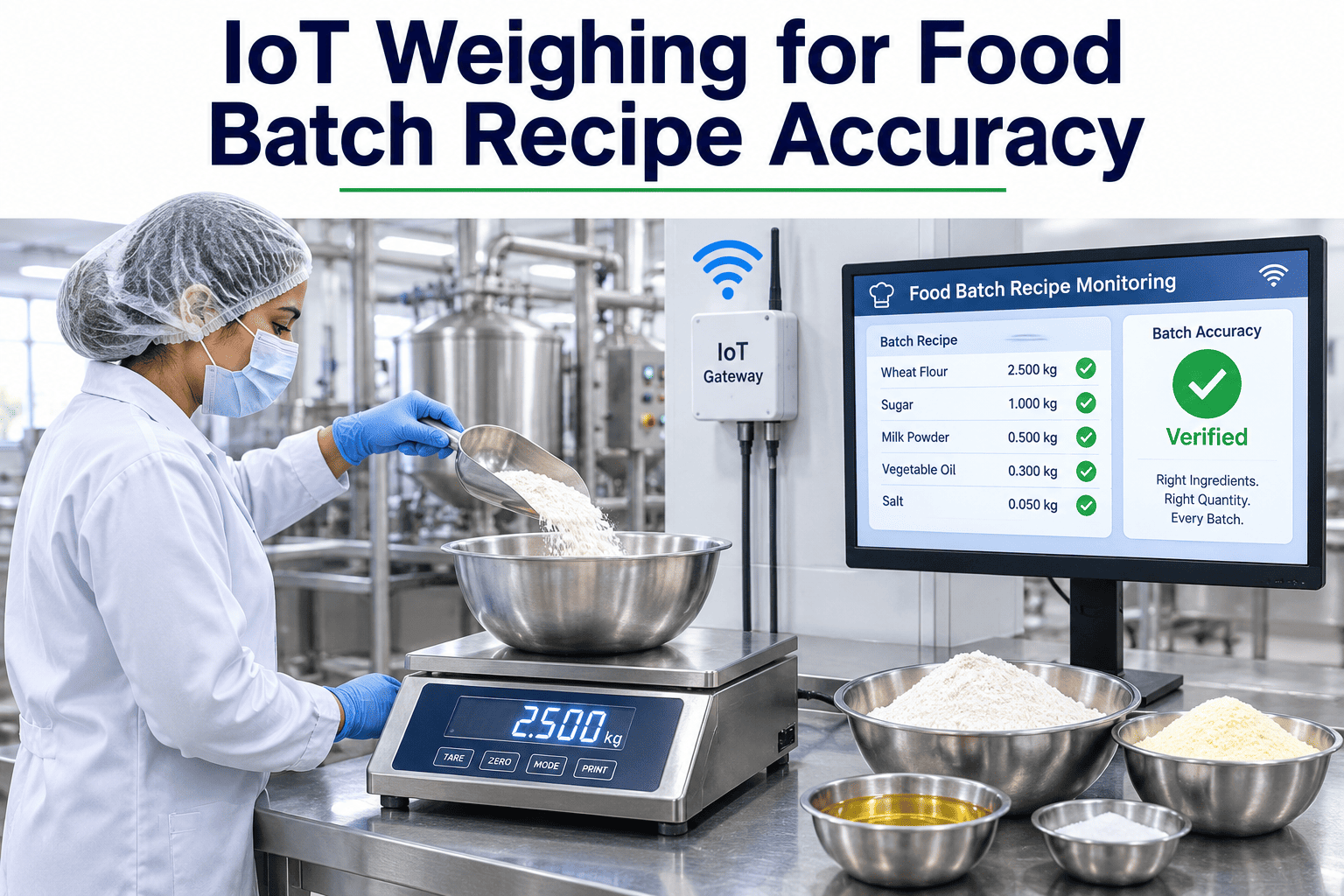
Recipe accuracy in food manufacturing ultimately comes down to a much simpler question than most quality teams treat it as — did the correct weight of each ingredient actually go into the batch, verified in real time, rather than assumed based on an operator's manual scale reading. IoT-connected weighing systems answer that question definitively by streaming load cell data directly into a batch management system as ingredients are added, flagging deviations from the target recipe the moment they occur instead of leaving discovery to a failed quality check hours or days later. This shift from manual, after-the-fact verification to continuous, automated weight tracking is one of the highest-value digital investments a food plant can make, because recipe accuracy touches product consistency, cost control, and regulatory labeling claims all at once. A recipe that is even slightly off on a key ingredient can affect texture, shelf life, or nutritional labeling accuracy without producing any obvious sensory sign that something went wrong, which is exactly why relying on operators to catch these errors visually or by feel is not a reliable long-term control. The sections below explain how IoT weighing integrates with batch management, what auto-batching verification actually catches, and how ingredient-level traceability supports both quality and recall readiness, with additional detail in iFactory's support documentation.
01 / Why Manual Scale Checks Miss More Than Plants Expect
A manual weighing process depends on an operator correctly reading a scale, correctly identifying the right ingredient and target weight from a printed or digital recipe sheet, and correctly recording that the addition was made — three separate points where a busy, fast-paced production shift can introduce error without anyone noticing until well after the batch has moved on. IoT weighing systems remove the recording and verification steps from human memory entirely by connecting load cells directly to the batch management system, so the actual weight added is captured automatically and compared instantly against the target recipe value rather than relying on an operator's separate confirmation step. This matters most during high-volume shifts and staffing transitions, when the manual verification step is exactly the kind of secondary task that gets rushed or skipped under time pressure, even by experienced operators who understand its importance under normal conditions.
02 / How Load Cell Data Connects to Batch Management
The technical architecture behind IoT weighing is straightforward in concept — load cells under a scale or vessel generate a continuous weight signal, which an IoT gateway converts and transmits to the batch management platform, where it is compared in real time against the specific recipe step currently active for that batch. This connection is what allows the system to know not just that a certain weight was recorded, but that the weight matches the specific ingredient and step called for at that exact point in the recipe sequence, rather than simply logging weight in isolation. This context awareness is the key technical difference between a smart scale that simply digitizes a weight reading and a true IoT weighing system integrated with batch management, since only the latter can tell an operator, in real time, whether the weight just recorded actually belongs at this stage of this specific recipe.
03 / What Auto-Batching Verification Actually Catches
Auto-batching verification catches a specific, recurring set of errors that manual processes are structurally prone to, and understanding this list is often what convinces a plant the investment is worthwhile beyond a general sense that automation is a good idea. Each of these error types tends to occur at a different point in the production shift and for a different underlying reason, which is why a system designed to catch the full range, rather than just the most obvious overweight or underweight case, provides considerably more protection than a simple scale-reading check alone.
04 / Ingredient-Level Traceability Beyond the Batch Record
Every verified weight reading captured by an IoT weighing system becomes part of a permanent, ingredient-level traceability record that ties a specific lot of a specific ingredient, at a specific verified weight, to a specific finished batch — a level of detail that manual paper batch records rarely achieve consistently across every ingredient in every batch. This traceability depth matters considerably during a recall investigation, since it allows a plant to trace forward from a suspect ingredient lot to every finished batch that used it, or backward from a finished batch to every ingredient lot involved, without depending on legible handwriting or complete manual recordkeeping. The speed of this lookup matters as much as its accuracy — a recall investigation that would otherwise take days of manual batch record review can often be completed in minutes when the underlying ingredient and weight data is already digitized and searchable rather than scattered across paper records in a filing room.
| Traceability Element | What It Enables |
|---|---|
| Ingredient Lot Number | Links a specific supplier lot to the exact batch it was used in |
| Verified Weight | Confirms the actual quantity used, not just that an addition was attempted |
| Timestamp | Establishes exact sequencing of ingredient additions within the batch |
| Operator or Station ID | Identifies which station or operator performed the addition |
05 / Recipe Accuracy and Cost Control Are the Same Problem
Overweighing an ingredient is frequently treated as a food safety non-issue since it does not create a compliance risk the way underweighing a critical ingredient can, but it represents pure cost leakage that compounds across every batch run over a production year. A facility running thousands of batches annually can lose a meaningful percentage of an expensive ingredient's total spend to small, consistent overweighing that no single instance would ever trigger a quality investigation on its own, yet the cumulative effect across a full year of production is often larger than plants expect until they actually measure it. IoT weighing systems that flag overweight additions with the same rigor as underweight ones give plants visibility into a cost control opportunity that manual processes typically miss entirely, since an operator adding slightly too much of an expensive ingredient rarely triggers any quality concern under a manual process even though it directly affects margin.
06 / Integrating IoT Weighing With Existing ERP and Quality Systems
An IoT weighing system delivers its full value only when the verified batch data flows into the systems that already manage inventory, quality, and compliance, rather than existing as an isolated island of data that staff still have to manually reconcile against ERP records. Integration typically routes verified consumption data automatically into inventory management, so ingredient stock levels update based on actual verified usage rather than a planned recipe assumption, while quality records receive the full weight verification trail without a separate manual data entry step. This automatic flow also improves inventory forecasting accuracy over time, since planning based on actual verified consumption patterns tends to be more reliable than planning based on theoretical recipe usage that may not reflect the small but consistent variances that occur in real production.
07 / Rolling Out IoT Weighing Without Disrupting Active Production
A phased rollout, starting with the highest-value or highest-risk recipes rather than attempting a full-line conversion on day one, allows a plant to validate the integration and build operator familiarity before expanding coverage. Running the new system alongside existing manual verification for an initial overlap period on each converted line confirms the automated readings match expected results before the manual backstop is retired. This overlap period is also a valuable opportunity to fine-tune deviation tolerances against real production data, since a tolerance set purely on paper before any live production data is available often needs minor adjustment once actual variability in the addition process becomes visible.
08 / Conclusion — Recipe Accuracy Becomes Verifiable, Not Assumed
IoT weighing systems shift recipe accuracy from something a plant assumes happened correctly to something verified automatically, in real time, for every ingredient in every batch. The combination of immediate deviation flagging, ingredient-level traceability, and integration with existing ERP and quality systems turns a recurring manual verification burden into a continuous, auditable record that supports both product consistency and cost control at once. Plants that make this shift typically find that the return extends well beyond the original recipe accuracy goal, showing up in tighter inventory forecasting, faster recall response, and a materially reduced burden on quality staff who previously spent significant time manually reconciling batch records after the fact. Book a demo to see how automated weighing verification would integrate with your current batch process.
Frequently Asked Questions — IoT Weighing for Batch Recipe Accuracy
Tolerance levels are typically defined per ingredient and per recipe rather than applied as a single blanket rule, since a critical allergen-control ingredient may warrant a very tight tolerance while a bulk filler ingredient can reasonably tolerate a wider range without affecting product quality or safety. Setting these tolerances requires input from both quality and formulation teams to balance practical production variability against the accuracy the recipe genuinely requires, and the tolerance can be adjusted over time as a plant gathers real production data showing how consistently a given ingredient addition process actually performs.
In many cases existing scales and load cells can be retrofitted with an IoT gateway that captures and transmits their signal rather than requiring full hardware replacement, which considerably lowers the cost and disruption of a rollout. Older analog scales without a digital output may need a compatible signal converter or, in some cases, replacement if the underlying hardware cannot support reliable digital integration, but this is typically a smaller subset of a facility's total scale inventory rather than the norm. iFactory's support documentation outlines compatibility considerations for common scale and load cell types.
Most systems are configured to pause the batch process or clearly alert the operator before the next recipe step proceeds, giving staff the opportunity to correct the addition, document an approved override with justification, or escalate to a supervisor depending on the severity of the deviation and the specific ingredient involved. This immediate-stop approach is what distinguishes true auto-batching verification from passive logging systems that record the deviation but allow production to continue regardless, since the value of catching a deviation is significantly reduced if the batch proceeds before anyone acts on the alert.
Yes, and this is one of the more valuable secondary benefits beyond core recipe accuracy — verified ingredient weight data provides direct evidence supporting label claims about ingredient quantities, and it confirms that allergen-containing ingredients were added only to the specific batches where they belong rather than relying on assumption or memory. This becomes particularly valuable for facilities running shared lines between allergen-containing and allergen-free products, where verified weight and ingredient identity data adds a documented layer of confidence beyond standard line clearance procedures alone.
Implementation timelines vary with the number of scales being connected and the complexity of the existing batch management system, but a single production line with a defined set of recipes can typically be connected and validated within several weeks, including a parallel verification period against the existing manual process before full cutover. Facilities converting multiple lines or integrating with a more complex ERP environment should expect a longer phased timeline, prioritizing the highest-value recipes first rather than attempting a simultaneous full-facility conversion. Book a demo to scope a realistic implementation timeline for your specific production environment.