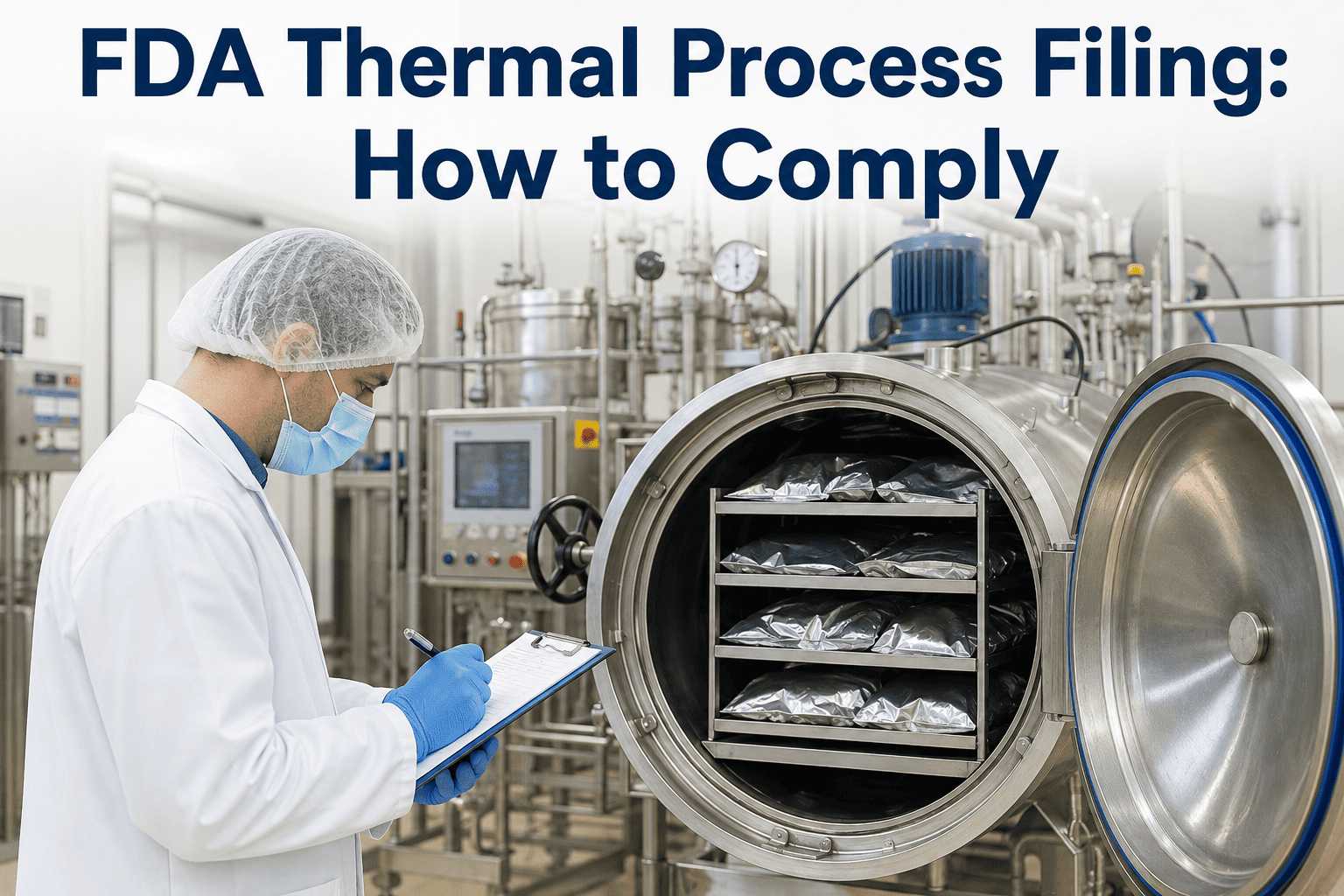
Every low-acid canned food product a facility produces has to be backed by a filed thermal process before a single case can ship — not as a formality, but as a legal requirement under 21 CFR 113 that exists because underprocessed low-acid canned food is one of the few food safety failures capable of producing fatal botulism outbreaks. Filing a scheduled process with FDA means establishing, through validated science, that a specific process — a specific retort, a specific container size, a specific fill weight, a specific initial temperature — reliably delivers a lethal thermal treatment to the coldest point in every container. Quality teams managing this process often find that the science is usually the easier part; the harder part is the standing operational discipline required to keep a filed process valid as production conditions inevitably drift from what was originally validated. Continuous thermal process monitoring closes that gap by tracking retort performance against the filed scheduled process in real time, not just during the original establishment study. You can book a demo to see how this monitoring layer supports ongoing 21 CFR 113 compliance on a live retort operation.
Why FDA Requires Thermal Process Filing for Low-Acid Canned Foods
Low-acid canned food — anything with a pH above 4.6 and water activity above 0.85, packaged in a hermetically sealed container — creates exactly the anaerobic, low-acid environment Clostridium botulinum spores need to germinate and produce toxin if the container isn't processed correctly. This is not a theoretical risk category; it's the specific failure mode behind historical botulism outbreaks that led directly to the regulatory framework under 21 CFR 113 that governs LACF processing today.
What makes this hazard particularly unforgiving from a quality standpoint is that a botulism-contaminated can looks, smells, and often tastes completely normal. There is no visible spoilage cue that alerts a consumer or a quality inspector that a container was underprocessed — the only reliable defense is confidence that the thermal process itself was executed correctly, every time, for every container. This is precisely why the regulatory framework places so much weight on process validation and ongoing verification rather than end-product testing, since destructive testing of finished product can never provide the statistical confidence needed to guarantee safety across an entire production run.
The regulation's core requirement is straightforward in concept and demanding in execution: every commercial processor of low-acid canned food must establish a scheduled process — validated by a qualified process authority — for every product, container, and equipment combination they run, and file that process with FDA before commercial distribution begins. The filing isn't a one-time approval that then sits in a drawer. It's the reference standard that every subsequent production run has to actually deliver, which is exactly where the operational challenge begins.
What Goes Into a Thermal Process Filing — Document by Document
A complete thermal process filing package is built from several distinct documents, each serving a specific regulatory function. Understanding what each one actually establishes helps quality teams see why the filing process takes the time it does — and why maintaining ongoing compliance requires more than a single successful submission. Facilities new to LACF processing sometimes treat the filing as a single event to get through; experienced quality teams understand it as the foundation document for a compliance obligation that continues for as long as the product remains in production. Book a demo to see how these filing components map to continuous production monitoring.
Assembling this documentation set typically takes weeks to months depending on how many heat penetration study runs are required to build statistical confidence in the proposed process. That upfront investment is precisely why maintaining the filing's validity through disciplined production monitoring afterward makes sense — a facility that has already invested in establishing a defensible scheduled process has every reason to protect that investment with equally disciplined ongoing verification, rather than letting operational drift quietly erode the margin the original study worked to establish.
21 CFR 113 Requirements — What Each Section Actually Covers
21 CFR 113 is organized into distinct subparts, each governing a specific dimension of low-acid canned food processing. Quality teams building or auditing a compliance program benefit from understanding which subpart governs which operational area, since audit findings are typically organized around these same divisions — an inspector reviewing establishment registration is looking for a very different set of records than one reviewing equipment and procedure compliance, and a well-organized quality program keeps documentation structured to match this same regulatory logic rather than as one undifferentiated compliance folder.
| Requirement Area | What It Governs | Key Documentation |
|---|---|---|
| Establishment Registration | Facility identification and registration with FDA | Food Canning Establishment (FCE) number |
| Process Filing | Scheduled process submission for each product/container combination | Form 2541, process authority letter |
| Equipment and Procedures | Retort design, instrumentation, and operating procedures | Retort validation records, calibration logs |
| Container Closure | Seal integrity for hermetically sealed containers | Closure evaluation reports, seam inspection records |
| Records and Reports | Production record retention and deviation documentation | Process records, deviation logs, retention schedule |
How a Scheduled Process Actually Gets Established
Establishing a scheduled process is a scientific validation exercise, not a paperwork exercise — though the paperwork is how that science gets communicated to FDA. The process authority's job is to demonstrate, with defensible thermal data, that the proposed process reliably achieves commercial sterility at the coldest point in the container across realistic production variation. This means the validation study has to be deliberately designed around worst-case conditions rather than typical ones — because a process that only works under ideal, best-case production conditions provides no real safety margin once normal production variability enters the picture. Book a demo to see how continuous monitoring extends this validation logic into daily production.
Filed vs. Actual — Why the Gap Between Them Is the Real Risk
A scheduled process filing describes what a process is supposed to achieve. It says nothing about whether every subsequent production run actually achieves it. This distinction is where most real-world LACF compliance risk concentrates, and it's a gap that traditional record-keeping — a chart recorder strip and a manual log entry — is poorly equipped to close in real time. Most facilities discover this gap the hard way, either through an internal deviation investigation that reveals a pattern of near-misses nobody had been tracking systematically, or worse, through an FDA inspection finding that surfaces the same pattern from the outside.
Moving From Periodic Records Review to Continuous Process Verification
The traditional model of LACF compliance monitoring relies on retort operators recording chart data and quality staff periodically reviewing those records against the filed process. This model works, but it is fundamentally retrospective — a deviation that occurred on a Tuesday afternoon might not be caught until a weekly or monthly record review, by which point the affected product may have already shipped.
Continuous process monitoring changes the timing of that verification without changing the underlying regulatory framework. Retort temperature, time, and come-up performance are compared against the filed scheduled process parameters as each cycle completes, flagging any run that falls outside validated tolerances immediately rather than at the next scheduled record review. This doesn't replace the process authority relationship or the formal filing requirements under 21 CFR 113 — it strengthens the operational discipline that keeps a filed process meaningful long after the original validation study concluded. This distinction matters more than it might initially appear, because the regulatory expectation has never been that a process is validated once and then trusted indefinitely — it is that the facility maintains ongoing evidence that the filed process is what's actually happening on the plant floor, shift after shift, run after run, which is precisely the standing burden continuous monitoring is built to carry. Book a demo to see how this fits into your existing HACCP and process authority relationships.