A sanitary centrifugal pump usually gives its warning long before it fails, but the warning is easy to miss: a slightly different hum, a seal that weeps only under load, a flow rate that drifts a few percent. On a food and beverage line, that missed signal turns into a dead pump, a stopped batch, and product that cannot be saved. Pump predictive maintenance software reads those early signs continuously so the repair happens in a planned window instead of an emergency. This article shows what to look for in 2026, and you can watch the detection run on real pump data before you decide.
ARTICLE · PUMP PREDICTIVE MAINTENANCE · FOOD AND BEVERAGE
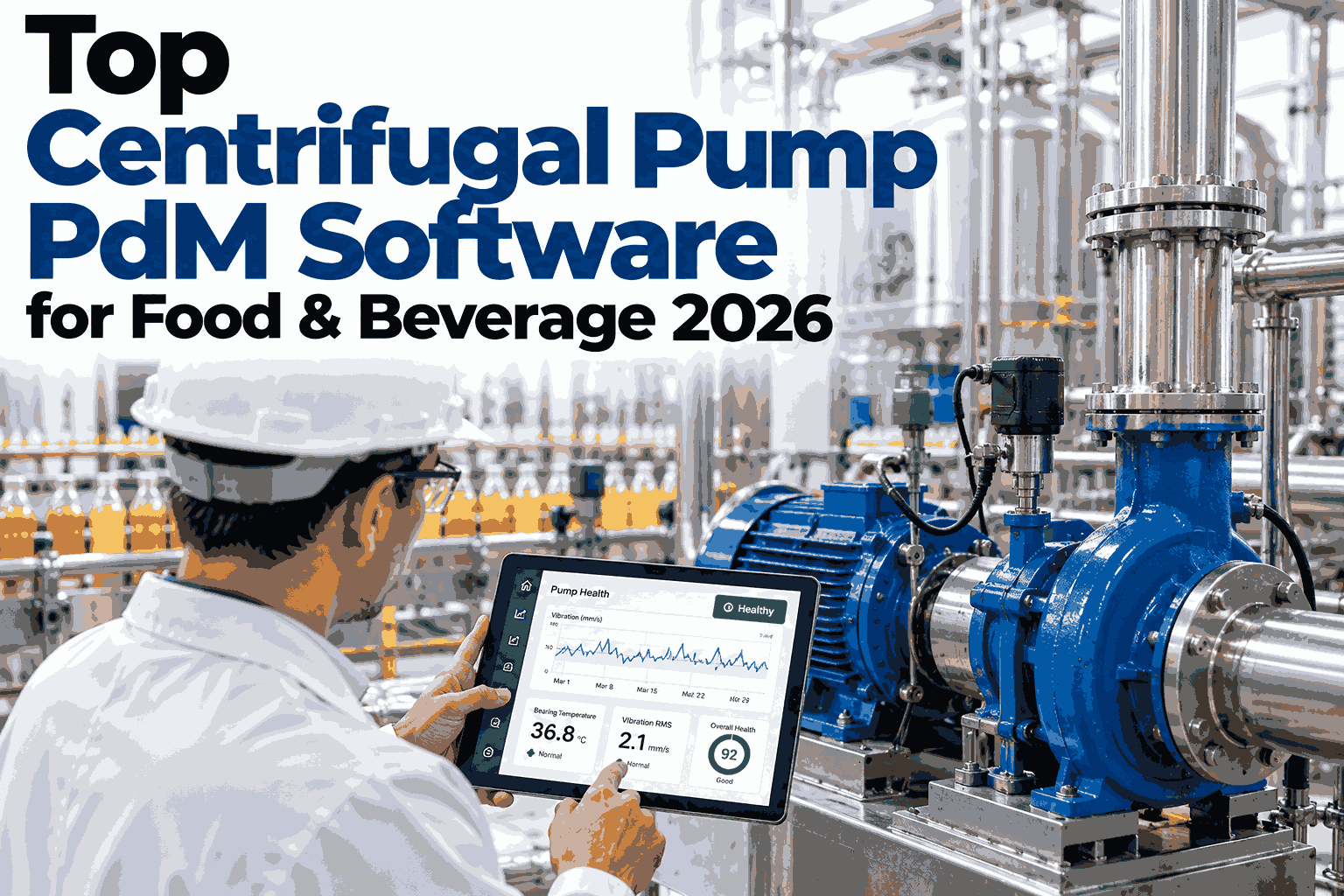
Top Centrifugal Pump PdM Software for Food and Beverage in 2026
Catch cavitation, seal wear, and impeller erosion weeks before catastrophic failure, with AI that understands sanitary pump duty.
WHY PUMPS HURT MOST
The Pump Is the Heart of Every Liquid Line
When one transfer pump stops, everything upstream and downstream waits.
Product at risk
A pump failing mid batch can spoil product that is already in process.
Sanitation cost
A seal failure means teardown, cleaning, and revalidation before restart.
Hidden spares
Sanitary pumps and seals are often not on the shelf when they are needed.
THE WARNING WINDOW
Six Weeks of Signals Before a Pump Gives Up
Illustrative degradation path. Bars show how strongly the fault shows in the data as failure approaches.
Software acts in the early bars. Operators usually notice only in the last two.
FAILURE SIGNATURES
What Each Pump Fault Looks Like in the Data
Cavitation
Broadband vibration noise and unstable discharge pressure.
Usual cause: low suction pressure or a blocked line
Seal wear
Rising temperature at the seal and small leak trends.
Usual cause: dry running or hard cleaning cycles
Impeller erosion
Falling flow at the same motor current, then vane pass changes.
Usual cause: abrasive or particulate product
Bearing wear
Growing high frequency vibration and heat at the housing.
Usual cause: misalignment or lubricant breakdown
DATA LAYERS
The Four Layers a Good Platform Combines
Vibration signature
Motor current and power draw
Pressure and flow trend
Temperature at seal and bearing
One layer alone raises false alarms. Together they confirm which fault is developing.
TWO KINDS OF TUESDAY
Reactive Pump Care vs Predictive Pump Care
Reactive
Pump trips during a batch
Line stops and product is at risk
Seal kit is ordered in a hurry
Repair happens under pressure
Predictive
Seal trend flagged weeks earlier
Part ordered at normal lead time
Swap done in a planned clean down
Batch never notices
BUYER CHECKLIST
Six Questions to Ask Every Vendor
1
Does it separate cavitation from seal and bearing faults?
2
Can it use motor current where sensors are not fitted?
3
Does it learn each pump's own baseline by product and duty?
4
Does it ignore cleaning cycles instead of alarming on them?
5
Does an alert say which part to order and by when?
6
Does it write work orders straight into your maintenance system?
VALUE LEVERS
Where the Return Actually Comes From
| Lever | What Changes | Who Feels It |
|---|
| Fewer emergency stops | Failures move into planned windows | Production |
| Lower spares cost | Parts bought at normal lead time | Stores |
| Less product loss | Batches finish before pumps fail | Quality |
| Longer seal life | Dry running and cavitation caught early | Maintenance |
FREQUENTLY ASKED QUESTIONS
What Food Plant Teams Ask About Pump PdM
How early can the software warn about a failing pump?
For gradual faults such as seal wear, cavitation, and impeller erosion, the warning window is typically several weeks. Sudden events like a foreign object strike give far less notice. The platform reports how confident each warning is, so planners know when to act.
Reserve a live detection walkthrough.
Does it work on sanitary pumps with no room for sensors?
Yes. Where mounting space is limited, motor current and process data such as flow and pressure carry much of the signal. External vibration sensors are added on the housing only where they improve certainty. This keeps the sanitary design intact and the installation simple.
Plan a sensor layout with our team.
Will cleaning cycles trigger false alarms?
No, because the platform learns the normal pattern of cleaning in place and wash-down runs for each pump. Those known events are treated as expected behavior instead of faults. Alerts appear only when readings depart from that learned pattern.
Ask support how cleaning cycles are handled.
Which pumps should we monitor first?
Start with pumps that stop a line when they fail, such as product transfer, homogenizer feed, and filler supply pumps. Add pumps with a history of seal or bearing trouble next. A short criticality ranking usually settles the first group in one session.
Rank your pumps in a demo session.
How do we measure the return on pump monitoring?
Compare unplanned pump stops, emergency spares spend, and product loss before and after rollout. Most plants can pull these figures from maintenance history in advance, which gives a clear baseline. The platform then tracks avoided failures month by month.
Build a pump ROI baseline with us.
PLANNED REPAIRS, NOT PANIC REPAIRS
Hear Your Pumps Before They Fail
See how iFactory reads vibration, current, pressure, and seal temperature to give your team weeks of notice on every critical pump.