Most Total Productive Maintenance rollouts are written for discrete manufacturing and then handed to food plants with almost no changes, which is why so many stall out after the first six months. A food plant runs on wash-down schedules, allergen changeovers, cold chain limits, and USDA or FDA oversight that a generic TPM template never accounts for. The eight pillars of TPM are still the right foundation, but each one has to be rebuilt around sanitation windows, shift-based crewing, and the paperwork that regulators expect to see. Plants that skip this localization step end up with autonomous maintenance checklists that ignore CIP cycles and planned maintenance calendars that collide with production freeze periods. Before rolling out pillar by pillar, it helps to see how a properly localized program compares to a generic one, which is exactly what teams building this out with iFactory can walk through in a working session.
TPM Only Works When It Fits the Plant Floor It Runs On.
This playbook rebuilds each of the eight TPM pillars for food manufacturing — sanitation windows, allergen changeovers, cold chain limits, and the audit trail regulators expect.
Food Plants Break Standard TPM Assumptions in Four Specific Ways
Standard TPM literature assumes continuous access to equipment, a stable crew on each machine, and no regulatory inspection layer sitting on top of the maintenance program. None of those assumptions hold on a food production floor. Equipment access is gated by sanitation schedules that can consume two to four hours of every shift change. Crews rotate through lines on a rotation board rather than owning a single machine for years, which changes how autonomous maintenance skill-building has to be structured. And every maintenance action on food-contact equipment has to be documented in a way that survives a USDA, FDA, or third-party GFSI audit without extra reconstruction work. A rollout plan that does not build these four realities into the pillar structure from day one will keep hitting the same friction points every quarter, no matter how much training the maintenance team receives.
Sanitation Windows Eat Access Time
CIP and COP cycles claim the same hours maintenance teams need for inspection and lubrication, so pillar activities have to be scheduled around the sanitation clock, not against it.
Allergen Changeovers Add Hidden Risk
Any maintenance task that touches product contact surfaces during an allergen changeover introduces cross-contact risk that generic TPM checklists were never designed to flag.
Crews Rotate, Not Own
Autonomous maintenance depends on operator ownership, but rotating crews mean the skill-building has to be role-based rather than machine-based to actually stick.
Every Action Needs an Audit Trail
Paper checklists and whiteboards cannot reconstruct a defensible maintenance history when an auditor asks for six months of records on a single piece of equipment.
Rebuilding Each TPM Pillar Around Food Plant Realities
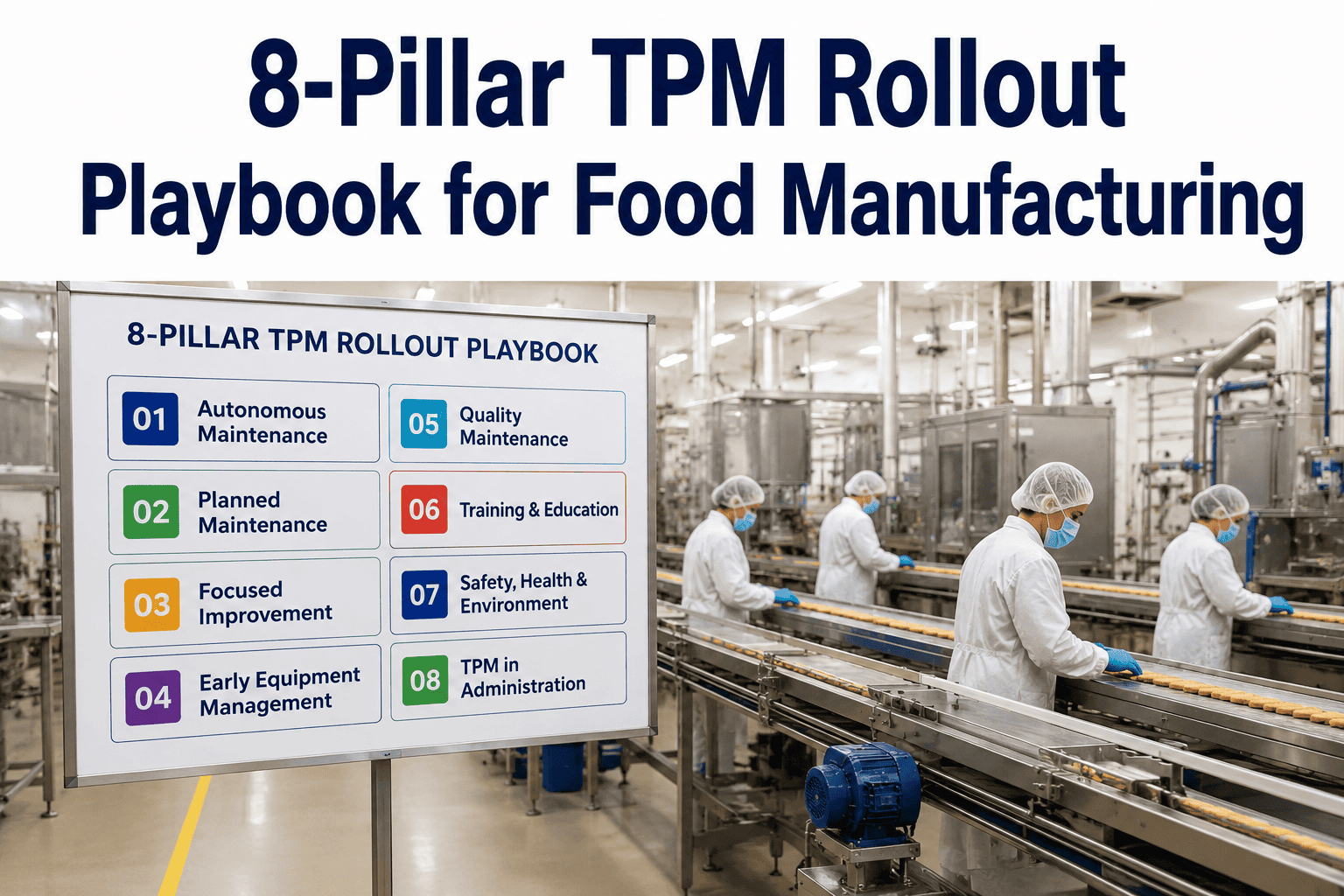
The eight pillars have not changed since TPM was formalized decades ago, but what sits inside each pillar has to be rewritten for a hygienic, regulated, shift-driven environment. The sequence below keeps the original pillar names so the framework stays recognizable to anyone trained on standard TPM, while the content underneath each one reflects what actually has to happen on a food production line.
Autonomous Maintenance
Operator-level checks are rebuilt around what can realistically be inspected between CIP cycles: belt tension, guard integrity, lubrication points that do not require tool access, and visual checks on food-contact surfaces for wear that could harbor bacteria. Because crews rotate across lines, the checklist is tied to the role on shift rather than a fixed operator, with sign-off captured digitally so the record survives a shift change.
Planned Maintenance
PM calendars are built against the production and sanitation schedule rather than a fixed weekly cadence, so a bearing replacement on a mixer never lands during the two-hour window reserved for allergen changeover cleaning. Work orders reference the specific sanitation phase they can safely run in, which keeps maintenance techs from opening equipment that has already been through a CIP verification.
Quality Maintenance
This pillar ties equipment condition directly to product quality defects — a worn seal that causes a fill weight drift, a misaligned guide that scores packaging film, or a bearing that introduces metal fragments detectable at the X-ray inspection stage. Quality maintenance in a food plant means the maintenance team and the QA team share the same defect data instead of working from separate systems that never get compared.
Focused Improvement
Kaizen events target the specific losses that dominate food production: changeover time between SKUs, micro-stops on filling and packaging lines, and sanitation cycle time itself. Because sanitation is a fixed cost of doing business in this industry, focused improvement teams increasingly treat CIP duration as a loss category worth attacking with the same rigor traditionally reserved for changeover time.
Early Equipment Management
New equipment specifications now include cleanability requirements — hygienic design standards, tool-less disassembly for cleaning, and materials that tolerate the specific sanitizer chemistry used on the line — as a formal input alongside reliability and throughput specifications. Equipment that is hard to clean generates recurring sanitation labor cost for its entire service life, so this criterion carries real weight in the purchase decision.
Training and Education
Skill matrices track both maintenance competency and food safety competency together, since a technician working on product-contact equipment needs GMP and allergen awareness training in addition to mechanical skill. Cross-training is structured around the rotation board rather than a single line, so any qualified technician can pick up autonomous maintenance duties on whichever line they are assigned that shift.
Safety, Health, and Environment
Beyond standard lockout-tagout and machine guarding, this pillar covers chemical handling for sanitizers and cleaning agents, wet-floor and cold-room safety protocols, and environmental controls tied to wastewater discharge from CIP systems. Incident tracking in food plants also has to distinguish between safety incidents and food safety near-misses, which follow different investigation and reporting paths.
TPM in Administration
Administrative TPM in a food plant centers on the documentation burden that keeps the plant audit-ready year round: work order records, calibration logs, sanitation verification records, and the traceability data that ties a maintenance event to the production lots it may have affected. Digitizing this pillar removes the scramble that happens every time an audit is scheduled with short notice.
Generic TPM Program vs. Food-Localized TPM Program
The table below lines up the same TPM activity as it is typically defined in generic manufacturing guidance against how it needs to run inside a food or beverage plant. Scroll the table horizontally on smaller screens to see every column.
| TPM Activity | Generic Manufacturing Approach | Food-Localized Approach |
|---|---|---|
| Autonomous Maintenance Checklist | Fixed operator, fixed machine, weekly cadence | Role-based checklist tied to rotation board, scheduled around CIP windows |
| PM Scheduling | Calendar-based, independent of production | Sequenced against sanitation phase and allergen changeover calendar |
| Quality Data Ownership | Maintenance and QA track defects separately | Shared defect data linking equipment condition to product quality events |
| Loss Categories for Kaizen | Changeover time and micro-stops | Changeover time, micro-stops, and CIP cycle duration as a tracked loss |
| New Equipment Criteria | Throughput, reliability, footprint | Throughput, reliability, footprint, plus hygienic design and cleanability |
| Documentation Standard | Internal recordkeeping | Audit-ready records for USDA, FDA, and GFSI inspection |
Rolling Out an Eight-Pillar Program Is Easier With the Right System Underneath It.
iFactory ties autonomous maintenance checklists, PM scheduling, and audit documentation into one workflow built for regulated production floors.
A Five-Phase Sequence for Bringing the Eight Pillars Online
Rolling out all eight pillars at once overwhelms both the maintenance team and the crews being asked to take on new autonomous maintenance duties. A phased sequence lets each pillar build on data and habits established in the phase before it, which is the pattern that tends to hold up past the first year rather than fading out after the initial launch enthusiasm wears off.
Baseline and Pilot Line Selection
Select one line, capture current OEE, unplanned downtime, and sanitation cycle time as a baseline, and begin building the autonomous maintenance checklist around that line's actual schedule.
Autonomous and Planned Maintenance Launch
Roll out the role-based autonomous maintenance checklist and rebuild the PM calendar around the sanitation and changeover schedule for the pilot line's crew rotation.
Quality Maintenance Integration
Connect the maintenance data feed to the QA defect log so equipment condition and quality events are visible in the same record instead of two disconnected systems.
Kaizen and Early Equipment Management
Stand up the first focused improvement team targeting changeover or CIP cycle time, and formalize the hygienic design checklist for the next piece of capital equipment on order.
Plant-Wide Expansion
Extend the full pillar structure to every line using the pilot line's checklist templates, training matrix, and documentation workflow as the starting template rather than rebuilding from scratch.
The KPIs That Show a Food-Localized TPM Program Is Working
Standard TPM tracks Overall Equipment Effectiveness as its headline metric, and that number still matters in a food plant. But because sanitation time is a fixed and unavoidable cost of running a hygienic facility, food manufacturers need a second layer of metrics that separate sanitation-driven downtime from true equipment failure, so the improvement team is not chasing a number that can never reach the benchmarks published for discrete manufacturing. Plants that publish a single blended OEE figure without this separation often demoralize maintenance teams who are, in reality, performing well against equipment reliability but appear to be underperforming against a discrete-manufacturing benchmark that was never designed for a facility running several CIP cycles a day. Splitting the metric set restores an apples-to-apples comparison and gives leadership a clearer read on where the next improvement dollar should go.
Overall Equipment Effectiveness
Tracked with sanitation downtime separated out, so the availability component reflects true equipment reliability rather than the fixed CIP schedule.
Mean Time to Repair
Measured from breakdown to line restart including any sanitation re-verification the repair triggered, since that step is often the longest part of the recovery.
Planned Maintenance Compliance
The percentage of scheduled PM tasks completed within their sanitation-aligned window, which is a more honest measure than raw completion rate against a fixed calendar.
Sanitation Cycle Time
Tracked as its own loss category once focused improvement teams start treating CIP duration as a target for reduction rather than a fixed constant.
Where Food Plant TPM Rollouts Typically Stall
The same handful of mistakes account for most stalled TPM programs in food and beverage plants, and nearly all of them trace back to treating the program as a maintenance department initiative rather than a cross-functional one that has to include QA, sanitation, and production scheduling from the start. Recognizing these patterns early, before the program has been running long enough to lose credibility on the floor, is usually the difference between a rollout that recovers with a course correction and one that gets quietly shelved at the next budget review.
Checklists Built Without Sanitation Input
Autonomous maintenance tasks scheduled without checking the CIP calendar get skipped constantly, and skipped tasks quietly erode trust in the whole program within a few weeks.
Training Tied to a Single Line
Skill matrices built around fixed operator-to-machine assignments break down the first time a rotation board moves someone to an unfamiliar line during a staffing gap.
Paper Records That Cannot Survive an Audit
Whiteboards and paper logs get lost, damaged by wash-down water, or simply never filled in consistently, leaving gaps that surface at the worst possible moment during an inspection.
Quality and Maintenance Data Kept Separate
Without a shared data link, the same recurring defect can be investigated by QA and maintenance independently for months before anyone notices the equipment condition is the root cause.
What a Localized TPM Program Actually Returns to a Food Plant
Plant leadership teams evaluating whether to invest in a full eight-pillar rollout usually want a business case that goes beyond the standard OEE improvement story, because a food plant carries costs that a discrete manufacturing facility never has to budget for. Recall risk, allergen cross-contact exposure, and audit preparation labor all sit on top of the traditional maintenance cost structure, and a well-run TPM program touches every one of them. Autonomous maintenance catches the small mechanical issues — a loose fastener near a product stream, a worn gasket on a hygienic fitting — before they become the kind of foreign material or contamination event that triggers a hold or a recall. Quality maintenance closes the loop between equipment condition and product defects fast enough that a drifting fill weight or an intermittent seal failure gets fixed in days rather than showing up as a customer complaint trend months later. Planned maintenance sequenced against the sanitation calendar reduces the number of emergency repairs that force an unplanned CIP re-verification, which is often a far larger time cost than the repair itself once the re-clean and paperwork are factored in. And administrative TPM turns audit preparation from a multi-week scramble into a routine data pull, freeing quality and maintenance leadership to spend that time on improvement work instead of record reconstruction. None of these gains show up cleanly in a single OEE number, which is exactly why the KPI set for a food-localized program has to include sanitation-adjusted metrics, defect-linked maintenance data, and audit readiness time as tracked outcomes in their own right, not just OEE alone.
TPM in Food Manufacturing — Common Questions
How long does a full eight-pillar TPM rollout typically take in a food plant?
Most food manufacturers spend twelve to eighteen months moving from a single pilot line to a plant-wide program, though the timeline depends heavily on how many lines and SKUs are involved and how much cross-functional buy-in exists between maintenance, QA, and production scheduling at the outset. Plants that try to compress this timeline by launching all eight pillars simultaneously across every line tend to see early enthusiasm fade quickly because neither the crews nor the documentation systems can keep pace with the volume of new tasks. A phased rollout that proves out the model on one line before expanding tends to move faster in total elapsed time because the templates, training materials, and checklist logic only have to be built once and then reused. Teams planning a rollout timeline can book a working session with iFactory to map a phase sequence against their specific line count and shift structure.
Does autonomous maintenance conflict with food safety rules about who can touch equipment?
No, but the checklist has to be written with food safety boundaries in mind rather than borrowed directly from a discrete manufacturing template. Operator-level autonomous maintenance tasks in a food plant are typically limited to visual inspection, external cleaning, lubrication at points that do not require opening product-contact zones, and basic adjustments that do not require breaking a sanitary seal. Any task that touches food-contact surfaces or requires disassembly of hygienic equipment components stays with trained maintenance technicians who have completed the appropriate GMP and allergen awareness training. The distinction between what operators can do and what requires a qualified technician needs to be explicit in the checklist itself, not left to individual judgment on the floor.
How do you track sanitation time separately from equipment downtime in OEE calculations?
Sanitation time is coded as a separate, planned category in the availability calculation rather than being lumped into either planned production time or unplanned downtime. This means the OEE denominator excludes scheduled CIP and COP windows entirely, so the availability score reflects how well the line performs during the time it is actually available for production. Unplanned sanitation events, such as an emergency clean triggered by a contamination concern, get tracked as a distinct downtime reason code so they do not get confused with routine breakdowns. This separation is what allows a food plant's OEE to be benchmarked meaningfully against other food facilities rather than against discrete manufacturing standards that were never built around a hygienic production environment.
What role does the QA team play in a TPM rollout beyond quality maintenance?
QA involvement typically starts with the quality maintenance pillar, where equipment condition data gets linked to defect and non-conformance records, but the collaboration usually extends further once the program matures. QA input on hygienic design criteria strengthens the early equipment management pillar when new capital equipment is being specified, and QA representation in focused improvement events ensures that changeover time reduction efforts do not inadvertently compromise allergen control or cleaning validation. Plants that keep QA at arm's length from the TPM program past the initial quality maintenance pillar tend to see friction later when maintenance-driven process changes run into food safety requirements that were never surfaced during planning.
Can a smaller food plant realistically run all eight pillars, or should some be combined?
Smaller plants with limited maintenance headcount often combine pillars in practice even while keeping all eight represented on paper — for example, the same continuous improvement team that runs focused improvement kaizen events also owns the training and education pillar, since both require similar planning and facilitation skills. What matters more than having eight separate teams is that each pillar's core objective is being actively pursued somewhere in the organization, even if the org chart consolidates responsibility. The iFactory Support team frequently helps smaller plants structure a lean version of the eight-pillar model that fits a leaner maintenance organization without dropping any of the underlying discipline.
Build a TPM Program That Actually Fits Your Sanitation Schedule.
Talk to iFactory about structuring autonomous maintenance, planned maintenance, and audit-ready documentation around the way your plant actually runs.