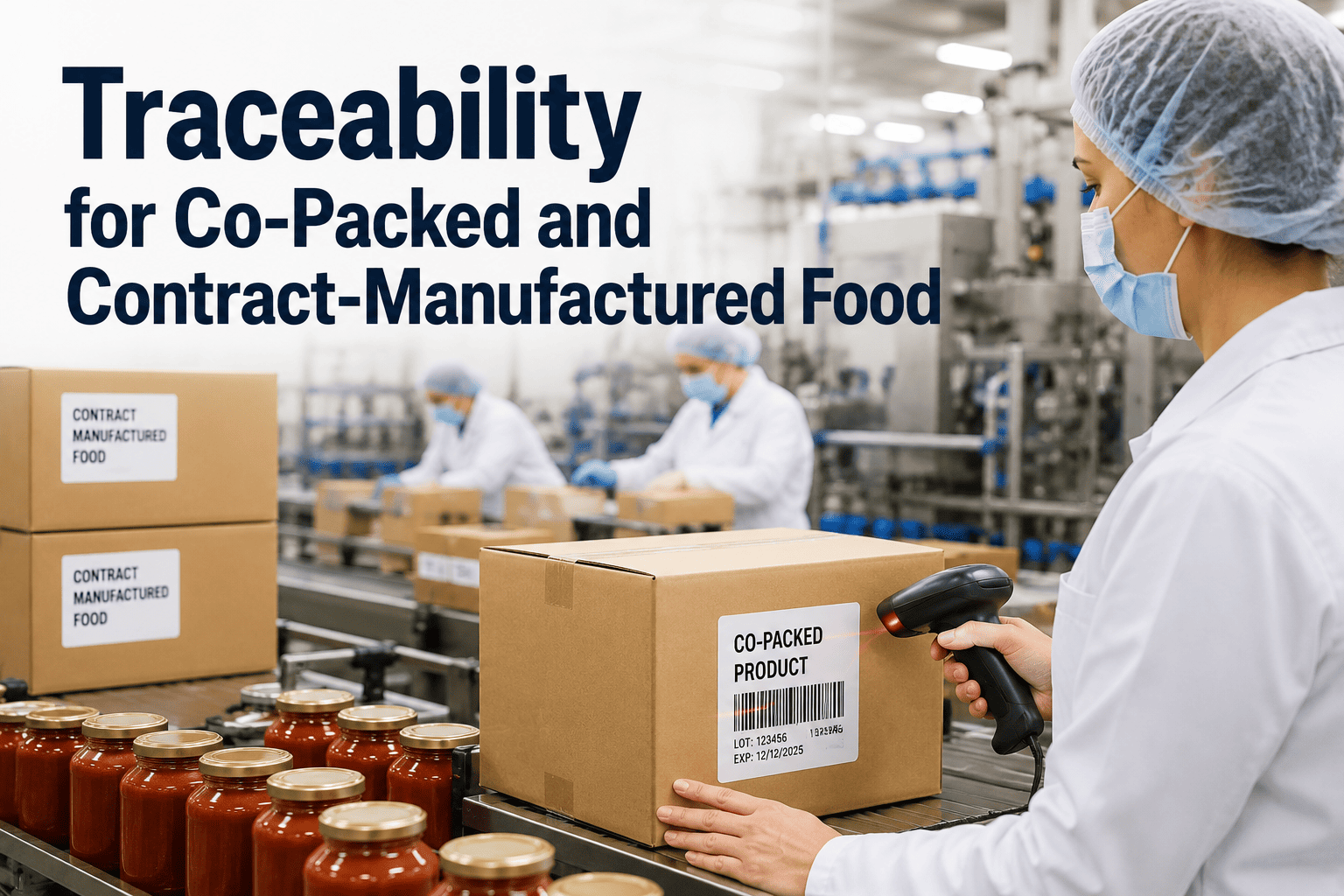
Co-packing and contract manufacturing let food brands scale production without owning a plant, but they also split the traceability chain across two organizations that may not share the same systems, standards, or urgency around data capture. When a recall hits, the brand owner's name is on the package — not the co-packer's — and regulators, retailers, and consumers all look to the brand for the traceability records that prove exactly which lots, ingredients, and lines were involved. If those records live in the co-manufacturer's system in a format the brand cannot access or parse, the brand has no way to respond within the recall timelines that FSMA 204 and retailer requirements now demand. Traceability teams at brand owners and co-packers alike can Book a Demo to see how AI-driven capture closes the data exchange gap at co-pack lines.
Why Co-Packing Splits the Traceability Chain
When a food brand partners with a co-packer or contract manufacturer, it gains production capacity but loses direct control over the data capture that underpins its traceability chain. The brand owner specifies the product, the ingredients, the labeling, and the quality standards — but the co-packer runs the line, receives the materials, and generates the production records. The traceability chain that connects an incoming ingredient lot to a finished case on a retailer's shelf now crosses an organizational boundary, and that boundary is where data breaks happen most often. The result is a shared-risk environment where the brand owner carries the downstream liability but the co-packer controls the upstream data.
Brand Owner's Exposure
The brand name appears on every package, and in a recall scenario, regulators notify the brand owner first. If the brand cannot produce traceability records that link a finished lot back to specific ingredient suppliers, production dates, and line assignments, the recall scope widens to everything the co-packer produced during a window — because the brand cannot prove otherwise. This dramatically increases recall costs, destroys consumer confidence, and can trigger regulatory penalties that fall entirely on the brand, not the manufacturer who actually made the product.
Co-Packer's Data Burden
Co-packers often serve multiple brand owners on the same lines, sometimes with similar products and shared ingredients. Their traceability systems are built around their own operational needs — tracking what ran, when, and in what quantity — not around the specific KDE formats, lot-code structures, or export requirements that each individual brand owner may demand. This misalignment means the data exists but is not in the shape the brand needs it to be, creating a gap that only surfaces when a recall or audit forces both sides to reconcile their records under time pressure.
Retailer Mandates
Major retailers now require SSCRP data in specific formats within 24 hours of a recall notification. If the co-packer's system cannot produce that data in the required format, the brand owner fails the retailer's requirement — and risks being delisted from shelves that may represent a significant portion of total revenue. The brand cannot blame the co-packer to the retailer; the retailer's relationship is with the brand, and the brand is expected to have solved the data problem before the recall notification arrives.
Regulatory Pressure
FSMA 204's Section 204(d) requires that food facilities maintain sortable electronic traceability records for items on the Food Traceability List. Co-manufactured products are not exempt — if the brand's product contains an FTL item like fresh-cut produce, finfish, or certain cheeses, the traceability records must exist regardless of who operated the line that produced it. The FDA does not accept "our co-packer handles that" as a compliance response, and the brand owner remains the accountable party in any enforcement action.
What Needs to Flow Between Brand Owner and Co-Manufacturer
Traceability across a co-pack relationship is not a single data point — it is a continuous chain of information that starts when raw materials arrive at the co-packer's dock and ends when finished cases are scanned onto a truck heading to a distribution center. Each layer in this chain must connect cleanly to the layer above and below it, or the entire traceability record becomes unreliable. The four layers below represent the critical data handoff points where traceability breaks most often in co-pack and contract manufacturing relationships.
Ingredient Provenance
The co-packer receives ingredients from suppliers — sometimes sourced by the brand, sometimes sourced by the co-packer, often a mix of both. For each incoming lot, the traceability chain needs to capture the supplier name, supplier lot code, date of receipt, quantity received, and the internal lot or batch number the co-packer assigns upon receiving. Without this foundational layer, there is no way to trace a finished product back to its ingredient origins, which is the entire purpose of a recall trace. AI vision at receiving docks can read supplier lot codes from labels, tags, and cases as they arrive, logging them directly without manual entry.
In-Process Capture
As ingredients are staged, weighed, mixed, cooked, filled, and packaged, each step generates traceability data — formulation codes, batch sizes, line assignments, shift records, and timestamps. At co-pack facilities running multiple brands and SKUs, the risk of a data mix-up between products is highest during changeovers. AI vision systems capture KDEs like lot codes, dates, and weights directly from labels, screens, and printed marks on the line, ensuring that the in-process record is complete and accurate regardless of line speed or operator workload.
Finished Lot Records
When a finished lot comes off the line, the traceability record must tie the finished lot number or batch code to every ingredient lot that went into it, the production line and shift, the pack date, and any quality holds or rework events that occurred during the run. This is the record that regulators and retailers will request first during a recall, and it must exist in a format the brand owner can access, interpret, and submit without relying on the co-packer's availability to manually pull and format the data.
Shipping and Distribution
The final layer connects finished lot records to the cases, pallets, and shipments that leave the co-pack facility. Ship-to locations, carrier information, case-level lot codes, and pallet identifiers allow the brand owner to identify exactly which retailers or distribution centers received the affected product — narrowing a recall from a blanket pull across every customer to a targeted action that minimizes waste, cost, and public exposure. Without this layer, even a perfect upstream traceability record cannot translate into an effective recall response.
Which KDEs Matter Most at a Co-Pack Operation
Not every data point in a co-pack facility carries equal traceability weight. The KDEs below are the ones that regulators, retailers, and brand owners depend on to trace a product from finished case back to ingredient source. Missing or inaccurate capture at any of these points creates a gap that widens with every step downstream, and in a recall, the brand owner is the one who pays for that gap.
Supplier Lot Codes
Every ingredient arriving at the co-pack facility carries a supplier lot code — the primary link between the finished product and the ingredient's origin. AI vision reads lot codes from incoming labels, tags, and cases as they are received, logging them directly into the traceability record without manual transcription that introduces errors compounding downstream.
Incoming Weight and Date
The quantity of each ingredient lot received and the date of receipt are KDEs that regulators expect to see in traceability records. Weight capture at receiving docks is often automated through scales, but the date and lot association still require accurate logging — a step where manual processes introduce discrepancies that grow larger as the ingredient moves through production.
Formulation and BOM Link
The bill of materials or formulation code connects ingredient lots to the specific product being produced. At co-pack facilities where multiple brands and SKUs run on shared lines, ensuring the correct formulation is linked to the correct ingredient lots is critical to maintaining traceability integrity across product changeovers and preventing cross-contamination of records.
Production Line and Shift
Which line produced the lot and during which shift determines the investigation scope when a quality issue surfaces. Line-level and shift-level traceability allows a targeted response — isolating affected lots to a specific production window — rather than a plant-wide hold that stops all output and damages the co-packer's ability to serve other brand partners.
Finished Lot or Batch Code
The code assigned to the finished product — whether printed on the case, applied as a label, or etched into a container — is the identifier retailers, distributors, and consumers reference. Verifying this code is correct, legible, and consistently applied to every unit in the lot is where AI vision adds the most immediate value at co-pack lines running high volumes across multiple brands.
Pack Date and Best-By Date
Dates printed on or applied to finished packages are both regulatory requirements and consumer-facing trust signals. A misprinted date — even by a single day — can trigger a quality hold, a label revision, or a recall if it affects food safety claims or shelf-life accuracy. AI vision verifies date printing at the point of application on every unit.
What Brand Owners Should Verify at Every Co-Pack Partner
A co-packing agreement typically specifies production volumes, quality standards, and delivery schedules — but traceability requirements are often addressed in vague language that leaves the brand owner exposed. The checklist below represents the specific verification points that brand owners should confirm before signing a co-pack agreement and audit periodically throughout the relationship. Each item addresses a point where traceability data can break, and each break carries downstream cost that the brand owner will bear.
Incoming Material Traceability
Verify that the co-packer captures supplier lot codes, receipt dates, and quantities for every ingredient lot received — and that those records are stored in a format the brand can access on demand. Request sample traceability reports for recent production runs and manually trace an ingredient lot from receiving through to finished product to confirm the chain is unbroken and the data is accurate.
In-Process KDE Capture
Confirm that KDEs are captured at each critical tracking event during production — not just at receiving and shipping, but at formulation, mixing, filling, packaging, and labeling. Ask specifically how those KDEs are captured: manual entry, barcode scan, or automated vision — and request the documented error rate for each method. Manual entry rates above 1 in 500 should be a red flag.
Lot Code Consistency
Check that the lot code printed on the finished package matches the lot code recorded in the production log and the lot code on the shipping manifest. Lot code mismatches between internal records and external labels are one of the most common and most damaging traceability failures at co-pack operations because they make it impossible to reliably identify affected product in the field.
Data Export Format and Access
Ensure the co-packer can export traceability data in the format your systems require — whether that is CSV, JSON, XML, or a direct API integration. Data that exists in the co-packer's system but cannot be accessed, exported, or parsed by the brand owner's systems is effectively useless during a recall, when response time is measured in hours, not days or weeks.
Recall Simulation Capability
The ultimate test of co-pack traceability is a simulated recall. Ask the co-packer to trace a finished lot back to its ingredient suppliers within the timeline that FSMA 204 or your retailers require — typically 24 hours or less. If they cannot complete the trace in a drill, they will not be able to complete it under the pressure and scrutiny of a real recall event with regulators and media watching.
Traceability Differences Between Co-Packed and In-House Production
The traceability challenges at a co-pack facility are fundamentally different from those at a brand-owned plant, even when the products and processes are identical. The table below highlights the key differences that brand owners must account for when designing their traceability programs for co-manufactured products.
| Factor | In-House Production | Co-Pack Production |
|---|---|---|
| Data Ownership | Brand controls all systems and records | Co-packer generates records; brand depends on access |
| KDE Format | Aligned with brand's internal standards | May follow co-packer's format, requiring conversion |
| Ingredient Sourcing | Brand procures directly from approved suppliers | May be co-packer's suppliers, brand's suppliers, or mixed |
| Multi-Brand Risk | Single brand on line, no cross-contamination of records | Multiple brands on shared lines, higher mix-up risk |
| Recall Response | Direct access to all records, fast traceback | Dependent on co-packer's response time and data availability |
| Audit Rights | Full internal audit capability at all times | Limited to contractual audit windows and agreed scope |
| System Integration | Native integration with brand MES and ERP | Requires custom integration or manual data exchange |
How a Co-Pack Recall Unfolds With and Without Verified Traceability
The moment a recall is triggered — by an internal quality finding, a customer complaint, a regulator's notification, or a positive pathogen test — the clock starts on the brand owner's response. The difference between having verified traceability data and not having it determines whether that response is measured in hours or weeks, and whether the recall is surgical or sprawling.
Without Verified Traceability
Day 1–2: Scramble for Records
Brand contacts co-packer to request production and shipping records. Co-packer's team must manually pull data from multiple systems, format it, and send it — a process that can take 24 to 48 hours even with cooperative partners.
Day 3–5: Reconcile and Decode
Brand receives the data but finds it in a different format than expected. Lot codes do not match internal references, ingredient suppliers are listed by co-packer's internal IDs, and shipping records lack case-level detail. Reconciliation takes additional days.
Day 5–7: Broad Recall Issued
Unable to precisely identify affected lots, the brand issues a broad recall covering all production during a multi-day window. Retailers pull far more product than necessary, media coverage amplifies the scope, and consumer confidence drops sharply.
With Verified Traceability
Hour 1–2: Pull Complete Chain
Brand accesses the co-pack traceability record directly — KDEs captured by AI vision at every critical tracking event, formatted to match the brand's system requirements. The full chain from ingredient supplier to finished lot to ship-to location is available immediately.
Hour 2–4: Identify Affected Lots
Using the verified traceability data, the brand precisely identifies which finished lots contain the affected ingredient, which lines produced them, and which shipments delivered them to specific retailers or distribution centers.
Hour 4–8: Targeted Recall Issued
A targeted recall is issued covering only the confirmed affected lots and destinations. Retailers pull exactly what is necessary, the media narrative focuses on the brand's swift and precise response, and consumer impact is minimized.
What FSMA 204 Changes for Co-Packed Food Products
FSMA 204's Food Traceability Rule is not optional for co-manufactured products, and it is not something the brand owner can delegate entirely to the co-packer. The rule requires that every entity in the traceability chain maintain sortable electronic records for items on the Food Traceability List, and it specifies the exact KDEs that must be captured at each Critical Tracking Event. For co-packed products, this means both the brand owner and the co-packer have obligations — and both must be able to demonstrate compliance independently.
FSMA 204 requires that the entire traceability chain for an FTL item be reconstructable within 24 hours of a request from the FDA. For co-packed products, this means the co-packer's data must be accessible to the brand in under a day — which is impossible without pre-established data exchange and export capabilities.
The rule defines 10 CTEs where KDEs must be captured — including receiving, transforming, creating, and shipping. At a co-pack facility, transformation and creation events are the co-packer's responsibility, and the brand must ensure those records meet FSMA 204's format and completeness standards.
The rule specifies up to 16 KDEs that must be captured depending on the CTE. Missing even one required KDE at a single CTE breaks the sortable record requirement and puts the brand owner out of compliance — even if the missing data point is controlled entirely by the co-packer.
The FSMA 204 compliance date is January 20, 2026. Co-pack relationships that have not established KDE capture, data exchange protocols, and verification processes by this date will put brand owners in a position where they cannot demonstrate compliance for products they did not physically manufacture.
Co-Pack Traceability — Common Questions
Who is legally responsible for traceability records on co-packed products?
Under FSMA 204, every entity in the traceability chain that performs a Critical Tracking Event is responsible for maintaining the required KDE records for that event. The brand owner is responsible for the CTEs they perform — such as receiving finished goods from the co-packer or shipping to retailers — while the co-packer is responsible for CTEs at their facility, including receiving ingredients, transforming them, and creating finished lots. However, regulators will look to the brand owner first in a recall or compliance investigation, so the brand must have contractual rights and technical access to the co-packer's records. Teams can discuss their specific liability structure with the iFactory Support team to understand how AI-driven capture at co-pack lines supports compliance documentation.
Can AI vision capture KDEs at a co-pack line without changing the existing process?
Yes, AI vision cameras are installed alongside existing marking, labeling, and printing equipment at co-pack stations, reading lot codes, dates, and other KDEs directly from labels, printed marks, and screens as part of the normal production flow. The system does not require changes to the co-packer's line layout, MES, or labeling process — it adds a parallel capture layer that logs verified data in the format the brand owner needs, while the co-packer continues operating their existing systems unchanged. This makes deployment practical even at co-pack facilities that serve multiple brands with different requirements.
How does AI vision handle multiple brands running on the same co-pack line?
The vision system is configured with separate recognition and validation profiles for each brand and SKU that runs on the line, switching automatically based on the production schedule or a signal from the co-packer's MES. Each profile defines the expected label layout, lot code format, date format, and KDE requirements for that specific product, so the system verifies the correct data against the correct standard at every unit — even during rapid changeovers between brands with different label designs and lot code structures.
What happens if the co-packer's existing traceability system does not integrate with the brand's systems?
iFactory's AI vision system captures and stores KDEs independently of the co-packer's existing traceability infrastructure, then exports the data in the format the brand owner requires — whether that is CSV, JSON, XML, or a direct API push to the brand's MES or ERP. This means the brand gets the traceability data they need without requiring the co-packer to modify or replace their existing systems, which is often the biggest barrier to data exchange in co-pack relationships. Teams can Book a Demo to see how the export and integration process works for their specific systems.
How quickly can KDE capture be deployed at a co-pack facility?
A single-station KDE capture deployment — covering lot code reading, date verification, and label content validation — can be operational at a co-pack line within two to three weeks, including camera installation, lighting setup, profile configuration for each brand or SKU, and integration with the brand owner's data export requirements. Multi-station deployments across receiving, production, and shipping typically complete within six to eight weeks, with each station coming online sequentially so the co-packer can continue production without interruption throughout the rollout.