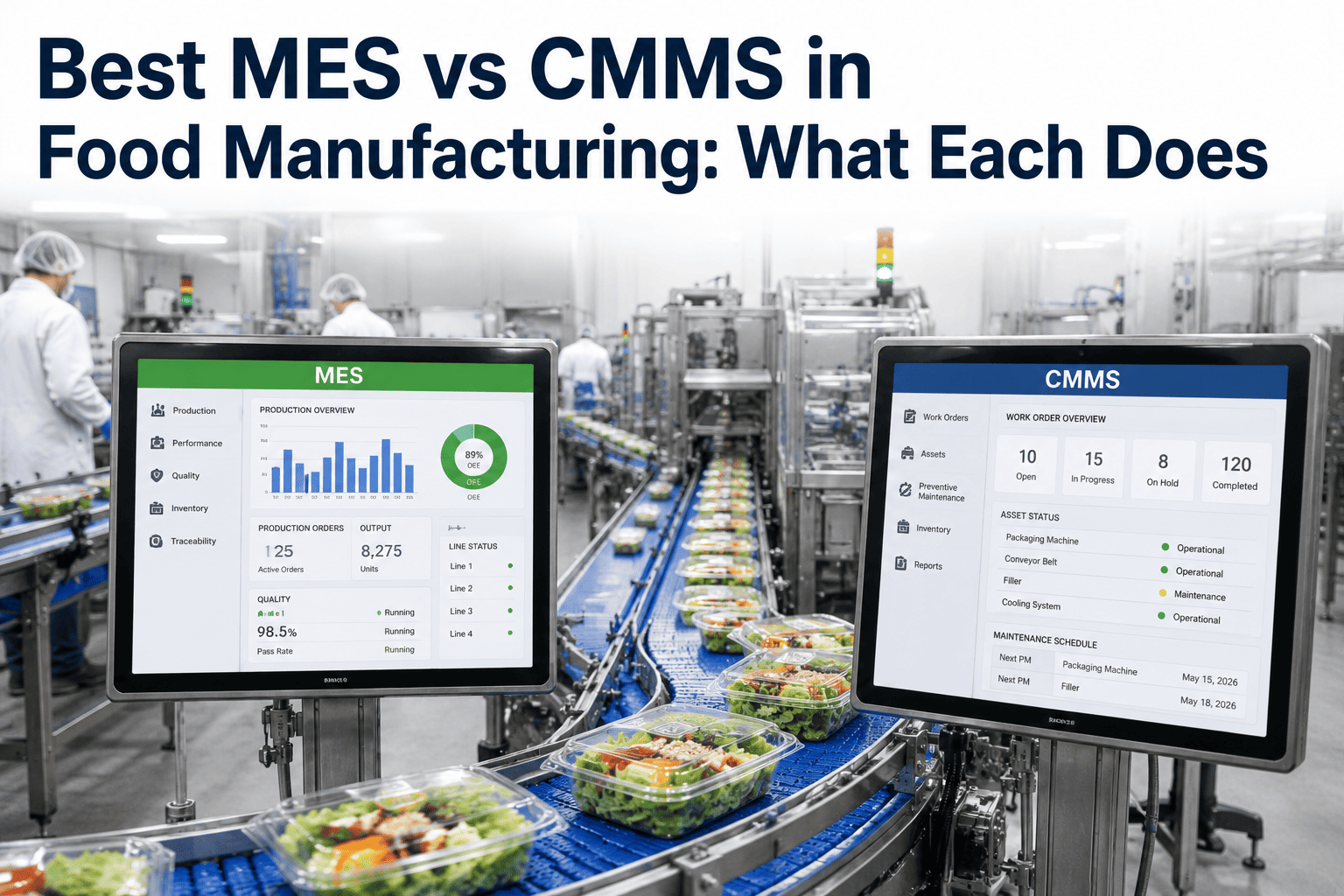
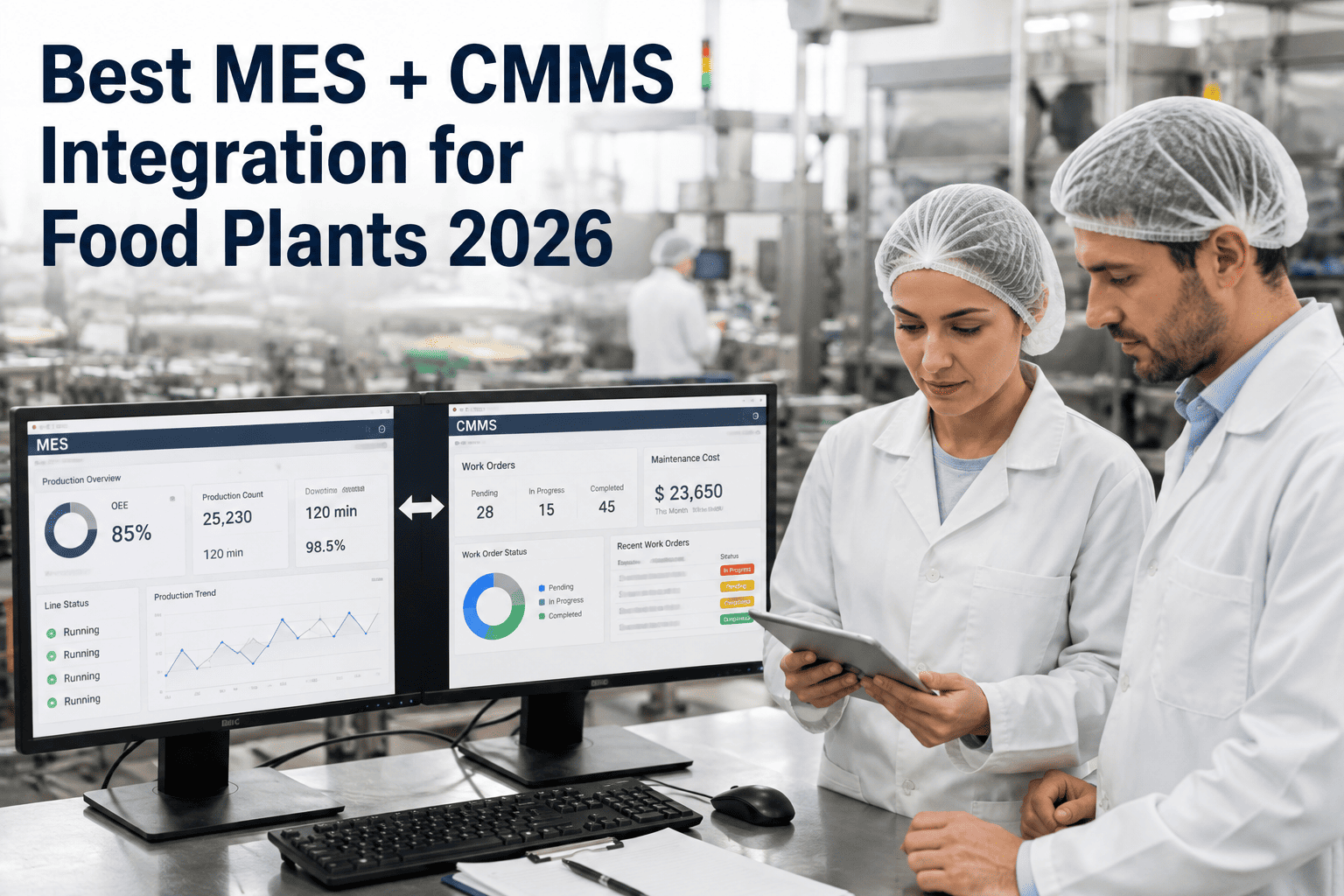
Ask five people in a food plant to define where MES ends and CMMS begins, and there's a decent chance you get five different answers — not because the systems are poorly understood, but because the boundary genuinely gets fuzzy in daily use. A downtime event lives in MES. The work order that downtime triggers lives in CMMS. The line between "this is a production record" and "this is a maintenance record" isn't always obvious in the moment, and plants that never resolve that ambiguity end up with data scattered across both systems in ways that make neither one a complete picture. See where MES and CMMS scope actually diverge in food manufacturing, and why running them as disconnected silos costs real production hours.
Digital Operations · System Scope
MES and CMMS Aren't Competing Systems. They're Answering Different Questions.
A clear breakdown of what MES does, what CMMS does, where the two genuinely overlap, and why letting them operate as silos costs a food plant real production time.
The Core Question Each System Answers
What MES Is Built to Track vs. What CMMS Is Built to Track
MES — "What Is the Line Doing Right Now?"
Manufacturing Execution Systems track production in near real time: line speed, throughput, quality events, batch genealogy, and OEE. MES answers questions about what's happening on the floor at this moment and how that compares to what should be happening according to the production schedule.
CMMS — "What Condition Is the Equipment In?"
Computerized Maintenance Management Systems track the asset side: work orders, maintenance history, spare parts inventory, and preventive maintenance schedules. CMMS answers questions about equipment condition, upcoming maintenance needs, and repair history over the asset's lifecycle.
Feature-by-Feature Scope
Where Each System's Responsibility Actually Sits
| Function | MES | CMMS |
|---|
| Real-time line performance | Primary owner | Not tracked |
| Downtime event logging | Primary owner | Consumes downtime data |
| Work order management | Not tracked | Primary owner |
| Preventive maintenance scheduling | Not tracked | Primary owner |
| Batch/lot genealogy | Primary owner | Not tracked |
| Spare parts inventory | Not tracked | Primary owner |
| Asset failure history | Partial (via downtime) | Primary owner |
The Scope Question Only Matters If the Data Connects
Clear Boundaries Still Need a Bridge Between Them
iFactory connects MES production data with CMMS maintenance records so the clear scope split above doesn't turn into a data silo in practice.
Where the Two Genuinely Overlap
The Gray Zone Between Production and Maintenance Data
The cleanest way to think about MES and CMMS scope is that MES owns what's happening now and CMMS owns what should happen to keep equipment capable of running — but several events sit squarely in both worlds. A downtime event is a production record the moment it happens and a maintenance trigger the moment someone needs to act on it. A quality deviation might be a process issue MES should track or an equipment condition issue CMMS should track, and often it's genuinely both until root cause investigation sorts out which. This overlap isn't a flaw in either system's design — it's simply where the two domains meet in a real plant, and it's exactly the zone that benefits most from the systems being connected rather than treated as fully separate.
Plants that try to force every event into a single system's ownership usually end up duplicating data or losing context — logging a downtime reason code in MES that doesn't match the failure description eventually entered in CMMS, because two different people typed two different descriptions of the same event into two different systems without either one referencing the other.
The Cost of Running Them as Silos
What Disconnected Systems Actually Cost a Plant
01
Duplicate Data Entry
The same downtime event gets described twice, once in each system, by two different people, with no guarantee the descriptions actually match.
02
Delayed Work Orders
A maintenance planner has to notice a production issue and manually translate it into a work order rather than having one generated automatically from the MES event.
03
Maintenance Schedules Blind to Actual Usage
CMMS runs preventive maintenance on a fixed calendar without knowing an asset has been under unusual production stress that MES data would have shown.
04
Incomplete Root Cause Investigations
Investigating a recurring failure requires pulling data from both systems manually, since neither one alone has the full production-and-maintenance picture.
Common Questions
Frequently Asked Questions
Can one platform handle both MES and CMMS functions instead of running two systems?
Some platforms offer combined MES-CMMS functionality, and this can work well for smaller operations with simpler needs, though larger or more complex plants often find that best-in-class dedicated systems for each domain, properly integrated, outperform a single platform trying to do both jobs equally well.
Talk to support about which approach fits your plant's scale and complexity.
Which system should own a downtime event caused by an equipment failure?
MES typically logs the downtime event itself as it happens, since that's a real-time production record, while CMMS owns what happens next — the work order, repair record, and updated maintenance history for that asset. The connection between the two is what determines whether that handoff happens automatically or requires manual translation.
Do smaller food plants need both systems, or can one be skipped?
It depends on plant complexity and regulatory requirements — a very small operation with simple production lines and light maintenance needs might get by with a lighter combined tool, but most food plants running multiple lines with meaningful equipment complexity benefit from dedicated systems for each domain, connected rather than duplicated.
How do we decide which system is the source of truth for asset downtime hours?
MES is generally the more accurate real-time source for downtime hours, since it's directly tracking line status as it happens, while CMMS downtime figures are often derived from work order timestamps that may lag the actual event. Integrating the two lets CMMS reference MES's real-time downtime data rather than maintaining a separate, less precise version.
Book a demo to see how downtime data reconciles across both systems.
Does connecting MES and CMMS change who is responsible for each system?
No — integration connects the data flow between systems, not the organizational ownership of them. Production teams typically continue owning MES and maintenance teams continue owning CMMS; the integration simply ensures each team's system reflects relevant information from the other automatically.
Clear Scope, Connected Data
Let MES and CMMS Do Their Jobs Without Working in the Dark
iFactory keeps MES and CMMS scope clean while making sure the data each system generates actually reaches the other one automatically.