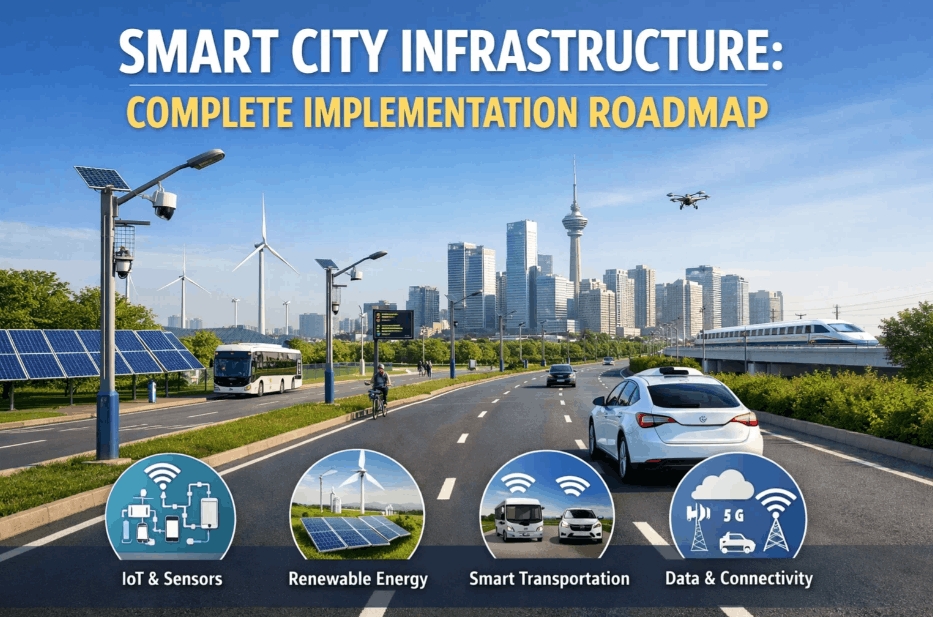
Smart city infrastructure represents the backbone of modern municipal development, transforming how cities operate, serve residents, and address sustainability challenges. A comprehensive smart city implementation roadmap combines IoT deployment, integrated data platforms, AI-driven analytics, and citizen-centric digital services to create responsive, efficient urban environments. Whether you're a municipal leader, IT director, or urban planner, understanding the strategic steps of smart city development is essential for maximizing ROI and ensuring long-term success.
SMART CITY INFRASTRUCTURE · URBAN PLANNING · IOT DEPLOYMENT
AI-Powered Infrastructure for Smart City Leaders
iFactory helps municipal departments automate sensor tracking, infrastructure monitoring, compliance documentation, and urban reporting — all from a single platform built for smart city leadership.
Why Smart City Infrastructure Matters: The Business Case
Cities worldwide are investing heavily in smart city technology to address pressing challenges: traffic congestion, energy waste, public safety gaps, and citizen dissatisfaction. A well-executed smart city platform delivers measurable outcomes within 12-24 months of deployment, including operational cost reductions of 15-30%, improved response times for emergency services, enhanced quality of life metrics, and sustainable urban growth. The global smart city market is projected to exceed $2.5 trillion by 2030, with early adopters capturing significant competitive advantages. Cities that implement a structured municipal digital transformation strategy gain better budget allocation, improved citizen engagement, and data-driven decision-making capabilities. This is where a clear smart city roadmap becomes your competitive advantage.
15-30%
Operational cost reduction through smart infrastructure optimization
40%
Average reduction in energy consumption with IoT monitoring
3-5 years
Typical payback period for smart city capital investments
60%+
Improvement in emergency response times with integrated systems
Implementation Foundation
Smart City IoT Deployment: The First Layer of Your Strategy
Smart city IoT deployment is the physical foundation upon which all analytics and citizen services rest. This phase involves strategically placing sensors, connectivity infrastructure, and edge computing devices across municipal assets—traffic systems, utility grids, parking facilities, public spaces, and environmental monitoring stations. Without comprehensive IoT infrastructure, your data collection capabilities remain fragmented and insights remain limited. A successful smart city guide emphasizes phased IoT rollout: begin with high-impact use cases (traffic management, utility monitoring, public lighting), establish robust connectivity networks (5G, LoRaWAN, mesh networks), and build standardized data collection protocols. Many municipalities make the mistake of deploying IoT devices without unified architecture, leading to data silos and wasted investment. The right approach integrates IoT planning with your broader smart city plan from day one. Book a demo to see how unified IoT platforms accelerate your smart city timeline.
01
Sensor Deployment and Network Architecture
Deploy comprehensive IoT coverage across traffic signals, environmental sensors, utility meters, and public spaces. Establish unified connectivity through 5G networks and LoRaWAN gateways ensuring 99.5%+ uptime with standardized data protocols.
02
Data Ingestion and Edge Processing
Deploy edge computing that processes sensor data locally, reducing latency and bandwidth costs by up to 40%. Execute critical decisions at the edge instantly without waiting for cloud response.
03
Integration with Existing Infrastructure
Connect IoT devices to legacy municipal systems using middleware that bridges old and new technology. Preserve working infrastructure investments while modernizing data collection capabilities.
Your IoT deployment directly impacts the quality of insights your smart city strategy can deliver. Cities investing in enterprise-grade IoT architecture see 3x faster service deployment and 5x improvement in data reliability compared to ad-hoc approaches.
Data Intelligence
Building Your Smart City Data Platform and AI Analytics Engine
Raw sensor data is worthless without a powerful data platform to aggregate, process, and transform it into actionable intelligence. Your smart city infrastructure requires a centralized data hub that collects information from thousands of sources—IoT sensors, traffic cameras, weather stations, citizen apps, utility systems—and unifies it in formats that analytics and AI models can consume instantly. A robust smart city platform architecture combines data ingestion, real-time processing, historical analytics, and predictive modeling. Cities that build proper data foundations see decision-making cycles compress from weeks to minutes. Traffic optimization algorithms reduce congestion by 20-35%, predictive maintenance systems cut infrastructure failures by 40%, and citizen service platforms improve response satisfaction from 65% to 85%+. Book a demo to understand how enterprise data platforms power world-class smart city operations.
Unified Data Lake for City Operations
Aggregate data from all IoT sensors and departmental systems into one accessible repository. Enable any department to query city data without friction or information silos.
Real-Time Analytics and Decision Support
Deploy streaming analytics that process incoming data continuously, identifying patterns and anomalies within seconds for instant operational improvements.
Predictive AI Models for Urban Planning
Build machine learning models that forecast infrastructure demand, citizen service needs, and resource requirements. Prevent 70% of equipment failures before they occur.
Advanced Data Visualization and Dashboards
Create intuitive dashboards for different stakeholders. Transform complex data streams into clear decision triggers enabling faster action across departments.
The difference between a struggling smart city implementation and a thriving one often comes down to data platform quality. Cities spending 25-30% of smart city budgets on data infrastructure see 3-4x faster time-to-value compared to those cutting corners.
Implementation Phases
Smart City Development: Phased Implementation Roadmap
A structured smart city implementation roadmap prevents common failures where cities deploy technology without clear outcomes, exceed budgets, or face adoption resistance. The proven approach divides smart city development into distinct phases, each delivering measurable value and creating momentum for the next phase.
Phase 1
Foundation and Planning (Months 1-6)
Establish your smart city strategy foundation by identifying priority use cases aligned with city objectives. Conduct comprehensive assessments of existing infrastructure, determine IoT deployment locations, and build stakeholder alignment across departments and citizen groups. Create a detailed budget model that quantifies expected outcomes: cost savings, revenue opportunities, service improvements, and sustainability metrics.
Outcome: Approved smart city roadmap with clear outcomes and stakeholder buy-in
Phase 2
Pilot Deployment and Quick Wins (Months 6-12)
Launch initial smart city implementations in 1-2 high-impact domains (traffic management, parking, street lighting). Deploy IoT sensors in selected areas, establish connectivity infrastructure, build initial data platform, and create first dashboards. Quick wins in months 2-3 build political support and justify continued investment.
Outcome: Pilot success demonstrating 15-25% operational improvement and user adoption above 40%
Phase 3
Platform Expansion and Integration (Months 12-18)
Scale successful pilots across the entire city. Expand IoT deployment to all planned locations, integrate additional data sources (utilities, emergency services, planning systems), and enhance analytics models with additional predictive capabilities. Deploy municipal digital transformation initiatives including citizen-facing mobile apps and predictive maintenance systems.
Outcome: City-wide smart city platform with integrated services and measurable ROI achievement
Phase 4
Optimization and Advanced Capabilities (Months 18-24)
Fine-tune operations through continuous optimization, advanced AI model refinement, and citizen feedback integration. Implement sophisticated cross-domain optimization that compounds efficiency gains. Introduce new services: environmental monitoring dashboards, real-time budget tracking, and predictive resource allocation.
Outcome: Smart city infrastructure delivering 25-35% operational improvements and sustained citizen satisfaction above 75%
This structured approach to smart city plan execution dramatically improves success rates. Cities following phased implementation complete projects 35% faster, stay within budget 80% of the time, and achieve 60%+ higher citizen adoption compared to big bang approaches.
Citizen Engagement
Citizen Services Integration: The Human Layer of Smart City Technology
Smart city infrastructure succeeds or fails based on citizen adoption and satisfaction. The best data and analytics mean nothing if citizens don't understand city services, can't access them easily, or don't trust government with their information. Successful smart city development requires intentional design of citizen-facing interfaces that make urban life simpler, more transparent, and more responsive. Implement integrated citizen service platforms that consolidate disparate city applications into unified mobile and web experiences. A resident should be able to report a pothole, check permit status, register for parking, access transit schedules, and pay bills from a single interface—not navigate 15 different city websites. Book a demo to see how integrated citizen platforms increase service adoption by 150%+ and satisfaction by 35%.
Unified Service Portal
Single entry point for all city services—permits, payments, requests, information. Reduce citizen frustration from 340 average searches per service to unified search. Improve first-contact resolution rates from 45% to 75%.
Personalized Mobile Experience
AI-powered recommendations show citizens relevant services, alerts, and information based on location, lifecycle stage, and preferences. Proactive notifications about parking expirations, transit disruptions, or permit deadlines reduce violations and service calls.
Two-Way Communication Channels
Enable citizens to report issues, provide feedback, and participate in planning through accessible channels. Sentiment analysis on citizen feedback identifies service gaps and improvement priorities automatically. Citizens feel heard; city leadership makes decisions on real data.
Transparent Data and Accountability
Share anonymized data showing city performance metrics, budget allocation, and service delivery outcomes. Transparency builds trust and demonstrates government responsiveness. Citizens understand where tax dollars go and see direct improvement over time.
Security and Governance
Smart City Security: Protecting Infrastructure and Citizen Data
As cities deploy smart city IoT infrastructure, security becomes paramount. A connected city is an exposed city without proper security architecture. Traffic systems can be hijacked, utility grids attacked, and citizen data compromised. Your smart city guide must prioritize security from architecture to operations, treating it as a foundational capability, not an afterthought.
1
Zero-Trust Architecture for IoT Networks
Assume all connections could be compromised. Implement continuous authentication, encryption everywhere (data in transit and at rest), and microsegmentation that isolates critical infrastructure.
2
Data Privacy and Citizen Protection
Implement privacy-by-design principles where personal data collection is minimal and transparent. Deploy anonymization techniques and comply with GDPR, CCPA, and local regulations.
3
Continuous Monitoring and Incident Response
Deploy 24/7 security monitoring across all systems, detecting anomalies instantly. Establish incident response procedures that isolate threats within minutes with regular security audits.
Cities investing adequately in security (8-12% of smart city budgets) experience zero critical incidents. Those skimping on security face breaches, downtime, and citizen trust erosion. Security enables sustainable smart city operations.
Success Metrics
Measuring Smart City Success: KPIs That Matter
A smart city implementation without clear success metrics becomes a technology vanity project. Define specific, measurable outcomes aligned with city strategic objectives. Typical smart city KPIs span operational efficiency, citizen outcomes, financial impact, and sustainability metrics. Track these metrics continuously and publish progress transparently. Early wins (traffic reduced 15% in 4 months, energy savings apparent in first bill cycle) build stakeholder confidence and fund subsequent phases. Book a demo to see how advanced analytics dashboards make outcome tracking automated and transparent.
| Category |
KPI |
Baseline |
Target (Year 2) |
| Traffic & Transportation |
Average commute time reduction |
35 minutes |
28 minutes (-20%) |
| Traffic & Transportation |
Traffic congestion incidents per week |
85 |
52 (-39%) |
| Utilities & Energy |
Overall energy consumption reduction |
Baseline |
22% reduction |
| Utilities & Energy |
Street lighting maintenance costs |
$2.4M annually |
$1.2M annually (-50%) |
| Public Services |
Emergency response time (life safety) |
8.2 minutes |
5.8 minutes (-29%) |
| Public Services |
Citizen service satisfaction score |
62% |
81% (+31%) |
| Financial |
Operational cost reduction |
Baseline |
$18-24M annually |
| Environmental |
Air quality improvement index |
58 (moderate) |
72 (good) |
Frequently Asked Questions About Smart City Implementation
How much does a comprehensive smart city implementation cost?
Total investment varies by city size and scope, but typical municipal smart city programs range $50-150M for implementation and first 3 years of operations. These investments generate $2-4 in annual benefits through cost savings and efficiency gains.
Book a demo to see ROI models.
What's the timeline for seeing results from a smart city initiative?
Quick wins appear within 60-90 days of pilot launch (traffic optimization, energy savings). Measurable city-wide impact takes 12-18 months. Full mature platform takes 24-36 months.
Book a demo to understand implementation timelines.
How do we address citizen privacy concerns with extensive IoT monitoring?
Privacy is a feature, not a limitation. Implement privacy-by-design: collect minimal personal data, anonymize where possible, and comply with regulations. Transparency builds citizen trust and support.
Book a demo to see privacy-first architecture.
Can legacy cities with older infrastructure implement smart city initiatives?
Absolutely. Smart city technology works with legacy infrastructure through middleware and adapter technology. Infrastructure age is not a barrier; strategy and commitment are what matter for municipal modernization.
What's the most common reason smart city initiatives fail?
Poor executive sponsorship and unclear ROI expectations. Successful implementations have dedicated city leadership, clear business cases, and structured governance.
Book a demo to see success frameworks.
SMART CITY INFRASTRUCTURE · URBAN PLANNING · IOT DEPLOYMENT
AI-Powered Infrastructure for Smart City Leaders
Transform your city with iFactory. Automation of sensor tracking, infrastructure monitoring, and urban reporting from a single platform built for modern municipal leadership.