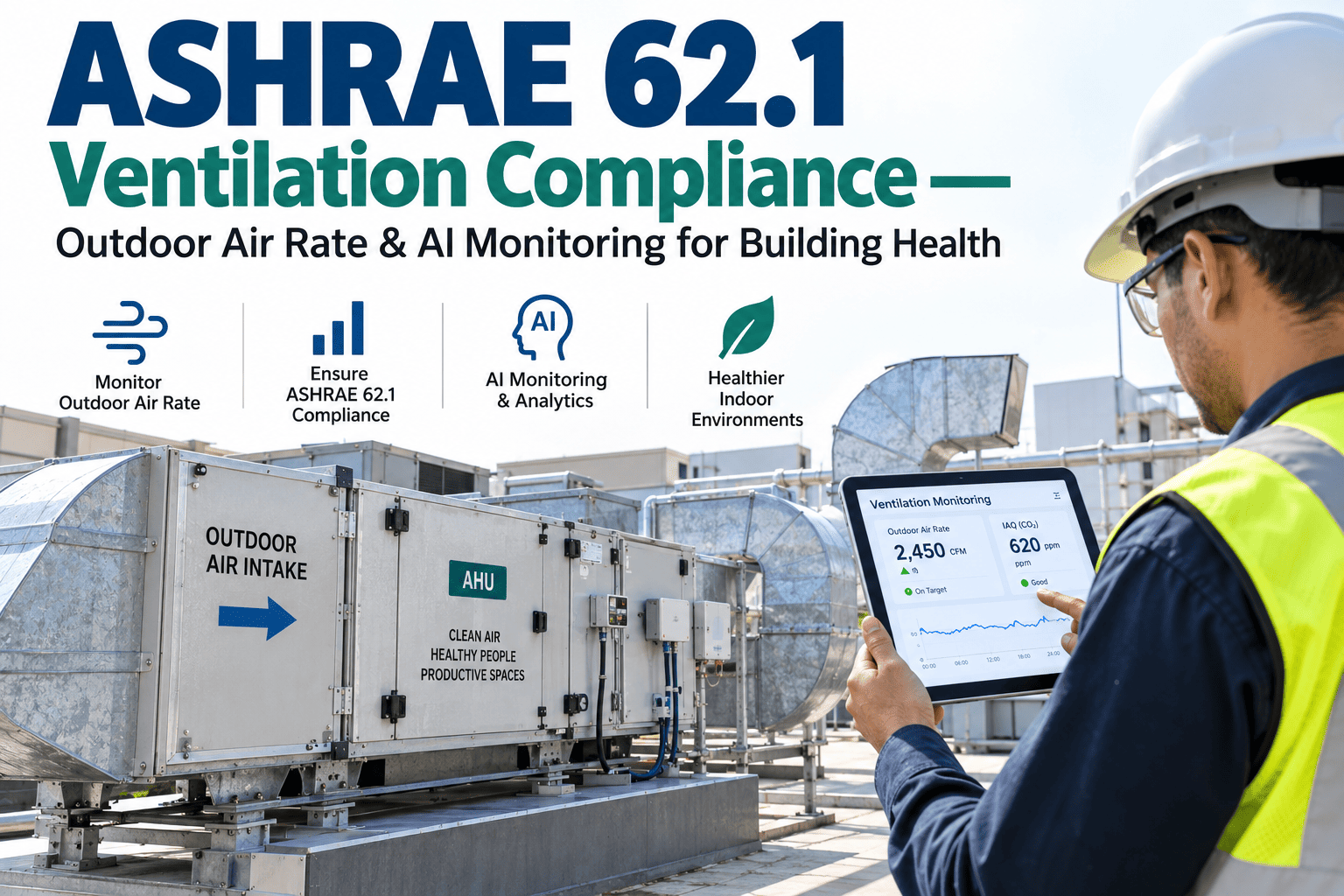
A building can pass its ASHRAE 62.1 ventilation commissioning with every zone delivering exactly the outdoor air rate the standard requires, and still fall out of compliance eighteen months later without a single piece of equipment being replaced or a single design decision being changed. A CO2 sensor drifts out of calibration and quietly under-reports occupancy. A damper that was correctly balanced during commissioning sticks partially closed after a few hundred cycles. A filter that should have been changed on schedule gets deferred during a busy quarter and starts restricting airflow below what a zone's design calls for. None of these are individually dramatic, and none of them trip an alarm on their own, but together they explain why the overwhelming majority of buildings that fail an unscheduled ventilation audit passed their original commissioning without issue. If you can't currently prove your ventilation rates are still where they were on day one, book a demo to see what continuous zone-level verification actually looks like.
COMPLIANCE & CODE · ASHRAE 62.1 VENTILATION
Passing Commissioning Isn't the Same as Staying Compliant
iFactory continuously monitors outdoor air delivery, CO2 levels, and damper performance across every occupied zone, so ventilation compliance is provable on any given day, not just the day of the last audit.
A1
A2
A3
A4
B1
B2
B3
B4
C1
C2
C3
C4
Compliant Drifting Below Minimum
FOUR OBLIGATIONS, EVERY ZONE
What 62.1 Actually Asks a Facility Team to Prove
The Ventilation Rate Procedure at the center of ASHRAE 62.1 produces a specific outdoor airflow requirement for every occupied zone based on occupant density and floor area. The standard doesn't stop at calculating that number once, it implicitly requires the building to keep delivering it, which breaks down into four concrete, ongoing obligations.
Zone-Level Outdoor Air Verification
Every occupied zone needs its actual delivered outdoor airflow checked against its calculated minimum, not just the system-level total.
CO2 and IAQ Sensor Accuracy
Demand-controlled ventilation strategies depend entirely on sensor accuracy, and a drifted CO2 sensor silently undermines the entire control strategy built on top of it.
Damper and Filter Condition
Outdoor air dampers and filters that restrict airflow below design intent are one of the most common causes of a zone quietly falling under its required rate.
Continuous Documentation
Evidence needs to demonstrate compliance across time, not just at a single audit snapshot, since intermittent failures between audits are exactly what a periodic check misses.
WHERE COMPLIANCE ACTUALLY BREAKS
The Gap Between Audits Is Where Buildings Fail
The large majority of commercial buildings that fall out of ASHRAE 62.1 compliance between scheduled audits do so because of untracked PM deferrals rather than any deliberate design failure, which is exactly why the problem is so persistent and so easy to miss until it's discovered the hard way.
!A CO2 sensor drifts out of calibration over months of continuous operation, causing a demand-controlled ventilation sequence to under-deliver outdoor air without any visible symptom in the space.
!An outdoor air damper actuator fails partially closed, reducing airflow to a zone while the control system still reports the damper commanded to its intended position.
!A filter change gets deferred during a busy maintenance quarter, and static pressure buildup gradually restricts airflow below the zone's design minimum.
!A zone's occupancy changes after a space renovation without anyone recalculating its ventilation requirement against the new layout and density.
Find out which zones are already drifting
iFactory can run a zone-by-zone ventilation compliance check against your building's current sensor and damper data.
DEMAND CONTROLLED VENTILATION, DONE RIGHT
Why Sensor Accuracy Is the Whole Game
CO2-based demand controlled ventilation is one of the most effective tools available for cutting ventilation energy cost without sacrificing air quality, modulating outdoor air to actual real-time occupancy instead of a fixed worst-case rate. It's also entirely dependent on sensor accuracy, since every efficiency gain the strategy produces comes directly from trusting a reading that, left unchecked, drifts exactly like every other sensor on a building automation system.
Continuous Sensor Drift Tracking
CO2 sensor readings are cross-checked against expected baseline patterns to catch drift before it silently undermines the ventilation strategy.
Occupancy-to-Airflow Correlation
Actual delivered airflow is checked against real occupancy patterns, not just against the setpoint the control sequence believes it's achieving.
Zone Recalculation Triggers
A flagged renovation or occupancy change prompts a ventilation requirement recalculation rather than leaving an outdated number in place indefinitely.
PERIODIC AUDIT VS CONTINUOUS MONITORING
What Changes When Every Zone Is Watched Continuously
| Factor |
Periodic Audit |
Continuous Zone Monitoring |
| Detection window |
Only at scheduled inspection intervals |
Ongoing, gaps flagged as they appear |
| Sensor drift |
Discovered only if recalibration is scheduled |
Trended and flagged automatically |
| Damper or filter degradation |
Found during the next physical inspection |
Correlated to airflow drop in near real time |
| Occupancy or layout changes |
Easy to miss without a formal update process |
Flagged for ventilation recalculation |
| Audit readiness |
Reactive scramble when notified |
Always current, exportable on demand |
TURNKEY DEPLOYMENT
How iFactory Gets Every Zone Under Watch
What Gets Built
Zone-level outdoor air rate calculation against your actual occupancy and layout
CO2 and IAQ sensor drift tracking with recalibration alerts
Damper and filter condition correlation against delivered airflow
Continuous compliance dashboard covering every occupied zone
One-click audit export for any zone, any date range
Rollout Timeline
Weeks 1-2: Zone-by-zone ventilation requirement baseline audit
Weeks 3-4: Sensor and damper monitoring integration
Week 5: Compliance dashboard go-live and facilities training
FREQUENTLY ASKED QUESTIONS
What Facility Managers Ask About 62.1 Compliance
How can our building fall out of compliance without anyone changing anything?
This is exactly the pattern most buildings experience, and it happens through gradual equipment degradation rather than any deliberate change. A CO2 sensor drifts out of calibration over months of continuous use, a damper actuator fails partially closed while the control system still reports it in its commanded position, or a filter change gets deferred and static pressure buildup quietly restricts airflow, none of which trip an obvious alarm on their own. The overwhelming majority of buildings that fail an unscheduled ventilation audit passed their original commissioning cleanly, which tells you the compliance gap develops afterward rather than existing from day one.
Book a demo to check your own building's current zone-level status.
Do we need to verify every single zone, or just the ones with the highest occupancy?
Every occupied zone technically carries its own outdoor air requirement under the Ventilation Rate Procedure, so a compliance gap in a lower-occupancy zone is just as real a finding as one in your busiest conference room, even though the consequence of a shortfall may feel less urgent day to day. That said, prioritizing verification by occupancy density and by which zones have had recent renovations or layout changes is a reasonable way to sequence a rollout, starting with the zones most likely to have drifted or to carry the highest compliance risk if an issue is found.
Contact our support team to prioritize a zone rollout for your specific building.
How do you actually verify a CO2 sensor has drifted without a manual field calibration check?
Continuous drift tracking compares a sensor's readings against expected patterns given known occupancy schedules and correlates its behavior against other sensors serving comparable zones, which surfaces a sensor that's reading meaningfully differently than it should be well before a scheduled field calibration would catch it. This doesn't eliminate the need for periodic physical calibration entirely, CO2 sensors do require occasional field verification against a reference standard, but it dramatically shortens how long a drifted sensor can silently undermine a demand-controlled ventilation sequence before anyone notices.
Book a demo to see drift detection running against real sensor data.
What happens when a space renovation changes occupancy without anyone flagging it for ventilation review?
This is a genuinely common and easy-to-miss compliance gap, since ventilation requirements are calculated based on occupant density and floor area at a specific point in time, and a renovation that changes a space's layout or intended use, converting an office area to a denser conference configuration, for example, changes that underlying calculation without automatically updating the ventilation system's setpoint. Continuous zone monitoring is built to flag a mismatch between a zone's current configured ventilation requirement and its actual observed occupancy pattern, prompting a recalculation review rather than letting an outdated number sit unnoticed indefinitely.
Contact our support team to review your process for flagging renovations for ventilation recalculation.
How fast can we produce compliance evidence if we're notified of an upcoming audit?
With continuous zone-level monitoring in place, a compliance export covering any zone and any date range is available essentially on demand, since the underlying data is already being captured and structured continuously rather than needing to be reconstructed from scattered logs and sensor histories after the fact. This is the core practical difference between a continuous monitoring approach and a periodic audit-only process, the latter often means days or weeks of manual document assembly under real time pressure once an audit notice arrives, while the former means the record is already current the moment it's requested.
Book a demo to see a sample compliance export generated on demand.
EVERY ZONE, VERIFIED CONTINUOUSLY
Prove Ventilation Compliance on Any Day, Not Just Audit Day
iFactory continuously monitors outdoor air delivery, sensor accuracy, and damper condition across every occupied zone, keeping your ASHRAE 62.1 compliance record always current.