Digital twin technology is revolutionizing HVAC system management by creating virtual replicas of physical equipment that simulate real-time performance, predict failures before they occur, and optimize energy consumption without risking actual system disruption. This guide explores how HVAC digital twins enable building owners and facility managers to model energy scenarios, test control strategies, run what-if analyses, and predict equipment degradation — all within a safe virtual environment before applying changes to live systems. By leveraging BIM integration, IoT sensor data, and physics-based simulation models, digital twins deliver 300% to 600% ROI over five years while reducing unplanned downtime by 40% to 60% and cutting energy consumption by 18% to 35%.
Simulate HVAC Performance With Digital Twin Technology
iFactory's AI Dashboard integrates digital twin simulation, real-time HVAC monitoring, and predictive analytics in a single platform that helps facility managers optimize system performance before making physical changes. Book a demo to see how digital twin technology reduces energy costs and prevents equipment failures.
Understanding HVAC Digital Twin Technology
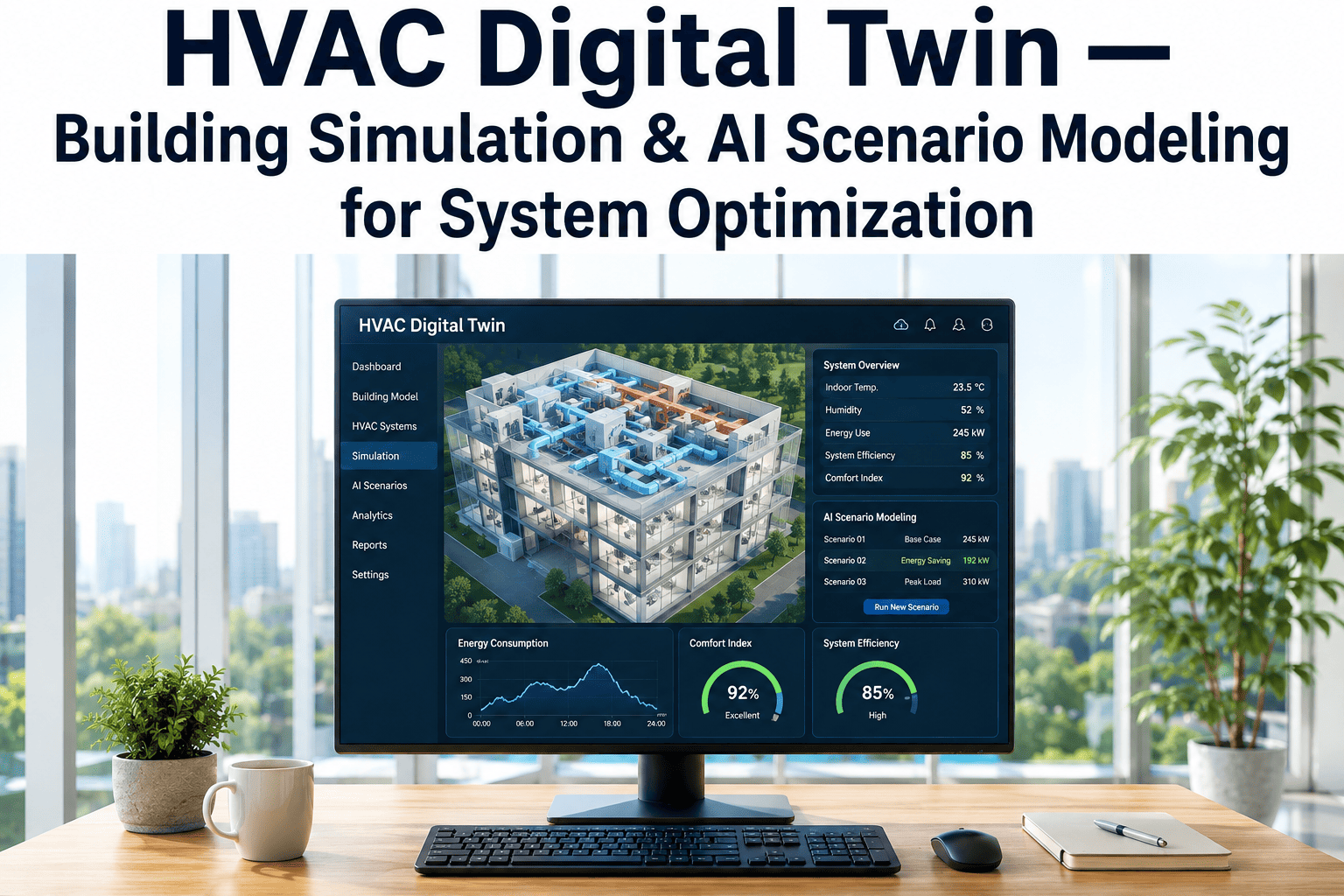
An HVAC digital twin is a physics-based virtual replica of a building's heating, ventilation, and air conditioning infrastructure that mirrors the behavior of physical equipment in real time. Unlike static 3D models or traditional building management systems, a digital twin continuously ingests live sensor data, applies thermodynamic and mechanical simulation engines, and maintains a bidirectional data flow between the virtual and physical worlds. This enables facility teams to test control strategies, model energy consumption under different scenarios, simulate equipment degradation patterns, and run predictive failure analyses — all within a risk-free virtual environment before implementing changes on live systems.
The technology sits at the intersection of BIM, IoT, and advanced analytics. BIM provides the spatial and equipment geometry foundation. IoT sensors stream temperature, pressure, flow, vibration, and power data at sub-minute intervals. Physics-based simulation engines apply heat transfer, fluid dynamics, and mechanical wear models to predict how equipment will perform under current and future conditions. Together, these layers create a living digital model that becomes more accurate over time as it learns from actual operating data and equipment responses.
Digital twin adoption in commercial HVAC is accelerating rapidly. Buildings equipped with digital twin technology achieve 18% to 35% energy savings through optimized setpoints, improved scheduling, and validated equipment upgrades. Unplanned downtime drops by 40% to 60% because operators receive predictive alerts about component degradation weeks or months before failure occurs. The result is a proactive maintenance paradigm that replaces reactive repair cycles with data-driven decisions grounded in simulation rather than guesswork.
The Four Levels of Digital Twin Maturity
Digital twin capabilities are typically classified into four maturity tiers that reflect increasing analytical depth and simulation fidelity. Understanding where your organization falls on this spectrum helps prioritize investments in sensor infrastructure, data pipelines, and modeling capabilities. Each level builds on the previous one, with the ultimate goal of full predictive simulation that enables what-if scenario testing before making physical changes.
Describe
- Real-time equipment monitoring and data visualization
- Dashboard displays of temperature, pressure, flow, and power
- Alarm and event logging with historical trend analysis
- Basic performance dashboards for operator situational awareness
Data: IoT sensor streams, BMS points, equipment schedules
Diagnose
- Automated fault detection and diagnostics on all equipment
- Root cause analysis for performance deviations and alarms
- Energy anomaly identification with deviation quantification
- Comparative analysis across similar equipment and zones
Data: Historical trends, equipment specs, fault libraries
Predict
- Degradation forecasting for bearings, coils, filters, and valves
- Remaining useful life estimation for each major component
- Failure probability scoring with lead-time alerts
- Condition-based maintenance triggering with confidence intervals
Data: Degradation curves, failure histories, load profiles
Simulate
- Full physics-based what-if scenario modeling for any condition
- Energy optimization through virtual testing of control strategies
- Equipment upgrade and retrofit validation before capital spend
- Commissioning optimization via virtual startup and tuning
Data: BIM models, weather data, utility rates, occupancy forecasts
Validating Savings Through Virtual Scenario Testing
One of the most powerful applications of HVAC digital twin technology is the ability to model energy consumption and cost impacts of operational changes before committing resources. Instead of implementing a new setpoint strategy or equipment upgrade and waiting months to measure results, facility managers can run dozens of what-if scenarios in the digital twin in a matter of hours. The table below shows typical results from four common optimization scenarios validated through virtual simulation.
| Scenario | Baseline Energy (kWh/yr) | Simulated Energy (kWh/yr) | Savings % | Implementation Cost | Payback |
|---|---|---|---|---|---|
| Optimize Setpoints | 2,450,000 | 1,960,000 | 20% | $12,500 | 8 months |
| Upgrade Equipment | 2,450,000 | 1,715,000 | 30% | $185,000 | 28 months |
| Retrofit Controls | 2,450,000 | 1,837,500 | 25% | $95,000 | 18 months |
| Schedule Shift | 2,450,000 | 2,082,500 | 15% | $8,500 | 3 months |
Each scenario was simulated using physics-based models calibrated against 12 months of historical BMS data. The digital twin accounted for weather variability, occupancy schedules, equipment efficiency curves, and part-load performance characteristics to produce realistic savings projections. This virtual validation enables facility teams to prioritize changes with the best risk-adjusted returns and build confidence among stakeholders before approving capital expenditures.
Digital Twin Modeling by Equipment Type
Every HVAC component has unique performance characteristics, failure modes, and optimization opportunities. A comprehensive digital twin models each equipment type with component-specific physics, sensor integration patterns, and degradation behaviors. The digital twin captures how each piece of equipment interacts with others in the system, enabling holistic optimization rather than siloed equipment management.
Chiller
35 sensors typical
Simulated degradation: fouling, refrigerant charge loss, bearing wear
Digital twin use case: Condenser water temperature optimization and refrigerant leak prediction
AHU
28 sensors typical
Simulated degradation: filter loading, coil fouling, damper drift
Digital twin use case: Airside economizer optimization and supply air temperature reset validation
Boiler
22 sensors typical
Simulated degradation: scale buildup, combustion inefficiency, thermal stress
Digital twin use case: Combustion tuning optimization and staged firing sequence modeling
VAV Box
15 sensors typical
Simulated degradation: damper sticking, flow sensor drift, reheat valve leakage
Digital twin use case: Zone-level demand control and pressure-independent flow optimization
Cooling Tower
30 sensors typical
Simulated degradation: fill media deterioration, fan imbalance, water distribution fouling
Digital twin use case: Approach temperature optimization and variable-speed fan sequencing
Heat Pump
25 sensors typical
Simulated degradation: refrigerant migration, compressor wear, reversing valve leakage
Digital twin use case: Defrost cycle optimization and capacity modulation strategy validation
End-to-End Simulation Workflow
A structured simulation workflow ensures that digital twin analyses produce actionable, reliable results. Each phase builds on the previous one, transforming raw sensor data into validated performance insights that guide operational decisions. The workflow below outlines the standard five-step process for running an HVAC digital twin simulation from data ingestion through results interpretation.
Data Collection
- Aggregate sensor data from BMS, IoT gateways, and sub-meters
- Validate data quality and fill gaps using interpolation models
- Align time-series data to common timestamps and units
Model Calibration
- Configure physics-based equipment models for each component
- Calibrate model parameters against measured performance data
- Validate simulation accuracy using holdout data sets
Scenario Definition
- Define baseline operating conditions and performance metrics
- Configure what-if parameters: setpoints, schedules, equipment selections
- Set simulation duration, weather files, and occupancy profiles
Simulation Execution
- Run physics-based simulation engine across all defined scenarios
- Monitor convergence and validate numerical stability
- Generate time-series outputs for energy, temperature, and wear metrics
Results Analysis
- Compare scenario outputs against baseline with variance reporting
- Generate cost-benefit analysis with payback calculations
- Export recommendations and implementation roadmap
Model Energy Scenarios Before Making Physical Changes
iFactory's platform provides end-to-end digital twin capabilities from BIM integration and sensor data ingestion to physics-based simulation and scenario analysis. Book a demo to see how virtual HVAC modeling identifies savings opportunities and extends equipment life.
Projected ROI and Performance Metrics
Investing in HVAC digital twin technology delivers compelling financial returns that improve as the model matures and more data becomes available for calibration. Early adopters report that the combination of energy optimization, reduced downtime, extended equipment life, and deferred capital spending generates returns that far exceed the initial implementation investment. The metrics below reflect typical outcomes across commercial office, healthcare, and higher education facility deployments.
Implementation Cost
Typical investment for a mid-size commercial building including sensors, software, integration, and calibration services
Annual Energy Savings
Yearly electricity and fuel cost reductions from optimized setpoints, scheduling, and equipment sequencing
Payback Period
Time to recover full implementation investment through measured energy savings and maintenance cost reductions
5-Year ROI
Total return over five years including energy savings, avoided downtime costs, and deferred equipment replacements
Frequently Asked Questions About HVAC Digital Twins
What is an HVAC digital twin and how does it work?
An HVAC digital twin is a dynamic virtual replica of a building's heating, ventilation, and air conditioning systems that mirrors physical equipment in real time. It integrates IoT sensor data, BIM models, and physics-based simulation engines to create a living digital model that reflects actual operating conditions. The digital twin continuously ingests data from sensors on chillers, AHUs, boilers, VAV boxes, cooling towers, and heat pumps, then applies thermodynamic models and machine learning algorithms to simulate performance under various conditions. Unlike static BIM models, digital twins update continuously, enabling operators to test control strategies, predict equipment degradation, model energy consumption scenarios, and run what-if analyses without touching live equipment. The result is a decision-support system that improves reliability, reduces energy costs, and extends equipment life by validating changes virtually before physical implementation.
How does a digital twin differ from a building management system?
A building management system monitors and controls HVAC equipment based on programmed setpoints and schedules, providing real-time data and alarms but limited predictive capability. A digital twin goes beyond monitoring by creating a physics-based virtual model that simulates how equipment will behave under conditions that have not yet occurred. While a BMS answers what is happening now, a digital twin answers what will happen if. Digital twins use BMS data as one input among many, layering in BIM geometry, weather forecasts, occupancy patterns, utility rate structures, and equipment degradation curves. The digital twin can simulate control strategy changes, equipment upgrades, and fault conditions virtually before applying them to the physical system, which a BMS cannot do. This predictive simulation capability is the fundamental difference between reactive monitoring and proactive optimization.
What data and sensors are needed to create an HVAC digital twin?
Creating an HVAC digital twin requires data from multiple sources: IoT sensors measuring temperature, humidity, pressure, flow rate, valve position, damper angle, power consumption, and vibration on all major equipment; BMS and DDC controller data for setpoints, schedules, and control logic; BIM or CAD models for spatial geometry and equipment specifications; weather data for ambient conditions; and utility meter data for energy benchmarking. A typical chiller installation needs 30 to 40 sensors, an AHU requires 25 to 30, and a VAV box needs 10 to 15. The key is not just sensor quantity but data quality and frequency. Sub-minute polling intervals with time-series storage enable the physics-based models to accurately simulate thermal dynamics and equipment degradation patterns across all operating conditions.
How much does an HVAC digital twin cost and what is the ROI?
HVAC digital twin implementation costs typically range from $50,000 to $200,000 depending on building size, equipment count, existing sensor infrastructure, and integration complexity. This includes BIM model creation or update, sensor deployment where gaps exist, data pipeline setup, simulation engine configuration, and dashboard development. Annual operating costs run $10,000 to $30,000 for cloud hosting, data storage, and model maintenance. ROI is substantial: most installations achieve payback in 14 to 18 months with 300% to 600% five-year returns. Energy savings of 18% to 35% come from optimized setpoints, improved scheduling, and equipment upgrade validation. Unplanned downtime reductions of 40% to 60% result from predictive failure alerts that enable proactive maintenance before equipment fails and disrupts building operations.
How long does it take to implement an HVAC digital twin?
A complete HVAC digital twin implementation typically takes 12 to 16 weeks from project kickoff to full operation. Phase one, weeks one through three, covers BIM model audit, sensor gap analysis, and data source mapping. Phase two, weeks four through seven, involves sensor installation and commissioning, data pipeline development, and integration with existing BMS and IoT platforms. Phase three, weeks eight through eleven, focuses on simulation engine configuration, model calibration against measured data, and scenario template creation. Phase four, weeks twelve through sixteen, delivers dashboard development, user training, and go-live validation. Ongoing model tuning continues for four to eight weeks post-launch to refine accuracy. Accelerated timelines of eight to ten weeks are possible when existing BIM models and sensor infrastructure are already in place.
Simulate, Predict, and Optimize HVAC System Performance
iFactory's AI Dashboard delivers comprehensive digital twin functionality including real-time equipment simulation, energy scenario modeling, predictive failure analysis, and ROI tracking for commercial HVAC systems. Book a demo to see how simulating performance before failure transforms your maintenance strategy.