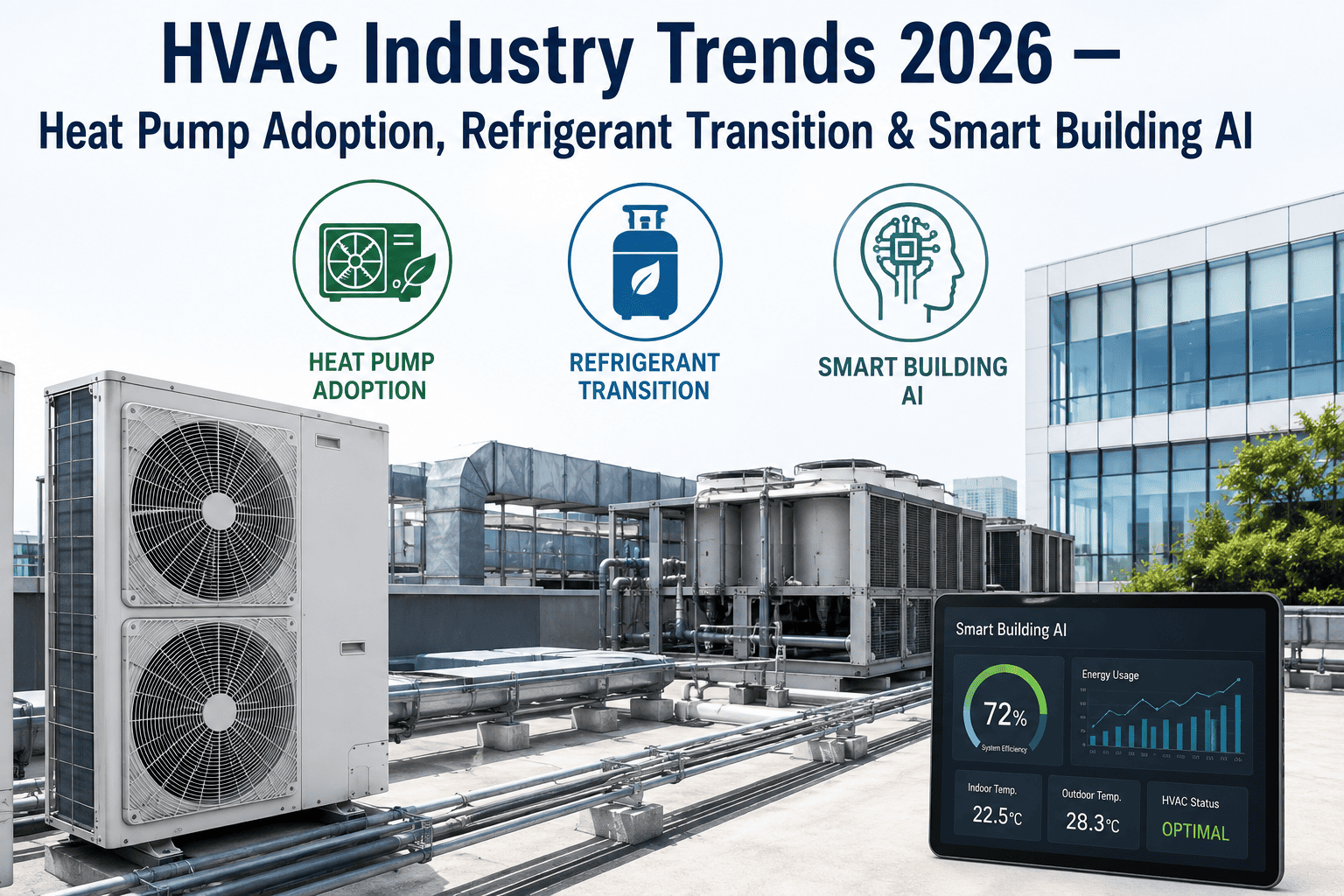
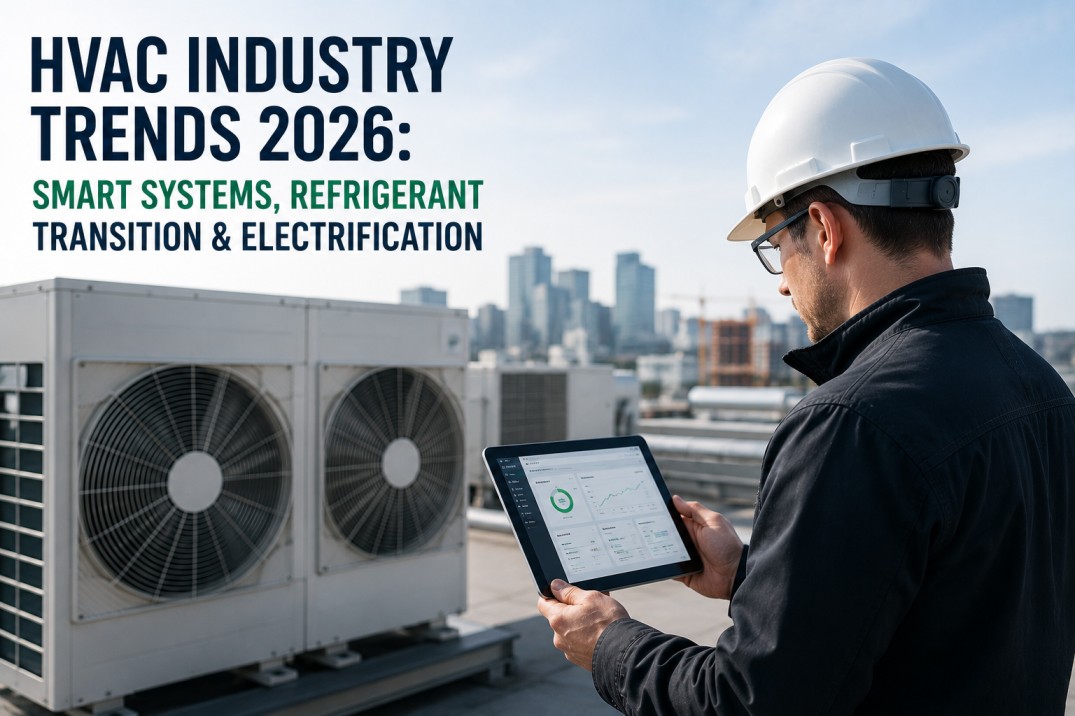
Three forces are converging on commercial HVAC at the same time in 2026, and most facility organizations are only tracking one of them. Heat pump adoption is accelerating as electrification targets tighten, the refrigerant transition away from high-GWP HFCs is reaching hard compliance deadlines, and smart building AI has moved from pilot projects to standard specification on new construction and major retrofits. Treating these as three separate initiatives is where most portfolios lose time and budget. To map how these three trends intersect for your specific building mix, book a demo.
2026 OUTLOOK · THREE CONVERGING SHIFTS
HVAC Industry Trends 2026: Heat Pumps, Refrigerants, and Smart Building AI
Electrification, refrigerant compliance, and AI-driven building intelligence are no longer three separate roadmaps — VPs of operations who plan them together are avoiding the retrofit costs of those planning them apart.
THE 2026 COMPLIANCE AND ADOPTION TIMELINE
What Is Actually Changing, and When
The pace of change in HVAC regulation and technology can be hard to track across a portfolio spanning multiple states or countries. The timeline below captures the shifts most likely to affect a VP of operations planning capital and maintenance budgets through the next several years.
01
HFC Phasedown Reaches Its Steepest Drop
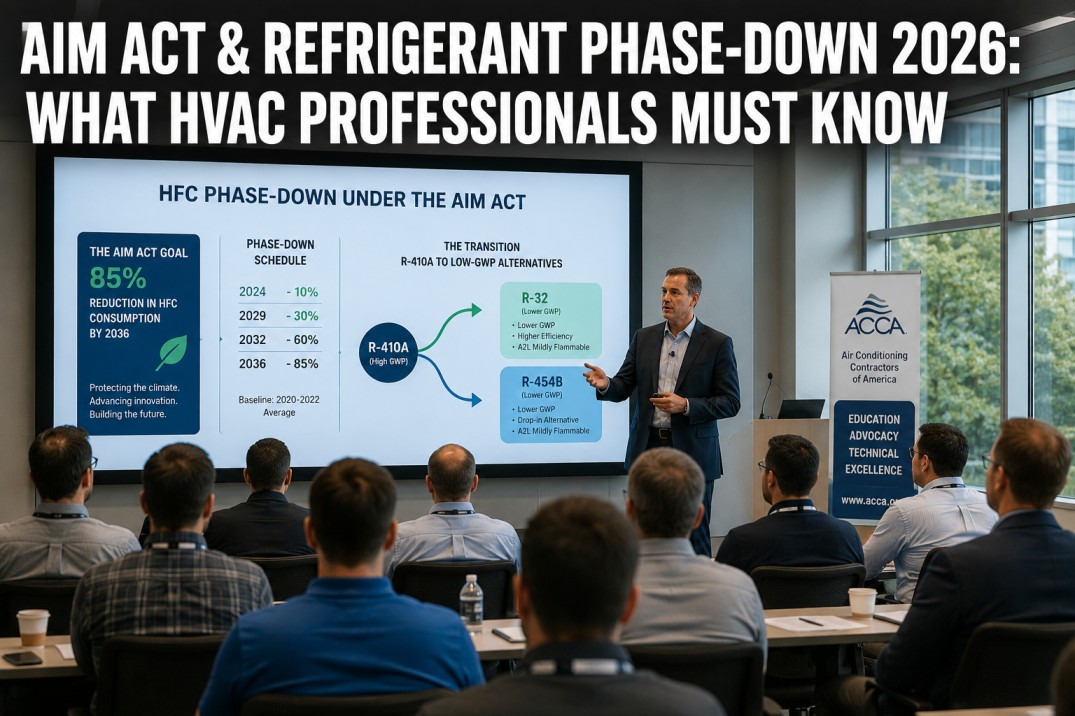
Under the AIM Act, allowed HFC production and consumption drops in stages, with the steepest reductions concentrated in the years immediately ahead. Equipment specified with older high-GWP refrigerants faces tightening availability and rising reclaim costs, pushing new installations toward A2L and other lower-GWP alternatives.
02
A2L Refrigerant Systems Become the Default Spec
Major manufacturers have largely completed the shift to A2L mildly flammable refrigerants for new residential and light commercial equipment, which carries implications for technician training, leak detection requirements, and code compliance that commercial portfolios need to plan for ahead of installation, not during it.
03
Heat Pump Adoption Accelerates in Commercial Retrofits
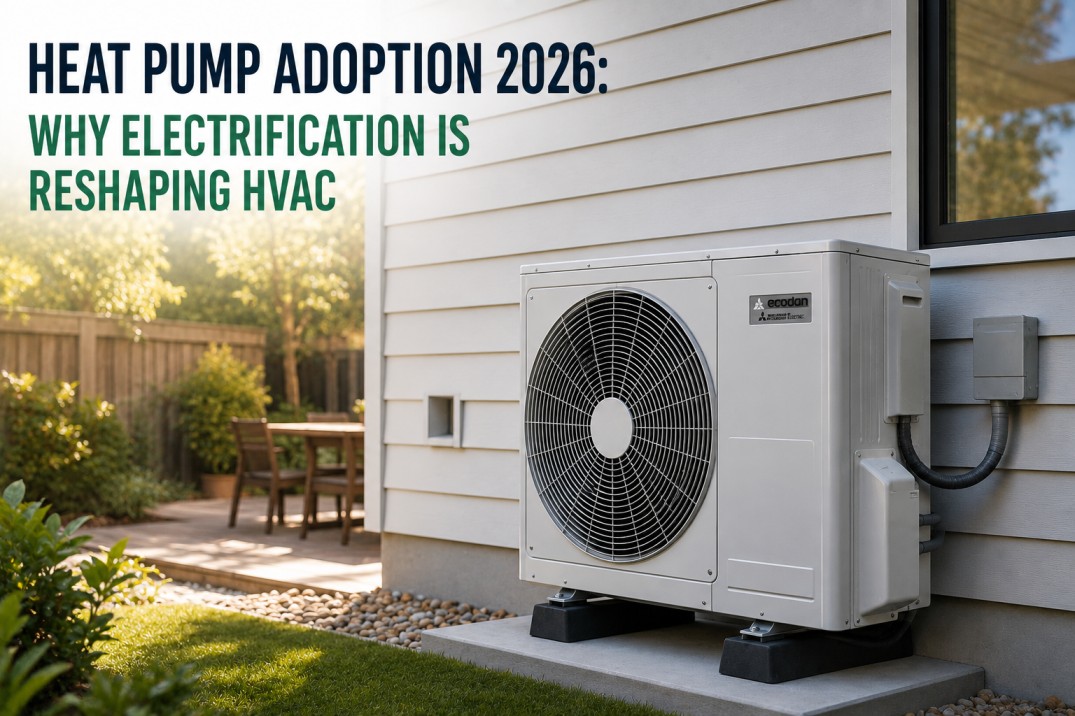
Electrification mandates in multiple jurisdictions, combined with heat pump efficiency gains at lower ambient temperatures, are pushing heat pumps from a residential-first technology into mainstream commercial retrofit specification, particularly for buildings pursuing decarbonization targets.
04
AI Fault Detection Moves From Pilot to Standard Spec
AI-powered predictive maintenance has crossed from an experimental add-on into a standard line item on new building management system contracts, with adoption reported to be accelerating across maintenance teams despite ongoing budget and skills-gap friction.
05
Smart Building Integration Consolidates Around Fewer Platforms
Connected HVAC, lighting, and access control systems are increasingly expected to report into a single building intelligence layer rather than separate siloed dashboards, driven by facility teams wanting one place to see cross-system correlations instead of five.
Plan Your Refrigerant and Electrification Roadmap Together
See how a coordinated approach to refrigerant compliance, heat pump retrofits, and AI monitoring compares to handling each initiative separately.
HEAT PUMP ADOPTION IN DETAIL
Why Heat Pumps Are Moving Past the Residential-Only Assumption
For years, heat pumps were treated in commercial planning as primarily a cold-climate liability, with reduced efficiency below freezing making them a secondary system at best. Cold-climate heat pump technology has closed much of that performance gap, and combined with electrification incentives and decarbonization targets, that has shifted the calculus for portfolio-wide retrofit planning.
Legacy Assumption
Heat pumps were viable primarily in moderate climates, with gas or resistance backup required for cold-weather reliability.
2026 Reality
Cold-climate heat pump models maintain meaningful efficiency well below freezing, expanding the geographic range where all-electric retrofits make operational sense.
REFRIGERANT COMPLIANCE IN DETAIL
What VPs of Operations Should Verify Before the Next Equipment Order
Refrigerant compliance timelines vary by jurisdiction, equipment class, and installation date, which makes a blanket assumption risky for a multi-site portfolio. A few verification steps consistently save budget headaches later.
1Confirm which refrigerant class new equipment orders are being quoted in, and whether that class remains compliant through the expected equipment lifespan.
2Check state and local phase-out schedules separately from federal AIM Act timelines, since several states have moved faster than federal deadlines.
3Verify technician certification and leak-detection equipment readiness for A2L mildly flammable refrigerants before installation, not after.
4Budget for potential reclaim and disposal costs on legacy high-GWP equipment being phased out ahead of its expected end-of-life.
SMART BUILDING AI IN DETAIL
The Shift From Dashboards to Decisions
Early smart building deployments were largely dashboards — useful for visibility but requiring a human to interpret every chart and decide what mattered. The 2026 shift is toward AI systems that surface a prioritized, ranked list of what needs attention, rather than a wall of charts a facility manager has to interpret unaided.
2/3+
Of maintenance teams report plans to adopt AI-driven tools by the end of 2026
30%+
Reduction in compliance deviation events reported where automated environmental monitoring replaced manual checks
Rising
Downtime costs even as downtime incidents fall, driven by aging equipment and rising parts costs
PUTTING THE THREE TRENDS TOGETHER
A Sequencing Approach That Avoids Redundant Capital Spend
The costliest mistake a portfolio can make is sequencing these three initiatives independently — installing new refrigerant-compliant equipment without evaluating heat pump retrofit potential at the same time, for instance, or deploying an AI monitoring layer that only covers half the building systems slated for replacement within two years. A coordinated sequence typically looks like assessing equipment nearing end-of-life first, since that is where refrigerant compliance and heat pump retrofit decisions naturally converge, then layering AI monitoring across both new and existing equipment so the fault-detection baseline is established before, not after, a wave of equipment turnover.
FREQUENTLY ASKED QUESTIONS
What VPs of Operations Are Asking About the 2026 Shift
Do we need to replace existing R-410A equipment before its scheduled end-of-life?
Generally no — the phasedown restricts new manufacture and installation of high-GWP refrigerant equipment rather than mandating early retirement of systems already in service, though servicing costs and refrigerant availability for legacy systems are expected to rise as the phasedown progresses. The practical planning question is whether to accelerate replacement for equipment already nearing end-of-life rather than replacing early across the board.
Book a demo to review your equipment age profile against the compliance timeline.
Are heat pumps actually cost-competitive with gas systems in a large commercial building?
The answer depends heavily on local electricity and gas pricing, climate zone, and available electrification incentives, which is exactly why a blanket industry-wide answer is less useful than a building-specific model. What has changed in 2026 is that cold-climate heat pump efficiency has widened the set of buildings where the comparison is worth running at all.
Contact support to discuss modeling this for a specific building profile.
How disruptive is it to add AI monitoring to a building that already has a BMS in place?
Retrofit AI monitoring layers are designed to sit alongside an existing building management system rather than replace it, pulling additional sensor resolution where the BMS lacks it and cross-referencing setpoint data the BMS already collects, which means most deployments do not require ripping out existing controls infrastructure.
Book a demo to check compatibility with your current BMS platform.
Which of these three trends should a portfolio prioritize first if budget is limited?
There is no universal answer, but equipment already nearing end-of-life is usually the natural starting point, since that is where a refrigerant-compliance decision and a heat pump retrofit decision have to be made anyway, and layering AI monitoring onto that replacement wave costs far less than retrofitting it separately later.
Reach out to support for help sequencing a plan specific to your portfolio's equipment age.
PLAN 2026 WITH ONE ROADMAP, NOT THREE
Get a Coordinated View of Refrigerant, Electrification, and AI Readiness
iFactory helps operations leaders sequence equipment replacement, refrigerant compliance, and AI monitoring rollout as one plan instead of three competing budget lines.