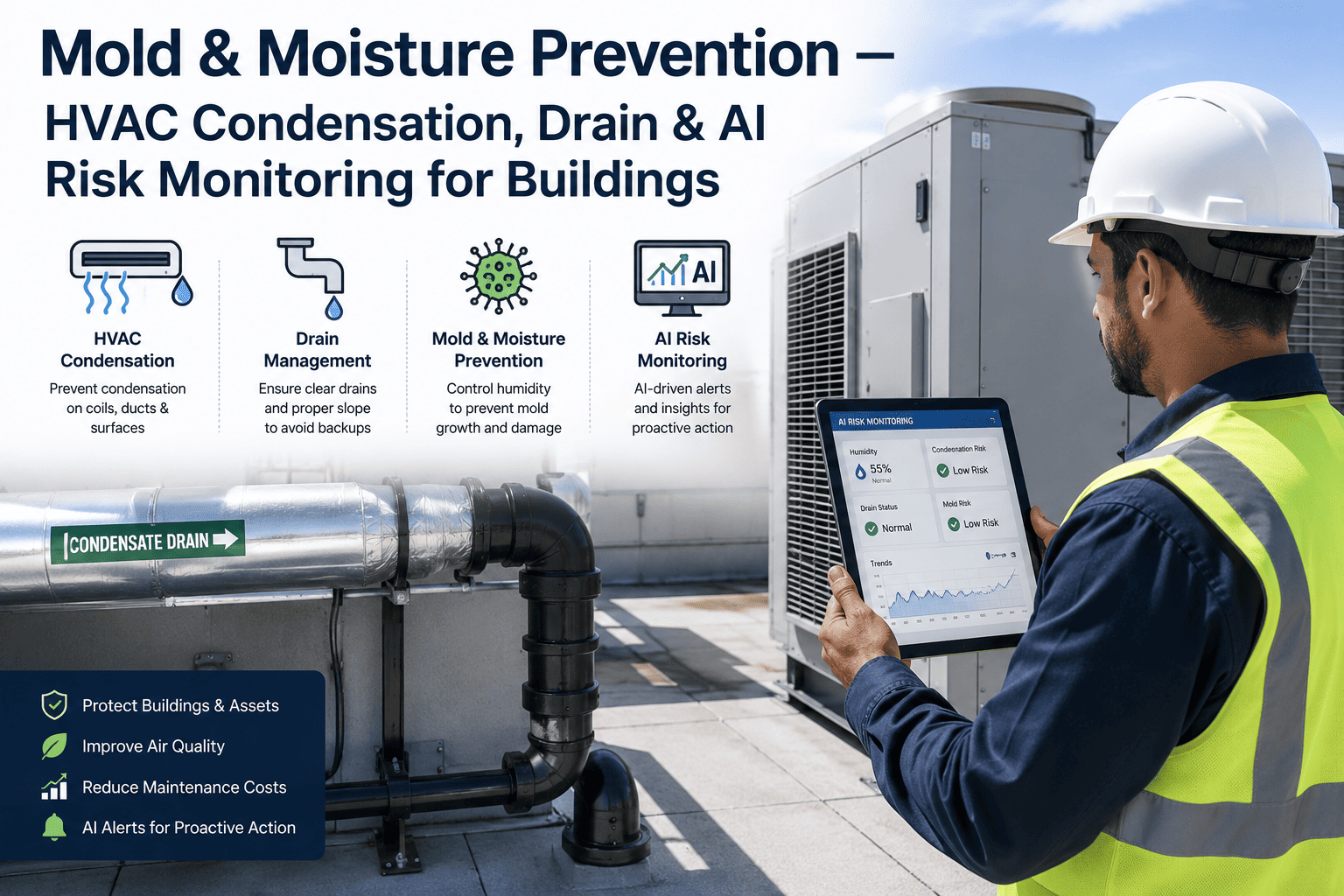
Mold problems rarely start with a leak someone notices right away. They start with a drain pan that is 80 percent blocked, a condensate line running slightly out of pitch, or a dehumidification setpoint that has quietly drifted for weeks. By the time visible mold or a musty odor triggers a complaint, moisture has usually been accumulating in a wall cavity or ceiling tile for far longer than anyone realized. AI monitoring exists to catch that accumulation while it is still just a drain pan reading a few percentage points off, not after it becomes a remediation project. To assess moisture risk factors specific to your building's HVAC systems, book a demo.
EHS RISK MANAGEMENT · MOISTURE PREVENTION
Mold and Moisture Prevention: Catching HVAC Risk Before It Becomes a Health Hazard
AI monitoring of condensation, drain pan overflow risk, and humidity control effectiveness gives EHS teams an early warning system for the moisture conditions that lead to mold growth and occupant health complaints.
THE FOUR RISK FACTORS EHS TEAMS TRACK
Where Moisture Risk Actually Originates in HVAC Systems
Mold risk in commercial buildings is overwhelmingly tied to a small set of recurring HVAC failure points, each of which produces a distinct, detectable signal before conditions become severe enough to support visible growth.
HIGH RISK
Drain Pan Overflow
Clogged condensate drains cause water to overflow the pan and saturate ceiling tiles or wall cavities, often undetected until staining appears.
HIGH RISK
Undersized Dehumidification
A system sized for temperature but not latent load leaves humidity elevated even when temperature setpoints read as satisfied.
MODERATE RISK
Duct Condensation
Poorly insulated ductwork in humid spaces can sweat, dripping condensation into ceilings over an extended period.
MODERATE RISK
Coil Icing and Thaw Cycles
Repeated icing and thawing on evaporator coils can overwhelm drain capacity in short bursts rather than a steady drip.
Get an Early-Warning Layer on Your Highest-Risk Equipment
See how continuous condensation and humidity monitoring would flag risk on your specific building's HVAC configuration.
SEASONAL RISK PATTERNS
When Moisture Risk Actually Peaks Through the Year
Moisture risk is not constant across the calendar, and treating it as a year-round flat risk profile causes EHS teams to under-monitor during the seasons when risk is actually highest.
SPRING
Moderate Risk
Rising outdoor humidity as cooling season begins strains dehumidification systems not yet running at full capacity.
SUMMER
Peak Risk
Highest cooling and dehumidification load of the year is when drain pans, coils, and condensate lines are most likely to reveal a capacity or maintenance gap.
FALL
Lower Risk
Reduced cooling load eases pressure on drainage systems, though residual moisture from summer can linger in poorly ventilated spaces.
WINTER
Moderate Risk
Heating season introduces its own condensation risk on cold surfaces and window areas, distinct from cooling-driven moisture.
WHAT CONTINUOUS MONITORING ACTUALLY CATCHES
From Raw Sensor Signal to an EHS Action Item
The value of AI monitoring in this context is less about detecting mold itself, which sensors cannot do directly, and more about catching the precursor conditions early enough that mold never gets the chance to establish. Drain pan level sensors flag a rising trend well before overflow, humidity sensors flag a zone drifting above the range where mold spores can begin colonizing, and condensate flow sensors flag a line trending toward a clog before it fully blocks.
1Drain pan level sensor detects a rising trend over several days rather than a sudden overflow event.
2System cross-references the trend against recent maintenance history and current cooling load.
3An EHS-routed alert is generated with the specific unit, location, and estimated days until overflow risk.
4A work order is created for drain line clearing before any water damage or mold-supporting conditions occur.
BEYOND HVAC MECHANICALS
Correlating Moisture Data With Building Envelope Conditions
HVAC condensation is only one moisture source, and a genuinely effective prevention program looks at HVAC signals alongside building envelope conditions such as roof leaks, window seal failures, or slab moisture intrusion, since mold does not distinguish between a mechanical source and an envelope source. Correlating an unexplained humidity spike in one zone against maintenance records for nearby windows or roof sections often reveals whether the HVAC system is the cause or simply the first place the symptom becomes visible.
FREQUENTLY ASKED QUESTIONS
What EHS Managers Ask About Moisture Monitoring
Can this system actually detect existing mold, or only prevent new growth?
Continuous condensation and humidity monitoring is designed to catch the precursor conditions that allow mold to establish, not to detect mold that has already formed, which still requires a physical inspection or air quality test. The value is in reducing how often that inspection becomes necessary in the first place by catching moisture risk earlier.
Book a demo to see the specific precursor signals the system tracks.
How quickly does an alert reach the right person after a drain pan trend is detected?
As outlined in the detection flow above, alerts are routed directly to the responsible EHS or facilities contact with the specific unit and estimated timeline attached, typically within the same monitoring cycle the trend is first identified rather than waiting for a scheduled report review.
Contact support for details on alert routing and escalation configuration.
Does this replace the need for a scheduled preventive maintenance program on drain lines?
No, continuous monitoring complements a preventive maintenance schedule rather than replacing it, catching the cases where a drain line clogs faster than the scheduled cleaning interval anticipated, which is a common gap in calendar-based maintenance programs regardless of how well-designed the schedule is.
Book a demo to discuss how monitoring fits alongside your existing PM schedule.
Is this monitoring approach different for buildings in humid versus dry climates?
The underlying risk factors are the same everywhere HVAC systems produce condensate, but the seasonal risk pattern and the specific humidity thresholds worth alerting on do shift by climate zone, which is why the seasonal calendar above should be treated as a general pattern to calibrate against your building's specific location.
Reach out to support to calibrate thresholds for your climate zone.
CATCH IT BEFORE IT BECOMES A HAZARD
Get Ahead of Moisture Risk Before It Becomes a Remediation Project
iFactory monitors the specific HVAC conditions that lead to mold-supporting moisture, routing early warnings to your EHS team before occupant health or building integrity is at stake.