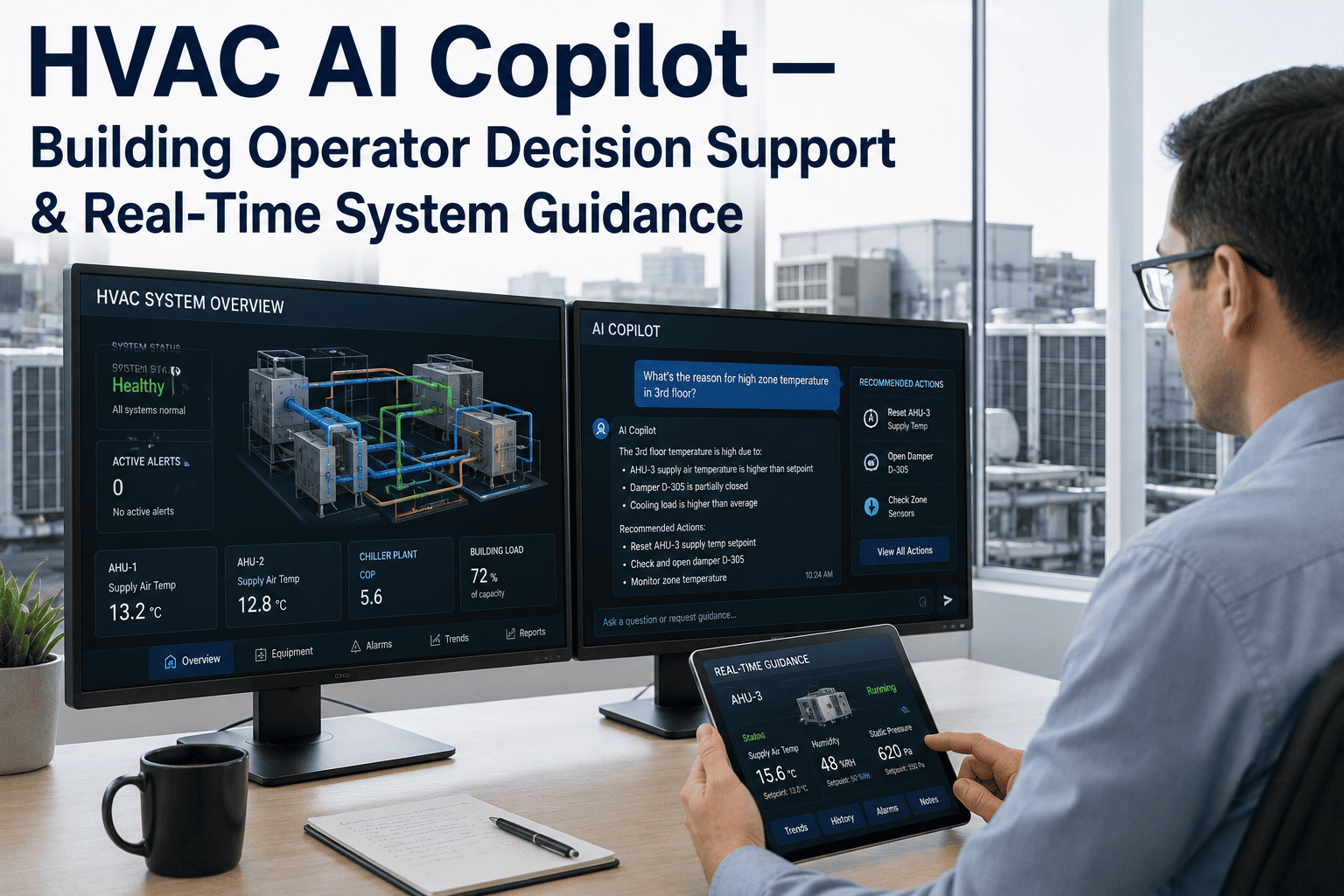
A raw BAS alarm reads "AHU-07 SUPPLY TEMP HIGH." That's the entirety of the information a building operator gets at 2 AM, on a floor with forty other pieces of equipment, with no indication of whether this is a filter fouling issue, a valve failure, or a sensor drift that self-corrects in ten minutes. Every operator eventually builds the mental model to interpret that alarm correctly — but that knowledge lives in one person's head, walks out the door at shift change, and starts from zero with every new hire. iFactory's HVAC AI copilot turns that same raw alarm into the context an experienced operator would already have — what it likely means, what to check first, and how urgent it actually is. This gap between what a BAS alarm literally says and what an experienced operator understands it to mean is one of the most persistent, quietly expensive problems in commercial building operations. It's not a data problem — the sensor readings are accurate. It's an interpretation problem, and interpretation has historically lived entirely in individual human memory rather than anywhere the organization can systematically access, train against, or hand off cleanly between shifts.
Every Alarm Means Something Different Depending on Who's Reading It. The Copilot Reads It Like Your Best Operator Would.
A raw alarm code and a contextualized recommendation are two very different starting points for the exact same operational decision — one requires fifteen years of institutional memory to interpret correctly, the other doesn't.
The Same Alarm, Interpreted Two Completely Different Ways
The gap between a junior operator and a fifteen-year veteran isn't access to different data — both are looking at the same BAS screen, the same alarm feed, the same trend graphs. The gap is interpretation: the veteran has seen this specific alarm pattern on this specific unit type dozens of times and knows within seconds what it usually means, while the junior operator is starting the diagnostic process from first principles every single time. That gap is exactly what an AI copilot is built to close — not by replacing the operator's judgment, but by giving every operator access to the pattern recognition that used to require years to develop.
A recent industry perspective on this shift captured it well: automation didn't eliminate the operator, it elevated the role. The modern building operator is increasingly a coordinator of building reality — aligning sensor data, field conditions, maintenance history, occupant experience, and organizational decision-making into a coherent response. That coordination role becomes far more effective when the raw data arriving from the BAS is already partially interpreted, rather than requiring the operator to do all of that synthesis manually, alarm by alarm, for every single event.
This distinction matters because it reframes what the technology is actually for. A copilot isn't autonomous control — it doesn't adjust setpoints or override the BAS on its own. It's a layer that sits between the raw alarm stream and the operator, translating "AHU-07 SUPPLY TEMP HIGH" into the specific, contextualized read a senior engineer would already have: what this pattern usually indicates on this equipment type, what to check first, and how urgent it genuinely is relative to everything else happening in the building right now.
Alarm Contextualization
Raw alarms get enriched with the surrounding data that gives them meaning — related sensor trends, maintenance history, and how far the current reading has drifted from the unit's own established baseline, not a generic fixed threshold applied uniformly across every piece of equipment in the building regardless of how that specific unit normally behaves.
Severity & Urgency Scoring
Not every alarm deserves the same response speed. Pattern-matched severity scoring separates the alarm that needs attention in the next five minutes from the one that can wait until the next scheduled round, cutting through the noise of a feed where everything otherwise looks equally urgent to an operator scanning it quickly.
Suggested First Checks
A recommended diagnostic starting point based on what this alarm pattern has historically indicated — not a replacement for the operator's own judgment, but a starting point that skips the first ten minutes of "where do I even begin" that a junior operator otherwise spends alone.
Shift Handoff Context
Institutional knowledge that used to live in one operator's head and get lost at shift change — the history of the last several similar events on this specific unit — is instead attached directly to the alarm, available to whoever picks it up next.
The Operator Still Makes the Call. The Copilot Just Makes Sure They're Not Starting From Zero.
iFactory's copilot surfaces relevant context and a recommended first action on every alarm — your operators retain full authority over what actually happens next in the building.
Why This Has to Stay Human-in-the-Loop, Not Fully Autonomous Control
There's an important distinction in AI-assisted operations literature between human-in-the-loop, where a human makes the final call on every action, and human-on-the-loop, where the system acts autonomously and a human retains veto power to intervene. For most building HVAC decisions — a comfort complaint, a filter change recommendation, an energy optimization suggestion — human-in-the-loop is the appropriate model, and for good reason: the operator has context the copilot doesn't. Occupant complaints already lodged for that zone, a contractor working nearby, a scheduled event that changes normal occupancy patterns — none of that is necessarily visible to a system reading sensor data alone.
Research into human-in-the-loop systems across safety-critical domains has identified a real failure mode worth naming directly: override fatigue. If an AI system requires constant correction because its recommendations are frequently wrong, operator trust erodes quickly, and operators either disengage entirely or start mechanically approving whatever the system suggests without genuine scrutiny — both outcomes defeat the purpose of keeping a human in the loop at all. This is precisely why recommendation accuracy and appropriate confidence calibration matter as much as the underlying interpretability of the alarm context itself; a copilot that's confidently wrong too often trains operators to stop trusting it, which is functionally the same as not having it.
This isn't a limitation to work around; it's the actual design intent. The value of a copilot comes from compressing the time between an alarm firing and an operator having enough context to act — not from removing the operator's judgment from decisions that genuinely benefit from it. A building operator who understands sequence, documentation, occupant history, and organizational risk brings something to a decision that pattern-matched sensor data alone cannot replicate, and a copilot built to sideline that judgment rather than support it is solving the wrong problem.
| Decision Type | Appropriate Model | Why |
|---|---|---|
| Comfort complaint response | Human-in-the-loop | Occupant context and history matter beyond sensor data alone |
| Alarm triage and prioritization | Human-in-the-loop, AI-assisted | Copilot ranks urgency; operator confirms and acts |
| Routine setpoint optimization within bounds | Human-on-the-loop | Low-risk, reversible, operator retains override at all times |
| Safety-critical equipment shutdown | Human-in-the-loop, always | Irreversible consequences require a human decision, no exceptions |
Alarm Fatigue Is the Actual Failure Mode This Is Specifically Built to Prevent
The most common way a well-intentioned building automation system undermines itself is generating so many alarms, at such uniform apparent urgency, that operators stop meaningfully engaging with any of them. Once a facility team learns that most alarms are false positives or low-priority noise, the instinct to dismiss quickly becomes rational self-preservation — and the one alarm in a hundred that actually mattered gets dismissed along with the ninety-nine that didn't. This pattern is well documented across safety-critical operator domains, not unique to HVAC, and it's a predictable consequence of poorly tuned alarm systems rather than operator negligence.
The uncomfortable reality is that alarm fatigue is often self-inflicted by well-meaning system design. A vendor or integrator, aiming to be thorough, configures generous alarm thresholds "to be safe" — better to alert on something minor than miss something major, the reasoning goes. But that reasoning ignores the compounding cost of false positives: each unnecessary alert erodes trust in the next one, and the erosion is cumulative and largely irreversible without a deliberate retuning effort. A building generating dozens of low-value alarms daily isn't safer than one generating three well-calibrated ones — it's less safe, because the operators have learned, correctly given their experience, that most alarms don't warrant urgent attention.
The fix isn't more alarms with more detail bolted on — that makes the noise problem worse, not better. The fix is fewer, better-prioritized signals: alarms scored against a unit's own historical baseline rather than a generic fixed threshold, genuinely low-priority events suppressed or batched rather than interrupting in real time, and every alarm that does surface arriving with enough context that an operator can make a fast, confident decision instead of having to investigate from scratch before even knowing whether the alarm deserves attention.
Baseline each unit's normal operating range individually
A fixed threshold applied uniformly across every AHU in a building generates false alarms on units that naturally run warmer or noisier than others — individual baselines dramatically cut nuisance alerts.
Score severity against pattern history, not just current reading
A reading that's technically outside a fixed limit but matches a known, benign pattern shouldn't carry the same urgency as an identical reading that matches a pattern preceding equipment failure.
Attach context automatically, not on request
Requiring an operator to manually pull maintenance history and related sensor trends before they can even assess an alarm's urgency defeats the purpose — context needs to arrive with the alarm, not after a separate investigation.
Route by confidence, not blanket escalation
High-confidence pattern matches can suggest a specific first action directly; genuinely novel or ambiguous situations should flag for full operator investigation rather than offering a low-confidence guess dressed up as a recommendation.
Review and retune regularly with the operators who use it
An alarm system's relevance decays as building conditions, equipment, and occupancy patterns change — periodic review with the facility team keeps false-positive rates low over time rather than letting them creep upward unnoticed.
What Operations Directors Should Realistically Expect From a Deployment
The realistic value of an HVAC AI copilot isn't a building that runs itself — it's a facility team that spends less time on low-value diagnostic guesswork and more time on decisions that genuinely need human judgment. Energy waste from HVAC systems ignoring real occupancy and running on fixed schedules is a documented and substantial inefficiency in commercial buildings — closing that gap requires exactly the kind of context-aware, continuously adjusted operation a copilot layer supports, working alongside the operator team rather than instead of it.
It's worth setting expectations honestly around what "AI-assisted" means in practice, because the marketing language across this category often implies more autonomy than what's actually being delivered — or what should be delivered, for a domain where occupant comfort and equipment safety both carry real consequences for getting it wrong. The realistic pitch to an operations director isn't "the building manages itself" — it's "your team makes faster, better-informed decisions, with less time wasted on alarms that turn out to be nothing, and more consistency across shifts and staff turnover than institutional memory alone ever provided."
What shouldn't be expected is a system that eliminates the need for experienced operators, or one that works well immediately with zero tuning and adjustment. Fault detection and diagnostics platforms have matured considerably as a category, but the value compounds over the first several months of operation as the system's pattern-matching improves against a specific building's actual historical behavior — a new deployment on day one won't carry the same institutional knowledge as one that's been learning from a building's alarm and maintenance history for a year.
The operators who get the most value from a copilot are the ones who already understood their building deeply — the tool doesn't replace that understanding, it scales it. A junior operator with copilot context can act with something close to the confidence of someone who's worked the building for a decade, on the specific alarm patterns the system has already learned. But the moment a situation falls outside what the pattern history covers, that experienced judgment is still exactly what the building needs, and no copilot changes that.
Frequently Asked Questions About HVAC AI Copilot Deployment
Does the AI copilot make decisions automatically, or does it just provide recommendations?
The copilot surfaces context, prioritizes alarms by urgency, and suggests a recommended first action — it does not autonomously adjust setpoints, override the BAS, or shut down equipment. Every action that actually changes building operation requires an operator's confirmation, which is the appropriate design for a domain where occupant context and organizational judgment genuinely matter beyond what sensor data alone can capture.
Lower-risk, easily reversible optimizations can operate with more autonomy and operator veto power, but safety-critical and comfort-affecting decisions stay firmly human-in-the-loop. Book a demo to see exactly where the line sits between AI recommendation and operator decision in iFactory's copilot.
How long does it take before the copilot's recommendations become genuinely accurate for our specific building?
Accuracy improves progressively as the system accumulates historical alarm and maintenance data specific to your building's actual equipment and operating patterns — a new deployment starts with general pattern knowledge but hasn't yet learned the specific quirks of your particular AHUs, chillers, and zones. Most facilities see meaningfully improved recommendation quality within the first few months of continuous operation as enough real events accumulate for the system to learn from.
This is why early recommendations should be treated as informed starting points for operator investigation rather than final answers — the system genuinely gets better with more building-specific history. Book a demo to discuss a realistic accuracy timeline for your specific portfolio.
Will this reduce the number of experienced operators we need, or change what we need them to do?
The more accurate framing is a shift in what experienced operators spend their time on, not a reduction in the need for their judgment. Time that used to go toward basic diagnostic investigation — "what does this alarm usually mean, where do I even start" — gets compressed, freeing experienced staff to spend more time on the decisions that genuinely require years of accumulated judgment: ambiguous situations, novel failure modes, and the organizational context a sensor feed alone can't capture.
Junior operators benefit disproportionately, since the copilot closes some of the experience gap between them and senior staff on well-understood alarm patterns — but the most experienced judgment on the team remains just as necessary for everything the system hasn't seen before. iFactory's support team can walk through how this typically reshapes operator workflows without reducing headcount needs.
How does the copilot avoid adding to alarm fatigue instead of reducing it?
This is a legitimate risk if implemented poorly — a copilot that generates additional AI-flagged notifications on top of an already noisy BAS alarm feed makes the fatigue problem worse, not better. The correct implementation approach reduces the number of alerts an operator has to actively triage by scoring severity against each unit's own baseline, suppressing or batching genuinely low-priority events, and attaching context directly to the alarms that do surface so operators aren't investigating from scratch.
The goal is fewer, better-prioritized signals rather than more signals with more detail — volume reduction is as important as context enrichment. Book a demo to see how iFactory's alarm scoring is specifically designed to reduce total alert volume, not add to it.
Does deploying this require replacing our existing BAS, or does it work alongside it?
A copilot layer is designed to read from your existing building automation system rather than replace it — connecting through standard protocols like BACnet, Modbus, or direct API integrations with major BAS platforms. Your existing controls, sequences, and BAS interface continue operating exactly as they do today; the copilot adds a context and decision-support layer on top of the alarm stream your BAS already generates.
This matters because replacing an established BAS carries real cost and operational risk that most facility teams have no appetite for — the value here comes specifically from working with what's already installed. Book a demo to see how iFactory connects to your specific BAS platform.
Give Every Operator the Context Your Best Operator Already Has
iFactory's HVAC AI copilot contextualizes every alarm, scores urgency against each unit's own baseline, and surfaces a recommended first check — while your operators retain full authority over what happens next and how the building actually responds.