Parking structures are among the most aggressively exposed concrete assets in any building portfolio. Deicing salts carried by vehicles, freeze-thaw cycles, constant live loading, and carbonation create a corrosive environment that causes reinforcing steel to rust, expand, and spall the surrounding concrete — typically within 15 to 25 years of construction if waterproofing and drainage are not actively maintained. The 2024 American Parking Association state-of-the-industry report estimates that 62 percent of US parking structures over 20 years old require repair work exceeding $500,000, and 18 percent require more than $2 million in structural rehabilitation. Despite this, fewer than 30 percent of parking structure owners have a formal condition assessment and maintenance plan. Analytics-driven concrete condition monitoring — including half-cell potential mapping, ground-penetrating radar for delamination detection, crack width tracking with digital sensors, and waterproofing membrane integrity testing — enables owners to shift from reactive emergency repairs to predictive maintenance that extends structure life by 10 to 20 years while reducing total repair expenditure by 35 to 55 percent.
Start Your Parking Structure Analytics Program
iFactory Parking Structure Analytics module provides digital condition tracking, inspection scheduling, repair cost modeling, and lifecycle forecasting for concrete parking assets of any size.
Concrete Condition Assessment — Four Critical Parameters
Regular concrete condition assessment detects deterioration before it becomes visible. The four parameters below are the primary indicators of concrete health in parking structures and determine the urgency and scope of required repairs.
Waterproofing Membrane Inspection — Six Integrity Checks
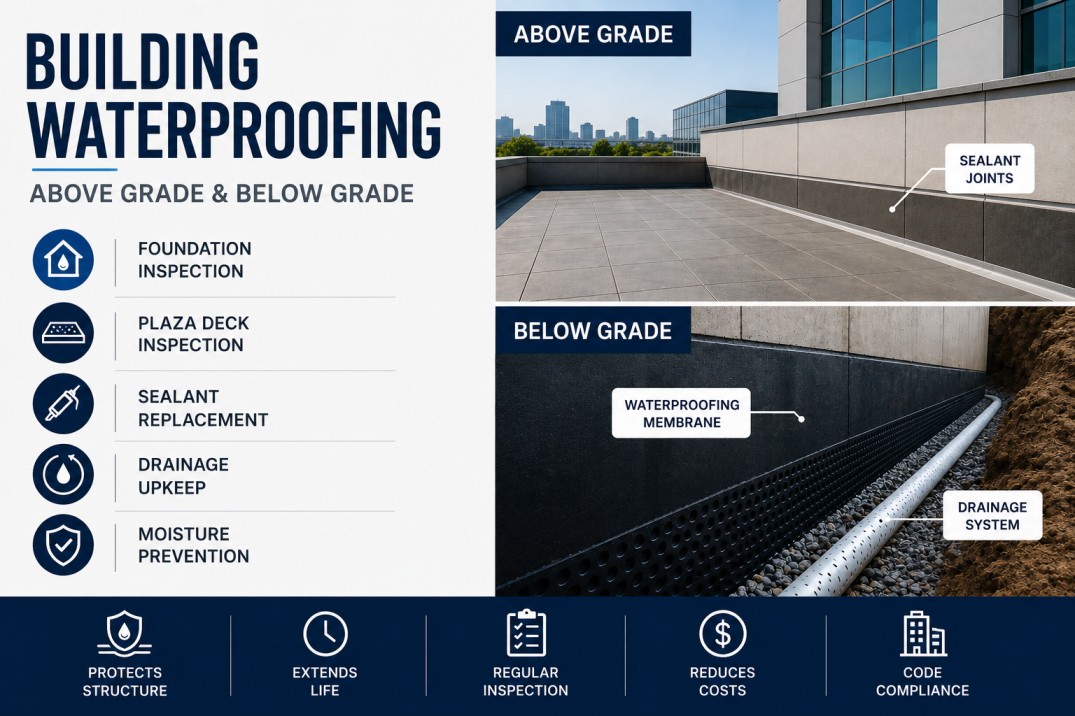
The waterproofing membrane is the primary barrier protecting the concrete structure from chloride ingress. Membrane failure is the leading cause of rebar corrosion in parking structures. Inspection should be performed annually and after any deck resurfacing or utility work.
Expansion Joint Analytics — Types, Monitoring, and Replacement Triggers
Expansion joints accommodate thermal movement, creep, and seismic displacement in parking structures. Joint failure allows water and chlorides to reach the substructure, making joint condition a leading indicator of overall structural health.
| Joint Type | Typical Spacing | Movement Capacity | Failure Mode | Replacement Trigger |
|---|---|---|---|---|
| Open Joint (Strip Seal) | 50–80 ft | ±25–50 mm | Rubber extrusion wear, anchor failure | Leak visible below joint |
| Filled Joint (Elastomeric) | 30–50 ft | ±12–25 mm | Sealant adhesion loss, cohesive cracking | Crack depth >50% of sealant width |
| Modular (Multiple Seals) | 80–150 ft | ±50–100 mm | Center beam wear, seal extrusion | Seal displacement >5 mm from center |
| Bolt-Down Plate | 20–40 ft | ±10–20 mm | Corrosion of plate, anchor bolt loosening | Plate lift >3 mm above deck surface |
| Pour-in-Place (CIP) | 60–100 ft | ±30–60 mm | Nose concrete spalling, support bar corrosion | Spall depth >25 mm at joint edge |
Digital Joint Monitoring — From Visual to Sensor-Based
iFactory joint analytics module tracks crack width, seal displacement, and leakage events over time, alerting your team when joint condition crosses repair thresholds.
Structural Steel Corrosion — Detection and Prevention Strategies
Reinforcing steel corrosion is the root cause of 90 percent of parking structure concrete distress. Chlorides from deicing salts penetrate the concrete cover, depassivate the steel, and initiate electrochemical corrosion that produces expansive rust — generating tensile stresses that crack and spall the concrete.
Inspection and Maintenance Schedule — Annual Cycle
A structured inspection and maintenance cycle prevents small issues from becoming structural emergencies. The schedule below follows International Parking & Mobility Institute (IPMI) and American Concrete Institute (ACI) recommended practices for parking structure maintenance.
Frequently Asked Questions
How often should a parking structure be inspected?
The International Parking & Mobility Institute recommends a comprehensive condition survey every 12 months for structures over 10 years old, and every 24 months for structures under 10 years old. Structures exposed to deicing salts, in coastal environments, or with known repair history should be inspected every 6 months. The annual inspection should include a full visual survey of all parking levels, chain drag or hammer sound delamination survey on at least 10 percent of the deck area (or 100 percent if the structure is over 20 years old), joint seal condition inspection, drain functionality testing, and review of previous repair records. A more detailed analytical inspection including half-cell potential mapping, GPR delamination survey, and chloride content profiling should be performed every 3 to 5 years or when the annual inspection identifies areas of concern.
What is the most common cause of parking structure concrete deterioration?
Reinforcing steel corrosion caused by chloride ingress from deicing salts is the primary deterioration mechanism, responsible for approximately 90 percent of parking structure concrete distress. The process begins when chloride ions from salt-laden water penetrate the concrete cover and accumulate at the rebar depth. Once the chloride concentration at the rebar surface exceeds the corrosion threshold (approximately 0.05 percent chloride by weight of concrete for black steel bars), the protective passive layer on the steel breaks down and corrosion initiates. Corrosion products (rust) occupy 2 to 6 times the volume of the original steel, generating tensile stresses that cause the surrounding concrete to crack, delaminate, and eventually spall. The time from initial chloride ingress to visible spalling typically ranges from 5 to 15 years depending on concrete quality, cover depth, and exposure severity. Waterproofing membrane failure is the event that most often accelerates this timeline — a failed membrane allows chlorides to reach the deck surface directly rather than being shed to drains.
How much does parking structure concrete repair cost?
Parking structure repair costs vary significantly by scope and location. Superficial crack sealing costs $2 to $5 per linear foot. Partial-depth spall repair (surface patching, 20 to 40 mm depth) ranges from $15 to $35 per square foot. Full-depth concrete repair involving rebar cleaning and replacement ranges from $50 to $120 per square foot. Waterproofing membrane replacement costs $8 to $18 per square foot depending on membrane type and surface preparation requirements. Expansion joint replacement ranges from $60 to $200 per linear foot for strip seal joints and $150 to $400 per linear foot for modular joints. Cathodic protection system installation costs $8 to $20 per square foot for impressed current systems and $5 to $12 per square foot for galvanic systems. Total repair costs for a typical 200,000-square-foot parking structure over a 10-year maintenance cycle range from $800,000 to $2.5 million. Proactive analytics-based maintenance typically reduces 10-year repair expenditure by 35 to 55 percent compared to reactive repair strategies.
What non-destructive testing methods are most effective for parking structures?
Ground-penetrating radar (GPR) is the most effective method for delamination detection in parking structures, providing rapid survey coverage of entire decks at walking speed with real-time data visualization. GPR detects delaminations at the rebar depth horizon and maps their extent in plan view with accuracy within 1 to 2 feet of actual boundaries. Chain drag and hammer sounding are the lowest-cost methods and remain the most widely used for initial screening, but they are operator-dependent and limited to detecting delaminations that are at least 50 percent open. Half-cell potential mapping is the standard method for identifying active corrosion zones — a full-grid survey at 1 meter spacing provides a corrosion probability map of the entire deck. Impact echo testing is used for assessing concrete thickness and detecting deep delaminations or voids behind wall panels. Infrared thermography can detect subsurface moisture and delamination in certain conditions but requires direct sun exposure and specific time-of-day windows for accurate results. iFactory's NDT integration module consolidates data from all these methods into a single condition map with automated repair prioritization.
How long does a parking structure waterproofing membrane last?
The service life of a parking structure waterproofing membrane depends on membrane type, traffic exposure, climate, and maintenance quality. Fluid-applied polyurethane membranes typically last 8 to 12 years before requiring replacement or significant restoration. Sheet-applied modified bitumen membranes last 10 to 15 years. Cementitious crystalline waterproofing has an indefinite lifespan in theory but is typically rated at 15 to 20 years for above-grade parking applications. Hot-applied rubberized asphalt membranes provide 12 to 18 years of service life. Methyl methacrylate (MMA) membrane systems, commonly used for rapid-cure applications, last 8 to 12 years. The single most important factor extending membrane life is annual inspection with prompt repair of punctures, blisters, and joint edge failures — a well-maintained membrane typically lasts 40 to 60 percent longer than one that receives attention only when active leaks occur. Membrane replacement accounts for 25 to 35 percent of a parking structure's total maintenance budget over a 30-year lifecycle, making early detection of membrane failures one of the highest-ROI analytics applications.
From Reactive Repairs to Predictive Analytics — Extend Structure Life by a Decade
iFactory Parking Structure Analytics gives your team the data, schedule, and budget models to manage concrete condition proactively across your entire portfolio.