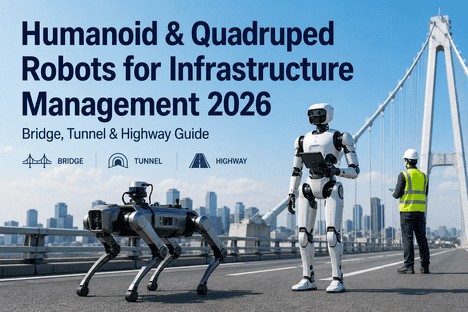
Every year, thousands of bridges, tunnels, highways, and power grids pass their inspection deadlines with the same manual methods used decades ago. A human engineer climbs a scaffold, walks a culvert, or leans over a guardrail, taking notes by hand. The infrastructure ages, but the inspection process barely changes. That gap is now closing. Quadruped robots walk through confined culverts and map bridge cavities in complete darkness. Humanoid robots set cones on motorway construction sites, flag deviations against BIM models, and patrol live substations. Together they form a new layer of infrastructure management — one that sees, measures, and predicts before failure occurs.
START YOUR ROBOTIC INFRASTRUCTURE JOURNEY
See How iFactory Bridges Quadruped and Humanoid Robotics With Your Existing Operations
One platform connects any robot, any sensor, any asset — no hardware lock-in, no infrastructure replacement required.
480%
Global humanoid robot shipment growth (2024-2025)
5,000+
Quadruped robots deployed by State Grid China in 2026
$1B
State Grid's 2026 embodied AI procurement budget
90%
Reduction in high-risk worker exposure with robot deployment
THE LANDSCAPE SHIFT
Why Infrastructure Management Needs Robots in 2026
The world's critical infrastructure is aging. In the United States, 70% of the power grid was built between the 1950s and 1970s and is approaching end of life. Europe's 40,000 bridges require regular inspection, with over 1,600 already classified as dilapidated. Meanwhile, the workforce that maintains these assets is retiring, and fewer skilled workers are entering the trades. The gap between what needs inspection and who can inspect it is widening every year.
Quadruped and humanoid robots are not futuristic replacements for human workers. They are practical tools already deployed today — by Caltrans, National Grid, Hamburg Port Authority, State Grid China, and UK contractors — to handle the tasks that are repetitive, hazardous, or simply impossible for humans to perform efficiently.
+22%
Global infrastructure inspection demand increase (2020-2025)
vs
-14%
Available certified inspection workforce change
QUADRUPLED VS HUMANOID
Two Robots, Two Roles: Which One Does What?
The distinction between quadruped and humanoid robots in infrastructure is not about which is better. It is about which form factor fits the task. Quadrupeds excel at terrain navigation, stability, and endurance in confined or uneven spaces. Humanoids bring dexterity, reach, and the ability to use human-designed tools and interfaces. Understanding the difference is the first step in planning any robotic infrastructure program.
QUADRUPED
Boston Dynamics Spot, Deep Robotics X30, Unitree B2
- Navigates stairs, rubble, steep slopes, and loose terrain
- Runs 90+ minutes per charge; swappable batteries
- SLAM LiDAR + thermal + acoustic payload capacity
- Autonomous patrol and multi-day unsupervised missions
- Deployed in culverts, bridge soffits, substations, tunnels
VS
HUMANOID
Unitree G1, Figure 02, Tesla Optimus, H.E.R.O.
- Bimanual manipulation: opens panels, flips switches, carries tools
- Operates human equipment: ladders, valves, safety barriers
- Vision-language AI for context-aware decision making
- Deployable alongside human crews without facility modification
- Trialed on motorways, construction sites, live substations
APPLICATIONS
Where Robots Are Already Working on Infrastructure
These are not pilot programs running in empty warehouses. Quadruped and humanoid robots are inspecting live bridges, patrolling active substations, mapping underground tunnels, and monitoring highway construction sites today. Here is where they are deployed and what they deliver.
Bridge Inspection
Quadruped robots like Boston Dynamics Spot navigate bridge cavities, soffits, and confined cells in complete darkness. Hamburg Port Authority uses Spot for autonomous multi-day inspections of the Kohlbrand Bridge, capturing LiDAR point clouds and high-res images at predefined points of interest. The robot works unsupervised, recharges autonomously, and produces digital twin data that engineers compare across inspection cycles.
Digital twin generationCrack detectionAutonomous recharge
Tunnel & Confined Space Inspection
Caltrans deployed Spot to inspect a 300-foot culvert beneath a California highway after a sinkhole formed. The robot walked over loose gravel, mud, and debris, scanning the pipe interior with SLAM LiDAR in a single pass, capturing what would have required multiple static scans and significant traffic disruption. In Singapore, the DEEP Robotics X30 (SPock) patrols 40km of underground power transmission tunnels, generating real-time inspection reports at the end of each shift.
SLAM LiDAR mappingGas sensingZero traffic disruption
Highway & Road Infrastructure
National Highways UK trialled Spot for geotechnical embankment inspections along the M5 motorway, replicating principal inspections that normally require two inspectors walking the top and bottom of slopes. In Italy, Edil San Felice's H.E.R.O. humanoid — the first patented for road construction sites — handles cone placement, signage setup, and traffic management across kilometres of active motorway worksites.
Slope stability monitoringTraffic managementGeotechnical survey
Power Grid & Substation Patrol
State Grid China's 2026 embodied intelligence plan allocates 5,000 quadruped robots for substation inspection and 500 humanoid robots for live-line ultra-high-voltage maintenance. National Grid in the UK uses Spot for infrared hot-spot detection inside energised thyristor halls during operation — inspections that previously required shutting down equipment entirely. Each robot saves an estimated $70,000-110,000 annually in labour and outage costs.
Thermal anomaly detectionLive-line maintenancePartial discharge acoustics
Port & Rail Infrastructure
Hamburg Port Authority plans to extend Spot deployments to 120 bridges, 300km of rail tracks, and fire safety inspections across its estate. In China, Hefei Metro deploys quadruped robot dogs for station patrol and drones for tunnel inspection as part of a coordinated robot cluster. The system captures sensor data across platforms to enable predictive maintenance and operational anomaly detection.
Rail corridor monitoringMulti-robot coordinationPredictive maintenance feed
THE WORKFLOW
How a Robot Deployment Works in Practice
Moving from human-led inspection to robotic infrastructure management follows a repeatable pattern. The specifics vary by asset type, but the workflow below reflects the approach taken by early adopters across transport, energy, and utilities.
01
Asset Audit & Route Mapping
Engineers walk the asset once with the robot, recording waypoints, points of interest, and access constraints. The robot's navigation system builds a reference map using SLAM, identifying fiducial markers or structural features for autonomous relocalisation on subsequent visits.
02
Sensor Configuration & Payload Calibration
The robot is equipped with asset-specific sensors: thermal cameras for electrical inspection, acoustic imagers for mechanical anomaly detection, LiDAR for structural mapping, or gas sensors for confined-space air quality monitoring. Payloads are swapped in under five minutes.
03
Autonomous Patrol or Inspection Mission
The robot runs its programmed mission — during working hours alongside crews or overnight in autonomous mode. Data streams in real time to the operations platform. Alerts for anomalies (hot spots, gas leaks, structural deviations) are dispatched automatically.
04
Digital Twin Update & Condition Reporting
Captured data is ingested into the asset's digital twin. Historical comparisons reveal crack progression, equipment wear, or terrain change over time. Reports are generated automatically and fed into the CMMS or asset management system for maintenance scheduling.
OUTCOMES & DATA
Measurable Results From Real Deployments
$60,000
Saved by Caltrans in under 10 minutes
A single Spot deployment at a California culvert collapse avoided permits, excavation, and environmental mitigation costs — paying for the robot in a single inspection event.
90%
High-risk exposure reduction
State Grid China reports that robotic deployment cuts worker exposure to live electrical, confined space, and elevated hazard scenarios by over 90%, with accident rates down 80%.
480 hrs
Annual manual inspection hours saved
Singapore SP Group projects 480 hours of manual inspection time saved per year after deploying the DEEP Robotics X30 in its underground power cable tunnels.
2-3 yrs
Robot payback period per unit
State Grid's procurement analysis projects each quadruped inspection robot delivers $70,000-110,000 in annual labour and operational savings, achieving full payback within 2-3 years.
DEPLOY ROBOTIC INFRASTRUCTURE MANAGEMENT
Ready to Move From Manual Inspection to Intelligent Robotics?
iFactory's infrastructure platform connects quadruped and humanoid robots, sensor networks, AI analytics, and digital twin reporting into a single operations dashboard. No hardware vendor lock-in. No infrastructure replacement required.
FREQUENTLY ASKED QUESTIONS
What Infrastructure Managers Ask About Adopting Robotics
Can quadruped robots operate in GPS-denied environments like tunnels and bridge interiors?▼
Yes. Quadruped robots use SLAM (Simultaneous Localization and Mapping) with LiDAR and visual odometry to navigate spaces where GPS is unavailable. Boston Dynamics Spot operates inside Hamburg's Kohlbrand Bridge cavities in complete darkness, and the DEEP Robotics X30 patrols 40km of underground power tunnels in Singapore — both relying entirely on onboard sensors for positioning and navigation.
How do humanoid robots handle tasks that require tool use or physical manipulation?▼
Modern humanoids like Unitree G1 and Figure 02 are equipped with sensorised hands that provide force feedback and multi-degree-of-freedom articulation. They can grip, lift, turn, and place objects using standard human tools. Edil San Felice's H.E.R.O. humanoid handles cone placement and sign positioning on motorways, while State Grid's humanoids perform live-line maintenance on ultra-high-voltage equipment — tasks that require precise tool handling in high-risk environments.
What is the typical ROI timeline for a quadruped robot deployment?▼
ROI varies by use case, but published data from large-scale deployments indicates a 2-3 year payback period per unit. State Grid China projects each quadruped robot saves $70,000-110,000 annually in labour costs. Caltrans recovered the equivalent of its robot cost in a single culvert inspection that avoided $60,000 in permits and excavation. When factoring in avoided incident costs, reduced traffic disruption, and extended asset life from earlier defect detection, total ROI often exceeds initial projections.
Can these robots integrate with existing asset management and CMMS platforms?▼
Yes. Modern robotic platforms export data through standard APIs that connect with GIS systems, digital twin platforms, and Computerised Maintenance Management Systems (CMMS). Inspection reports, anomaly alerts, and digital twin updates flow directly into the existing operations interface. Platforms like iFactory provide the middleware layer that unifies data from multiple robot types and sensor feeds into a single infrastructure management dashboard.
Are regulatory and certification pathways clear for robotic infrastructure inspection?▼
The regulatory landscape is maturing quickly. Faraday Future's FX Aegis quadruped achieved FCC certification in the US in early 2026, clearing the path for commercial deployment in regulated environments. In Europe, non-intrusive robotic inspection systems that do not modify core signalling or safety equipment can often be deployed without full re-certification under CEN-CENELEC standards. For humanoid robots on road construction sites, operators like Edil San Felice are working directly with regulatory authorities to establish operational permits. The trend is toward accelerated approval as safety data accumulates from early deployments.
INFRASTRUCTURE INTELLIGENCE PLATFORM
Your Infrastructure Deserves More Than a Clipboard and a Flashlight
iFactory connects your existing asset inventory with robotic inspection workflows, AI anomaly detection, and predictive maintenance scheduling. One platform. Any robot. Every asset. No unnecessary infrastructure changes.