A container vessel carrying 24,000 TEU arrives at berth. Over the next 24 hours, every one of those boxes must be lifted off by quay crane, transferred across the yard by autonomous vehicle, stacked by automated gantry, inspected for damage, scanned for hazardous contents, verified against customs manifests, and loaded onto a truck, train, or feeder vessel — and the entire cycle repeats in reverse for outbound cargo. The terminal operates on a footprint of less than a square kilometre, with equipment valued at over half a billion dollars, and any unplanned downtime on a single crane or a single inspection bottleneck cascades into berth delays measured in hours at costs exceeding $100,000 per hour. For decades, the weakest link in this chain was manual inspection: human operators reading container numbers by radio, divers inspecting submerged quay walls, technicians climbing crane gantries with vibration pens, and yard patrols walking between stacks with clipboards. That is changing. Quadruped robots, AI vision systems at the crane level, autonomous underwater vehicles, and predictive maintenance platforms are now deployed across the world's busiest terminals — converting every container move, every crane cycle, and every patrol pass into structured asset intelligence. This is the technical guide to how port and maritime infrastructure robotics for quay crane, yard, and container terminal automation actually works, and why the ports deploying it are achieving vessel turnaround times, inspection coverage, and equipment availability that manual operations cannot match.
PORT ASSET INTELLIGENCE PLATFORM
See How iFactory Connects Port Robotics, Crane AI, and Asset Management Into One Terminal Workflow
One platform fuses quadruped patrol data, crane predictive maintenance, container inspection AI, and CMMS integration. No rip-and-replace. Value from your first terminal deployment.
99%
Container ID recognition accuracy at STS crane level (Ningbo Customs quadruped pilot)
95%
Foreign object detection rate by quadruped in container inspections
20%
Less port time for vessels using integrated port-wide AI scheduling (Port of Rotterdam Data)
1,100+
Automated stacking cranes operating worldwide across major container terminals
THE FOUR ZONES OF PORT AUTOMATION
Quay, Yard, Container, and Submerged Infrastructure — Each Zone Needs Different Robotics
A container terminal is not one asset. It is a collection of interconnected zones — each with its own equipment, its own failure modes, and its own inspection requirements. The quay side handles ship-to-shore container transfer under dynamic vessel movement. The yard stores and retrieves thousands of containers using gantry cranes operating in tight blocks. The container inspection process validates identity, contents, and structural integrity at the individual box level. The submerged infrastructure — quay walls, berth foundations, and fender systems — degrades invisibly below the waterline. An effective automation strategy must address all four zones with the appropriate robotics, sensors, and AI models for each.
QC
Quay Side — STS Crane Zone
ABB Waterside AutomationDocker Vision OCRVisy STS OCR
Key Capabilities: AI-powered quay crane autonomy with real-time vision and sensor fusion. Container ID, ISO code, IMDG label, seal presence, and door direction recognised automatically during each lift. Operator decoupling enables one supervisor to manage multiple cranes from a remote centre. Exception handling, stowage confirmation, and digital work instructions integrated into a coordinated workflow.
YD
Yard — RTG / RMG / AGV Zone
Konecranes ARTG 2.0Konecranes ARMGPSA AHT
Key Capabilities: Automated rubber-tired and rail-mounted gantry cranes with active load control, anti-sway, and automated gantry travel for mixed-traffic yards. Vibration sensors on hoist, trolley motors, gearboxes, and bearings feed Konecranes Predictive Services for condition-based maintenance. Autonomous horizontal transport (AGVs and AI trucks) optimise container movement between quay and stack.
CI
Container Inspection Zone
Ningbo Unitree QuadrupedGenova VLM QuadrupedALL
Key Capabilities: Quadruped robots with dual-light gimbal, LiDAR, and AI navigate container stacks autonomously. Container number recognition at 99% accuracy, foreign object detection at 95%, interlayer and vector recognition for quarantine compliance. Thermal cameras detect temperature anomalies. Gas sensors monitor hazardous goods parks. The Port of Genova research validated quadrupeds for 60% of yard safety tasks.
SI
Submerged Infrastructure Zone
Planys ROVEyeROV TUNAIQUA Sparus II
Key Capabilities: Micro-ROVs and AUVs replace human divers for quay wall, berth, and ship hull inspection. AI de-hazing algorithms provide clear imagery in zero-visibility port waters. Ultrasonic thickness measurement, acoustic camera 3D imaging, and millimetre-level crack detection on submerged concrete and steel. Eliminates dry-docking for hull checks, saving millions per vessel.
HOW IT WORKS
The Port Automation Stack: From Sensor to Terminal Operating System
Port automation delivers its full value when every robotic system, sensor stream, and AI model connects into a single terminal-wide data layer. The stack has four layers.
L1Perception Layer
Cameras, LiDAR, vibration sensors, thermal imagers, gas detectors, sonar, and acoustic sensors mounted on quay cranes, yard cranes, AGVs, quadrupeds, ROVs, and UAVs capture continuous data across every terminal zone during normal operations.
L2AI Processing Layer
Edge AI models process sensor streams in real time: YOLO-based container ID and defect recognition at the crane level, VLM-based semantic inspection for port environments (Khalifa University framework), vibration analysis for predictive maintenance (Konecranes), and quadruped onboard reasoning for anomaly detection during yard patrol.
L3Orchestration Layer
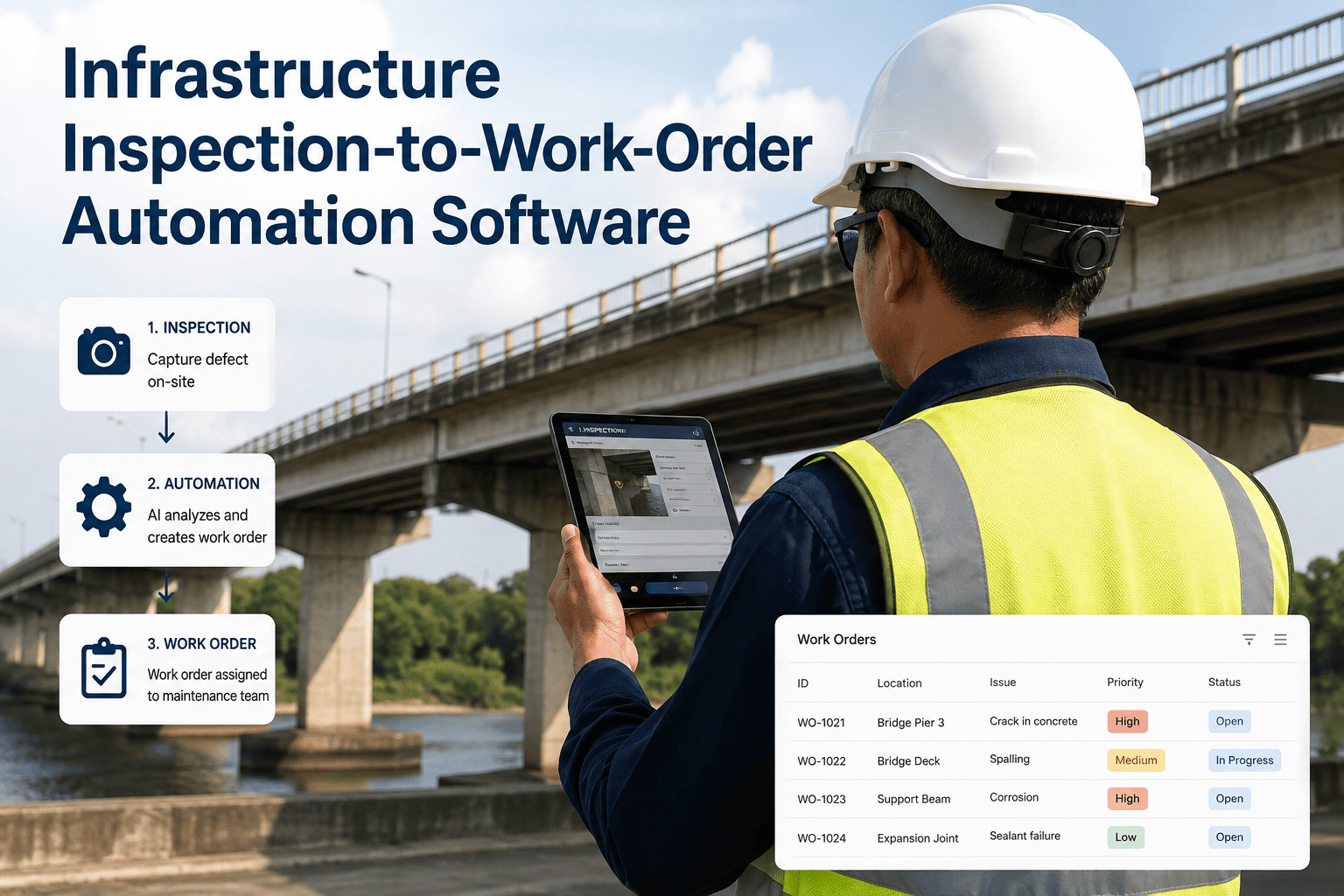
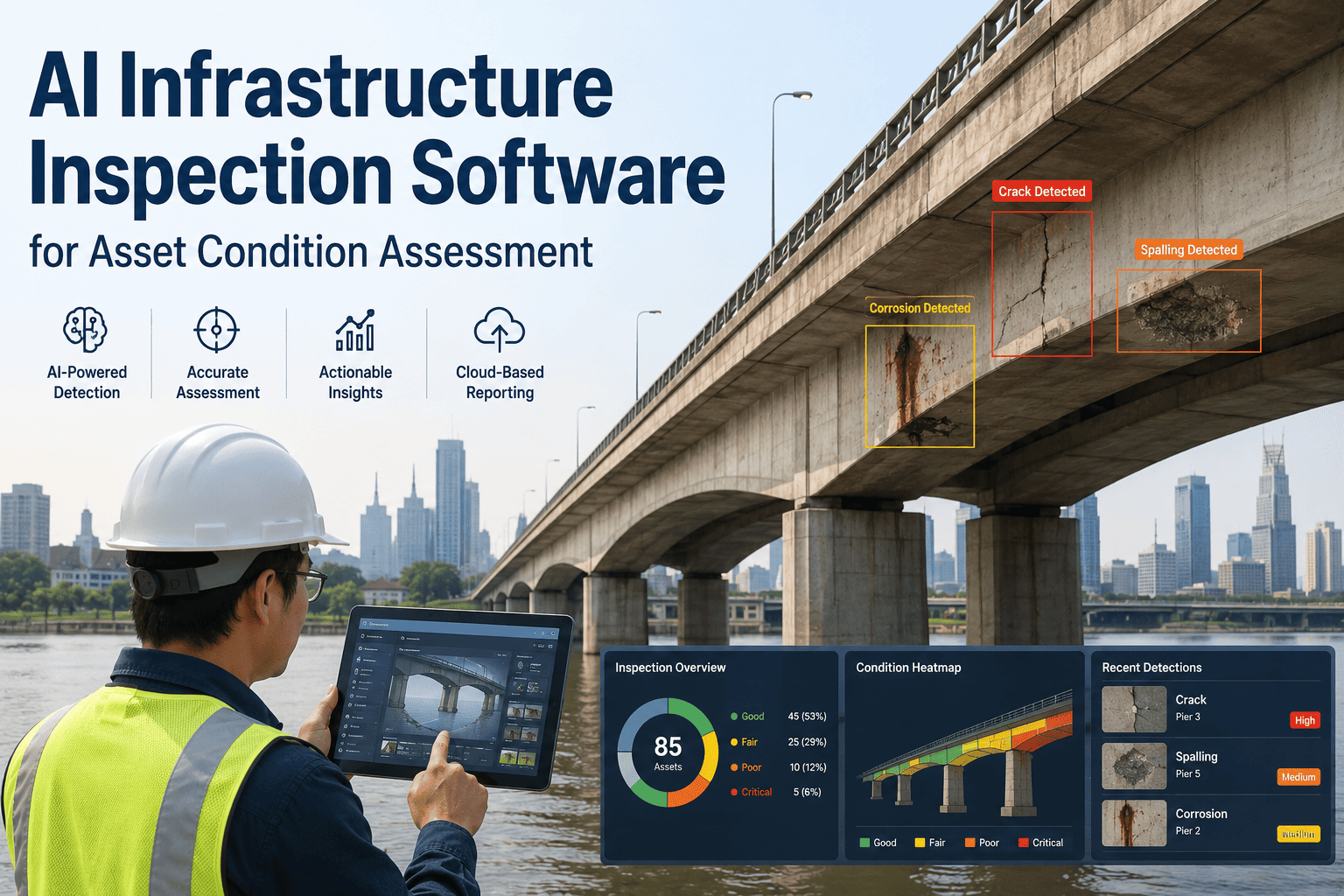
The platform — iFactory or equivalent — cross-references inspection data against asset inventory, applies severity scoring, groups anomalies by zone for efficient route-based intervention, and generates prioritised work orders. Real-time dashboards provide terminal-wide visibility across berth, yard, gate, and rail operations.
L4CMMS and TOS Integration
Work orders flow directly into the terminal's CMMS (Maximo, SAP PM) and TOS (Navis, TSB). Each order carries asset ID, defect photo, GPS coordinate, severity score, and recommended action. When the next patrol or crane cycle confirms resolution, the work order closes automatically. No manual entry. No paper trail.
REAL TERMINAL DEPLOYMENTS
Port and Maritime Robotics Programs Running Today
These programs represent the current operational frontier — systems deployed by the world's largest port operators and terminal automation providers, with measurable outcomes in throughput, inspection accuracy, and equipment availability.
PSA Tuas Mega Port
Singapore
All Zones
PSA Singapore's Tuas Port completed Phase Two of its automation program in March 2026, deploying fully automated berths with extensive fleets of AGVs and AI-powered yard cranes. The port operates autonomous horizontal transport (AHT) using AI-electric prime movers, and launched an autonomous inter-gateway feeder vessel EOI with MPA in April 2026. PSA's PSAT 4.0 blueprint spans Port, Marine, Data, Digital, and Sustainability Technologies — integrating autonomous prime movers, automated empty container handlers, remote and automated quay cranes, and robotics for stevedoring. Predictive maintenance and AI container stacking are embedded across the operation. The port also launched the world's first AI-powered expansion joints inspection hub at Jurong Island Terminal in May 2026, reducing clearance time from 72 to 36 hours.
DP World Global Terminals
UAE / UK / Global
QuayYard
DP World deployed AI-powered crane automation systems across key global terminals including Jebel Ali and London Gateway in 2026, using machine learning to optimise crane movements and predict maintenance needs. At London Gateway, DP World invested GBP 170 million in BOXBAY High Bay Storage technology — a fully automated, enclosed system that stores empty containers up to 16 tiers high using electric stacker cranes. The system handles containers like a "giant vending machine," eliminating rehandling, reducing truck turnaround times, and operating on one-third of the land of a conventional yard. At Jebel Ali, BOXBAY handled nearly 500,000 TEU during extensive trials before the London Gateway deployment.
Ningbo Customs Quadruped Inspection
Ningbo-Zhoushan, China
Container Insp.
Ningbo-Zhoushan Port became the first port in China to deploy a quadruped robot for container verification in March 2026. The Unitree Robotics quadruped at Meishan terminal autonomously navigates container stacks with high-res cameras, thermal sensors, and LiDAR — capturing container numbers, seal codes, and inspecting interiors for foreign objects. Results: 99% container number recognition accuracy, 95% foreign object detection rate, and 100 containers inspected per day during trials — reducing a task from 4-6 personnel over one hour to 20 minutes. By January 29, 2026, the robot had assisted inspections of 1,655 containers. The system integrates six core functions: automatic inspection, container number recognition, interlayer recognition, foreign object recognition, vector recognition, and anomaly early warning.
Konecranes Predictive Services
Global
Yard
Konecranes extended its Predictive Services to RTG and RMG yard cranes globally in May 2026, building on the platform already proven on Gottwald mobile harbour cranes. Vibration sensors installed on hoist motors, trolley motors, gearboxes, and bearings transmit operating data for AI-driven analysis. Exception-based reporting enables targeted maintenance interventions before failure occurs. At Bothra Shipping Services in India, the system detected vibration anomalies in winch motors, identified scoring abrasion in a cooling gear pump through oil sample analysis, and enabled warranty replacement within the notification period — preventing unplanned downtime and extending component life. The service also includes TRUCONNECT brake monitoring and wire rope monitoring for continuous safety assessment.
Hamburg Port Authority Spot Inspection
Hamburg, Germany
SubmergedInfrastructure
Hamburg Port Authority deployed Boston Dynamics Spot for autonomous structural inspection of the Koehlbrand Bridge, a 3.8km road bridge carrying 38,000 vehicles daily. Spot operates in total darkness inside bridge cavities, navigating narrow passages between segments with steps and stairs. Equipped with a Leica RTC360 3D laser scanner, the robot creates digital twins of bridge interior spaces, enabling remote engineers to inspect points of interest through VR. Every crack and damaged area is classified using HPA's own rating system and tracked over successive inspection rounds to assess progression. The bridge already has 500+ permanently installed sensors; Spot provides the mobile inspection layer that fixed sensors cannot cover. HPA is now evaluating Spot for railway track inspection, fire safety compliance, and environmental sampling across its 120 bridges and 300km of rail.
AUTOMATE YOUR TERMINAL INSPECTION WORKFLOW
Your Terminal Has Sensors, Cranes, and Robots. Connect Them to the Right Work Orders.
iFactory fuses quadruped patrol data, crane predictive maintenance, container inspection AI, and CMMS routing into one port asset management platform. Works with existing TOS, CMMS, and fleet vehicles.
OUTCOMES AND DATA
Measurable Results From Port and Maritime Robotics
99%
Container ID recognition accuracy
Ningbo quadruped — 1,655 containers inspected
95%
Foreign object detection rate
Ningbo quadruped — thermal + LiDAR fusion
20%
Less vessel time in port (Rotterdam)
AI-integrated scheduling — Nextlogic platform
60%
Yard safety tasks suited to quadrupeds
Port of Genova — worker interview study
72 to 36
Hours to clear expansion joint inspections
PSA Jurong — AI simulation hub (May 2026)
50%
Faster container inspection (quadruped vs manual)
Ningbo Customs — 4-6 staff to 20 min per batch
FREQUENTLY ASKED QUESTIONS
What Port Operators and Terminal Managers Ask About Robotics
Which port zones benefit most from quadruped robots versus fixed automation?▼
Quadruped robots deliver the highest return in zones requiring mobility across uneven terrain, confined spaces, or areas with variable layouts. The Port of Genova research found 60% of identified safety-critical tasks were in storage yards — container and bulk goods inspection, hazardous materials monitoring, and restricted area patrol. Ship hold inspection (27%) and crane-related tasks (13%) also benefit from legged mobility. Fixed automation — like Konecranes ARTG, ABB Waterside Automation, and OCR systems at STS cranes — is better suited to repetitive, high-volume operations on structured paths. The optimal strategy is layered: fixed automation for crane cycles and container moves, quadruped and UAV patrols for inspection, surveillance, and anomaly detection in unstructured zones.
How does crane predictive maintenance reduce unplanned downtime in terminals?▼
Predictive maintenance uses vibration sensors on critical rotating components — hoist motors, trolley gearboxes, and bearings — to detect degradation patterns before failure. Konecranes Predictive Services, now available for RTG and RMG cranes globally, transmits operating data for AI-driven analysis and delivers exception-based reports that allow maintenance teams to intervene selectively. At Bothra Shipping in India, this approach detected a failing cooling gear pump through vibration anomalies and oil sample analysis, enabling warranty replacement before the pump failed during operations. The financial impact is direct: unplanned crane downtime on a quay crane costs upwards of $100,000 per hour in missed vessel windows, while predictive intervention costs a fraction of that and can be scheduled during low-activity periods.
Can container inspection robots replace manual customs checks entirely?▼
Current generation inspection robots augment rather than replace human customs officers. The Ningbo Customs quadruped deployment demonstrated that a robot can reduce a manual inspection task from 4-6 personnel over one hour to 20 minutes — a 3x productivity improvement — while achieving 99% container number recognition accuracy and 95% foreign object detection. However, the system maintains a 60% foreign object type recognition rate, meaning human classification is still needed for a subset of anomaly types. The recommended approach is tiered: robots handle high-volume initial screening, container ID verification, and known anomaly patterns, while customs officers focus on exception handling, complex classification decisions, and targeted inspections flagged by the AI.
What sensors are needed to retrofit existing terminal equipment for automation?▼
The sensor configuration depends on the automation goal. For quay crane container data capture at the STS level, the minimum is PTZ cameras with OCR software (Docker Vision, Visy) integrated with the PLC and TOS. For yard crane predictive maintenance, vibration sensors on hoist, trolley, gearbox, and bearing assemblies are sufficient. For container yard patrol, a quadruped needs dual-light cameras, LiDAR, and gas/thermal sensors. For submerged infrastructure, an ROV requires sonar, ultrasonic thickness gauges, and AI de-hazing cameras. The key integration requirement is that all sensor data — regardless of zone — flows into a unified platform that cross-references findings, generates work orders, and pushes them to the CMMS and TOS. This middleware layer is what turns individual sensor investments into terminal-wide automation value.
How does iFactory integrate with existing terminal operating systems and CMMS platforms?▼
iFactory provides the middleware layer that connects robotic inspection data, crane sensor telemetry, and container AI detection with existing TOS (Navis, TSB) and CMMS (IBM Maximo, SAP PM, Oracle) platforms. The integration pipeline works as follows: sensor data is processed at the edge, transmitting only detection metadata (defect type, severity, GPS location, timestamp, annotated image). The iFactory platform cross-references against asset inventory, applies proximity-based grouping for efficient route-based repair, and auto-generates fully detailed work orders. These are pushed to the existing CMMS via standard API connectors. The terminal operating system receives real-time status updates on asset condition without workflow disruption. Typical integration timeline is 30-60 days.
PORT ASSET INTELLIGENCE PLATFORM
Your Terminal Runs on Equipment. Run It on Intelligence.
iFactory connects your quay cranes, yard equipment, inspection robots, and asset management system into one unified port automation workflow. Works with your existing infrastructure. Results from your first patrol pass.