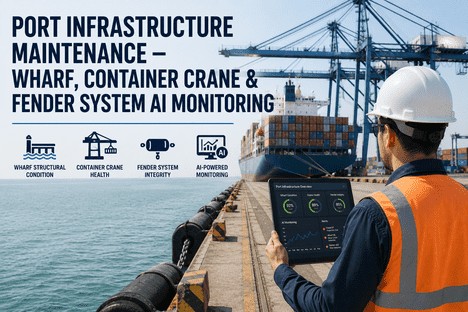
Port Infrastructure Maintenance — Wharf, Container Crane & Fender System AI Monitoring
By Grace on June 22, 2026
The global port infrastructure market reached $188.75 billion in 2025 and is projected to grow at 4.6% CAGR to $295.94 billion by 2035. With over 80% of international trade by volume moving through seaports and the average age of wharf structures at major terminals exceeding 35 years, the reliability of wharf structural integrity, container crane availability, and fender system condition directly determines whether a port operator captures that growth or loses it to unplanned downtime, emergency repair costs, and berth closures that cascade across vessel schedules. Yet most port maintenance programmes still depend on fixed-interval visual inspections, spreadsheet-based condition tracking, and reactive repair cycles that detect failures only after they have already disrupted operations. A single container crane breakdown at a deep-sea terminal can delay 3,000 to 5,000 container moves. A single fender failure can close a berth for 72 hours. A corroded wharf section can restrict load capacity for months before the structural assessment catches it. iFactory's AI-powered port infrastructure monitoring platform replaces this inspection-gap model with continuous real-time condition intelligence — giving operations directors instant visibility into the structural health of every wharf, the drive train status of every STS and RTG crane, and the integrity of every fender assembly across the entire terminal network from a single dashboard that never waits for the next quarterly inspection cycle.
AI Port Infrastructure Monitoring · Predictive Crane Maintenance · Smart Fender Integrity · Wharf Structural AI
Stop Inspecting on a Schedule. Start Knowing in Real Time. iFactory Monitors Every Berth, Every Crane, Every Fender from a Single AI Platform.
Real-time AI monitoring of wharf structural condition, container crane health, and fender system integrity — with predictive alerts that give you weeks of lead time on potential failures, not hours. A single platform that eliminates the blind spots in your terminal maintenance programme.
Projected port infrastructure market by 2035 at 4.6% CAGR — operators with AI-driven predictive maintenance will capture more throughput at lower cost per berth hour
80%
Of global trade by volume moves through ports — every hour of unplanned crane or fender downtime disrupts supply chains across continents and costs terminals in lost revenue
62%
Of fender failures could have been avoided with earlier detection — AI-powered condition monitoring catches structural degradation before it causes berth closures
25%
Reduction in unplanned crane downtime achievable with predictive maintenance — translating to millions in recovered throughput per terminal annually
The Real Problem With Port Infrastructure Maintenance Is Not the Age of the Assets — It Is the Blindness to Their Condition
The operational challenges of maintaining ageing port infrastructure across a network of terminals are well understood. Wharf structures corrode. Crane gearboxes wear. Fender systems fatigue. What is less discussed is the specific failure mode that reactive and time-based maintenance programmes produce — and why it persists even at ports that have invested millions in individual asset monitoring tools that operate in isolation from one another. The issue is not a lack of data. The issue is that the data sits in separate systems — structural monitoring platform here, crane maintenance logs there, fender inspection photos on a shared drive — with no single view that connects wharf condition to crane health to fender integrity in a way that supports real-time operational decisions.
How Disconnected Port Maintenance Fails — and What It Costs Every Terminal
The Wharf Inspection Gap
Structural assessments happen quarterly. Corrosion happens daily. The gap between them costs millions in accelerated degradation.
Most wharf structural inspections still rely on visual surveys conducted at fixed intervals — typically every three to six months depending on the terminal's age and regulatory framework. A cathodic protection system can fail within weeks of the last inspection, leaving steel piling and concrete substructures exposed to accelerated corrosion that remains completely undetected until the next scheduled survey. In marine environments, corrosion rates can reach 0.2 to 0.5 millimetres per year for unprotected steel in splash zones — meaning a six-month gap between inspections can allow measurable section loss before any corrective action is triggered. By the time a spalled panel, exposed rebar, or section loss is visually identified, the structural remediation cost has already multiplied by a factor of three to five compared to what early intervention would have required at the first sign of cathodic protection failure or abnormal chloride ingress. Port operators without continuous structural monitoring absorb this cost silently across every berth, every year — and it accumulates in the form of shortened structure service life, reduced load ratings, and emergency repair programs that consume maintenance budgets that should have been allocated to planned renewal.
A single STS crane generates terabytes of vibration, temperature, and load cycle data every month. Most terminals analyse almost none of it.
Ship-to-shore cranes are the most expensive single asset in any container terminal, with replacement costs exceeding $15 million per unit and lead times of 12 to 18 months for new crane delivery. Yet the majority of terminals still maintain these critical assets on calendar-based schedules — changing gearbox oil every 12 months regardless of condition, replacing wire rope at fixed intervals regardless of actual wear patterns, and inspecting drive motors and slew bearings only when performance degradation becomes audible or visible to operators. The vibration signatures, temperature trends, load cycle profiles, and oil debris analysis data that could predict bearing failure four to six weeks in advance are either not collected from the crane's own PLC systems or sit unanalysed in control system logs that no one reviews until after a failure event. A single unplanned crane outage at a busy deep-sea terminal handling 10,000 to 15,000 TEU per week can delay 3,000 to 5,000 container moves, miss two to three vessel sailing windows, and trigger overtime costs, demurrage claims, and customer penalty clauses that compound the direct repair cost by a factor of five to ten.
Unplanned Outage + Supply Chain Cascade Costs
The Fender Integrity Blindness
A failed fender can close a berth for three days. Most operators do not know their fenders are degrading until the vessel hull contacts the quay structure.
Fender systems are consistently the most neglected critical asset in port infrastructure maintenance programmes. They absorb vessel impact energy daily — often multiple times per day at busy container berths — operate in the most corrosive marine environment on the terminal with constant salt spray, UV exposure, and tidal cycling, and are typically inspected only when a visible defect is reported by line crew or after a berthing incident triggers an insurance investigation. A single fender failure causes $50,000 to $200,000 in direct damage to the fender unit and mounting hardware, plus 24 to 72 hours of berthing delays while the failed unit is assessed, removed, and replaced. For a container terminal handling 10,000 TEU per week at an average revenue of $150 to $300 per TEU, three days of reduced berth availability represents $650,000 to $1.3 million in lost throughput revenue — before accounting for vessel damage claims, potential environmental liability from hull impact or fuel spill during uncontrolled berthing, and the reputational cost of a safety incident at a major terminal.
Berth Closure + $650K-$1.3M Lost Revenue Per Incident
The Workforce Knowledge Drain
40% of experienced port maintenance engineers will retire by 2030. Their undocumented knowledge of asset condition and failure history leaves with them.
Port maintenance has traditionally relied on the tacit knowledge of senior engineers who carry decades of asset-specific experience in their heads — knowing which STS crane has a history of motor overheating during summer peak loads, which berth has a fender panel that needs closer monitoring after north-east monsoon season, which section of wharf shows accelerated chloride ingress and needs more frequent potential mapping. As this workforce retires at an accelerating rate across the global port industry, this institutional knowledge about asset condition, failure patterns, and effective inspection intervals leaves with them. Terminals that have not digitised their condition monitoring programmes face a situation where they have the same assets, the same inspection budget, and the same maintenance procedures — but dramatically less ability to interpret the data those inspections produce, to recognise early warning signs that experienced engineers would catch, and to make informed decisions about repair vs. replace vs. monitor for each asset. The knowledge transfer gap is not solved by hiring replacements — it is solved by capturing asset condition data continuously and converting it into actionable intelligence that any competent engineer can interpret regardless of their years of experience at that specific terminal.
Institutional Knowledge Loss + Widening Competency Gap
What iFactory's Port Infrastructure Monitoring Platform Actually Does
iFactory is not a bolt-on sensor dashboard that adds another screen to a control room already crowded with alarms. It is an AI-native infrastructure monitoring platform that ingests data from existing structural health sensors, crane PLCs, vibration monitoring systems, thermal imaging feeds, and fender telemetry — and converts it into actionable condition intelligence that terminal operations directors can trust for real-time decisions about asset deployment, maintenance scheduling, and capital replacement planning. The platform applies asset-specific AI models to each infrastructure type — because the way a wharf corrodes is fundamentally different from the way a crane gearbox wears, and both are fundamentally different from the way a fender loses energy absorption capacity — while presenting a unified condition view across all asset categories in a single interface.
Capability 01
Wharf Structural AI Monitoring — Continuous Condition Assessment of Every Berth with 4-8 Week Early Warning Lead Time
iFactory integrates with existing structural health monitoring sensors — inclinometers, corrosion potential probes, half-cell potential mapping systems, strain gauges, settlement markers, and tidal level monitors — to deliver a continuous condition rating for every wharf structure in the terminal network. The AI model learns the baseline structural behaviour of each berth under operational loading, tidal variation, seasonal temperature cycling, and storm surge events, then flags deviations that indicate active degradation mechanisms. When a cathodic protection system drops below the industry-standard protection threshold of -850 mV on Berth 4, or a deck panel deflection exceeds its seasonal baseline by two standard deviations on Berth 7 after a storm event, the platform generates a structural alert with a severity rating, probable cause classification, and recommended inspection timeline — typically providing four to eight weeks of lead time over a scheduled quarterly inspection cycle. This lead time is the difference between scheduling a targeted cathodic protection repair during a routine maintenance window and discovering the corrosion damage during the next scheduled inspection when the repair scope has already expanded by a factor of three.
Continuous wharf condition rating per berthCathodic protection and corrosion anomaly alerts4-8 week early warning vs quarterly inspection
Capability 02
Container Crane Predictive Maintenance — Vibration-Based Drive Train and Structural Health Intelligence for STS, RTG, and RMG Fleets
iFactory connects to crane PLCs, vibration monitoring systems, thermal imaging cameras, and oil debris sensors to build a continuous health model for every crane in the terminal fleet — ship-to-shore gantry cranes, rubber-tyred gantry cranes, rail-mounted gantry cranes, and mobile harbour cranes. The AI analyses vibration signatures across gearboxes, motors, slew bearings, and boom hinge points; temperature trends on drive motors, hoist brakes, and electrical cabinets; load cycle patterns that affect structural fatigue on booms and legs; and oil debris particle counts that indicate internal gearbox wear. When a hoist gearbox shows early-stage bearing degradation characterised by increasing vibration amplitude at specific frequencies, or a boom hinge develops abnormal oscillation under load that indicates pin wear, the platform generates a predictive maintenance work order with the specific component identified, the failure mode classified, and the recommended intervention window calculated based on the remaining useful life estimate. Terminals using iFactory's crane monitoring module typically see a 25% to 30% reduction in unplanned crane downtime within the first six months of deployment, with the most significant gains coming from the elimination of catastrophic gearbox and bearing failures that previously required 48 to 72 hour emergency repair windows.
Real-time crane health index per unitPredictive bearing and drive train alerts25-30% unplanned downtime reduction
Capability 03
Fender Integrity Monitoring — Smart Detection of Impact Damage, Compression Fatigue, and Bracket Corrosion Before They Cause Berth Closures
iFactory's fender monitoring module ingests data from impact load sensors, compression gauges, inclination monitors, and corrosion sensors installed on or retrofitted to existing fender systems — including cell fenders, cone fenders, arch fenders, and pneumatic fenders. The AI model tracks every berthing event at each fender location — recording impact energy magnitude, deflection depth, compression recovery time, and rebound behaviour — and builds a cumulative fatigue profile for each individual fender unit. When a fender begins showing reduced energy absorption capacity indicated by deeper compression at the same impact load, abnormal residual compression after vessel departure indicating internal material degradation, or bracket inclination change that signals mounting fatigue or corrosion weakening, the system generates a fender integrity alert with a remaining useful life estimate expressed in berthing events or calendar days. Port operators gain the ability to plan fender replacements based on actual condition rather than fixed time schedules — extending service life by 15% to 25% for units that are performing within specification while identifying failing units weeks before they would have caused an unplanned berth closure and the associated $650,000 to $1.3 million in lost revenue.
Per-fender condition and fatigue trackingBerthing impact energy analytics per event15-25% extended fender service life
Capability 04
Terminal Network Dashboard — Every Berth, Crane, and Fender Across All Terminals in One Real-Time Condition View with Cross-Terminal KPI Tracking
The network-level dashboard aggregates infrastructure condition data from every terminal in the port operator's network into a single real-time view designed for operations directors who need to assess the status of dozens of asset locations in minutes, not hours. The dashboard presents the structural rating of every wharf, the health index of every crane, and the integrity status of every fender across all terminals — colour-coded by severity from green (normal operation) through amber (monitoring recommended) to red (intervention required), filterable by asset category and terminal location, and drillable down to individual sensor readings and trend charts for any specific asset. When a crane at Terminal A shows a developing drive train anomaly with a predicted failure window of 14 days and a fender at Terminal B approaches its replacement threshold after 18,000 berthing events, the operations director sees both alerts on the same screen without switching between monitoring platforms or waiting for emailed status updates from terminal maintenance teams. The dashboard also tracks maintenance cost per asset category, work order completion rates by terminal, inspection compliance against regulatory requirements, and year-over-year condition trends that inform capital replacement planning and budget allocation across the terminal network.
Predictive Port Maintenance · Wharf AI Monitoring · Crane Health Analytics · Fender Integrity Intelligence
You Cannot Inspect Your Way to Reliable Port Infrastructure. You Can Monitor Your Way There. iFactory Gives You the Real-Time Visibility That Scheduled Inspections Cannot.
A single AI platform that monitors every wharf, every crane, every fender across your entire terminal network — with predictive alerts that provide weeks of lead time on failures, condition ratings that update with every berthing event and every crane cycle, and maintenance intelligence that eliminates the blind spots in your current inspection-based programme. No additional sensors required for most existing terminal configurations with standard monitoring infrastructure.
Why Different Port Asset Types Require Different Monitoring Approaches in the Same Platform
One of the underappreciated challenges of port infrastructure monitoring is that wharf structures, container cranes, fender systems, and mooring hardware do not just have different failure modes — they require fundamentally different monitoring data streams, analysis models, alerting thresholds, and intervention timelines. A wharf corrodes over years. A crane gearbox fails over weeks. A fender degrades with every berthing impact. A mooring bollard weakens gradually through a combination of corrosion and cyclic loading. Managing all four asset categories in a single monitoring environment requires a platform that applies asset-specific AI models calibrated to each failure mechanism while presenting a unified condition view to the operations director who needs to understand the status of the entire terminal at a glance.
Long-term trend model with seasonal baseline — alerts triggered by deviation from historical structural behaviour pattern with corrosion rate acceleration detection
Container Crane
Bearing wear, gearbox tooth fatigue, drive motor overheating, wire rope degradation, structural crack propagation on boom and leg structures
Short-to-medium horizon failure prediction model — bearing remaining useful life estimate, gearbox health score, drive train anomaly detection with 2-6 week advance warning
Fender System
Compression set and permanent deformation, rubber fatigue and cracking, bracket corrosion, anchor bolt loosening, progressive energy absorption capacity loss
Impact load monitoring per berthing event, deflection tracking during and after impact, rebound behaviour analysis, inclination change detection on brackets
Event-based cumulative degradation model — per-berthing impact energy analysis, cumulative fatigue tracking against manufacturer design curves, remaining energy absorption capacity estimation
Bollard and Mooring Hardware
Corrosion weakening of anchor bolts and base plates, concrete spalling around anchor embedment, capstan drive wear, rope roller seizure from corrosion
Visual condition scoring integrated with scheduled inspection data, load monitoring at high-stress mooring points on tanker and bulk berths
Rule-based condition scoring with trend tracking across inspection cycles — scheduled inspection data integrated with continuous mooring load monitoring alerts at high-utilisation berths
We operate four container terminals across two coastlines with a combined 28 STS cranes, 12 kilometres of wharf, and over 400 fender units. Before iFactory, our infrastructure maintenance team spent the first three days of every month compiling condition reports from each terminal — consolidating inspection spreadsheets, crane PLC logs, fender inspection photos, and cathodic protection readings into a single document that was already two to three days outdated by the time the monthly review meeting happened. The information we needed to make good decisions existed somewhere in the organisation. It just existed in six different places, in four different formats, with no consistent way to compare condition trends across terminals or to identify which assets needed attention before they failed. The first week on iFactory, our terminal director opened the dashboard during a Monday morning operations call and saw that the cathodic protection system on Berth 3 at Terminal B had dropped below the protection threshold at 3:00 AM that morning. We dispatched a repair team before lunch. Under our old quarterly inspection programme, that degradation would have been detected approximately sixty days later — and the repair cost, by that point, would have been four times higher because the corrosion damage would have progressed past the point where a simple anode replacement would have sufficed.
— Director of Terminal Infrastructure, Multi-Terminal Port Operator — 22 Years Port Engineering
Conclusion
The port infrastructure market is heading toward $295.9 billion by 2035, with terminal operators facing the compounding pressure of handling increasingly large vessels while maintaining ageing wharf structures, crane fleets, and fender systems across expanding terminal networks. The operators that solve this challenge with AI-driven continuous condition monitoring will outperform those still relying on scheduled inspections and reactive repairs on every metric that matters: unplanned downtime per asset, maintenance cost per berth hour, berth availability for vessel scheduling, and the quality of the capital replacement decisions that determine long-term terminal competitiveness. The data required to move from inspection-based to monitoring-based maintenance already exists at every terminal — in crane PLCs, structural monitoring systems, and fender sensor feeds.
What has been missing is the intelligence layer that connects these data sources, applies asset-specific AI models to convert raw sensor data into actionable condition assessments, and presents the results in a unified view that supports real-time operational decisions rather than retrospective monthly reviews. iFactory's port infrastructure monitoring platform provides this layer — connecting every wharf structure, every container crane, every fender system across your terminal network into a single real-time condition intelligence view with predictive alerts that identify failures weeks before they would have caused operational disruption. Book a Demo to see how the platform maps to your terminal network's specific asset mix, current monitoring infrastructure, and operational workflow, or Talk to an Expert to begin your port infrastructure condition monitoring assessment with a no-obligation review of your current inspection programme and the measurable improvements that continuous AI monitoring would deliver for your specific terminal configuration.
Frequently Asked Questions
iFactory is designed as an integration platform that connects to existing monitoring infrastructure wherever possible. For wharf structures, the platform ingests data from cathodic protection monitoring systems, inclinometers, strain gauges, half-cell potential mapping systems, and settlement markers that are already installed at most major container and bulk terminals. For container cranes, iFactory connects to existing PLC outputs, vibration monitoring systems (where installed), thermal imaging feeds, and oil debris sensors. For fender systems where no sensors currently exist, iFactory supports a low-cost retrofit sensor package — including impact load cells, compression gauges, and inclination monitors — that can be installed on up to 20 fender units during a single routine maintenance window without requiring berth downtime. The platform also ingests scheduled inspection data as a baseline for terminals at the start of their digital monitoring journey, enabling immediate value from existing inspection programmes while the sensor deployment is phased in across priority assets. Book a Demo to discuss your terminal's current monitoring infrastructure and the integration scope required for your specific configuration.
False alarm management is a core design requirement for iFactory's crane monitoring module, developed specifically for the high-noise environment of operating container terminals. The AI model is trained on a minimum of 90 days of operational data from each individual crane before active alerting begins — learning the specific vibration signature, temperature profile, load pattern, and ambient condition baseline that represents normal operation for that specific machine across different operational scenarios including laden vs. unladen cycles, windy vs. calm conditions, and peak vs. low-activity periods. Anomaly detection thresholds are set at three standard deviations from the learned baseline for each sensor channel, with a confirmation window that requires the anomaly to persist across multiple operational cycles — typically six to twelve container moves — before an alert is escalated. In production deployments across multiple container terminals, iFactory achieves a verified false positive rate of less than 2% for crane monitoring alerts, with each alert including a confidence score (expressed as a percentage), the specific sensor channel and component that triggered the alert, and supporting trend data that allows maintenance engineers to validate the AI recommendation before deciding whether to take action. Book a Demo to see the alert confirmation workflow demonstrated in a live terminal environment.
For a terminal network with existing monitoring sensors and data acquisition infrastructure, iFactory's standard implementation sequence covers: weeks one to two for platform configuration, data source integration, and connector setup for existing structural, crane, and fender monitoring systems; weeks three to four for AI model training on historical asset data — typically using 12 to 24 months of historical sensor records to establish accurate baseline models for each asset category; weeks five to six for dashboard configuration, alert threshold calibration by asset type and terminal, and operations team onboarding across all terminal sites; and weeks seven to eight for full platform go-live with active monitoring, predictive alerting, and network-level condition reporting. The first condition assessments for wharf structures and crane health indices are typically available in the platform dashboard within the first fourteen days of deployment — before the AI models have completed their full training cycle — using baseline models calibrated from the initial data feed. For terminals without existing monitoring sensors, an additional two to three weeks should be allocated for sensor specification development, procurement, and deployment planning across priority wharf, crane, and fender assets. Book a Demo to discuss your terminal network's implementation timeline based on its current monitoring infrastructure maturity and the scope of sensor deployment required.
iFactory is designed as a complementary monitoring and analytics layer that integrates with existing terminal infrastructure rather than replacing it. The platform supports data ingestion from standard terminal operating systems (TOS), crane management systems (CMS), structural health monitoring databases, and enterprise asset management platforms — including SAP, IBM Maximo, Oracle EAM, and Infor EAM — via REST API connectors and standard data format handlers. iFactory can also output condition alerts and predictive maintenance recommendations directly into existing CMMS or EAM systems as auto-generated work order requests with the component identification, failure mode classification, recommended intervention timeline, and supporting sensor data attached — so terminal maintenance teams continue working in their familiar work order management environment while receiving AI-generated condition intelligence from the monitoring platform. For terminals in the early stages of digital transformation that do not yet have a comprehensive CMMS deployment, iFactory includes a built-in asset registry and maintenance workflow module that can serve as the primary maintenance management system until a full enterprise EAM deployment is completed. Talk to an Expert to review the integration architecture specific to your terminal's current technology stack and data environment.
Scheduled Inspections Tell You What Happened Last Quarter. iFactory Tells You What Is Happening Right Now — and What Will Happen Next Week.
Real-time AI monitoring of every wharf structure, every container crane, every fender system across your entire terminal network. Predictive alerts that give you weeks of lead time on failures instead of discovering them during the next inspection cycle. A single dashboard that replaces dozens of inspection reports and system log reviews with one colour-coded condition view of every critical asset. The infrastructure intelligence your terminal network has been missing — available today without replacing your existing monitoring infrastructure.