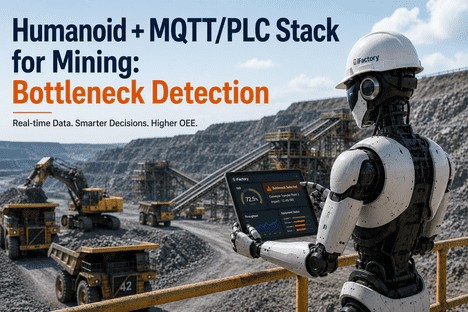
A humanoid robot inspecting a crusher in an underground mine detects abnormal vibration on the drive-end bearing at 2:00 AM. The finding is real — the accelerometer data is clean, the FFT profile matches a developing raceway defect. Inside the robot's ROS 2 graph, that anomaly is a published topic on a DDS bus. But for it to matter to the mining operation, that data point must cross into a completely different world — an OPC UA server serving the plant's SCADA layer, an MQTT broker streaming telemetry to the operations centre, and a PLC network that controls the crusher's interlock logic. It must trigger a bottleneck alert, update an OEE calculation, raise a CMMS work order, and land in the shift handover report — all before the next production cycle begins. None of that happens automatically. The robot speaks ROS 2. The mine speaks OPC UA, MQTT, and PLC fieldbuses. These are not compatible protocols, and the integration gap between them is the single largest obstacle to turning humanoid fleets into operational assets rather than expensive sensor platforms. This article is a technical reference for the architects and engineers integrating humanoid robots into mining and resource extraction operations — covering the protocol stack, the reference architecture for bottleneck detection and OEE visibility, and how iFactory's data-fusion layer bridges the robot's world to the mine's control systems without point-to-point custom integration.
4
Communication domains a humanoid must bridge in a mining operation: ROS 2 internally, OPC UA for SCADA/MES, MQTT for telemetry streaming, and PLC fieldbuses for equipment-level deterministic control. Each speaks a different protocol.
500ms
Target latency for an anomaly detected by a humanoid to trigger a bottleneck alert, correlate with PLC equipment state, raise a CMMS work order, and land in the operations dashboard — achievable only through a unified data-fusion layer.
1:Many
Integration ratio with a fusion layer approach — the humanoid integrates once and reaches every plant system. Without it, every new robot multiplies the connection count across every protocol, creating a spider web of point-to-point custom code.
Bridge the Protocol Gap in Your Mining Operation
iFactory integrates humanoid ROS 2 data with OPC UA, MQTT, and PLC networks — enabling real-time bottleneck detection, OEE visibility, and automated CMMS workflows without custom point-to-point code.
The Four Protocols — Where Each Lives and What It Does
OPC UA
Pattern: Client/server and pub/sub
Role in mining: Structured data exchange between SCADA, MES, and plant systems. Rich information modelling with security.
Integration boundary: Plant-side. The fusion layer acts as an OPC UA client and server.
MQTT
Pattern: Broker-based pub/sub (Sparkplug B)
Role in mining: Lightweight telemetry streaming from sensors and humanoid patrol data to multiple subscribers.
Integration boundary: Plant-side. Fusion layer publishes and subscribes to broker topics.
ROS 2
Pattern: DDS publish/subscribe
Role in mining: Humanoid internal perception, navigation, sensor data, and task state. The robot's native language.
Integration boundary: Robot-side. Fusion layer bridges ROS 2 topics outward.
PLC Fieldbus
Pattern: Deterministic cyclic (PROFINET, EtherNet/IP)
Role in mining: Equipment-level control, safety interlocks, crusher/conveyor state. Correlated with humanoid findings.
Integration boundary: Equipment-side. Accessed via OPC UA gateway or direct driver.
Reference Architecture — Humanoid-to-Mine Protocol Integration
Layer 1 — Humanoid Fleet (ROS 2)
Vibration sensors · thermal cameras · gas detectors · navigation state · patrol completion status
Layer 2 — iFactory Data-Fusion Layer
ROS 2 bridge · protocol normalisation · anomaly detection · PLC state correlation · alert triage
Layer 3 — Mining Plant Systems
SCADA · OEE dashboard · CMMS · EHS alerts · PLC / DCS · historian
OPC UA Bridge
Structured asset models, SCADA values, MES production context
MQTT Stream
Patrol telemetry, sensor readings, event alerts to operations centre
PLC Correlation
Equipment interlock state, valve positions, conveyor status for context
From Raw Data to Bottleneck Detection — The Pipeline
Bottleneck detection in a mining operation with humanoid robots follows a five-stage pipeline that spans the protocol boundary. Each stage depends on the one before it, and the pipeline as a whole requires seamless data flow from the robot's ROS 2 graph to the plant's OPC UA information model and MQTT telemetry bus. The iFactory fusion layer orchestrates this end-to-end flow without custom integration at any stage.
Humanoid detects anomaly
Vibration spike, thermal outlier, or gas reading captured by humanoid sensors. Data exists inside ROS 2 topic graph on the robot.
ROS 2 to OPC UA/MQTT
iFactory fusion layer subscribes to ROS 2 topics, normalises data, and publishes to OPC UA server and MQTT broker simultaneously.
PLC state correlation
Fusion layer reads equipment state from PLC via OPC UA gateway. Confirms crusher was running, valve positions, interlock status.
Bottleneck risk score
Anomaly severity, equipment criticality, and production impact are computed. Alert generated with recommended intervention window.
CMMS + OEE update
Work order auto-created in CMMS. OEE dashboard updated with projected availability impact. Shift handover report enriched.
What Changes When the Stack Is Unified
The difference between a humanoid fleet operating with point-to-point custom integration and one connected through a unified data-fusion layer is not a matter of convenience. It determines whether the deployment scales from a single robot proof-of-concept to an operational fleet that meaningfully impacts OEE, bottleneck detection accuracy, and maintenance cost-per-ton. The table below captures the practical differences across the dimensions that matter most to mining operations.
Without Fusion Layer
Custom code written per robot-per-system combination. Each new robot model requires rewriting protocol bridges. Sensor data stays siloed inside the robot. Bottleneck detection relies on manual observation and delayed reporting. OEE calculations exclude humanoid-contributed data entirely. Scaling from 1 to 10 robots multiplies integration effort 10x. Night-shift findings are lost or delayed until the morning shift reviews robot logs.
With iFactory Fusion Layer
Humanoid integrates once via ROS 2 bridge, reaches every plant system over OPC UA, MQTT, and PLC protocols. Anomalies detected by any robot in the fleet flow into the OEE model, SCADA dashboard, and CMMS in under 500ms. Bottleneck alerts carry PLC-correlated equipment context — false alarms are filtered before they reach operators. Scaling from 1 to 50 robots adds zero integration overhead per robot. Every shift inherits the findings of the previous one through structured handover data.
iFactory · OPC UA · MQTT · ROS 2 · PLC Integration · Bottleneck Detection · OEE
Your Humanoid Fleet Speaks ROS 2. Your Mine Speaks OPC UA, MQTT, and PLC. iFactory Translates.
Single integration, every protocol, real-time bottleneck detection and OEE visibility — built for mining and resource extraction operations where production cannot wait for custom middleware development.
Frequently Asked Questions
One Integration. Every Protocol. Real-Time Bottleneck Detection.
iFactory bridges humanoid ROS 2 data to OPC UA, MQTT, and PLC networks — enabling real-time bottleneck detection, OEE visibility, and automated CMMS workflows. Built for mining and resource extraction. Not adapted from factory floor logic.