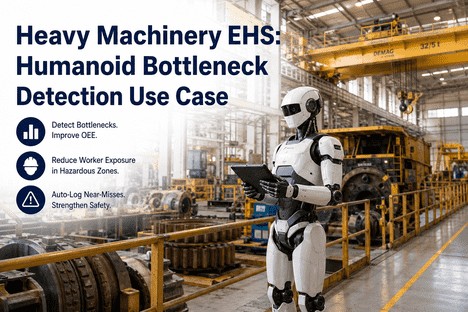
A hydraulic press in a heavy machinery plant begins drawing 12% more current than its baseline at 3:00 AM during an unattended night shift. The variance is subtle — not enough to trigger a hard fault, but enough that a trained eye would flag it as the early signature of a developing pump cavitation issue. In a conventional factory, that press runs until it fails catastrophically, costing 14 hours of unplanned downtime and $47,000 in emergency repair parts. In a self-healing factory, the sequence is different. A humanoid robot on patrol captures the anomaly through its vibration sensor, the iFactory platform correlates the reading against the equipment's historical baseline and cross-references it with motor current data from the PLC, the platform confirms a developing cavitation condition, generates a corrective work order in the CMMS, and dispatches the humanoid to perform a pre-emptive impeller adjustment before the next production cycle begins. No human saw the data. No human made the decision. No human intervention was required. The press kept running. That is the self-healing factory — not a future concept, but an operational architecture available today through iFactory's integrated platform connecting humanoid robots, CMMS, MES, QMS, and ERP in a single closed-loop system purpose-built for heavy machinery and equipment manufacturing.
What Makes the Self-Healing Loop Possible
The self-healing factory does not depend on a single technology breakthrough. It depends on the convergence of five enterprise systems — each performing its role, each connected through iFactory's orchestration layer, and each feeding data into a unified operational model that persists across every shift, every work order, and every production cycle. Without this convergence, the humanoid is a data collector without a decision-making backbone. Without the humanoid, the platform detects anomalies but cannot act on them physically. Together, they create a closed loop that heavy machinery operations have never had access to before.
Every anomaly the humanoid detects becomes a structured record in the CMMS. Equipment health scores are updated in real time. Work orders are generated automatically with the humanoid's sensor data attached — vibration spectra, thermal images, acoustic waveforms — so the technician or robot assigned to the corrective task arrives with full diagnostic context. The CMMS also tracks the humanoid itself as an asset, scheduling its own maintenance and calibration.
When an anomaly is detected on a critical machine, the MES provides production context: which orders are running, what the schedule impact of downtime would be, and whether production can be rerouted. iFactory uses this context to decide whether the corrective action should happen immediately or be deferred to the next planned maintenance window — balancing equipment health against production commitments.
Machine degradation affects part quality before it causes a breakdown. The QMS feeds defect trend data into iFactory's correlation engine, enabling the platform to detect quality drift patterns that indicate upstream equipment issues. When a humanoid detects a vibration anomaly, the platform cross-references it against QMS data for parts produced on that machine in the last hour. If defect rates are rising, the corrective action is escalated to immediate priority.
Corrective actions consume resources — spare parts, technician hours, production time. The ERP provides visibility into inventory levels, procurement lead times, and budget constraints. iFactory's decision engine factors these constraints into every corrective action recommendation, ensuring the self-healing loop operates within the plant's resource boundaries rather than creating secondary problems through unplanned parts consumption or schedule conflicts.
Shift Handover as the Loop Closer
The self-healing cycle does not reset at shift change. When the night shift humanoid detects and corrects an anomaly at 3:00 AM, that finding — the original sensor reading, the diagnostic trail, the corrective action taken, and the verification result — is packaged into a structured shift handover report. The day shift supervisor sees it in the iFactory dashboard before the first cup of coffee. The incoming humanoid fleet inherits the updated equipment health state and knows not to re-inspect that asset. The maintenance team has a closed work order with full documentation attached. The self-healing factory is also a self-documenting factory — every autonomous cycle produces the records that compliance, quality audits, and continuous improvement programs require, without a single manual entry.