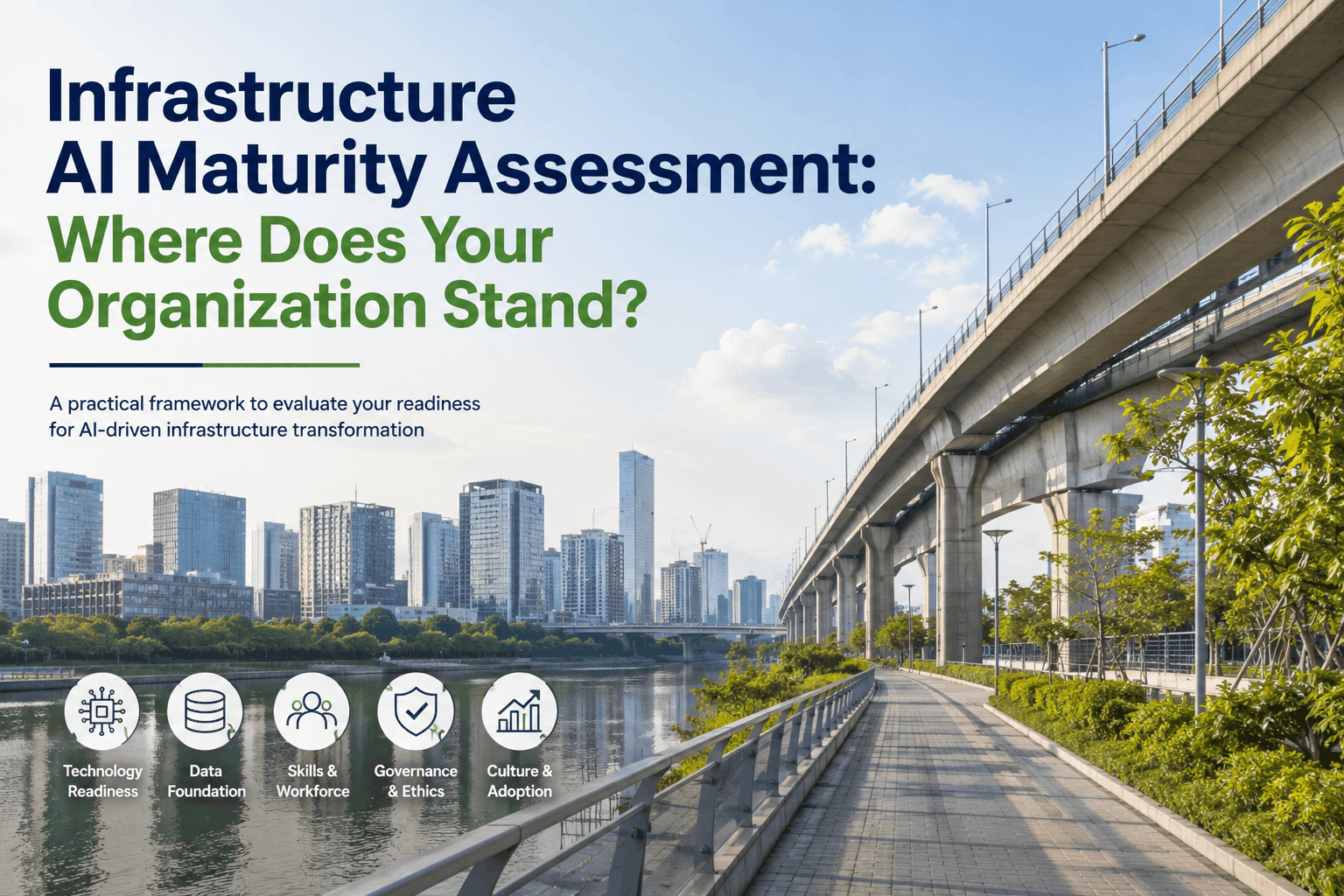
Infrastructure AI maturity assessment is the definitive starting point for organizations looking to transition from antiquated, calendar-based maintenance to the next generation of autonomous asset management. In an era where critical infrastructure — from municipal water networks to integrated steel mill galleries — is under increasing load and environmental stress, the "wait-and-fail" model has become an unacceptable financial and safety liability. Fiduciary responsibilities now dictate that infrastructure managers prove their assets are hardened against unforeseen volatility through data-backed risk modeling. Organizations that schedule a demo with iFactory are discovering that true maturity isn't just about deploying sensors; it is about building a unified data architecture that converts raw equipment telemetry into strategic executive decision support. By evaluating your standing across the five dimensions of AI readiness — technology, data integrity, workforce skills, governance, and culture — your organization can bridge the gap between "Digital Hindsight" and "Autonomous Foresight," ensuring long-term continuity in a volatile market.
Benchmark Your Infrastructure AI Maturity Today
iFactory's Mobile AI-driven platform unifies fragmented infrastructure data into a single operational control tower, delivering the predictive intelligence required for world-class asset longevity. Our system scales with your organization, moving you from manual logs to autonomous prescriptive actions in a single, unified deployment phase.
Why Infrastructure Analytics has Outgrown the "Cost Center" Model
For decades, infrastructure maintenance was treated as a necessary evil — a cost center defined by what it could not do. Disconnected plant historians, paper-based inspection logs that lagged reality by weeks, and a reliance on tribal knowledge were the hallmarks of an "Immature" system. In 2026, this model is being replaced by the "Strategic Control Tower" concept, where every motor, pump, and conveyor is treated as a live revenue-generating asset. The catalysts are structural: labor cost inflation has eliminated the buffer of manual oversight, and input volatility has compressed the margin for inefficiency to near zero. Organizations that successfully transition to an intelligent maintenance system share a single advantage: their analytics has been repositioned as a strategic engine that drives EBITDA growth rather than just logging repairs. This shift ensures that senior leadership can see the direct correlation between asset health and quarterly financial performance, enabling more precise capital allocation.
iFactory's maturity framework provides the "Digital Birth Certificate" and "Historical Memory" needed to satisfy international auditors and insurance underwriters who now demand verifiable risk-mitigation data. By utilizing AI-driven health monitoring, organizations can identify a bearing fault or a valve drift weeks before it stops production, converting a catastrophic outage into a minor planned maintenance event. High-maturity organizations no longer view "Digital Transformation" as an IT project; they view it as a competitive requirement for market leadership. This evolution demands a cultural shift where data-driven decisions are made by every technician on the floor, supported by real-time mobile intelligence. Teams looking to baseline their current standing often begin by choosing to book a maturity strategy session to map their SCADA tags against our industrial ML models.
Unified IoT Data Infrastructure and Edge Normalization
Maturity begins with ingestion at the source. A Level 4 organization uses secure IoT gateways to bridge legacy PLCs and modern sensors into a single, normalized data layer. iFactory removes the "Silo Barrier," ensuring that high-frequency vibration, thermal transients, and electrical harmonics flow into one unified model. This normalization process allows for cross-site benchmarking, where the performance of a pump in one facility can be compared directly against an identical unit in another plant. Without this unified layer, AI models remain fragmented and incapable of identifying enterprise-wide failure patterns.
Real-Time Asset Health Scoring and Predictive Fatigue Modeling
A mature AI infrastructure doesn't just alarm on static thresholds; it generates continuous, dynamic health scores. iFactory's ML models evaluate complex process signatures in real-time, converting equipment telemetry into maintenance timing recommendations and long-term capital replacement forecasts. By analyzing hysteresis in valves and FFT signatures in bearings, the platform calculates a "Remaining Useful Life" (RUL) metric for every critical asset. This allows managers to shift from "Fixing Breakdowns" to "Executing Reliability," ensuring that shutdowns are surgical and scheduled around production demands rather than mechanical failures.
Workforce Analytics Literacy and Autonomous Mobile Workflows
Digital transformation initiatives frequently fail because they ignore the cultural alignment of the frontline workforce. Mature organizations empower their technicians with mobile AI apps that act as a "Co-Pilot" during shift rounds. iFactory's interface translates complex metallurgical and mechanical data into actionable, geo-tagged tasks for every operator. By digitizing tribal knowledge into a permanent digital memory, high-maturity plants eliminate the risk of a "Seniority Gap" where critical reliability expertise leaves the company with retiring staff. This ensures that every shift operates to the same "World Class" standard.
Automated Compliance Intelligence and ESG Data Sovereignty
In a high-maturity state, regulatory compliance is not an administrative burden — it is an automated output of operational excellence. iFactory automates the logging required for ISO 55001 asset management and ESG sustainability reporting, converting audit preparation from a periodic crisis into a continuous "Audit-Ready" state. By providing immutable digital audit trails for safety-critical tasks like LOTO and pressure testing, the platform ensures that your organization is always prepared for OSHA or EPA inquiries. This level of data sovereignty protects the organization from legal liability and strengthens its reputation with bond-rating agencies.
Maturity Benchmark: Comparing legacy and matured models
Moving from Level 1 to Level 4 maturity increases the "Resolution of Control" by a factor of 100x. Traditional methods view assets as static machines; iFactory views them as dynamic, physics-aware digital entities. This table benchmarks the core dimensions that determine your organization's position on the AI readiness curve and its subsequent financial impact.
| Maturity Dimension | Level 1-2 (Reactive / Paper) | Level 4-5 (Autonomous iFactory AI) | Strategic Business Impact |
|---|---|---|---|
| Data Resolution | Manual spot-checks (Daily/Weekly frequency) | Continuous 100Hz IoT Data Streaming | Instant detection of micro-failure transients |
| Predictive Horizon | None (Run-to-fail or manual trending) | 4-6 Week failure mode forecasting | Zero unplanned shutdowns on critical HSM/EAF lines |
| Decision Logic | Subjective (Seniority and intuition dependent) | Objective (ML-driven pattern identification) | Consistent production across all operator shifts |
| Workflows | Manual radio/phone handover coordination | Autonomous mobile work order triggers | +22% Improvement in maintenance labor utilization |
| Supply Chain | Reactive emergency parts ordering post-fail | Predictive spares pre-staging based on health | –40% Reduction in MRO inventory holding costs |
| Regulatory Audit | Weeks of manual paper log reconciliation | Instant 1-click digital compliance export | Elimination of non-conformance findings/fines |
Visualizing the Maturity Roadmap: A Phased Evolution
The journey to AI maturity is not a one-step software installation; it is a phased evolution of data, people, and process. iFactory helps organizations navigate these four stages to ensure each technology investment delivers a measurable ROI before moving to the next tier of complexity. By following a structured roadmap, integrated mills and infrastructure hubs avoid the "Technology Overwhelm" that often stalls digital initiatives. Our platform scales alongside your internal capabilities, providing the guardrails needed for safe autonomous transition. Book a free roadmap strategy session to begin your assessment.
Descriptive Maturity: "What is happening now?"
This phase focuses on digitizing basic sensor tags and equipment logs. By establishing a central data lake and removing paper dependency, organizations gain their first unified view of plant-wide availability. This foundational step is critical for identifying initial energy waste and idle-run patterns that offer the fastest path to technology ROI.
Diagnostic Maturity: "Why is it happening?"
Here, the AI begins correlating multi-parameter trends to identify root causes. By comparing vibration harmonics with motor current, iFactory identifies issues like micro-cavitation or bearing fatigue across different asset zones. This stage moves the maintenance culture from "What broke?" to "Why did it break?", preventing the return of chronic failures.
Predictive Maturity: "What will happen?"
ML models mature to forecast failure windows 30 days in advance. Maintenance shifts from reactive "Firefighting" to planned, condition-based outages. This level of maturity allows supply chain teams to pre-stage high-value spare parts, reducing emergency air-freight costs and ensuring that every shutdown is executed within its allocated production window.
Prescriptive Maturity: "How can we optimize it?"
The highest level of maturity, where AI suggests autonomous setpoint adjustments to maximize yield and energy efficiency. iFactory integrates directly with your CMMS to manage the full work-order lifecycle autonomously. At this stage, the plant functions as a self-optimizing nervous system, responding to physics-based drifts in milliseconds to guarantee quality.
"Before iFactory, our 'Digital Transformation' was just a series of disconnected spreadsheets and tablet forms. The maturity assessment revealed that while we had data, we lacked actionability. Since moving to Level 4 maturity, we've recovered 48 hours of HSM production annually and reduced our emergency parts spend by 30%. It's no longer just an IT project—it is the strategic engine that powers our entire business growth model."
Frequently Asked Questions: Infrastructure AI Maturity Strategy
What is the main difference between Level 2 and Level 4 AI maturity in an industrial context?
Level 2 maturity is typically 'Digital-Passive,' meaning the organization is tracking data manually or via basic sensors but still relies on humans to interpret it. Level 4 is 'Predictive-Active,' where ML models perform the analysis autonomously and trigger proactive workflows. iFactory helps organizations skip the long 'Level 3' transition by deploying pre-trained industrial models that can ingest and analyze your existing SCADA history in a matter of days.
How long does a typical infrastructure AI maturity assessment take for a multi-site mill?
A comprehensive baseline assessment usually takes 1-2 weeks, involving data audits and interviews with key reliability stakeholders. However, iFactory's 'Data-Readiness Scan' can be performed in under 48 hours once we have read-only access to your plant historian or SCADA tags. This rapid scan identifies exactly which assets are ready for immediate predictive health monitoring and which require additional sensor density to reach high maturity.
Do we need to hire a team of Data Scientists to reach Stage 4 Prescriptive maturity?
No. One of iFactory's core design principles is 'Asset-Aware AI.' We provide pre-packaged, production-ready AI models for common industrial assets like HAGC pumps, gearboxes, and EAF electrodes. This allows your existing reliability and process engineers to manage high-maturity AI through an intuitive mobile interface without ever needing to write code or manage complex ML pipelines themselves.
Can the iFactory platform integrate with older 'Brownfield' assets that lack digital output?
Absolutely. High maturity is achieved by unifying the whole plant, not just the newest lines. iFactory's IoT gateways act as 'Digital Enablers' for older PLCs (Modbus, Profibus, etc.), digitizing those signals for our AI engine. We also provide non-invasive vibration and thermal sensors that can be retrofitted to 20-year-old assets, bringing them into the same predictive health model as your newest infrastructure.
What are the most common cultural barriers when moving toward high AI maturity?
The single greatest barrier is 'Tribal Knowledge Silos' — where critical maintenance information exists only in the heads of senior staff. Moving to high maturity requires digitizing this knowledge into a collective digital memory. iFactory's mobile-first UX is designed to lower this friction, ensuring that senior staff can easily input their expertise while enabling junior technicians to execute complex tasks with AI guidance.
How does reaching high maturity impact our mill's annual insurance premiums?
High-maturity organizations possess verifiable 'Loss Mitigation' data that traditional plants lack. By proving you can predict and prevent catastrophic failures through AI, you provide underwriters with an objective, data-backed risk-reduction profile. This frequently leads to significantly better terms on Business Interruption and Equipment Breakdown policies, as you can demonstrate 24/7 autonomous risk governance.
Does iFactory support cross-site benchmarking for large infrastructure groups?
Yes. A matured enterprise control tower allows you to compare the 'Asset Health Index' and 'Energy Intensity' of multiple facilities side-by-side. This identifies the management disciplines and maintenance practices that produce the highest OEE in your best plant and allows you to systematically transfer those best-practices to your lower-performing facilities through our unified digital framework.
What is the expected ROI timeframe for a Stage 3 Predictive deployment?
Most organizations achieve full ROI within 6-9 months of moving to predictive maturity. This is driven by three primary categories: the prevention of a single major unplanned outage, a 22% average improvement in maintenance labor efficiency, and a 15-20% reduction in energy waste through autonomous idle-run detection on large auxiliary motors.
Build the Infrastructure Control Tower Your Strategy Requires
iFactory's industrial analytics platform transforms fragmented asset data into a unified strategic control tower — giving infrastructure executives the real-time visibility and predictive intelligence to lead operations with precision rather than reacting with urgency.