Infrastructure Edge Computing — Low-Latency AI Data Processing for Remote Assets
By Johnson on August 20, 2026
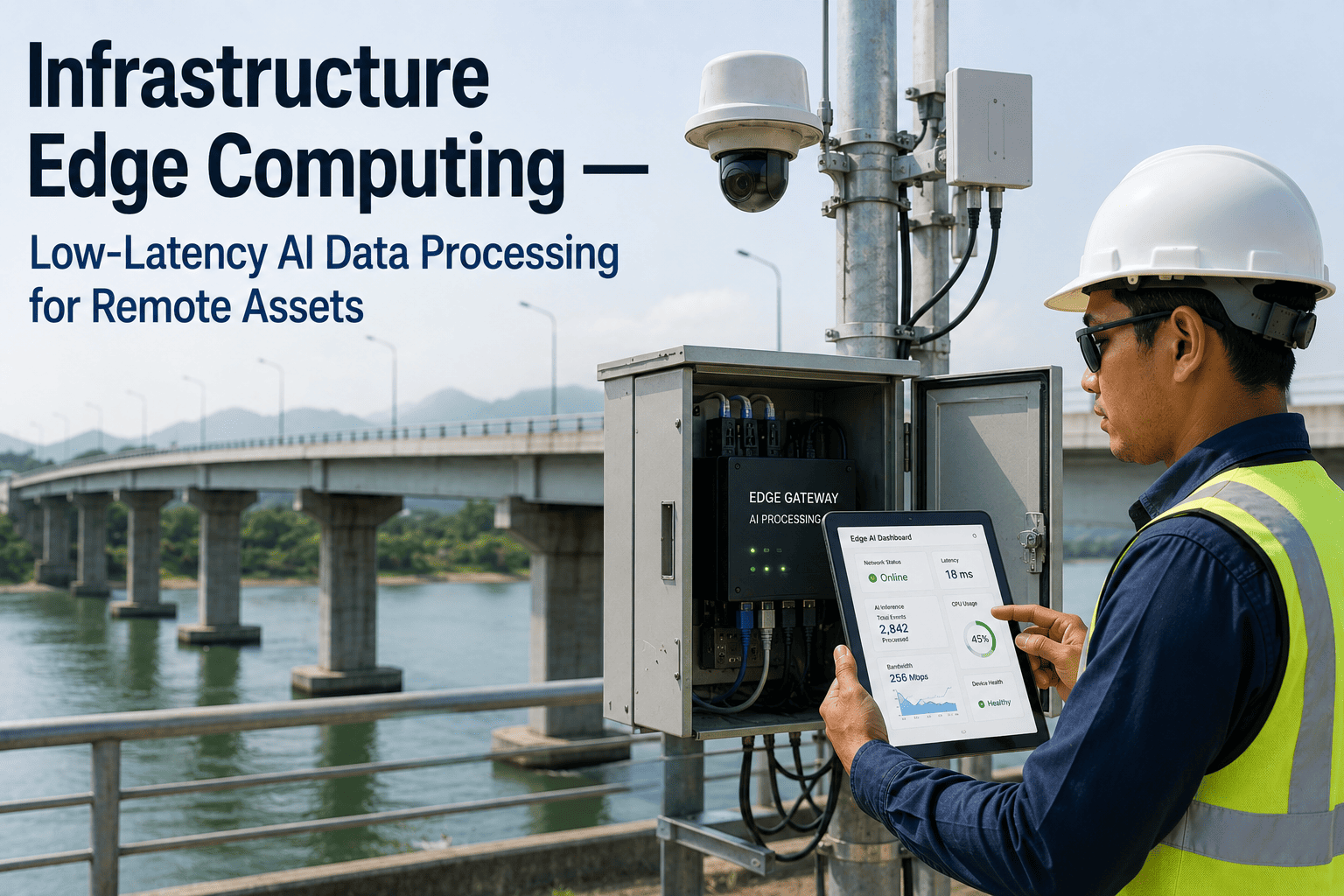
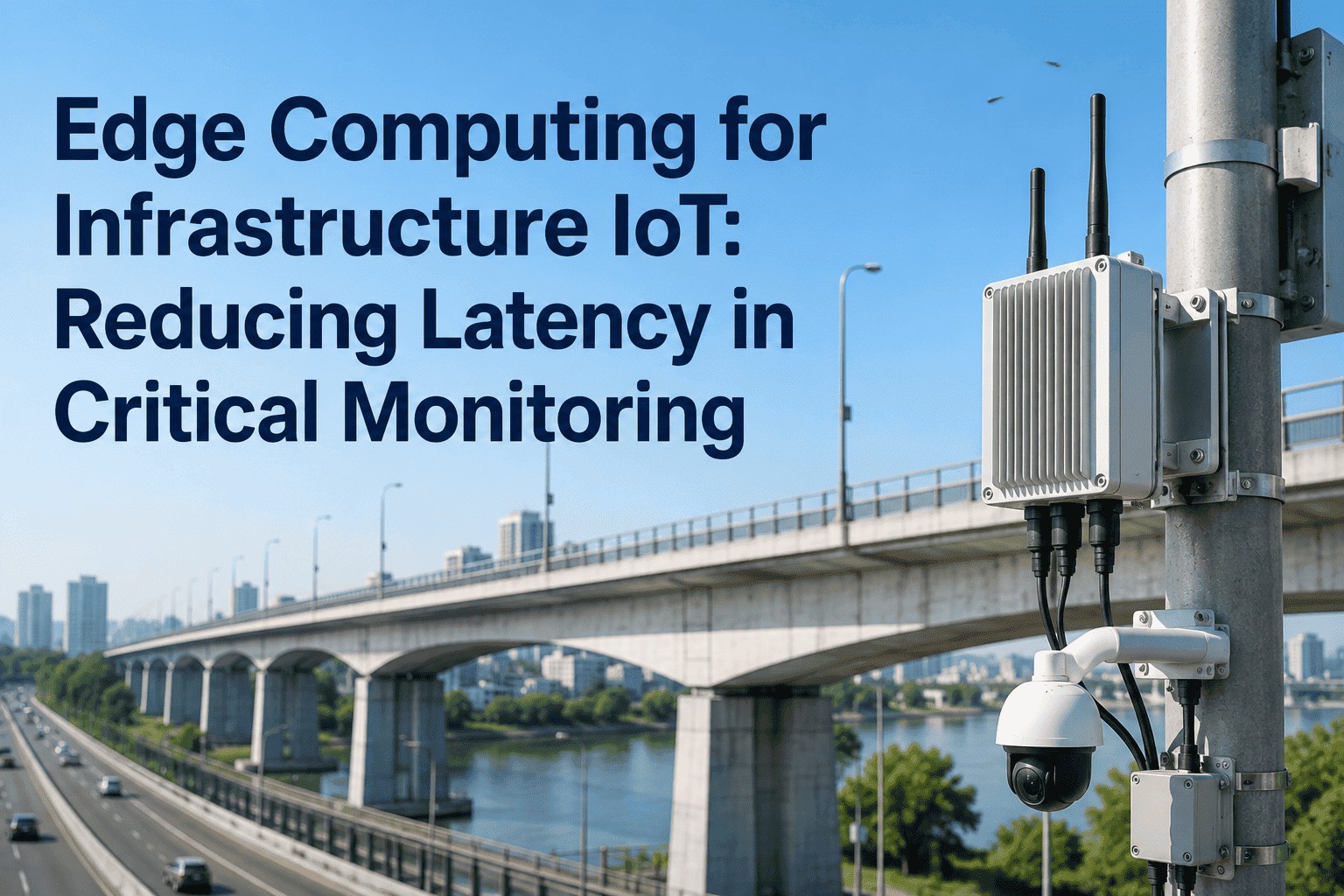
A vibration sensor on a remote pump station can detect a bearing failure in the time it takes to read this sentence — but if that reading has to travel to a cloud server, get processed, and travel back before anything happens, the failure has often already occurred by the time an alert fires. For infrastructure spread across hundreds of miles of pipeline, dozens of bridge structures, or water systems in areas with unreliable cellular coverage, that round trip is not a minor delay, it is the difference between a prevented failure and an emergency response. Edge computing solves this by running the AI model on-site, at or near the sensor, so the decision to alert happens in milliseconds rather than waiting on a network connection that may not even be available. This walkthrough covers how edge AI processing actually works for infrastructure monitoring, where it outperforms a cloud-only architecture, and what a deployment looks like for assets your team manages today — starting with a technical review of your current sensor and connectivity setup.
IoT & Smart Sensors · Edge Computing
Edge Computing for Infrastructure: Low-Latency AI Processing at Remote Assets
Run AI inference directly at bridges, pump stations, and remote monitoring points, so critical alerts fire in milliseconds instead of waiting on a cloud round trip that may never complete.
Why Cloud-Only Monitoring Struggles With Remote Infrastructure
Cloud-based AI monitoring works well when the asset sits somewhere with reliable, high-bandwidth connectivity — but a large share of critical infrastructure does not. Bridges in rural corridors, water systems in mountainous terrain, and pipeline segments far from cell towers routinely operate on intermittent or low-bandwidth connections, and a monitoring architecture built entirely around a round trip to the cloud inherits every weakness of that connection. The market is responding accordingly: analysts tracking the AI edge computing sector project it growing from roughly nine billion dollars in 2025 at more than twenty percent annually, driven in large part by exactly this kind of remote, latency-sensitive industrial monitoring.
Latency Stacks Up
Every hop from sensor to gateway to cloud to model to alert adds delay, and on a congested or low-bandwidth link that round trip can stretch well past the window in which a fast-developing failure needs a response.
Bandwidth Gets Expensive
Streaming raw sensor and video data continuously to the cloud from hundreds of remote sites consumes bandwidth and cellular data allowances fast, especially for vibration, acoustic, or high-frame-rate camera feeds.
Connectivity Is Not Guaranteed
A cloud-only architecture goes silent the moment the link drops, which is precisely when many infrastructure failures occur — during storms, floods, and other events that also tend to disrupt cellular and satellite connections.
How It Works
The Edge AI Processing Stack, Layer by Layer
Edge computing does not eliminate the cloud from the architecture — it changes what runs where, keeping the time-sensitive decision local while still sending summarized data upstream for long-term analysis and cross-site trending. Each layer below has a distinct job, and understanding where the boundary sits between local processing and cloud analysis is the key design decision in any edge deployment.
Layer 1
Sensors & Field Devices
Vibration, acoustic, strain, water level, and camera sensors continuously generate raw readings at the physical asset.
Layer 2
Edge Gateway & Local Compute
A ruggedized on-site device runs the AI inference model directly against incoming sensor data, without waiting on an external connection.
Layer 3
Local Alert & Control Logic
When a reading crosses a trained threshold, the edge device fires an alert immediately, through whatever local channel is available, including SMS or a site-level control signal.
Layer 4
Cloud Sync & Cross-Site Analysis
Summarized data and confirmed alerts sync to the cloud platform whenever connectivity allows, feeding portfolio-wide trend analysis and long-term condition modeling.
Test It Against Your Own Sites
See Edge AI Processing Run on a Site With Poor Connectivity
The clearest way to evaluate edge deployment is to see it running against a site that already gives your current monitoring setup trouble. We can scope a pilot around your most connectivity-challenged asset.
Faster alerting is the headline benefit, but process engineers evaluating a deployment budget usually find the operational savings matter just as much once a portfolio scales past a handful of sites.
Bandwidth Reduction
Only summarized data and confirmed events sync to the cloud instead of continuous raw sensor streams, cutting cellular and satellite data costs significantly across a distributed portfolio.
Reduced Cloud Processing Load
Routine inference runs locally rather than consuming centralized compute for every reading from every site, keeping cloud infrastructure costs proportional to what actually needs cross-site analysis.
Operational Resilience
Monitoring continues functioning through storms, outages, and connectivity gaps — precisely the conditions under which infrastructure failures are more likely to occur in the first place.
Applied Across Asset Types
What Edge AI Monitors, and How Fast It Has to Respond
The response window varies significantly by asset type and failure mode, and that window is exactly what determines whether a cloud round trip is fast enough or whether the decision needs to happen locally.
Asset Type
What Edge AI Monitors
Trigger Example
Required Response Window
Bridges & Structures
Strain, vibration, tilt
Sudden load shift or structural anomaly
Sub-second
Water & Wastewater
Flow rate, pressure, level
Pipe burst or overflow risk
Seconds
Dams & Levees
Seepage, movement, water level
Rapid water level rise
Seconds to minutes
Rotating Equipment
Vibration, temperature, acoustic
Bearing or motor fault signature
Sub-second
Perimeter & Access
Video, motion
Unauthorized access detection
Sub-second
When the Link Goes Down
Connected Mode vs. Disconnected Mode
The real test of an edge deployment is not how it performs on a good connection — it is what happens the moment connectivity drops, which is often exactly when monitoring matters most.
Cloud-Only Architecture
Sensor data stops reaching the model entirely
No alerts fire until connectivity is restored
Any anomaly during the outage goes undetected
Data gap appears in the historical record
Edge-Enabled Architecture
Sensor data continues processing on-site
Alerts still fire through local channels
Anomalies are detected and logged in real time
Full data set syncs once connectivity returns
Deployment Pitfalls
Where Edge Deployments Commonly Go Wrong
Most edge monitoring problems trace back to a small number of avoidable planning gaps rather than the underlying technology itself.
Treating Edge as All-or-Nothing
Not every asset needs edge processing — sites with reliable connectivity and slower-moving failure modes may be well served by cloud processing alone, and forcing edge hardware everywhere wastes budget.
Underpowered Field Hardware
Running an inference model that needs more compute than the deployed gateway can handle leads to dropped readings or delayed processing, undermining the entire latency advantage.
No Local Alert Fallback
An edge device that can detect an anomaly but has no way to alert anyone without an internet connection has solved only half the problem.
Ignoring Power Constraints
Remote sites often run on solar or battery power, and an edge deployment sized without accounting for that budget can end up offline more often than the connectivity it was meant to work around.
Applied Example
What Edge Processing Looks Like on a Remote Pump Station
Consider a wastewater lift station situated well outside cellular range, connected to the network only through an intermittent satellite link. Under a cloud-only setup, a sudden pressure spike from a clogged line would generate a reading that queues for transmission, waits on the next available satellite window, processes in the cloud, and returns an alert — a sequence that can take several minutes on a good day and simply not happen at all if the link is down. With an edge gateway deployed at the station, the same pressure spike is processed by the local model the instant it is read, triggering an on-site alarm and a local relay to shut down the inbound pump before the line ruptures, while the event itself queues for cloud sync and gets uploaded to the central dashboard once the satellite window opens. The difference is not a marginal improvement in reporting speed — it is the difference between a contained event and a spill that becomes a regulatory incident.
"
Process engineers evaluating edge deployments almost always ask the same first question: does this replace the cloud platform we already have? It doesn't. The cloud stays for long-term trending, cross-site analysis, and reporting. What changes is that the decision with a real time cost — do we alert right now, do we shut this pump down — happens locally, in milliseconds, whether or not the connection back to the cloud is up at that moment. That distinction is what makes edge worth the deployment effort for the sites where seconds actually matter.
Priyansh Vandermolen
Industrial IoT Systems Engineer · 13 years deploying edge and SCADA monitoring for water, energy, and transportation infrastructure
Edge Deployment Questions
Edge Computing for Infrastructure — Frequently Asked
Does edge computing replace our existing cloud-based monitoring platform?
No — edge processing handles the time-sensitive decision locally while the cloud platform continues to manage long-term trending, cross-site dashboards, and historical reporting, so the two work together rather than as replacements for one another. Book a demo to see how the two layers connect for your asset portfolio.
What hardware is required at each site?
A ruggedized edge gateway sized to the sensor load and inference model for that site, along with a local alert mechanism such as a relay, siren, or SMS module for sites without reliable connectivity. Contact support to review hardware sizing for your specific sensor mix.
How does the system behave when the site loses power?
Edge deployments for remote or solar-powered sites are sized with a battery buffer and configured to prioritize critical alerting functions first if power runs low, so the highest-value monitoring stays active longest during an outage. Book a session to plan a power budget for your site conditions.
Do all of our assets need edge processing, or just some of them?
Most portfolios only need edge deployment at a subset of sites — typically those with poor connectivity, fast-moving failure modes, or high consequence of delayed detection — while other sites are served well by cloud-only monitoring. Talk to our team about which of your sites actually need it.
How long does a typical edge deployment take from planning to live monitoring?
A single-site pilot is often live within a few weeks once sensor and connectivity details are confirmed, with a broader rollout timeline depending on how many sites need hardware installation and how much variation exists across site conditions. Book a call to scope a timeline for your specific site count.
Milliseconds Matter at the Edge
Give Your Remote Assets a Response Time That Doesn't Depend on a Connection
iFactory deploys edge AI processing at your remote infrastructure sites, keeping critical alerts local, fast, and functional even when the link back to the cloud goes down.