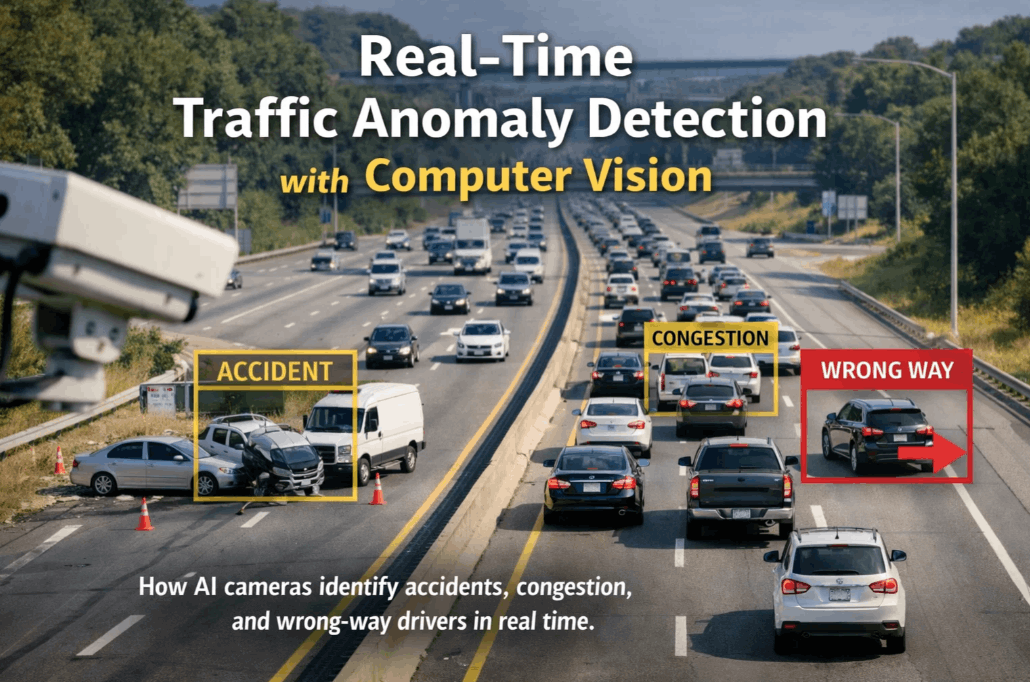
Manual monitoring of highway CCTV feeds is a statistically impossible task for human operators, who often suffer from 'attentional blink' within just 20 minutes of observation. Real-time traffic anomaly detection with computer vision has transformed the Traffic Management Center (TMC) from a reactive monitoring room into a proactive emergency response hub. By utilizing deep learning models to identify stopped vehicles, wrong-way drivers, and roadway debris in milliseconds, agencies can dispatch first responders before an incident cascades into a multi-vehicle pileup. As highways grow more congested, the ability to automate anomaly detection is the single most effective lever for reducing secondary accidents and improving roadway on-time performance. Book a Demo to see how iFactory's computer vision platform automates incident detection and highway safety oversight natively.
Identify Highway Accidents and Anomalies in Under 5 Seconds.
Detect stopped vehicles, wrong-way entries, and high-risk congestion waves automatically. Transform your existing camera network into a 24/7 autonomous safety sentinel.
What Is Real-Time Traffic Anomaly Detection?
Real-time traffic anomaly detection is the application of high-speed computer vision to identify critical safety events on public roadways. This technology processes video feeds natively at the gantry level to detect 'stopped vehicles', 'wrong-way drivers', 'pedestrians in lanes', and 'roadway debris'. By identifying these events in milliseconds, agencies can trigger immediate responses—such as variable message sign (VMS) alerts and emergency dispatch—eliminating the detection gap that typically leads to secondary pileups and long-duration congestion. It is the core intelligence layer of the 2025 Smart Highway model.
AI-Powered Roadway Oversight: The 6 Pillars of Traffic Anomaly Detection
Modern AID (Automated Incident Detection) platforms utilize 3D spatial mapping and temporal behavioral analysis to differentiate between standard traffic flow and life-threatening roadway hazards.
Stopped Vehicle Detection (SVD)
Identifying vehicles that have come to a halt in active lanes or on shoulders. The AI calculates 'dwell time' before triggering a high-priority alert to the TMC.
<8s Detection TimeWrong-Way Alerting
Detecting vehicles entering ramps or traveling lanes in the wrong direction. Sub-second latency triggers automated 'STOP - WRONG WAY' message signs instantly.
<1s Alert PipelineLost Load & Debris Identification
Detecting objects on the roadway down to 10cm². Precise localization allows maintenance crews to navigate directly to the hazard before an accident occurs.
10cm Detection Sens.Pedestrian & Wildlife Detection
Identifying vulnerable roadway users in restricted highway zones. IR-enhanced vision allows for detection in low-light and adverse weather conditions.
98% Detection AccuracySlow Vehicle & Queue Propagation
Monitoring the formation of traffic queues. The AI detects 'shockwave' patterns—where vehicles brake suddenly—allowing for speed harmonization through VMS.
-15% Jam DurationTunnel Fire & Smoke Monitoring
Specialized visual models identify smoke plumes or fire flashes in tunnels, triggering ventilation systems and emergency gates in under 3 seconds.
<3s Safety TriggerTraffic Incident Orchestration: A Step-by-Step AI Pipeline
Edge Visual Capture & Pre-Processing
Video is captured by gantry-mounted 4K sensors. The AI performs real-time 'noise normalization' to ignore shadows, rain, and snow, focusing only on actual vehicle vectors.
30FPS Native ProcessingAnomaly Identification & 3D Mapping
Detected anomalies are mapped to real-world GPS coordinates within 500ms. The system calculates the exact lane and distance relative to the nearest mile-marker.
500ms LocalizationAutomated Countermeasure Launch
Critical events (wrong-way/stopped vehicle) trigger automated highway responses. VMS signs are updated and emergency sirens are dispatched via CMMS integration.
Instant SOP TriggerDigital Compliance & Post-Incident Audit
Every event is time-stamped and logged with a 30-second video clip. This creates a tamper-proof audit trail for highway agencies and insurance investigators.
<15s Audit ExportSmart Highway Maturity Journey: From Manual to AI-Autonomous
Manual Monitoring & Radio Dispatch
Operators cycle through hundreds of feeds manually. Incident detection depends on driver phone calls or lucky 'eye-on-monitor' timing.
Legacy Motion Detection (Pixel Change)
Simple pixel-change alerts. High false-alarm rates due to weather, lighting, and shadows cause operator fatigue and ignored alerts.
AI-Driven Behavioral Detection
Deep learning models classify objects (car, truck, person) and analyze movement patterns. Accurate detection in all weather conditions.
Self-Healing Responsive Highways
Fully autonomous anomaly detection with automated ITS control. VMS, lane signals, and first responders are synchronized by the AI engine.
Key Technologies Powering AI Highway Monitoring in 2025
| Technology Layer | Application in Traffic Anomaly Detect | Performance Gain | Timeline |
|---|---|---|---|
| Edge GPU Clusters | Gantry-level video processing & inference | 99.9% bandwidth reduction | 7-14 days |
| Behavioral AI Models | SVD, Wrong-way, and queue detection | -12 min detection delay | 14-21 days |
| IR-Enhanced Sensors | Night-time and adverse weather visibility | 100% 24/7 uptime | 21-30 days |
| VMS API Integration | Automated hazard messaging to drivers | -30% secondary crashes | 14-21 days |
Highway Safety and Audit Compliance: The AI Advantage
Prevention
AI detects congestion waves at their genesis, allowing for speed harmonization that prevents the 'panic-braking' events that cause pileups.
-40% Hard Braking EventsDetection
Computer vision identifies wrong-way entries and stopped vehicles at the gantry level with detection latency under 3 seconds.
<3s Detection LatencyDocumentation
Every roadway incident is logged with pre-event and post-event video clips, providing an incontrovertible audit trail for law enforcement.
<15s Audit Export12-Month Smart Highway AI Transformation Data
Calculating the ROI of Autonomous Highway Monitoring
Congestion Cost Avoidance
Detecting incidents faster reduces queue formation, recovering millions in commuter time and fuel costs per high-volume corridor.
Operator Optimization
AI-AID allows a single TMC operator to effectively manage 4x more cameras, focusing only on validated, high-priority safety events.
Secondary Accident Reduction
Eliminating secondary crashes reduces highway repair costs, insurance claims, and multi-agency emergency response deployments.
Legal & Audit Protection
Automated video logging of every incident provides a shield against liability claims and confirms regulatory compliance in real-time.
Frequently Asked Questions: Traffic Anomaly AI
Can the AI differentiate between a stall and heavy congestion?
Yes. Behavioral AI analyzes the relationship between lanes. A stall is identified by a localized zero-velocity vector while adjacent traffic continues to flow, whereas congestion is identified by synchronized deceleration.
How does the system perform in heavy fog or night conditions?
Using IR-enhanced sensors and mult-spectral contrast algorithms, the AI can 'see' through atmospheric noise that renders human monitoring useless, maintaining 95%+ detection accuracy 24/7.
What is the false alarm rate in adverse weather?
Unlike legacy 'pixel-motion' systems that trigger on shadows or heavy rain, iFactory's behavioral AI classifies the 3D 'mass' and 'trajectory' of an object. This reduces false alarms by over 92% in heavy snow, fog, and nighttime lighting transitions.
Is the system compliant with GDPR or local privacy regulations?
Yes. The system processes video at the edge and can be configured to auto-blur faces and license plates before any data is stored. iFactory supports 'Anonymized Surveillance' modes that provide safety metadata without capturing personal info.
How do you handle occlusion (vehicles blocking others)?
The platform uses 'Multi-Sensor Fusion' to track vehicle persistent-IDs across overlapping camera fields. If a vehicle is momentarily occluded by a large truck, the AI maintains its position vector in 3D space for continuity.
Stop Reacting to Crashes—Start Preventing Secondary Accidents
Join the agencies running the world's safest highways. Move from manual surveillance to 3-second autonomous incident detection and response.