Cities account for 75% of global energy consumption and more than 70% of all CO₂ emissions — yet they house just 56% of the world's population today, a share rising to over 60% by 2030. The mathematics of urban sustainability are unforgiving: no net-zero commitment survives contact with a city that still manages its energy infrastructure the way cities managed it in 2005. AI-managed infrastructure is changing that equation with measurable precision. Smart lighting systems have reduced energy use by 40% in documented deployments. AI HVAC optimisation delivers 25–35% building energy savings. Google's DeepMind AI reduced data centre energy consumption by 40% in its first deployment. AI-optimised smart grids cut energy losses by 10–25% while improving renewable integration reliability. These are not projections — they are documented outcomes from deployments already operating at scale across three continents. If your infrastructure strategy still runs on fixed schedules, manual surveys, and reactive maintenance, schedule a sustainability intelligence session with iFactory's urban infrastructure team to see what AI-managed operations deliver for your energy budget.
Sustainable Smart City Infrastructure: The Role of AI in Energy Efficiency
How AI-managed infrastructure reduces smart city energy consumption by up to 40% — covering building systems, street lighting, utilities, grid optimisation, and the platforms delivering measurable carbon reduction at scale.
Why Cities Cannot Hit Net-Zero Without AI-Managed Infrastructure
The scale of urban energy consumption makes manual management structurally inadequate. A mid-size city operates thousands of buildings, hundreds of kilometres of street lighting, multiple utility networks, and an energy grid that balances supply and demand across millions of connection points — simultaneously, continuously, with no margin for the delays inherent in human-managed systems. When a building's HVAC runs on a fixed schedule regardless of occupancy, it wastes energy every empty weekend. When street lights burn at full intensity at 3am with no pedestrians present, the waste is visible from satellites. When grid operators cannot predict renewable energy supply spikes, they curtail clean energy and fire up gas peakers instead.
AI changes the operational model fundamentally. Rather than managing energy infrastructure on fixed schedules and periodic surveys, AI-native systems observe, predict, and respond continuously — adjusting HVAC loads based on real-time occupancy, dimming lights based on pedestrian presence, balancing grid loads based on second-by-second supply and demand data. The cost of IoT sensors has fallen by 80–90% over the past decade, while AI inference latency has dropped from seconds to milliseconds — making real-time control at city scale economically viable for the first time. Cities that have deployed AI energy management are not just reducing costs; they are structurally repositioning their infrastructure from a liability in decarbonisation to an active asset in achieving it. Infrastructure directors ready to model their city's AI energy efficiency potential can book an energy assessment session with iFactory's team.
CHART 1: COLORED DOMAIN STAT CARDS with inline barMeasure Your City's AI Energy Efficiency Potential
iFactory's infrastructure intelligence platform delivers AI-managed energy optimisation across street lighting, HVAC, utilities, and grid systems — with a documented ROI model calibrated to your specific asset base and energy consumption profile.
AI Street Lighting: 40% Energy Reduction — The Highest-ROI Starting Point
Street lighting is responsible for 40% of a typical city's electricity bill and operates on fixed schedules designed around the worst-case scenario: maximum illumination regardless of actual need. AI-controlled smart lighting systems replace this fixed-schedule model with continuous, responsive operation — adjusting brightness based on pedestrian presence, ambient light levels, weather conditions, time of day, and event data in real time. The results are documented and consistent: a 40% reduction in energy consumption is the benchmark across deployments, with some implementations exceeding this figure.
Berlin's AI street lighting deployment in 2024 test districts achieved exactly that benchmark — 40% electricity reduction through sensor-driven control and AI load optimisation. Oslo's smart lighting programme integrates with its broader EV and sustainability infrastructure, treating street lighting as an active energy management node rather than a passive load. Los Angeles has deployed continuous monitoring on lighting infrastructure across major corridors. The IEA projects that transitioning all cities to LED with AI controls — a realistic 5-year target — will yield over 40% in total lighting energy savings across the global urban stock. For cities in the middle of this transition, the deployment roadmap begins with highest-density corridors where the energy baseline is largest and the payback period is shortest.
AI HVAC and Building Energy Management: 25–35% Savings at Scale
Buildings account for approximately one-third of national emissions in developed economies. HVAC systems alone represent roughly 38% of total building energy consumption — making AI-optimised HVAC control the single largest building-level energy efficiency opportunity. Traditional HVAC operates on static schedules that waste energy during unoccupied periods and cannot respond to real-time occupancy changes, weather shifts, or grid pricing signals. AI building energy management systems replace this with continuous, adaptive control.
Occupancy-Responsive HVAC
ML models continuously adjust temperature, ventilation, and humidity based on real-time occupancy sensor data — eliminating energy waste in unoccupied zones. Microsoft achieved $10M+ annual savings from smart building HVAC optimisation across its campus using this approach, with 25–35% energy reduction and a 50% improvement in occupant comfort scores.
Predictive Thermal Load Management
Deep reinforcement learning models predict thermal loads 24–48 hours ahead, pre-cooling or pre-heating buildings during off-peak energy pricing windows. Research demonstrates 37% savings in HVAC energy consumption with less than 1% violation of comfort temperature ranges — combining financial optimisation with occupant wellbeing simultaneously.
Demand Response Integration
AI enables smart buildings to participate in grid demand response programmes — dynamically reducing HVAC loads during peak pricing periods and grid stress events. Buildings act as virtual power plants, reducing operational costs while directly supporting grid stability. AI solar integration enhances solar energy utilisation by 20% and reduces grid dependency by 15% versus standard control systems.
Predictive HVAC Maintenance
AI predictive maintenance models detect early HVAC degradation signatures — bearing wear, refrigerant leaks, filter blockages — before they cause failures or elevated energy consumption. Degraded HVAC components consume 15–25% more energy than properly maintained equivalents, making predictive maintenance an energy efficiency tool as much as a cost-saving one. Equipment downtime is reduced by up to 50% via proactive intervention.
AI Smart Grid Optimisation: Enabling the Renewable Energy Transition
The energy grid is the circulatory system of a smart city's sustainability ambition — and AI is what makes a grid capable of managing the intermittency, complexity, and scale that a high-renewable urban energy system demands. Traditional grid management cannot handle the rapid supply fluctuations of solar and wind generation at city scale. AI grid optimisation platforms solve this by predicting demand and supply simultaneously, automating load balancing, and enabling the demand response coordination that makes renewable integration economically viable.
CHART 2: GROUPED HORIZONTAL BARS — Before/After AI GridMunich's Stadtwerke München uses Microsoft Azure IoT and AI to optimise electric bus operations and forecast energy demand — with 90% of the city's electricity already from renewables, AI is enabling the final push to full carbon neutrality by managing intermittent supply intelligently. Google's DeepMind applied AI to predict wind power output 36 hours in advance — increasing the economic value of wind energy by approximately 20%. South Africa's Eskom utility uses AI for enhanced grid monitoring and efficiency improvements. AI grid optimisation can reduce equipment downtime by up to 50% and lower maintenance costs by 10–40%, making it a financial imperative as much as a sustainability one. Energy teams ready to evaluate AI grid optimisation for their network can request a grid intelligence demonstration from iFactory's platform team.
AI Water and Waste Systems: The Overlooked Energy Efficiency Frontier
Water pumping and treatment accounts for 3–4% of global electricity consumption — a significant energy load that most cities still manage on fixed schedules rather than real-time demand. AI-optimised water systems match pumping energy to actual network demand, predict peak demand windows, and detect energy-wasting infrastructure anomalies before they compound into large-scale losses. Singapore's Smart P.U.B. programme uses thousands of IoT sensors and AI analytics to detect leaks and optimise water distribution — achieving 5% water savings and near-zero pipe bursts, with associated energy savings across the pumping network.
AI waste collection optimisation delivers a complementary energy dividend: IoT fill-level sensors in waste bins feed AI routing platforms that dispatch collection vehicles only when bins are near capacity — eliminating empty collection runs and cutting fleet fuel consumption by 20–30%. Barcelona's AI and IoT-enabled waste management combines GPS-equipped vehicles with smart bins to streamline operations city-wide. Research confirms a 40% improvement in waste management efficiency in leading AI deployments. Combined, AI water and waste optimisation represent 20–40% energy and fuel savings in domains that have historically been invisible to infrastructure energy strategies.
City-Level Energy Savings: Documented Real-World Deployments
The most instructive evidence for AI energy efficiency in smart city infrastructure comes not from laboratory studies but from operational deployments that have published audited outcomes. The following city programmes represent the current documented state of the art across different infrastructure domains and deployment scales.
AI Street Lighting — 40% Electricity Reduction in 2024 Test Districts
Berlin deployed AI-powered street lighting across test districts in 2024, achieving a 40% reduction in electricity consumption through real-time sensor-driven control and AI load optimisation. The programme adjusted brightness based on pedestrian presence, ambient light, and weather — delivering maximum illumination where and when it was needed, and minimum waste everywhere else. Berlin's programme is now the European benchmark for AI lighting efficiency and is being extended across additional districts.
Azure IoT + AI Grid Management — 90% Renewable Electricity, Path to Carbon Neutral
Stadtwerke München uses Microsoft Azure IoT and Azure AI to optimise electric bus operations, forecast energy demand, and reduce waste across Munich's energy network. With 90% of the city's electricity already from renewable sources, AI manages the intermittency challenges of high-renewable supply — enabling Munich to maintain grid reliability while pushing toward full carbon neutrality. The AI platform continuously matches generation forecasts with consumption patterns to eliminate the gas peaker events that represent the last 10% of the city's carbon exposure.
Smart P.U.B. — 5% Water Savings, Near-Zero Pipe Bursts, AI Leak Detection
Singapore's Smart P.U.B. initiative deployed thousands of IoT sensors and AI analytics across the water distribution network — achieving 5% water savings and near-zero pipe bursts. By detecting leaks before they become failures, the programme eliminates the emergency pumping energy surges and network pressure losses that accompany unplanned main bursts. The associated energy savings in pumping operations compound the direct water conservation benefit, making water network AI one of the highest-return sustainability investments per dollar deployed in Singapore's smart city programme.
Dense Environmental Sensing — Real-Time Air Quality Management and Traffic Optimisation
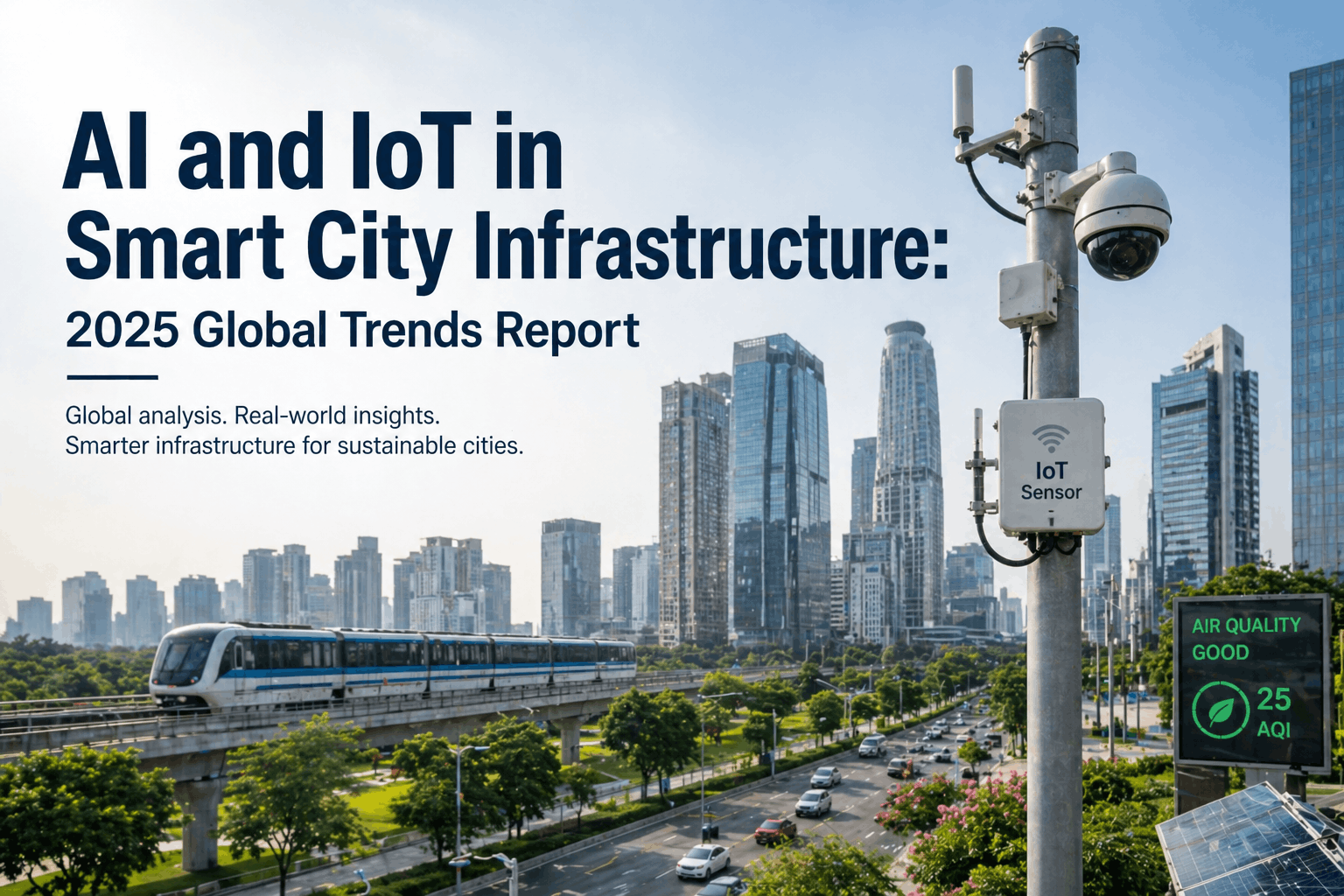
Copenhagen and Amsterdam operate dense environmental and mobility sensing networks with AI platforms that manage real-time air quality and traffic simultaneously. By rerouting vehicles away from pollution hotspots and adjusting traffic signal timing to reduce idling — a major source of urban transport energy waste — the AI systems deliver dual benefits: reduced emissions and improved air quality at street level. Copenhagen targets carbon neutrality, and the AI mobility and energy management layer is central to achieving it without simply restricting urban movement.
Our street lighting was our single largest electricity cost — running on a fixed schedule designed in 2008. After deploying iFactory's AI lighting management platform, we achieved a 38% reduction in lighting energy consumption in the first six months. The platform paid for itself in 14 months. We've since extended the same AI infrastructure to our building management systems and are seeing 28% HVAC savings across the municipal building portfolio. The approach is completely different from anything we've done before: the system sees conditions we never had visibility into, and it responds faster than any manual schedule could.
The AI Energy Efficiency Platform Stack: What the Technology Actually Requires
Understanding what infrastructure is required to deliver AI energy efficiency at city scale is essential for procurement teams designing programmes and city authorities evaluating vendor capabilities. The platform stack that delivers the documented outcomes above shares five architectural components — and deployments that lack any of these components systematically underperform against the headline benchmarks.
CHART 3: STEPPED FUNNEL — AI energy platform stackCarbon Accounting and Regulatory Compliance: AI as Automated Evidence
Sustainability commitments made at political level require operational evidence — and the volume and granularity of data required to demonstrate compliance with net-zero pathways, EU taxonomy obligations, and carbon reporting frameworks is rapidly exceeding human capacity to compile. A city committing to 40% carbon reduction by 2030 cannot demonstrate progress with annual surveys and estimated baselines; it needs continuous, auditable, asset-level energy and emissions data that AI platforms generate as a by-product of the operations they manage.
AI infrastructure platforms that manage energy in real time also generate the continuous compliance record that regulators and bond markets increasingly demand. Every intervention — every dimmed light, every demand response event, every predictive maintenance action that prevents an energy-wasting equipment failure — is timestamped, logged, and attributable. Seattle's 2025–2026 AI Plan sets the governance benchmark: mandating human oversight, audit trails for all AI decisions, and a Proof of Value Framework that connects every AI deployment to measurable public outcomes. For infrastructure directors building the compliance case for AI energy investment, request a compliance documentation walkthrough from iFactory's team to see how automated reporting integrates into your existing audit frameworks.
CHART 4: TIMELINE DOTS — Implementation roadmapImplementation Roadmap: AI Energy Efficiency in 12 Months
The fastest path from decision to measurable energy savings follows a domain-by-domain phased deployment that delivers documented ROI from each phase before the next begins. Cities that attempt full-scope simultaneous deployments consistently underperform against those that start narrow, demonstrate value, and expand with documented evidence.
Sensor Deployment and Baseline Establishment
Install IoT sensor packages on highest-energy-use assets — primary lighting corridors, largest buildings, main pumping stations. Establish a documented energy consumption baseline across all monitored assets. Connect sensor feeds to the AI platform data pipeline. This phase requires no operational changes and delivers the data foundation for all subsequent AI optimisation.
AI Lighting Optimisation Go-Live
Deploy AI lighting control across instrumented corridors — the fastest-ROI energy efficiency intervention. AI models begin adjusting brightness in real time based on occupancy, ambient light, and weather. First measurable energy savings appear within weeks of go-live, typically 30–40% reduction versus the fixed-schedule baseline. Document savings for Phase 2 budget justification.
Building Energy Management Deployment
Extend AI optimisation to HVAC and building energy management systems across the municipal building portfolio. AI models begin learning occupancy patterns and thermal load profiles. Predictive HVAC control replaces fixed schedules. First-phase savings of 20–25% are typical within 60 days of full building integration; full 30–35% savings are achieved as ML models accumulate seasonal data.
Utility and Grid Intelligence Integration
Connect AI platform to utility SCADA and smart meter networks. Enable demand forecasting and demand response programme integration. Begin water network AI optimisation — pump scheduling, leak detection, pressure management. Grid-level AI optimisation typically delivers 10–25% reduction in network losses and enables participation in demand response markets that generate direct revenue for the city.
Carbon Reporting and Cross-Domain Intelligence
Activate automated carbon accounting across all domains. Connect energy savings data to compliance reporting frameworks. Enable cross-domain AI optimisation — where traffic management, lighting, and building systems coordinate to minimise city-wide peak demand simultaneously. Produce first full annual energy and carbon performance report from AI-generated audit trail data.
Frequently Asked Questions: AI and Smart City Energy Efficiency
How much energy can AI actually save in smart city infrastructure?
Documented savings vary by domain: AI street lighting delivers 40%, AI HVAC optimisation 25–35%, AI smart grid 10–25% loss reduction, AI water systems 5–20%, and AI waste collection 20–30% fuel savings. Across a city deploying AI in all major energy domains simultaneously, a 25–35% total energy reduction versus fixed-schedule baselines is a well-supported target based on published deployment outcomes.
What is the ROI timeline for AI energy efficiency investment in city infrastructure?
AI street lighting typically achieves full payback within 12–18 months from energy savings alone. AI HVAC optimisation payback runs 18–30 months for large building portfolios. Grid and utility AI has a longer payback horizon of 24–48 months but delivers the largest absolute savings. Cities that phase deployment — lighting first, buildings second, grid third — generate documented returns from each phase before committing the next tranche of capital.
Can AI energy systems work with existing city infrastructure or does everything need replacing?
AI energy management platforms are specifically designed to add intelligence on top of existing infrastructure through non-invasive sensor retrofits and API-based integration with existing building management systems, SCADA, and utility platforms. Legacy assets without digital interfaces are instrumented using retrofit IoT packages. No replacement of working infrastructure is required — the AI layer extracts more performance from what already exists.
How does AI street lighting know when to dim and when to illuminate fully?
AI lighting systems integrate data from pedestrian movement sensors, vehicle detection, ambient light meters, weather feeds, event calendars, and historical patterns. ML models predict demand 15–30 minutes ahead and adjust brightness pre-emptively, rather than reactively. Safety thresholds are hardcoded as minimum illumination levels that AI cannot override — ensuring the system always meets lighting safety standards while optimising within those constraints.
What role does AI play in integrating renewable energy into city grids?
AI predicts renewable generation output (solar and wind) hours to days ahead and matches demand management to available clean supply — reducing curtailment of clean energy and minimising reliance on gas peakers. Google DeepMind's wind energy AI increased the economic value of wind assets by 20% through 36-hour output prediction. Munich's AI grid management is what makes 90% renewable electricity operationally viable without grid instability.
How does AI building management differ from a standard Building Management System (BMS)?
A standard BMS executes programmed schedules and set-point rules — it responds to conditions within pre-set parameters. AI building management learns occupancy patterns, predicts thermal loads, optimises across multiple systems simultaneously (HVAC, lighting, solar, demand response), and continuously improves its models as it accumulates more building-specific data. The difference is adaptive intelligence versus rule execution — AI systems achieve 25–35% savings; standard BMS typically delivers 10–15%.
Can AI energy efficiency data be used for ESG and carbon compliance reporting?
Yes — AI platforms that manage energy in real time generate a continuous, timestamped, asset-level audit trail of all energy interventions and outcomes. This data directly satisfies ESG reporting requirements, EU taxonomy compliance documentation, and carbon credit verification frameworks. Automated carbon accounting that was previously a manual, periodic exercise becomes a continuous, real-time output of the AI platform's normal operations.
What is the single highest-ROI AI energy investment a city can make first?
AI street lighting optimisation is consistently the fastest payback, highest-visibility first deployment for city-scale AI energy efficiency — typically 12–18 month payback, 30–40% energy reduction, and zero operational disruption during rollout. It provides the documented ROI evidence that justifies budget approval for subsequent phases across building management and grid optimisation, which deliver larger absolute savings over a longer horizon.
Start Your AI Energy Efficiency Programme with iFactory
iFactory's infrastructure intelligence platform delivers AI-managed energy optimisation across street lighting, buildings, utilities, and grid systems — with continuous IoT monitoring, automated carbon reporting, and a phased deployment model that generates documented ROI from every phase before the next begins.