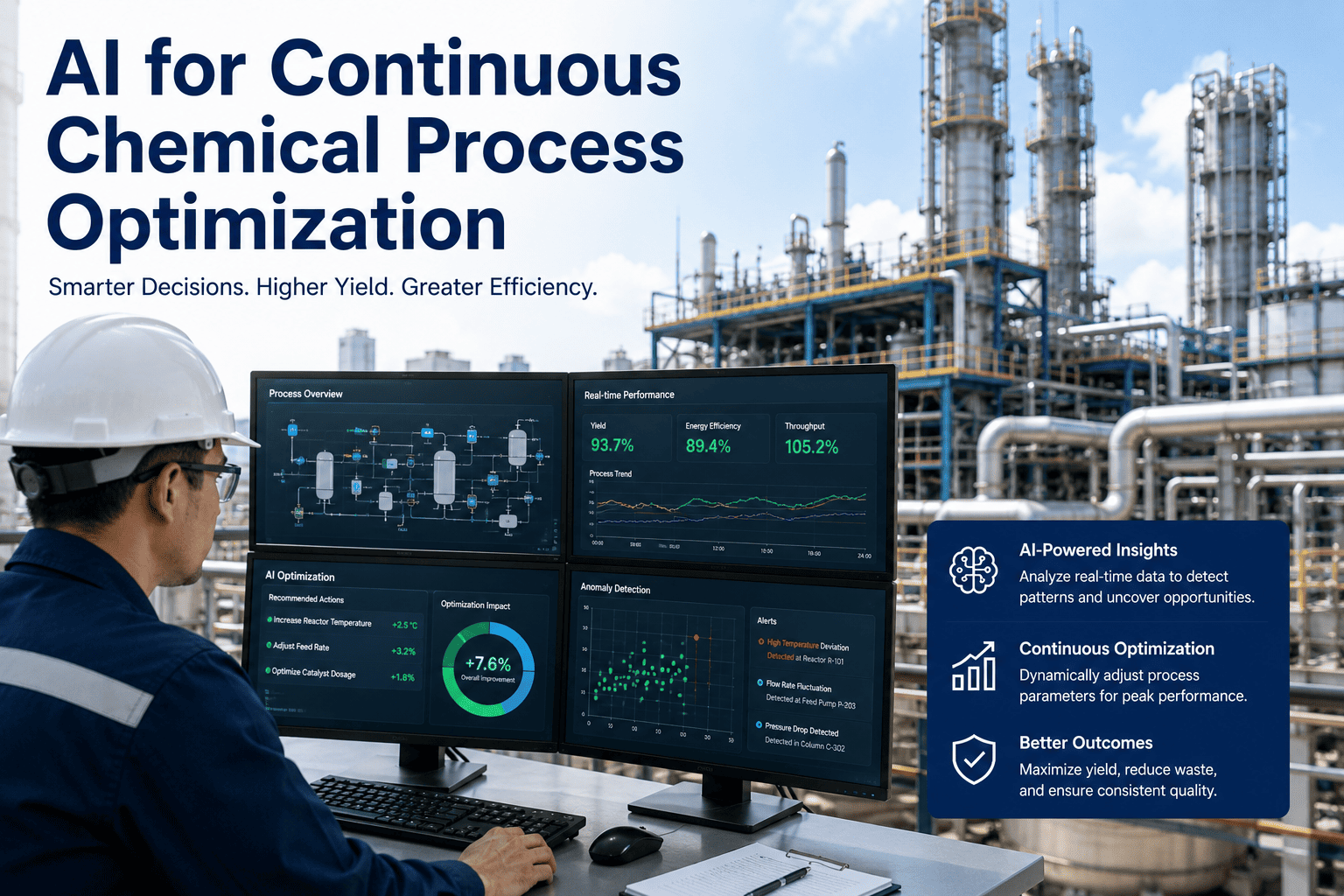
Most continuous chemical plants have run some form of advanced process control for over two decades, and for most of that time it worked well enough that nobody questioned the model underneath it. The problem is that those models are built on linear approximations and yield assumptions written when the plant was commissioned, updated on a cycle measured in months, not minutes. Catalyst ages, fouling accumulates, and feedstock chemistry drifts, while the model keeps issuing setpoints as though none of it happened. Operators compensate the only way they can — by running conservatively, sacrificing throughput and yield to stay safely inside a margin the model no longer represents accurately. AI-driven optimization closes that gap by learning directly from live plant data instead of a static equation, and you can see what it looks like on your own process with a free process review.
Continuous Process Chemicals · AI Optimization
Your APC Model Is Still Accurate — For The Plant You Had Two Years Ago
Traditional model predictive control runs on equations that go stale within weeks. AI process optimization keeps learning from your plant every day, closing the gap between what the model assumes and what's actually happening at the unit.
Why Traditional APC Runs Out of Room
Advanced process control and model predictive control transformed plant operations decades ago, and the base logic still matters — nobody is proposing to rip it out. What's changed is what sits on top of it. A static model updated every few months simply can't keep pace with a unit whose catalyst, fouling, and feed chemistry shift on a daily basis, which is exactly why so many experienced operators quietly run their units more conservatively than the model technically requires. They've learned, through years on the floor, that the model's confidence doesn't always match reality. The comparison below is what that gap looks like in practice, side by side.
Traditional APC / MPC
Linear model, fixed at commissioning
Re-tuned every few months by an engineer
Assumes catalyst and fouling stay constant
Operators run conservatively to cover the gap
Recommendations lag real plant behavior
AI-Driven Optimization
Dynamic model retrained continuously from live data
Adapts within days as conditions actually change
Learns catalyst aging and fouling as it happens
Operators run closer to true optimal constraints
Setpoint adjustments computed 30-120 seconds ahead
The Widening Gap Between Planning and Plant Execution
Every static model starts accurate. The question is how long it stays that way, and for most continuous chemical units the answer is measured in weeks, not the months between scheduled re-tunes. The gauge below is a simplified picture of how quickly that gap actually opens once catalyst aging and fouling start compounding.
68%
Model drift by month three post re-tune
Week 1-2: model tracks plant behavior closely
Week 3-6: catalyst activity and fouling begin diverging from assumptions
Month 3+: operators are compensating manually for a model that no longer matches the unit
What Continuous Optimization Actually Adjusts
Reaction conditions
Temperature, pressure and residence time are tuned against live composition analyzers instead of a fixed operating envelope, keeping conversion closer to its true optimum as feed chemistry shifts batch by batch and shipment by shipment.
Distillation column composition
Reflux ratio and reboiler duty adjust continuously against product purity targets, reducing the energy spent over-refining product that's already within specification.
Energy and utility balance
Steam consumption, combustion tuning and compressor loading are coordinated across units rather than optimized in isolation, which is where most of the reported energy savings actually come from, since single-unit tuning tends to just shift the inefficiency somewhere else downstream.
Constraint management
Equipment limits, safety margins and regulatory thresholds stay active constraints at every step, so optimization never trades stability or compliance for a marginal throughput gain.
Want to See How Stale Your Current Model Actually Is?
Our team can benchmark your existing APC performance against your live historian data and show you where the model has drifted, at no cost.
The Real-Time Loop That Replaces the Quarterly Re-Tune
Instead of a model that's accurate at commissioning and slowly drifts until the next scheduled update, AI process optimization runs a continuous loop that never stops learning from the plant it's actually controlling.
Sense
High-frequency sensor data — temperature, pressure, flow, composition — streams in continuously from across the unit, not just at scheduled sampling intervals.
Predict
Dynamic process models forecast how the unit will respond 30 to 120 seconds ahead, accounting for the current trajectory rather than a fixed assumption.
Act
Optimal setpoint adjustments are computed against economic objectives — yield, throughput, energy — while every active safety and quality constraint stays enforced.
Learn
Every outcome feeds back into the model, so it keeps adapting to catalyst aging, fouling and feedstock shifts instead of waiting for the next quarterly re-tune.
Expected Impact Across the Plant
5-8%
Yield increase reported at plants running closed-loop AI optimization
10-20%
Energy reduction from coordinated thermal and combustion tuning
30-50%
Reduction in unplanned downtime reported alongside predictive maintenance
30-120s
How far ahead the model predicts before computing a setpoint adjustment
Where This Sits in Your Control Hierarchy
Nobody wants to touch base-layer control logic to get these gains, and the good news is that you don't have to. AI optimization is deployed as an advisory or supervisory layer above your existing DCS and APC infrastructure, not a replacement for it.
AI Optimization Layer
Continuously retrained models compute economic setpoint recommendations, feeding into APC as advisory targets before any move toward autonomous adjustment
APC / MPC Layer
Existing model predictive control continues coordinating multivariable setpoints, now guided by continuously updated targets instead of a static model
Base Layer DCS / PID Control
Untouched. Regulatory control loops keep running exactly as they do today, with full operator oversight and existing safety interlocks intact
Why This Matters More in Petrochemicals Than It Looks
Continuous chemical units run twenty-four hours a day, every day, which means even a small gap between the model's assumptions and the unit's actual behavior compounds into a large number over a year. A one percent conversion loss on a large petrochemical unit isn't a rounding error, it's a margin loss measured in millions, and it's the kind of gap that's nearly invisible on a shift-by-shift basis because nothing looks wrong — throughput is steady, quality is in spec, alarms aren't firing. That's precisely the profile of a stale model: it doesn't announce itself as a problem, it just quietly leaves value on the table. Industrial research on offshore and petrochemical operations has pointed to the same pattern repeatedly — the units losing the most margin are rarely the ones with visible reliability issues, they're the ones running smoothly on assumptions nobody has checked in months.
Which Continuous Units Benefit Most
Not every unit on a continuous site has the same amount of value sitting behind a stale model. The units below are where plants most consistently report the largest gains once AI optimization is running against live data instead of a quarterly re-tune.
Distillation trains
Reflux and reboiler duty are among the most energy-intensive setpoints on site, and even small over-refining habits compound into significant utility cost across a full year of continuous operation.
Cracking and conversion units
High-value feedstock and tight yield margins mean a one percent conversion improvement often justifies the entire deployment cost within a single quarter.
Continuous reactor trains
Residence time and temperature profile optimization compounds meaningfully here, since these units run around the clock with no natural pause for a manual review to catch drift.
Utilities and steam systems
Cross-unit coordination of steam and compressed air demand tends to surface savings that single-unit optimization misses entirely, since the inefficiency is often in how units interact rather than in any one of them.
Frequently Asked Questions
Do we need to replace our existing DCS or APC system to deploy this?
No. AI optimization is deployed as an advisory layer that sits above your existing distributed control system and APC infrastructure. Recommendations are executed through your current DCS control loops with operator oversight, so there's no workflow disruption and no modification to your base-layer control logic. Most deployments start in pure advisory mode, giving your engineers time to validate recommendations before any automated setpoint changes are enabled. Reach out to our
support team with details on your current control stack to see what's involved.
How is this different from the model predictive control we already have?
Traditional MPC relies on a fixed linear model that's tuned at commissioning and updated on a scheduled cycle, typically every few months. AI optimization continuously retrains its process model from live plant data, so it keeps adapting to catalyst aging, fouling, and feedstock variability in near real time instead of waiting for the next scheduled re-tune. Your existing MPC keeps running the same multivariable coordination it always has, now guided by targets that reflect current plant conditions rather than assumptions from months ago.
What data does the AI model need from our plant to get started?
A useful starting point is historical process data from your existing historian — temperature, pressure, flow, and composition tags at one-second to one-minute resolution, covering at least twelve months to capture seasonal and campaign-level variation. Most continuous chemical plants already have this in an OSIsoft PI or Honeywell PHD historian, so the connection is typically read-only and doesn't require new instrumentation to begin.
Will this reduce our operators' control over the process?
The opposite is usually the case. Most deployments begin with the model producing recommendations that an operator reviews and approves before they're executed, which gives your team more visibility into why a setpoint is being suggested rather than less. As trust builds over weeks of shadow-mode operation, some plants choose to move specific, well-validated adjustments into automated execution, but that decision stays with your team and can be scoped narrowly to start. Book a
free consultation to walk through what that oversight model looks like for your process.
How long does deployment typically take on a continuous unit?
Most continuous process deployments reach live advisory operation within 45 days of kickoff, covering historian connection, model training against historical data, and shadow-mode validation before recommendations start reaching operators. Full transition to any automated setpoint execution, where a plant chooses to enable it, typically follows several additional weeks of validated performance once the team has confidence in the model's recommendations.
Find Out How Far Your Model Has Actually Drifted
Your historian already has the answer. Our team can benchmark your current APC performance against live plant data and show you where the gap is, before you commit to anything.