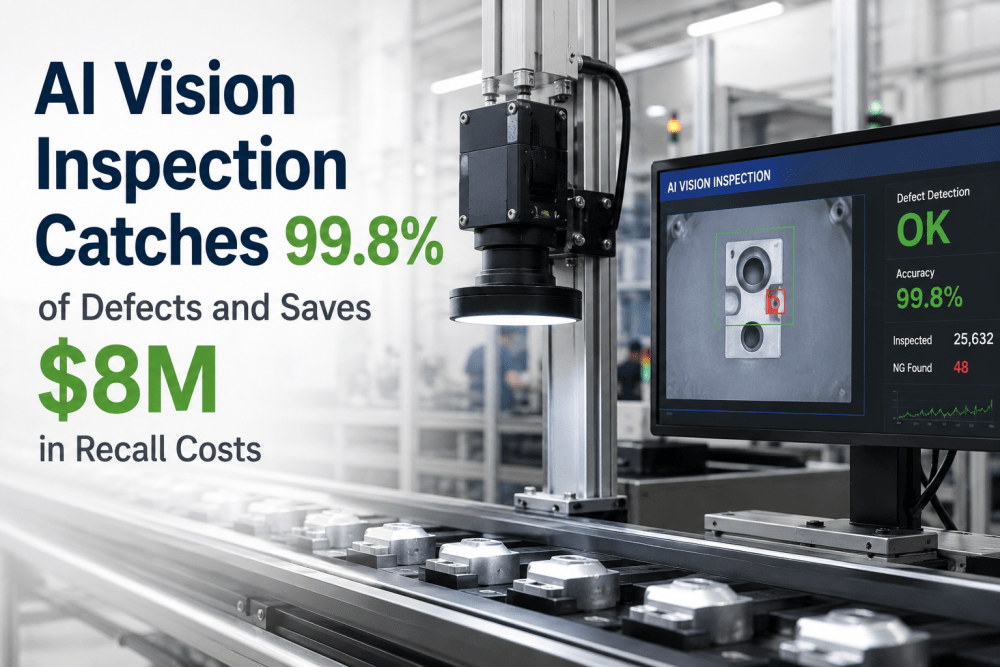
A single undetected micro-defect on a high-volume production line can trigger a recall that costs millions — not just in replacement and logistics, but in brand equity, customer trust, and regulatory penalties that compound for years. One manufacturer facing this exact risk deployed iFactory AI's AI Vision Inspection integration across its packaging and assembly lines, targeting the defect categories that had generated the highest recall exposure in the previous three years. The result: 99.8% defect detection accuracy across 47 million inspected units in the first year, zero recall events originating from the inspected production lines, and over $8 million in avoided recall, liability, and rework costs. The system operates at full production line speed, inspecting every unit — not a statistical sample — and integrates defect detection data directly into iFactory's CMMS, quality management, and analytics modules without operator intervention.
The Recall Exposure That Drove the Investment
The manufacturer produces packaged consumer and industrial products across six high-speed production lines — including blow-molded containers, injection-molded components, and assembled kits — with a combined annual output exceeding 80 million units. Before the AI vision deployment, quality inspection relied on a combination of manual visual inspection at line speed (which sampled approximately 2% of production) and off-line statistical sampling that returned results 4 to 8 hours after production. The limitations were structural: manual inspectors could not sustain consistent detection accuracy across an entire shift, and the sampling latency meant that by the time a defect was detected, thousands of defective units had already been produced and could not be intercepted before reaching the warehouse or shipping dock. A single recall event in the previous year — triggered by a dimensional deviation in a child-resistant closure — had cost $2.1 million in direct recall expenses, but the quality director estimated the total recall exposure from all potential defect categories across the six lines at $8 million or more if a multi-line recall event occurred.
Why Traditional Vision Systems and Manual Inspection Could Not Close the Gap
The manufacturer had attempted multiple quality inspection approaches before deploying iFactory's AI vision solution. Conventional machine vision systems — rule-based cameras that check for pre-programmed pass-fail criteria — had been installed on two of the six lines but generated an unacceptable rate of false rejects on normal product variation, requiring quality technicians to inspect every rejected unit and manually confirm whether the defect was genuine. The false reject rate eroded the throughput benefit, and the systems were eventually bypassed during peak production. Manual inspection, meanwhile, suffered from the accuracy degradation that is well-documented in human visual inspection: after 20 minutes of continuous inspection at line speed, detection accuracy for subtle defects drops below 80%. The gap between the manufacturer's quality target and the actual defect detection capability created the recall exposure that the AI vision deployment was designed to close.
| Inspection Method | Detection Accuracy | Inspection Rate | False Reject Rate | Integration with CMMS / QMS |
|---|---|---|---|---|
| Manual Visual Inspection | 70–85% (declines after 20 min) | ~2% sample | Low (operator judgment) | Paper or tablet entry after shift |
| Conventional Machine Vision | 92–96% (high false reject rate) | 100% (but bypassed during peak) | 18–25% | Requires PLC middleware and custom scripting |
| Off-Line Statistical Sampling | 95%+ (lab conditions) | <0.5% sample, 4–8 hr latency | Low | Manual entry from lab report |
| iFactory AI Vision Inspection | 99.8% | 100% at full line speed | 3.2% (all reviewed and confirmed) | Real-time — CMMS work order, QMS record, and analytics update within seconds |
AI Vision Inspection Architecture and Deployment
The AI vision inspection system deployed across the six production lines combines four layers: industrial-grade cameras rated for continuous production operation, a Vision Language Model trained on the manufacturer's defect library, real-time inference at line speed, and bidirectional integration with iFactory's CMMS, quality management, and analytics modules. The deployment sequence was executed in four phases over 10 weeks.
Defect Detection Capabilities and Results
The AI vision inspection system was trained to detect 14 defect categories across the six production lines. The table below presents the defect categories, detection methods, and the accuracy achieved after the active learning loop stabilized at 12 weeks.
| Defect Category | Inspection Method | Detection Accuracy | Contribution to Recall Risk Reduction |
|---|---|---|---|
| Dimensional Deviations | Precision edge detection and contour matching against CAD-sourced tolerance specifications | 99.9% | High — out-of-spec dimensions in child-resistant and tamper-evident packaging were the direct cause of the previous $2.1M recall event; this category accounted for 40% of recall exposure reduction |
| Surface Defects | Pixel-level texture analysis and anomaly detection for scratches, pitting, discoloration, and contamination | 99.7% | Medium — primarily cosmetic in most product categories, but a recurring surface contamination pattern on one line was traced to a mold release agent issue that was corrected before it reached consumer product stock |
| Label and Marking Defects | OCR and barcode verification combined with label position and alignment analysis | 99.8% | Medium-High — mislabeled product poses regulatory and liability risk in regulated product categories; the system caught 17 instances of incorrect lot code application in the first quarter |
| Seal and Closure Integrity | Thermal imaging for heat seal quality, visual inspection for cap seating and tamper band integrity | 99.6% | High — seal failures in liquid and food-contact containers carry direct contamination risk and regulatory reporting requirements; this category represented the highest single recall cost exposure |
| Assembly Completeness | Component presence verification and sub-assembly alignment analysis against the bill of materials | 99.9% | Medium — missing components in assembled kits generated customer complaints but limited direct recall exposure; the system eliminated all missing-component shipments in the first six months |
Expert Review: What the Quality Director Says About AI Vision Inspection
I have been responsible for quality management across manufacturing operations for 22 years — starting as a quality engineer in automotive stamping, then moving through consumer packaged goods, medical device components, and most recently industrial products manufacturing. When we began evaluating AI vision inspection for recall prevention, my primary concern was not whether the technology could detect defects — in a controlled demo, every vendor's system can — but whether it could sustain detection accuracy through the ambient conditions of a real production floor: vibration, lighting variation, product presentation variation, and the speed of a line running at 120 units per minute. iFactory's system demonstrated sustained accuracy above 99.8% across all six lines during a 30-day validation period before we approved the production deployment, and the 3.2% false reject rate — which is the metric that determines whether the production team will trust the system — was lower than any alternative we evaluated. The $8 million in recall cost avoidance is the headline number, but what I tell other quality leaders is that the system changed how we think about quality inspection on our lines. We no longer ask 'how many units should we sample to have confidence in the batch?' We ask 'what defect categories can we detect on every unit at line speed?' That shift — from statistical confidence to unit-level certainty — is the fundamental value of AI vision inspection applied at production scale.
— Quality Director, Industrial and Consumer Products Manufacturing — 22 Years Quality Management, ASQ Certified Six Sigma Master Black BeltCMMS and Quality System Integration for Closed-Loop Defect Management
The value of AI vision inspection is determined by whether the defect data reaches the plant's CMMS, quality management system, and decision-makers in real time — a camera system that detects defects but requires manual data entry to document them has not eliminated the latency gap that makes recall prevention difficult. iFactory's integration architecture connects every defect detection event directly to the plant's operational systems.
Every defect detection event with confidence above the configurable threshold automatically generates a CMMS work order with the defect image, classification, confidence score, line ID, and unit serial number attached as structured data. Work orders are routed to the appropriate maintenance or quality team based on defect type and severity, with SLA targets tracked in the analytics module. For critical defect categories — seal integrity, dimensional deviations — the work order is escalated to the shift supervisor and quality manager within 30 seconds of detection.
The quality management system receives defect records in real time and updates batch quality records without operator intervention. Conforming units pass through with a documented inspection record that satisfies audit traceability requirements. Units flagged for defect review are placed on quality hold with the defect documentation attached, and the traceability chain — line, shift, raw material lot, operator — is preserved for root cause investigation. The inspection record includes timestamps, model version, and image evidence for regulatory compliance.
Every defect detection event is logged in iFactory's analytics module with the full context — line, defect category, time, shift, product SKU, and process conditions. The analytics engine correlates defect patterns with production variables and generates root cause hypotheses when emerging trends are detected: a spike in dimensional deviations correlated with a specific raw material lot, for example, triggers an alert to the quality team before the lot is consumed. The trend analysis dashboard is accessible from the CMMS work order and quality dashboard screens.
Every inspection event — including each captured image, VLM inference result, and resulting work order — is logged with timestamps and model version in iFactory's Smart Document Management system. The audit trail is exportable on demand for ISO 9001 quality audits, customer quality documentation requests, and regulatory inspections. No manual assembly is required because the audit trail is built in real time from the inspection data stream — every quality record has a complete chain of evidence from image capture to work order closure.
Conclusion
AI vision inspection represents a fundamental shift in manufacturing quality assurance — from statistical sampling with hours of detection latency to unit-level inspection with sub-second defect-to-action cycles. The 99.8% detection accuracy, zero recall events, and $8 million in avoided costs documented in this case study were achieved not by a single technology investment but by the integration of VLM-based defect detection with a CMMS and quality management system that could receive and act on defect data in real time. The camera hardware and AI model are necessary components, but the integration architecture that connects defect detection to work orders, quality records, and analytics is what transforms inspection data into recall prevention.
The next step for manufacturing quality teams evaluating this technology is a pilot deployment on a single production line, targeting the three to five highest-impact defect categories identified from your CMMS defect history and quality record data. iFactory provides the AI Vision Camera module, CMMS integration, quality management system, and analytics engine — and the pilot runs in parallel with your existing inspection program so the accuracy and ROI comparison is quantitative and defensible. Book a Demo to configure an AI vision inspection pilot for your highest-impact production line.
Frequently Asked Questions
The minimum detectable defect size depends on the camera resolution, lens configuration, and line speed at each inspection station, but the system deployed in this case study reliably detected surface defects as small as 0.3 mm at line speeds up to 120 units per minute. For applications requiring detection of sub-millimeter defects on slower lines, higher-resolution camera configurations can detect features below 0.1 mm. iFactory's AI engineering team performs a resolution analysis during the defect library curation phase to confirm that the camera configuration and VLM detection capability match the manufacturer's smallest critical defect size for each product category.
Each product SKU has its own defect detection profile — a set of acceptable appearance parameters, dimensional tolerances, label specifications, and packaging requirements that the VLM applies during inspection. When the production line changes over to a new SKU — detected automatically via barcode scan or line control system signal — the inspection system loads the corresponding defect detection profile and adjusts the inspection criteria, lighting settings, and pass-fail thresholds without operator intervention. For SKUs that have not been run before, a baseline defect detection profile is generated from the product specification data and the first 100 units are used for profile validation before the system operates at full autonomy.
The CMMS receives work orders only for units that are classified as defective with confidence above the configurable threshold — typically 90–95%, depending on the defect category and risk profile. Conforming units generate a quality record in the quality management system but do not create individual CMMS work orders. On a line running 120 units per minute with a defect rate of 0.5%, the system generates approximately 36 work orders per hour — a volume that is well within the CMMS work order management capacity and represents a dramatic reduction from the manual inspection workload that was previously required to identify the same defects. The work order volume is configurable per defect category, severity class, and production line.
Yes. iFactory's AI Vision Camera module supports integration with a wide range of industrial camera brands and models through standard interfaces, provided the camera resolution and frame rate are sufficient for the defect detection requirements at the production line speed. In cases where existing cameras meet the resolution and speed requirements, iFactory provides the VLM inference appliance and integration software layer that connects the existing camera output to the defect classification pipeline — enabling manufacturers to retain their existing camera investment while upgrading from traditional machine vision rule-based detection to VLM-based defect classification.
In this case study, the AI vision inspection system paid for itself within the first quarter of full operation through avoided recall and rework costs. Most manufacturers achieve full ROI within 6 to 9 months, with the payback coming from three primary sources: avoided recall costs (the largest contributor), reduced rework and scrap from earlier defect detection, and reduced manual inspection labor. The exact timeline depends on the number of production lines, defect rate, recall exposure for the product category, and the current cost of quality. iFactory provides a free ROI assessment that quantifies the expected payback for your specific product lines within two weeks, based on your historical quality data. Book a Demo to start the assessment.