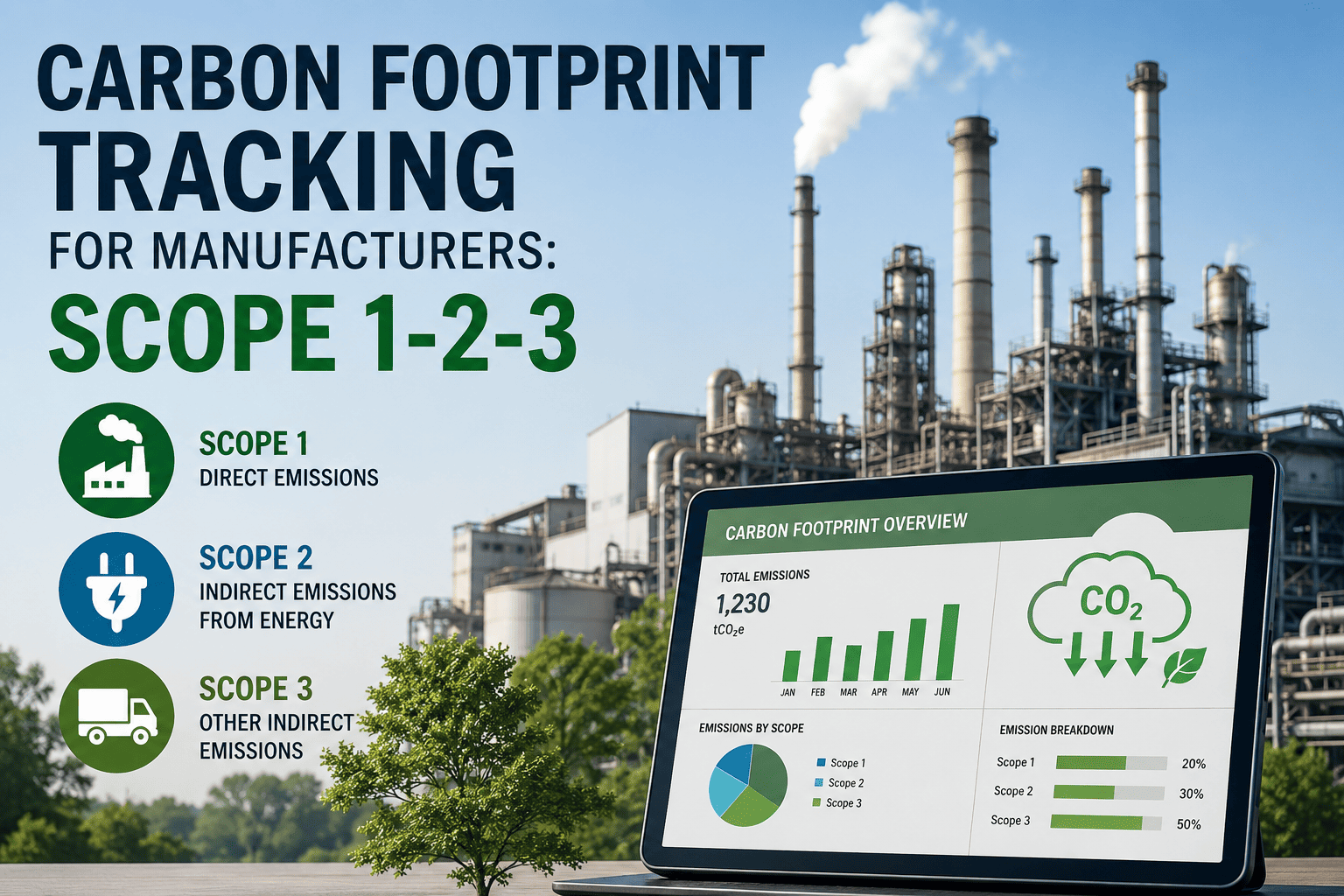
Every large customer request-for-proposal now asks the same question buried somewhere in the appendix: what is your facility's carbon footprint, broken down by scope. A plant manager who has never touched a greenhouse gas inventory suddenly has thirty days to produce numbers that used to take a sustainability consultant months to compile. Manual spreadsheets built from fuel receipts, utility bills, and supplier estimates cannot keep pace with how often that request repeats, and every gap in the data becomes a stalled contract or a failed audit. Scope 1 covers what burns on your own site, Scope 2 covers the electricity you buy, and Scope 3 covers everything upstream and downstream that your plant never directly touches but is still accountable for. See how iFactory turns that scattered paperwork into a live, auditable carbon register at ifactory support.
Your Biggest Customer Just Added a Carbon Question to the Contract. Are You Ready to Answer It?
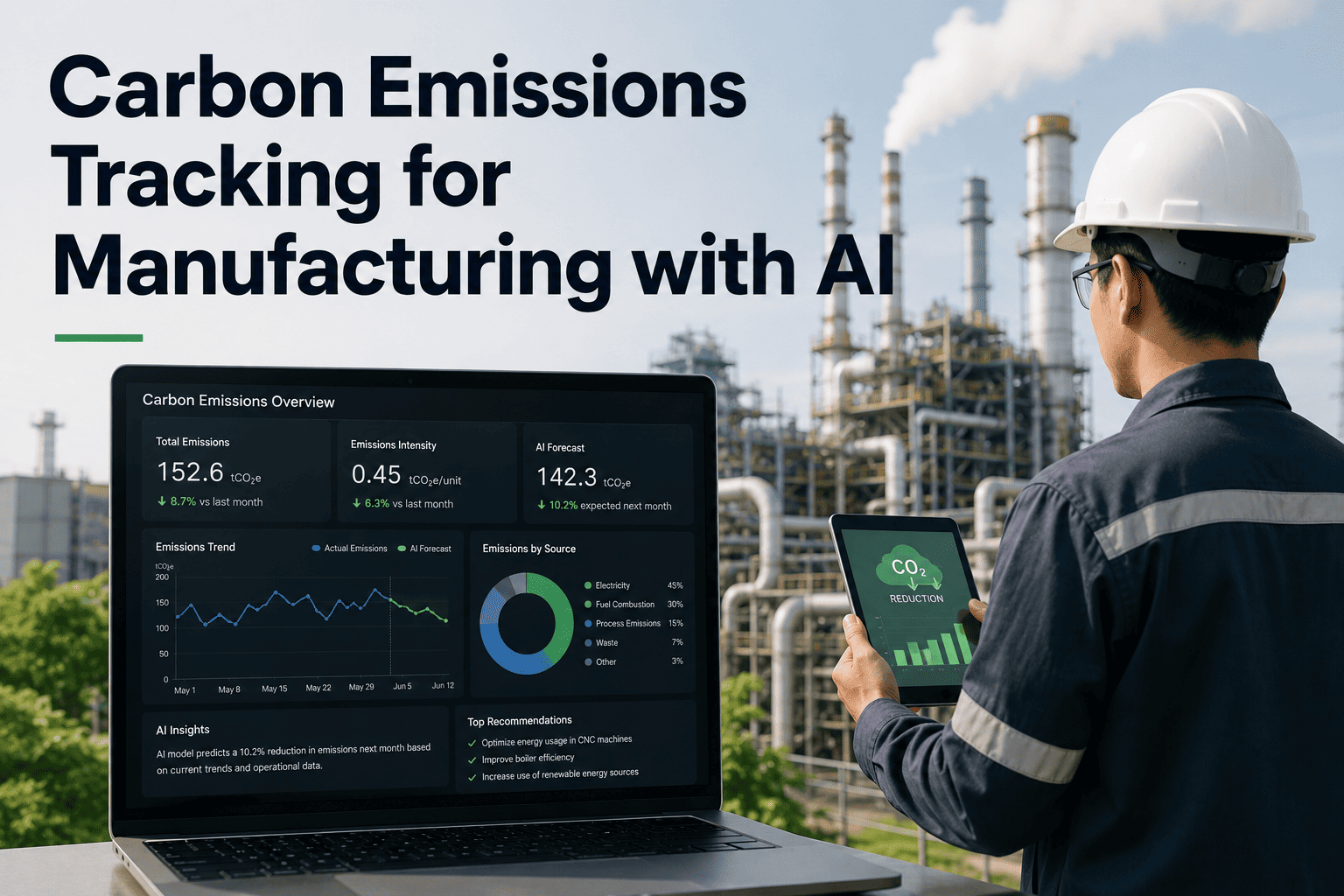
Automated Scope 1, 2, and 3 carbon accounting built for plant floors, not spreadsheets, so every emissions figure you report back to a customer, auditor, or regulator is traceable to the meter, invoice, or production run it came from.
Spreadsheets Were Never Built to Carry a Carbon Register
Most manufacturing carbon inventories start the same way: someone in EHS or finance is handed a deadline and a blank workbook, and told to reconstruct a year of fuel purchases, electricity bills, and supplier shipping data from whatever records happen to still exist. The first submission is usually close enough to pass, but it is rarely repeatable, because the formulas, the emission factors, and the assumptions live in one person's head and one file on one laptop. When that person changes roles, the next cycle starts from zero again.
The deeper problem is that a spreadsheet cannot see the plant floor. It cannot tell you that a specific kiln ran hotter than usual for six weeks, or that a specific supplier switched to a longer shipping route that quietly raised transportation emissions. A carbon figure built from averages and estimates might satisfy a checkbox, but it will not survive a customer audit, and it gives operations no signal about which process actually needs to change to bring the number down next year.
Scope 1, 2, and 3 — What Actually Counts on Your Plant Floor
The three scopes were written for accountants, not plant managers, which is part of why they get confused so often on the shop floor. Translated into equipment and invoices instead of accounting language, the split becomes much easier to act on, and it changes which team inside the plant actually owns each number.
Where Your Emissions Actually Live
Plant managers are frequently surprised to learn that the smokestack on their own roof is rarely the biggest number on the page. For most discrete and process manufacturers, purchased raw materials and inbound logistics dwarf on-site combustion once the full value chain is counted, which is exactly why regulators and customers keep pushing the reporting boundary outward from Scope 1 toward Scope 3.
See What Your Plant's Actual Scope 1, 2, and 3 Split Looks Like
Bring a year of utility bills, fuel records, and supplier shipping data to the call. We will walk through how an automated carbon register would score and break down your site today.
How Automated Carbon Accounting Actually Works
An automated register does not remove the need for good source data, it removes the need for a human being to manually re-enter and reconcile that data every single reporting cycle. The work shifts from data entry to data review, which is a far better use of an EHS or sustainability team's time.
CSRD and the Reporting Frameworks Manufacturers Now Face
The regulatory picture shifted significantly in early 2026. The Omnibus I simplification package narrowed mandatory CSRD reporting from an estimated 50,000 companies to roughly 5,000, raising the threshold to companies with more than 1,000 employees and more than €450 million in turnover, and pushing later reporting waves out to financial years 2027 and 2028. That does not mean smaller manufacturers are off the hook. A supplier who no longer has to file CSRD reports directly is frequently still asked to hand carbon data to a larger customer who does, which means the underlying measurement work has not gone away, only the party who has to submit the final filing.
CSRD is also not the only framework in play. The GHG Protocol remains the underlying accounting standard almost every other framework builds on, ISO 14064 is common in supplier certification requests, and the EU Carbon Border Adjustment Mechanism adds a separate carbon-cost layer specifically on imported goods in carbon-intensive categories like steel, cement, and aluminum. A manufacturer exporting into the EU can end up needing to satisfy several of these frameworks from the same underlying dataset, which is exactly why a single live register beats maintaining separate spreadsheets for each one.
| Framework | Who It Applies To | What It Requires |
|---|---|---|
| GHG Protocol | Any organization measuring emissions | The underlying accounting method most other frameworks are built on |
| CSRD (post-Omnibus) | Roughly 5,000 large EU-linked companies | Audited sustainability disclosure filed alongside financial statements |
| CBAM | Importers of carbon-intensive goods into the EU | Embedded carbon reporting on covered product categories |
| ISO 14064 | Suppliers asked to certify emissions data | Third-party verified organizational or project-level inventory |
| Customer Scorecards | Any supplier to a large OEM or retailer | Recurring, standardized emissions data outside any formal regulation |
Not sure which frameworks actually apply to your plant? Talk to our team and we will help you map your reporting obligations against your customer and regulatory footprint.
Setting Reduction Targets That Actually Move the Needle
A carbon register that only ever looks backward tells you what already happened, but the real value shows up once the same data is used to set forward-looking targets. A Scope 1 reduction target might point straight at a boiler efficiency project or a fuel switch, while a Scope 2 target might be satisfied through a renewable energy purchase agreement rather than any change on the plant floor at all. Scope 3 targets are the hardest to set and the hardest to hit, because progress depends on supplier behavior a plant does not directly control.
The plants that make the fastest progress tend to pick two or three specific, measurable levers rather than a single vague company-wide goal. A kiln operating at a documented thermal efficiency improvement, a fleet of forklifts converted from diesel to electric, or a top-five supplier switched to a lower-carbon material each produce a number that can be tracked month over month, which keeps the reduction target connected to real operational decisions instead of becoming an annual slide that nobody revisits until the next report is due.
Frequently Asked Questions
Get a Live Scope 1, 2, and 3 Register Across Every Site
Bring your utility bills, fuel records, and any existing supplier emissions data to the call. We will walk through how an automated carbon register would score your plant today and what it would take to close the gaps.