A design engineer changes a tolerance in PLM on Tuesday. The production line is still building to the old spec on Thursday because nobody told MES. A customer calls about a field failure six months later, and tracing which exact engineering revision, which production lot, and which supplier batch went into that specific unit takes three people two days of digging through disconnected spreadsheets. This is the cost of a broken digital thread — a product lifecycle where design, production, and field data never actually connect. Book a demo with iFactory's product lifecycle team to see a connected thread in action.
Digital Thread · Product Lifecycle 2026
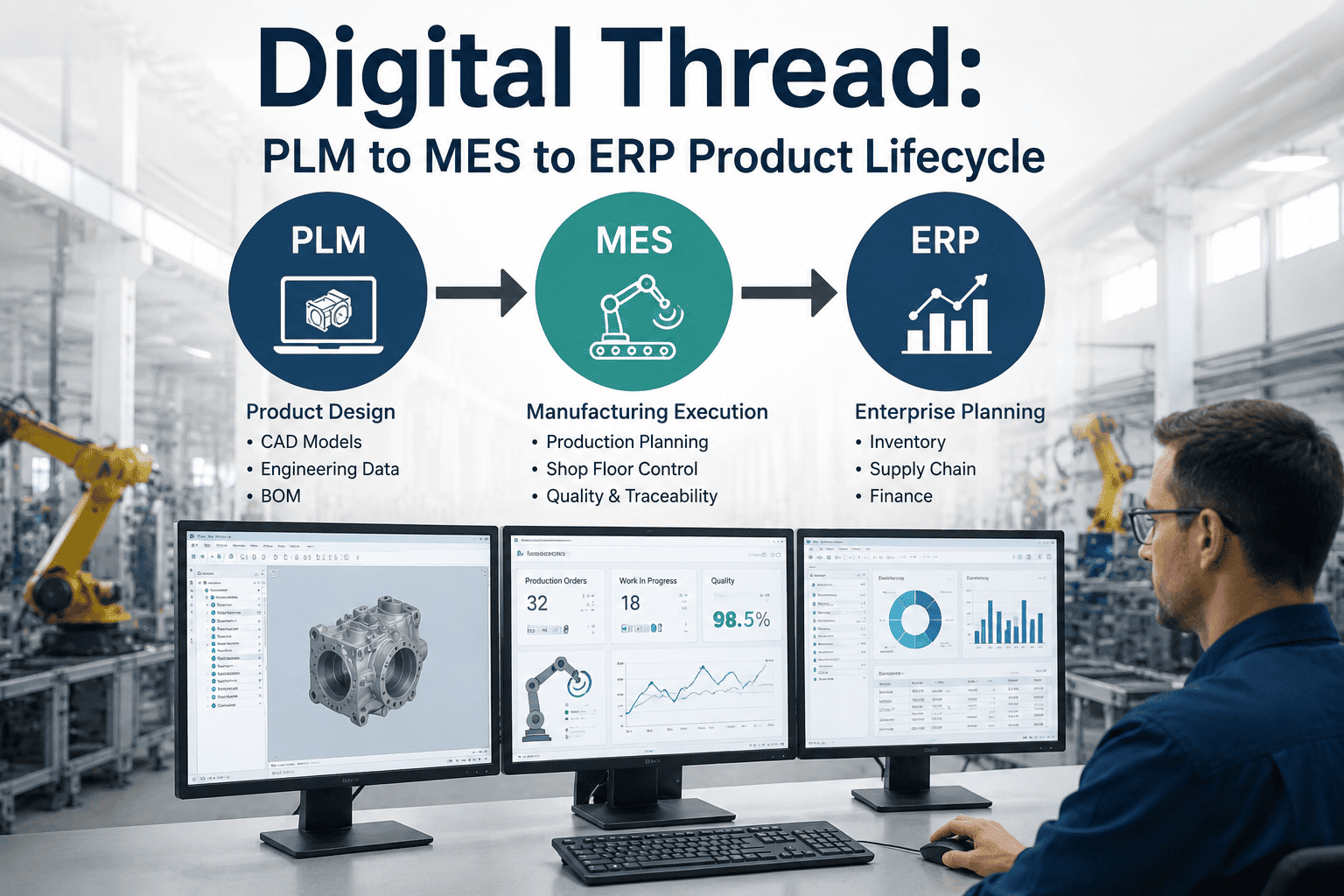
Digital Thread: Connecting Design, Production, and Field Service Into One Continuous Record
A single traceable path from PLM through MES to ERP and out to field service, so every engineering revision, production lot, and customer issue can be traced back to its origin in minutes, not days.
The Product Journey
Where the Thread Usually Breaks
1
Design in PLM
Engineering specifications, tolerances, and bill of materials are created and revised. This is where most product data originates and where version control is typically strongest.
Common break point: revisions don't automatically propagate downstream
2
Production in MES
The shop floor builds against a work order that may or may not reflect the latest engineering revision, recording actual production data against a specification that isn't always connected back to its PLM source.
Common break point: production and financial data are recorded in separate systems
3
Transaction in ERP
Cost, inventory, and order data are recorded for the finished product, often without a direct link back to the specific production lot or engineering revision that built it.
Common break point: field data rarely makes it back to engineering
4
Service in the Field
A field technician logs a failure or a maintenance event against a serial number, but that record usually terminates there instead of flowing back to inform the next design revision.
Connect the Whole Journey
iFactory Links PLM, MES, and ERP Into a Single Traceable Thread
Instead of four disconnected systems each holding a piece of the product story, iFactory maintains a continuous link from engineering revision through production lot to field performance, queryable from a single interface.
What a Connected Thread Enables
Four Capabilities That Only Exist When the Data Actually Connects
Full Traceability
Trace any finished unit back through its exact production lot, the engineering revision it was built to, and the supplier batches consumed, in a single query instead of a cross-system investigation.
Change Propagation
An engineering change in PLM automatically flags every open work order in MES still building to the prior revision, closing the gap where production silently continues on outdated specifications.
Design Feedback Loop
Field failure data flows back to engineering with the exact production and design context attached, so the next revision addresses the actual root cause instead of a generic complaint.
Faster Recall Scoping
If a defect is traced to a specific supplier batch or production window, the connected thread identifies exactly which finished units are affected, avoiding an overly broad recall.
Where Traceability Is Non-Negotiable
Industries That Depend on an Intact Digital Thread
| Industry | Why the Thread Matters | Typical Trigger |
|---|---|---|
| Aerospace & Defense | Regulatory requirement to trace every component to its certificate of conformance | Audit or airworthiness directive |
| Medical Devices | Full genealogy required for regulatory submission and post-market surveillance | Adverse event report |
| Automotive | Rapid recall scoping to limit warranty and safety exposure | Field failure pattern |
| Industrial Equipment | Warranty claims need production context to validate root cause | Customer service escalation |
Under the Hood
What Actually Links One System's Record to Another's
A digital thread isn't a single database replacing PLM, MES, and ERP. It's a set of persistent reference keys that let a record in one system point reliably to its corresponding record in another, even as each system continues operating independently.
Part and Revision ID
The engineering identifier and revision number carried consistently from PLM through the work order in MES, so the exact specification a unit was built against is always known.
Lot and Serial Number
The production-level identifier that ties a specific physical unit or batch to its work order, its consumed material lots, and eventually its field service history.
Transaction Reference
The link between a production lot and its corresponding ERP transaction, connecting cost and inventory data back to the specific build it represents.
Common Pitfalls
Where Digital Thread Projects Tend to Stall
Inconsistent Identifiers Across Systems
If PLM, MES, and ERP each use a slightly different format for the same part number, automated linking breaks silently, and someone has to reconcile the mismatch by hand.
Treating It as a One-Time IT Project
A digital thread degrades if new systems or product lines are onboarded without extending the same identifier discipline, quietly reintroducing the gaps the project was meant to close.
No Feedback Loop Ownership
Field data flowing back to engineering only creates value if someone is actually responsible for reviewing it and feeding it into the next design revision cycle.
Most manufacturers I work with think they have traceability because they can pull a serial number and see when it was made. Real digital thread traceability means you can go the other direction too — pull an engineering revision and instantly see every unit built against it, every supplier lot consumed, and every field event reported. That reverse lookup is what actually matters during a recall or a quality investigation, and it's almost always the piece that's missing because nobody designed the systems to be queried that way from the start.
Solenne Marchetti-Adeyemi
Product Lifecycle Management Consultant · 16 years implementing PLM-MES-ERP integration for regulated manufacturers
Digital Thread Questions
Product Lifecycle Integration — Frequently Asked
Do we need to replace our existing PLM, MES, and ERP systems to build a digital thread?
No, a digital thread is an integration and data model achievement, not necessarily a system replacement. Most successful implementations connect existing PLM, MES, and ERP platforms through an integration layer that maintains reference links between records across systems, rather than migrating everyone onto a single monolithic platform. The key requirement is that each system exposes its data through an interface the integration layer can consume reliably, which is achievable for the vast majority of established PLM, MES, and ERP products in use today.
How far back can a digital thread be built if historical data was never connected?
A digital thread going forward from the implementation date is always achievable, since new records are created with the linking structure built in. Retroactively connecting historical data depends heavily on whether identifying keys, like serial numbers or lot codes, were consistently captured across the old, disconnected systems. Where consistent keys exist, a one-time reconciliation project can link historical records after the fact. Where they don't, most manufacturers accept a clean starting point going forward rather than attempting a costly historical reconstruction with incomplete data.
What's the difference between a digital thread and a digital twin?
A digital thread is the connected data record tracing a product's actual history through design, production, and field life — it's fundamentally about traceability and data lineage. A digital twin is a simulation model representing a system's current or predicted behavior, often used to test scenarios before they happen in the real world. The two concepts complement each other well: a digital twin's simulation accuracy improves when it's fed by the real historical and field data a digital thread provides. Contact our support team to discuss how the two fit together for your specific product line.
Who typically owns the digital thread initiative inside a manufacturing organization?
Ownership varies, but the most successful implementations avoid making it solely an IT project or solely an engineering project. A cross-functional structure works best, with engineering defining what needs to be traced, production and quality defining how it gets captured on the floor, and IT owning the integration architecture that connects the systems. Executive sponsorship matters because the initiative touches multiple departments' existing systems and workflows, and without a clear mandate, change propagation rules in particular tend to stall in political disagreement between departments.
How long does a typical digital thread implementation take?
Timelines vary significantly with the number of systems involved and the complexity of the product structure, but a focused pilot connecting one product line's PLM, MES, and ERP records is often achievable within a few months, with full traceability queries working end to end by the end of that pilot. Expanding to the full product portfolio and adding field service integration typically follows as a second phase once the pilot proves the data model and integration pattern. Book a demo to see a realistic timeline scoped to your specific systems.
Stop Reconstructing History From Spreadsheets
Get One Traceable Thread From Design to Field Service
iFactory connects your PLM, MES, and ERP data into a single queryable product record, so tracing any unit's full history takes minutes, not a multi-day investigation across disconnected systems.