A forklift with a slight wobble, a CNC bed that won't hold tolerance, an AMR that keeps drifting off its path — the common thread in half the "equipment problems" on a factory floor is not the equipment at all. It is the floor underneath it. Concrete moves over years: it dishes, curls at joints, and wears unevenly under repeated wheel loads, and none of that shows up on a punch list until a machine tool or an automated vehicle starts reporting errors that have nothing to do with their own calibration. Floor condition is infrastructure, not decoration, and treating it that way starts with an assessment before it becomes an equipment failure. iFactory's facility and asset monitoring tools help plant teams catch floor-driven equipment issues before they're misdiagnosed as something else.
Factory Space Utilization
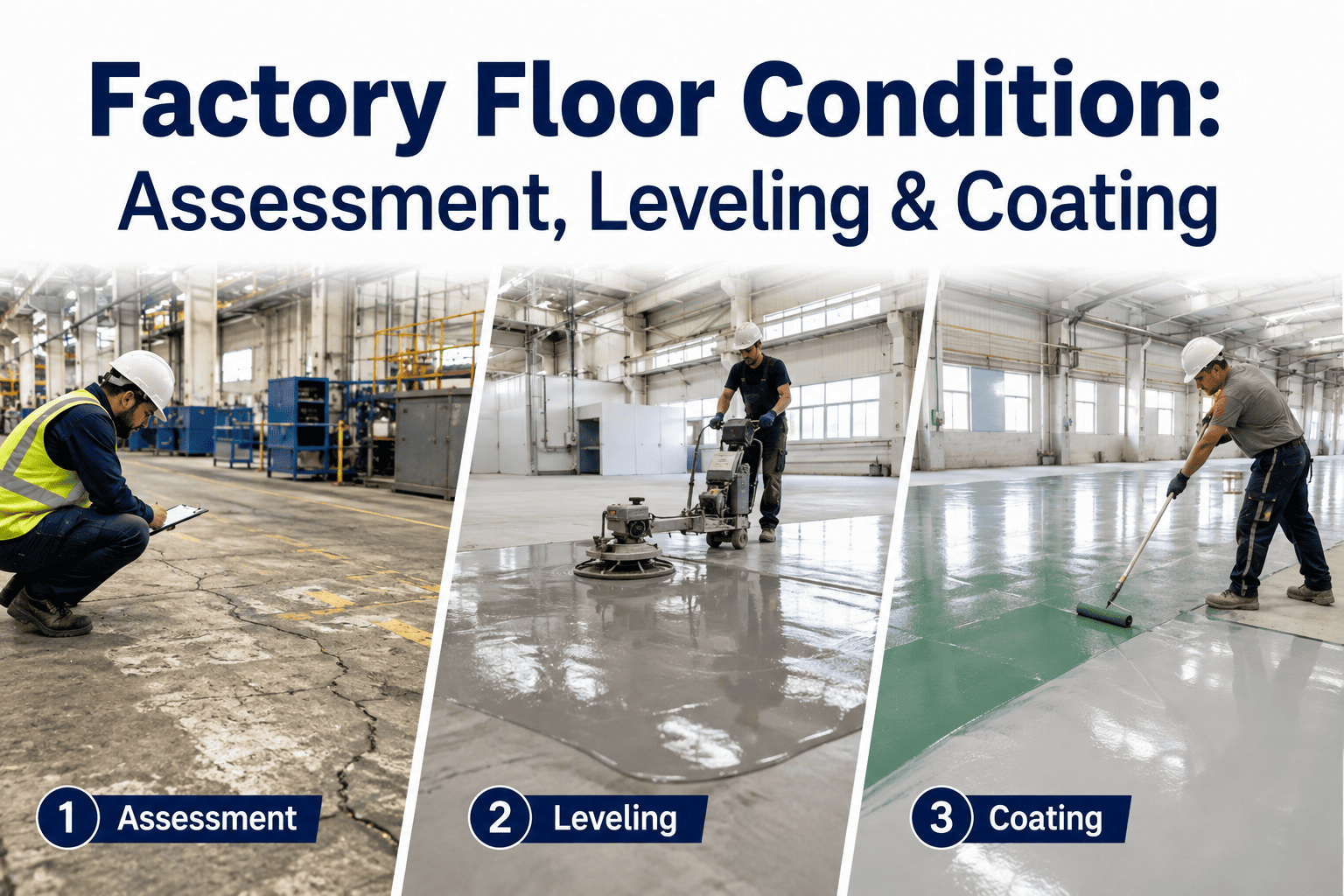
Factory Floor Condition: Assessment, Leveling, and Coating
A practical guide to surveying floor flatness, choosing a leveling method, and specifying a coating system that holds up under real production loads.
Why Floor Condition Gets Blamed on the Wrong Thing
Floor problems rarely announce themselves as floor problems. A dished slab reads as an alignment issue on a machining center. A curled joint reads as a random AMR routing fault. A worn, pitted surface reads as excess vibration in a press line. Every one of those symptoms can send a maintenance team chasing the equipment instead of the six inches of concrete underneath it.
01
Precision equipment losing calibration despite no change to the machine itself
02
AMRs or AGVs drifting or faulting at the same physical locations repeatedly
03
Visible standing water, dusting, or spalling near heavy-traffic aisles
04
Uneven wear patterns on forklift or cart wheels tied to specific routes
Assessing Floor Condition Before You Touch It
A proper assessment measures flatness and levelness separately, checks the slab for moisture and structural cracking, and maps the results against where sensitive equipment actually sits. Guessing at floor quality from a walk-through misses the gradual deviations that cause the most expensive problems.
Flatness Survey
F-Number profiling measures local bumpiness across short spans, catching the small deviations that affect precision equipment footing.
Levelness Survey
Measures overall tilt across longer spans — the deviation that causes AMRs to drift and racking to lean over time.
Moisture Testing
Vapor emission and relative humidity testing before any coating work, since moisture is the leading cause of coating failure.
Structural Inspection
Crack mapping and joint condition review to distinguish cosmetic wear from movement that needs structural repair first.
Flatness Specifications by Use Case
Not every zone of a factory needs the same floor tolerance. Matching the specification to the actual use of the space avoids over-spending on aisles and under-specifying the zones that actually need precision.
| Zone Type | Typical F-Number Target | Primary Driver |
| General storage / aisles |
Standard flatness |
Basic forklift travel |
| Very narrow aisle (VNA) racking |
Superflat |
Wire-guided lift trucks at height |
| Precision machining bays |
Superflat, tightly controlled |
Equipment calibration stability |
| AMR / AGV travel paths |
High flatness, low levelness deviation |
Consistent navigation and wheel contact |
Not sure what tolerance your zones actually need? Talk to our team before committing to a leveling or coating spec.
Leveling Methods, Compared
Once the survey identifies where the slab falls outside tolerance, the leveling method depends on how far out it is and how much downtime the area can absorb.
Self-Leveling Underlayment
A pourable cementitious layer that finds its own level across moderate deviations — fast to apply, good for large open areas needing a uniform base before coating.
Diamond Grinding
Mechanically removes high spots for precise, localized flatness correction — the standard choice ahead of tight-tolerance zones like precision machining bays.
Slab Jacking / Lifting
Addresses settlement by lifting the slab itself rather than adding material on top — used when the deviation is structural, not just surface wear.
Coating Systems That Hold Up to Production Loads
A coating chosen for appearance alone rarely survives forklift traffic, chemical exposure, and thermal cycling. Matching the system to the actual load profile is what determines whether it lasts years or needs recoating within a season.
1
Surface Prep
Shot blasting or grinding to open the concrete profile for proper adhesion
2
Moisture Mitigation
Epoxy vapor barrier applied where testing shows elevated moisture readings
3
Base & Build Coats
Epoxy or polyaspartic base layers build the wear and chemical-resistance profile
4
Topcoat & Cure
A UV-stable, abrasion-resistant topcoat is applied and cured before traffic returns
What Floor Investment Actually Protects
Floor work rarely shows up as a line item people get excited about, but the categories it protects against are some of the most expensive on the plant floor.
Fewer
Misdiagnosed equipment faults
Longer
Coating and slab service life
Safer
Forklift and pedestrian traffic
Want a floor condition review before your next equipment install or AMR rollout? Book a 30-minute walkthrough with our team.
Common Causes of Coating Failure
Most coating failures trace back to a small set of preventable causes, almost all of them tied to skipping or rushing the preparation stage rather than the coating product itself.
01
Insufficient surface profile from inadequate shot blasting or grinding before application
02
Moisture vapor pushing up through the slab that was never tested for before coating
03
Coating applied outside the recommended temperature or humidity window
04
Traffic returned to the area before the topcoat finished its full cure cycle
Maintaining a Coated Floor After Installation
A properly specified and installed coating system still needs a maintenance rhythm to reach its full service life — the same forklift traffic and chemical exposure it was designed to resist will wear it down faster without basic upkeep.
Routine Cleaning
Regular sweeping and washing prevents abrasive grit from grinding into the topcoat under wheel traffic.
Spot Repair
Addressing chips and gouges quickly stops moisture and chemicals from reaching the base coat and undermining adhesion.
Wear Pattern Review
Periodic inspection of high-traffic lanes identifies where a maintenance recoat is needed before the base layer is exposed.
Chemical Compatibility Checks
New cleaning agents or process chemicals introduced to the floor should be checked against the coating's resistance rating.
Frequently Asked Questions
How often should factory floors be reassessed?
High-traffic aisles and zones under precision equipment are worth reassessing every one to two years, since wear from forklift traffic and thermal cycling accumulates gradually and rarely announces itself until a machine or vehicle starts reporting problems. Lower-traffic storage areas can typically go longer between surveys.
Our team can help set an inspection interval based on your actual traffic patterns.
Can leveling be done without shutting down the whole area?
In most cases, yes. Self-leveling underlayment and diamond grinding can both be phased across sections of a floor, letting production continue in unaffected zones while work proceeds in one area at a time. The bigger constraint is usually cure time for the leveling material rather than the work itself, so scheduling around a planned downtime window minimizes disruption.
Why does moisture testing matter so much before coating?
Moisture vapor pushing up through a slab is the single most common cause of coating failure, showing up as bubbling, delamination, or a coating that never fully cures. Testing before application identifies whether a vapor barrier layer is needed, which is far cheaper than removing and reapplying a failed coating system after the fact. Skipping this step is the most frequent mistake in floor coating projects.
What flatness tolerance do AMR and AGV paths actually need?
Automated vehicles are more sensitive to levelness — the gradual, longer-span tilt of the floor — than to small local bumps, since a consistent lean across a path is what causes drift and repeated correction faults. A dedicated levelness survey along the vehicle's planned routes, rather than a general flatness number for the whole building, gives the most actionable result.
How do we know if it's the floor and not the equipment?
The clearest signal is a fault pattern tied to a physical location rather than a specific machine — if the same calibration drift, routing error, or vibration issue shows up regardless of which unit is placed there, the floor is the more likely cause. A flatness and levelness survey of that specific spot, compared against the equipment manufacturer's tolerance requirements, usually settles the question quickly.
Book a demo to see how facility monitoring flags these location-based patterns automatically.
Fix the Floor Before It Gets Blamed on the Equipment.
Get a Floor Condition Assessment Scoped to Your Plant
Bring your equipment fault history and traffic patterns. We'll show where flatness and levelness deviations are the more likely root cause, and what a leveling and coating plan looks like for your zones.