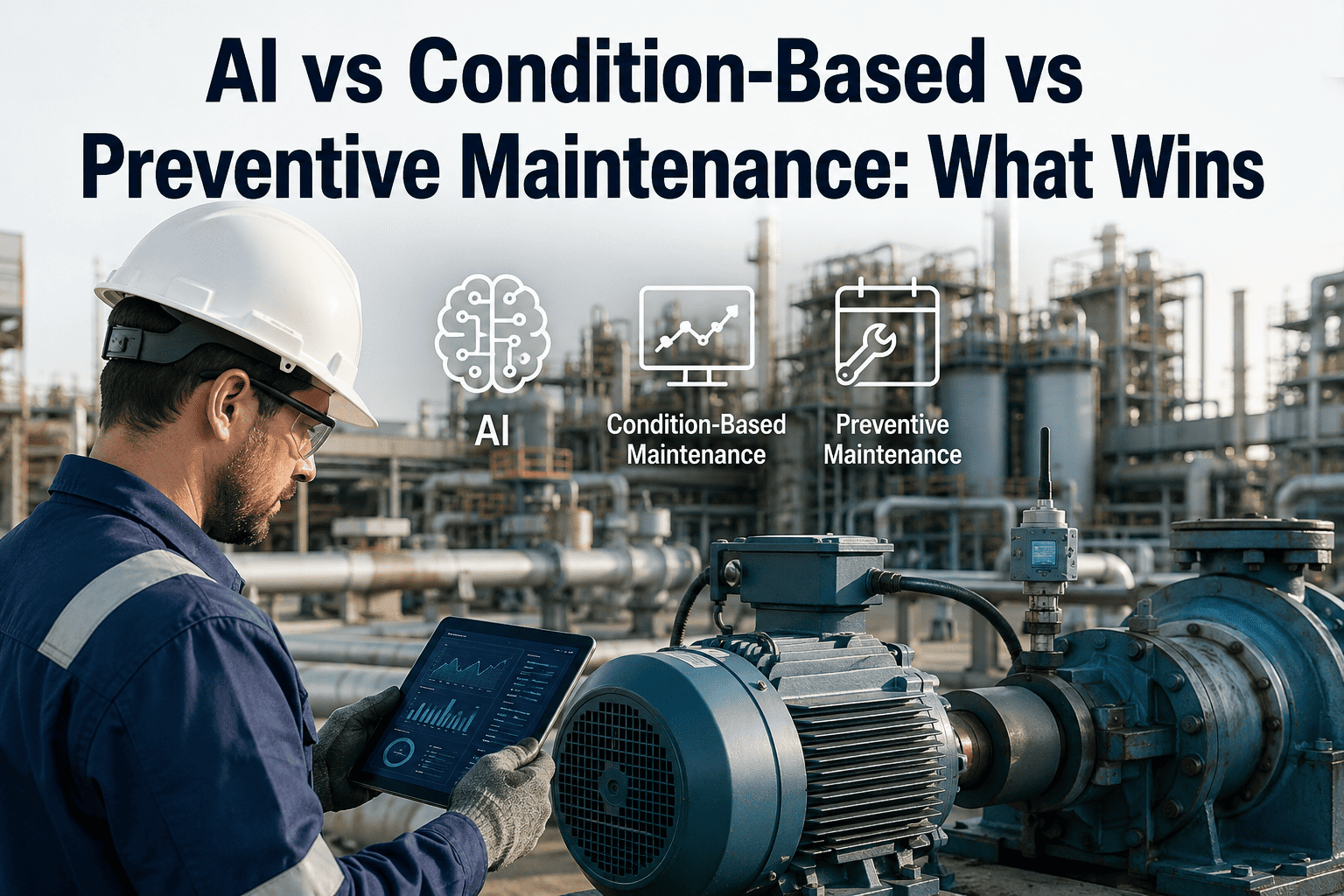
Operations directors don't need another maintenance philosophy lecture. What actually matters is which strategy moves the needle on uptime, cost, and headcount for the specific mix of assets running through your plant today. Preventive, condition-based, and AI-driven predictive maintenance all have a legitimate place on a modern floor, and the plants getting the best results aren't picking just one, they're matching the right strategy to the right asset class. This page lays out the real ROI math behind each approach, where each one wins, and where it quietly falls short, so the next budget conversation is grounded in numbers instead of vendor slides. Operations leaders ready to model this against their own asset list can book a demo and see a strategy comparison built around actual plant data.
MAINTENANCE STRATEGY · AI vs CONDITION-BASED vs PREVENTIVE
Which Maintenance Strategy Actually Wins?
Preventive, condition-based, and AI predictive maintenance compared head-to-head on downtime reduction, cost savings, and real ROI for operations leaders.
10:1-30:1
ROI ratio typically delivered by AI predictive maintenance within 12-18 months
18-25%
Maintenance cost reduction from predictive approaches versus reactive or preventive-only strategies
67%
Share of manufacturers still relying primarily on reactive or calendar-based maintenance today
82%
Share of industrial assets that fail randomly, not on a predictable calendar schedule
Three Strategies, Three Different Philosophies
Before comparing performance, it helps to see how each strategy actually decides when to act. The difference in trigger logic is what drives every downstream difference in cost and downtime.
Preventive Maintenance
Trigger: Fixed calendar or run-hour schedule
Service happens on a predetermined interval regardless of actual asset condition. Simple to plan and budget, but it over-maintains healthy equipment while still missing off-schedule failures.
Condition-Based Maintenance
Trigger: Threshold crossed on a monitored parameter
Sensors watch a specific parameter like vibration or temperature and trigger action once it crosses a set threshold. More targeted than preventive, but reactive to a static limit rather than a trend.
AI Predictive Maintenance
Trigger: ML-forecasted failure trajectory
Machine learning models learn each asset's unique degradation pattern and forecast the failure window itself, well before any fixed threshold would ever fire.
Head-to-Head Performance Comparison
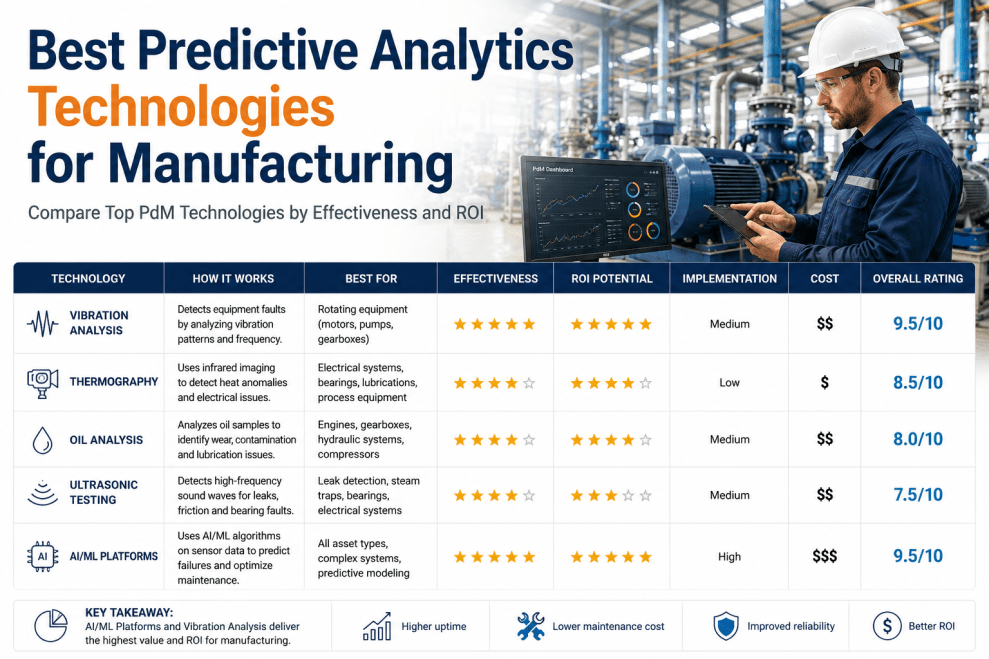
Across the three metrics operations directors actually get asked about in budget reviews, AI predictive maintenance consistently outperforms the other two, though condition-based monitoring remains a strong middle step for lower-criticality assets.
Preventive
Condition-Based
AI Predictive
Unplanned Downtime Reduction
Maintenance Cost Reduction
Failure Prediction Accuracy
MAINTENANCE STRATEGY · OPERATIONS · 2026
See This Comparison Against Your Own Plant Data
Get a strategy recommendation broken down by asset class, using your actual downtime and maintenance cost history.
The ROI Math Behind Each Strategy
Operations directors building a budget case need real numbers, not just percentage claims. Here is how the payback timeline typically looks for each approach.
Preventive Maintenance
12-18%
lower cost vs reactive
Lowest upfront investment, but ongoing over-maintenance spend never fully disappears, capping the long-term savings ceiling.
Condition-Based
12-18 mo
typical payback window
Solid middle ground for medium-criticality assets where full predictive modeling isn't cost-justified.
AI Predictive
10:1-30:1
ROI within 12-18 months
Highest upfront complexity, but the fastest payback and largest sustained savings on critical, high-downtime-cost assets.
Matching Strategy to Asset Type
Most operations directors don't pick one strategy plant-wide. They layer all three, matching intensity of monitoring to how expensive a failure would actually be.
| Asset Profile |
Recommended Strategy |
Why |
| Bottleneck / Critical Line |
AI Predictive |
Highest downtime cost justifies full sensor and model investment |
| Medium-Criticality Equipment |
Condition-Based |
Threshold monitoring catches most failures without full predictive cost |
| Low-Cost, Easily Replaced Parts |
Preventive |
Scheduled replacement is cheaper than monitoring investment |
What Operations Directors Are Seeing
We didn't rip out our preventive program. We layered predictive monitoring on top of the twelve assets that were actually driving our downtime cost, and left everything else on its existing calendar. That single decision cut our unplanned stoppages by almost a third without touching the rest of the maintenance budget.
Operations Director, Industrial Components Manufacturer
Frequently Asked Questions
MAINTENANCE STRATEGY · OPERATIONS · 2026
Build the Right Blend of Strategies for Your Plant
See exactly which of your assets justify AI predictive monitoring, which fit condition-based thresholds, and which stay on preventive schedules.