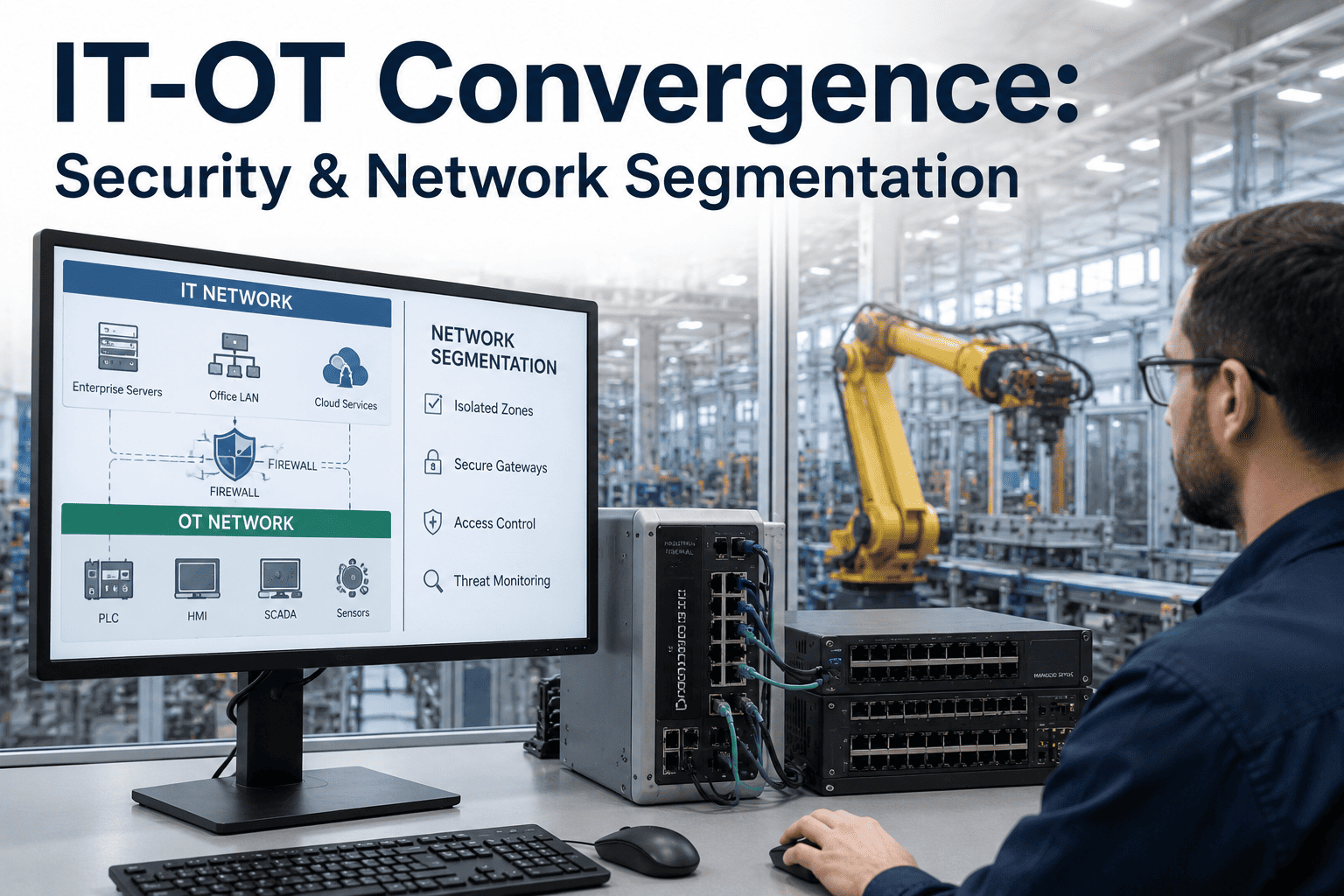
Operational technology was built for a world where the plant network never touched the internet. Programmable logic controllers, historians, and SCADA systems were designed with the assumption of physical isolation, not with authentication protocols hardened against a modern network intrusion. Now those same systems need to share data with cloud analytics platforms, remote monitoring tools, and enterprise IT — and every connection point is a door that wasn't designed to be locked. IT-OT convergence done carelessly turns a plant's control systems into an extension of its corporate attack surface. Book a demo with iFactory's security architecture team to see convergence done with segmentation built in.
Cybersecurity · IT-OT Convergence 2026
IT-OT Convergence: Sharing Operational Data Without Opening the Plant to Risk
Network segmentation, DMZ architecture, and access controls that let operational data flow to the systems that need it, while keeping the control layer isolated from the threats that target enterprise IT.
The Core Tension
Why IT and OT Have Fundamentally Different Priorities
IT Priorities
Confidentiality of data comes first
Frequent patching is standard practice
Downtime for updates is routine and expected
Systems refresh every three to five years
OT Priorities
Availability and safety come first
Patching requires validated downtime windows
Unplanned downtime can mean lost production or safety risk
Systems often run fifteen to twenty years unchanged
Neither set of priorities is wrong — they're optimized for different consequences. A converged security architecture has to respect both, rather than applying IT's patching cadence to OT systems that can't tolerate the same downtime.
Segmentation Architecture
The Purdue Model Zones and How Data Actually Flows Through Them
Zone 0-2
Process and Control Zone
PLCs, sensors, and basic control systems. This zone should never have a direct connection to enterprise IT or the internet under any circumstance.
Zone 3
Operations Management Zone
MES, historians, and SCADA supervisory systems. Data flows down to the control zone and up toward the DMZ, but this zone remains firewalled from direct enterprise access.
DMZ
Demilitarized Zone
The critical buffer layer. No system in enterprise IT connects directly into OT, and no OT system connects directly out to enterprise IT — all data passes through this intermediate zone, brokered and inspected.
Zone 4-5
Enterprise IT Zone
ERP, cloud analytics, and general business systems, where data ultimately lands for reporting, planning, and cross-site analysis after passing through the DMZ.
Convergence Without the Compromise
iFactory Reads Production Data Through a Properly Segmented DMZ
Rather than requiring a direct connection into the control layer, iFactory's data collection architecture respects Purdue model segmentation, brokering data through a DMZ so your plant floor stays isolated from enterprise and internet-facing risk.
Security Fundamentals
Controls That Belong in Every Converged Environment
1
Firewall rules between every zone boundary, denying by default and allowing only explicitly required traffic
2
Asset inventory covering every OT device, since unpatched and unmonitored devices are the most common entry point
3
One-way data diodes or brokered replication for the highest-risk connections where even the DMZ feels too permissive
4
Multi-factor authentication for any remote access into OT systems, including vendor support connections
5
Continuous network monitoring inside OT zones, since traditional IT security tools often miss OT-specific protocols
A Common Weak Point
Managing Vendor and Remote Access Into OT Networks
Third-party vendor access for equipment support is one of the most frequent paths into OT networks that never gets fully documented or cleaned up, precisely because it's set up under time pressure during a maintenance event and forgotten once the issue is resolved.
Time-Bound Access Only
Vendor remote sessions get scoped to a defined window tied to a specific maintenance ticket, expiring automatically rather than remaining open indefinitely.
Brokered, Not Direct
Remote sessions route through a jump host or access broker in the DMZ, so a vendor's credentials never grant a direct path into the control zone.
Logged and Reviewed
Every remote session is logged, and access grants are periodically reviewed to catch connections that were never formally closed out after the work finished.
When Segmentation Isn't Enough
Incident Response Planning for the OT Environment
Detection
Monitoring tuned for OT-specific protocols and traffic patterns, since generic IT security tools often miss anomalies unique to industrial control communication.
Containment
A pre-approved plan for isolating an affected zone without shutting down safety-critical systems, agreed with plant operations before an incident, not during one.
Recovery
Validated backups and known-good configurations for control systems, since restoring OT devices often requires more care than a standard IT system reimage.
The plants that get breached usually didn't lack a firewall diagram — they had one, framed and posted in the network operations center, that hadn't matched reality in two years. Someone added a remote access point for a vendor during a maintenance outage and never removed it. Someone connected a historian directly to the corporate network because the DMZ broker was slow and a deadline was looming. Segmentation isn't a project you finish, it's a discipline you maintain, and the maintenance is where almost every real-world failure happens.
Baptiste Uzomah-Lindqvist
OT Cybersecurity Architect · CISSP · 14 years securing industrial control networks across energy, chemical, and discrete manufacturing
IT-OT Security Questions
IT-OT Convergence — Frequently Asked
Is a DMZ always necessary, or can smaller plants get by with simpler firewall rules?
Plant size affects the scale of the implementation but not really the underlying principle. Even a small facility benefits from a buffer zone between control systems and any network that touches the internet, because the risk isn't proportional to plant size — a single compromised laptop on the corporate network can reach directly into unsegmented OT regardless of how many production lines the plant runs. Smaller sites can implement a lighter-weight DMZ using a single well-configured firewall appliance rather than a large dedicated infrastructure, but skipping the buffer zone entirely leaves the same direct-path risk that larger plants work hard to eliminate.
How do you patch OT systems that can't tolerate the downtime IT patching requires?
The practical answer is a risk-based patching schedule rather than IT's continuous cadence. Critical vulnerabilities with active exploitation get prioritized for the next available validated maintenance window, tested on a non-production system first wherever possible. Lower-severity patches often get bundled into scheduled outages that were already planned for other maintenance, minimizing additional downtime. Compensating controls, like tighter network segmentation around an unpatched system, can reduce risk exposure in the gap between vulnerability disclosure and the next feasible patch window.
Does cloud connectivity for analytics platforms inherently weaken OT security?
Not if it's architected correctly. The risk comes from how the connection is built, not from the fact that a connection exists at all. A properly designed integration reads data out through the DMZ using one-directional or tightly scoped protocols, meaning the cloud platform receives production data without ever gaining a path back into the control layer. The mistake that actually weakens security is a direct connection from a cloud platform into Zone 3 or lower, bypassing the segmentation that's supposed to contain exactly this kind of risk. Contact our support team to review how a specific integration is architected.
Who should own IT-OT security — the IT department, the plant, or both?
Shared ownership with clearly defined boundaries tends to work better than either department owning it alone. IT typically brings expertise in network architecture, firewall management, and general cybersecurity practice, while plant and OT engineering understand which systems can tolerate downtime, what a false positive alert actually means for production, and the physical safety implications of a control system going offline unexpectedly. Organizations that succeed usually establish a joint governance structure with representatives from both sides reviewing segmentation policy and incident response together, rather than leaving OT security as an afterthought bolted onto an IT security program built for office networks.
What's the first step for a plant that has no meaningful segmentation today?
Start with an accurate asset inventory and network map, since it's extremely common for the biggest gap to be simply not knowing what's connected to what. Many plants discover forgotten remote access points, unmanaged switches, or direct connections between OT and enterprise networks during this discovery phase alone. From there, prioritize eliminating the highest-risk direct connections first, then build out proper DMZ architecture for the remaining necessary data flows, rather than attempting a full Purdue model implementation across every zone simultaneously. Book a demo to discuss a phased approach scoped to your current architecture.
Share Data Without Sharing Risk
Get Operational Visibility With Segmentation Built In From Day One
iFactory's data architecture respects Purdue model zoning and DMZ best practices, so your plant floor gets the connectivity modern analytics require without exposing control systems to enterprise-level threats.