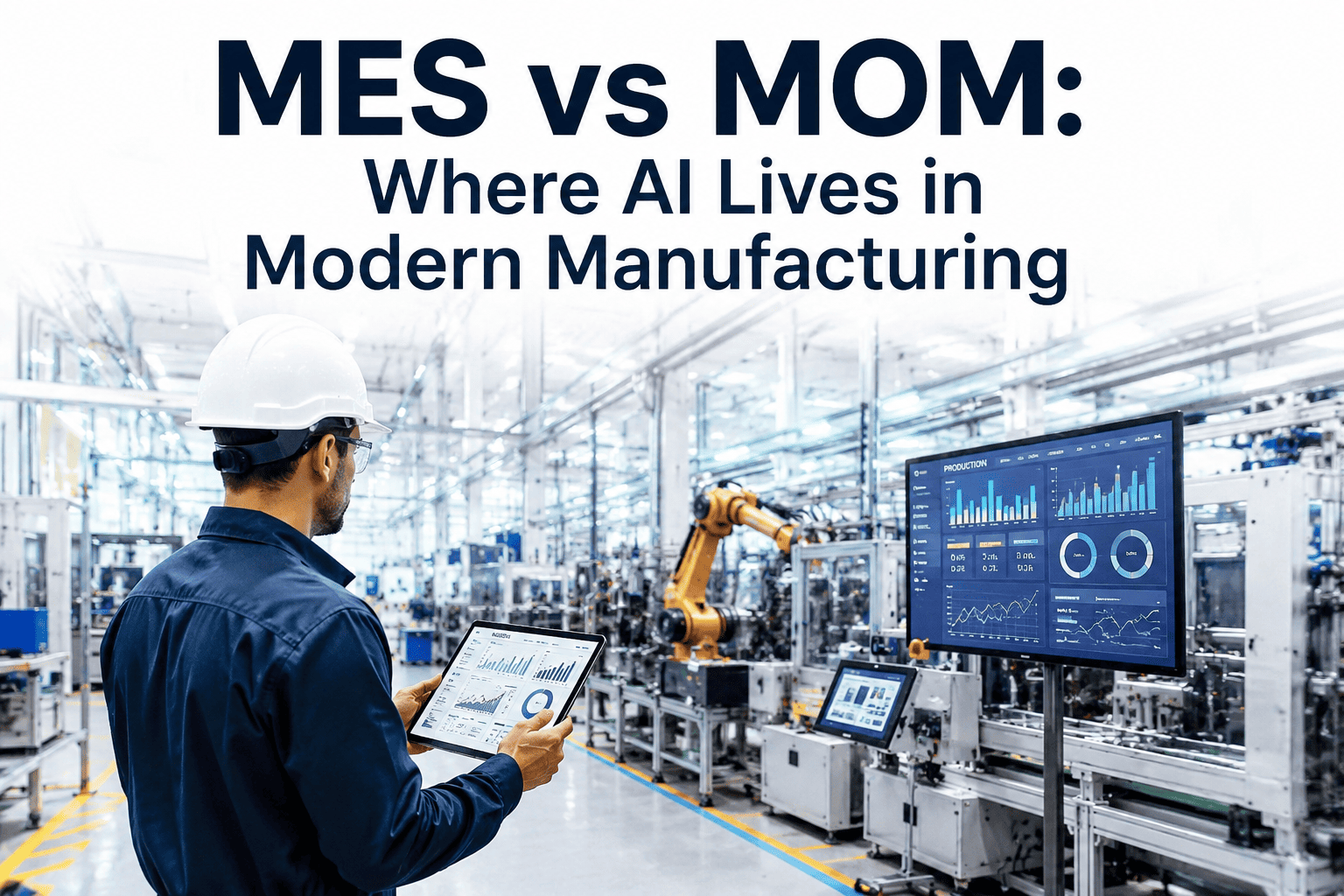
Ask five people at a manufacturing IT conference to define MOM and you will likely get five different answers, and that ambiguity is not just a vocabulary problem, it shapes which system gets budget for the next AI initiative. MES tracks what happened on the line: work orders, genealogy, quality holds, and downtime reasons tied to a specific batch or serial number. MOM is the broader umbrella that orchestrates MES alongside scheduling, quality management, and maintenance as one connected operations layer rather than isolated modules. AI does not replace either one; it threads through both, reading execution data from MES and orchestration logic from MOM to recommend and, in some workflows, automatically apply corrective actions. Manufacturing IT teams mapping this out can Book a Demo to see how an AI layer reads across both without forcing a rebuild of either system.
Why MES and MOM Get Confused So Often
The confusion is understandable because vendors have marketed both terms loosely for years, sometimes using MOM as a rebrand of the same product that used to be called MES. Analysts generally draw the distinction along scope: MES is the execution system tied tightly to the shop floor, tracking work orders, genealogy, and quality data against a specific unit or batch. MOM is the umbrella category that coordinates MES with scheduling, quality, maintenance, and inventory as one orchestrated layer, rather than treating each as a standalone silo that requires its own separate integration effort.
The distinction matters for AI planning because the two layers hold different kinds of data. MES holds granular, unit-level execution history, which is exactly the training data an AI model needs for defect correlation or genealogy-based root cause analysis. MOM holds the orchestration logic across functions, which is what an AI recommendation needs to act on, such as adjusting a schedule or triggering a maintenance work order in response to a detected pattern.
MES, MOM, and Where AI Fits Between Them
MES
Tracks work orders, batch genealogy, quality holds, and downtime reasons at the unit or lot level, tied directly to the shop floor.
AI Intelligence
Reads unit-level execution data from MES and orchestration logic from MOM, correlating both to recommend or trigger corrective actions.
MOM
Coordinates MES with scheduling, quality management, and maintenance as one connected operations layer across the plant.
Three Places AI Threads Through the Stack
Genealogy-Based Root Cause
AI correlates MES genealogy records against quality holds to trace a defect back to a specific machine, shift, or material lot far faster than manual review.
Schedule-Aware Maintenance
Reading MOM scheduling data alongside equipment condition, AI recommends maintenance windows that avoid the highest-priority production runs.
Cross-Function Quality Alerts
A quality trend detected in MES can trigger a MOM-level scheduling adjustment automatically, instead of waiting for a human to connect the two systems manually.
MES vs MOM — Core Capabilities Compared
| Capability | MES | MOM |
|---|---|---|
| Primary scope | Shop floor execution | Cross-functional orchestration |
| Data granularity | Unit or batch level | Aggregated across functions |
| Typical modules | Work orders, genealogy, quality holds | Scheduling, quality, maintenance, inventory |
| AI training data role | Granular execution history | Orchestration and scheduling context |
| Where AI acts | Flags unit-level anomalies | Adjusts schedules and workflows |
Planning an AI Layer Across MES and MOM in 2026
Map Data Ownership
Identify which system holds which data today, since many plants have overlapping or duplicated fields between MES and MOM instances.
Connect Both Layers to AI
Establish read access to both MES execution data and MOM orchestration logic so the AI layer has the full picture rather than half of it.
Pilot One Cross-Function Workflow
Start with a single high-value workflow, such as quality-triggered scheduling, before expanding to additional cross-system use cases.
Scale Across Lines and Sites
Once the pilot workflow is validated, extend the same AI correlation logic to additional lines, products, or plant sites.
MES, MOM, and AI — Common Questions
Do we need to replace our MES or MOM system to add an AI layer?
No. The AI layer is designed to read from your existing MES and MOM systems rather than replace either one, connecting through standard integration points to pull execution data and orchestration logic. This matters because MES and MOM systems are typically deeply embedded in daily operations, and a replacement project carries far more risk and cost than adding a layer that reads what already exists.
Our MES vendor calls their product MOM. Does that change anything?
Not for integration purposes. Vendor naming varies widely, and some MES products have been rebranded as MOM platforms without a meaningful change in scope. What matters for an AI deployment is the actual data the system holds, whether it is unit-level execution history, cross-functional orchestration logic, or both, rather than which label appears on the product itself.
Can AI recommendations from MES data actually change a MOM schedule automatically?
Yes, in workflows configured for automated action, a quality or genealogy pattern detected in MES data can trigger a scheduling recommendation or adjustment in MOM without a person manually connecting the two systems. Most plants start with recommendations that require human approval before enabling fully automated adjustments, so trust in the correlation builds before removing the manual checkpoint.
What data access does the AI layer need from each system?
Typically read access to MES work order, genealogy, and quality hold records, along with read access to MOM scheduling, maintenance, and inventory data, is enough to power most cross-function correlation use cases. Write access is only configured for specific approved workflows, such as an automated scheduling adjustment, and only after that workflow has been validated in a supervised mode.
How do we start scoping this for our plant?
A useful starting point is mapping which system currently owns which data field, since that mapping usually reveals both the overlap between MES and MOM and the specific gap an AI layer would fill. Manufacturing IT teams ready to walk through that mapping can Book a Demo or reach the iFactory Support team directly.