A plant floor system upgrade shouldn't require a six-month integration project just to let a new dashboard read a machine's output count. Yet that's exactly what happens in manufacturing environments built on point-to-point connections, where every new system means another custom bridge, another brittle script, another engineer who has to remember how MES talks to the historian. API-first architecture flips that model: instead of building connections between systems, you build a contract that any system can consume. Book a demo with iFactory's integration team to see what an API-first manufacturing stack looks like in practice.
Integration Architecture · Manufacturing IT 2026
API-First Integration: Building Manufacturing Systems That Talk to Each Other by Default
RESTful APIs, event streaming, and microservices replace fragile point-to-point scripts with a integration layer that scales as new systems, sensors, and applications get added — without a new custom bridge every time.
The Underlying Problem
Why Point-to-Point Integration Breaks Down at Scale
01
Connection Sprawl
Every new system added to the plant means a new custom connection to every existing system it needs to talk to. Ten systems can mean forty five separate point-to-point links, each one a maintenance liability.
02
Tribal Knowledge Dependency
The script that moves data from the historian to the quality system was written by an engineer who left three years ago. Nobody documents point-to-point integrations well because they're built as one-off fixes, not platform investments.
03
Change Fragility
A firmware update on one PLC or a schema change in one database can silently break three downstream connections that nobody realizes depend on the exact old format until a report goes blank.
04
Slow Onboarding
Adding a new analytics tool or a new vendor's equipment means starting the integration conversation from scratch, often taking months before the new system can actually see production data.
Architecture Comparison
Point-to-Point vs. API-First: What Actually Changes
| Dimension | Point-to-Point | API-First |
|---|---|---|
| New system onboarding | Weeks to months per connection | Days, using existing API contracts |
| Number of connections at N systems | Grows roughly as N squared | Grows linearly, one API per system |
| Failure isolation | One change can break multiple hidden links | Contract versioning isolates breaking changes |
| Documentation | Usually informal or absent | API spec is the documentation |
| Real-time capability | Typically batch or polling based | Event streaming supports near real-time updates |
The core shift isn't just technical — it's organizational. A point-to-point shop treats every integration as a custom project. An API-first shop treats integration as a reusable capability that every future system inherits for free.
See the Architecture in Action
iFactory Ships With an API-First Integration Layer Built In
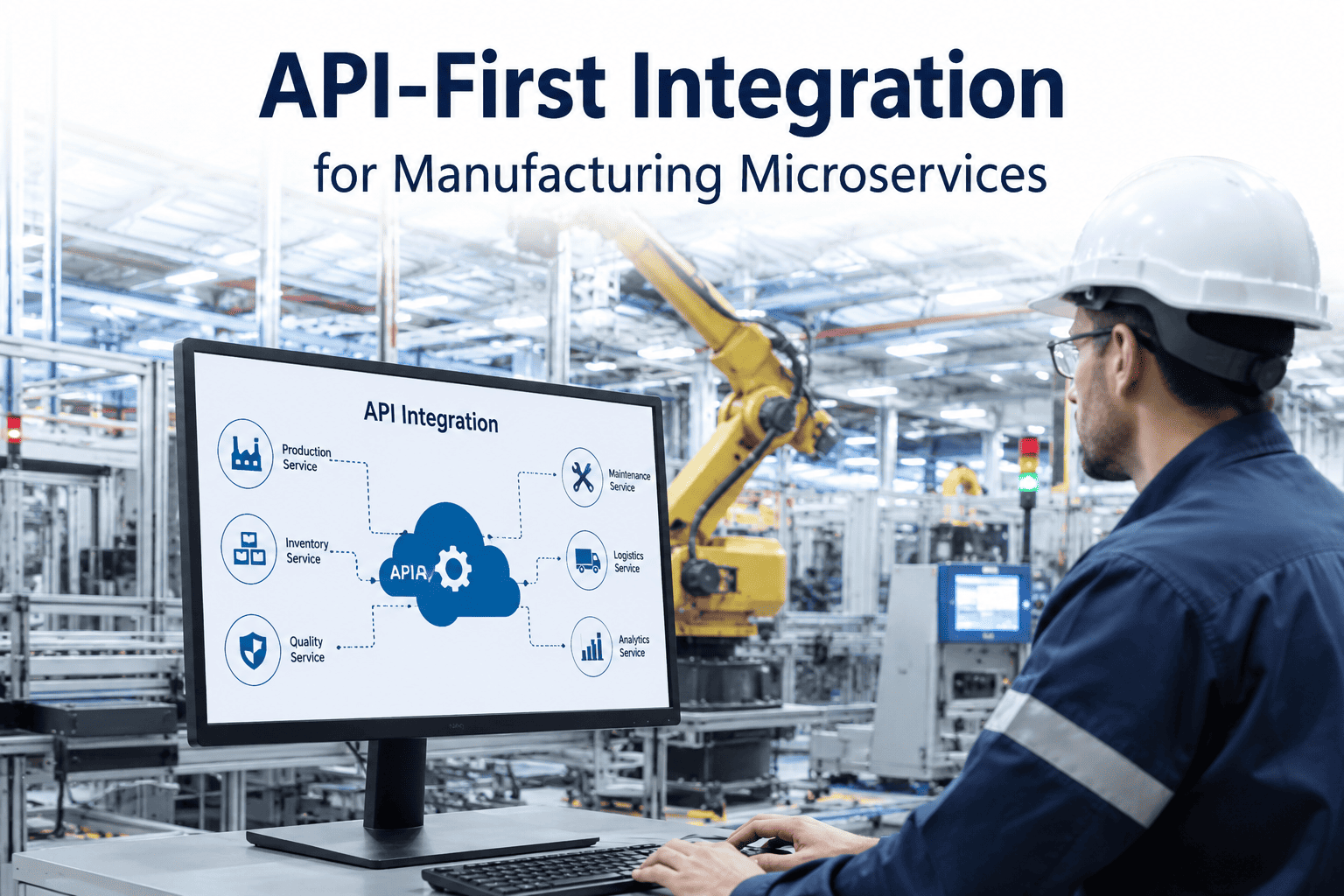
Rather than retrofitting APIs onto legacy connections, iFactory exposes production data, quality records, and maintenance events through documented REST endpoints and event streams from day one — so every new tool you add connects in days, not months.
Core Components
What an API-First Manufacturing Stack Actually Includes
Contract Layer
RESTful APIs
Standardized endpoints for reading and writing production, quality, and asset data, documented with a schema that any developer or system can consume without a walkthrough from the original builder.
Real-Time Layer
Event Streaming
A publish-subscribe backbone that pushes machine state changes, quality holds, and downtime events to any subscribed system the moment they happen, instead of waiting for the next polling cycle.
Service Layer
Microservices
Independently deployable services — one for OEE calculation, one for quality holds, one for scheduling — that can be updated or scaled without redeploying the entire integration stack.
Governance Layer
API Gateway
A single entry point that handles authentication, rate limiting, and version routing, so consuming systems always know exactly which contract version they're talking to.
Migration Path
Moving From Point-to-Point to API-First Without a Big-Bang Cutover
Phase 1
Wrap, Don't Replace
Build API wrappers around existing point-to-point connections so new systems can consume data through the new contract while legacy links keep running underneath, unchanged.
Phase 2
Route New Integrations Through APIs Only
Every new system added from this point forward connects exclusively through the API layer, stopping the growth of new point-to-point sprawl immediately.
Phase 3
Retire Legacy Links Opportunistically
As legacy connections come up for maintenance or break, replace them with direct API integrations rather than patching the old script, gradually shrinking the point-to-point footprint.
Phase 4
Add Event Streaming for Time-Critical Data
Once the REST layer is stable, layer event streaming on top for use cases that genuinely need real-time delivery, such as downtime alerts and quality hold notifications.
Keeping It Maintainable
API Versioning and Governance Rules That Prevent the Next Round of Sprawl
An API-first architecture solves connection sprawl on day one, but without governance it can quietly recreate the same problem a few years later — just with API calls instead of custom scripts. The discipline that keeps it clean over time is versioning and ownership, not the initial build.
Version Every Contract
Breaking changes get a new version number rather than modifying the existing endpoint in place, so consuming systems aren't silently broken by an upstream change they never approved.
Assign an Owner Per Domain
Each API — quality, scheduling, maintenance — has a named owner responsible for its contract, its documentation, and communicating planned changes before they ship.
Deprecate on a Published Timeline
Old versions get a firm sunset date communicated well in advance, rather than being pulled without warning or left running indefinitely alongside newer versions.
Review New Endpoints Before They Ship
A lightweight design review catches inconsistent naming, missing authentication scopes, or duplicated functionality before a new endpoint becomes another one-off pattern to maintain.
What Changes on the Floor
The Practical Difference Once the Integration Layer Is in Place
Days
Typical time to onboard a new analytics tool or vendor system once the API layer is established, down from weeks or months
One Contract
Each system integrates against a single documented interface instead of a custom connection per downstream consumer
Fewer Unknowns
A firmware or schema change surfaces as a version bump the API layer manages, not a silent break discovered when a report goes blank
None of this requires a plant to abandon its existing systems. The change is in how new and existing systems are connected going forward, not in what runs on the floor today.
The plants that struggle with API-first migrations almost always try to do it as a single cutover project, and it fails for the same reason big-bang IT migrations always fail — too much risk concentrated in one weekend. The plants that succeed treat it as a standing policy: nothing new gets built point-to-point, full stop, starting today. Eighteen months later, the legacy connections that remain are the ones nobody's touched because they still work fine, and that's actually the correct outcome. You don't need to migrate everything, you need to stop making the problem worse.
Colm Anders Whitfield-Nakagawa
Manufacturing Systems Architect · 15 years designing integration platforms for multi-site discrete and process manufacturers
Integration Architecture Questions
API-First Manufacturing Integration — Frequently Asked
Does API-first mean ripping out existing PLC and SCADA connections?
No, and this is one of the most common misconceptions about the approach. API-first architecture typically sits as a layer above existing OT connections rather than replacing them outright. A gateway or edge service reads from the PLC or SCADA system using its existing protocol and exposes that data through a standardized API, so the underlying field-level connections stay exactly as they are while everything consuming that data upstream gets a consistent, documented interface. The migration risk lives almost entirely in the application and reporting layer, not in the control layer.
How is this different from a traditional middleware or ESB approach?
Traditional enterprise service bus architectures centralize integration logic into one large, often monolithic hub that becomes a bottleneck and a single point of failure as complexity grows. API-first architecture distributes that logic into independently deployable services, each owning a specific domain like quality or scheduling, connected through lightweight, well-documented contracts rather than a heavyweight central broker. The practical difference shows up in deployment speed — updating one microservice doesn't require redeploying or even understanding the entire integration stack the way an ESB change often does.
What skills does a plant IT team need to support this architecture?
Teams need familiarity with REST API design and consumption, basic understanding of event-driven patterns like publish-subscribe messaging, and enough scripting or development capability to build lightweight consumers against documented endpoints. This is a meaningfully lower bar than maintaining custom point-to-point scripts in obscure legacy protocols, since API documentation and tooling are far more standardized and widely understood than one-off integration code. Contact our support team for guidance on the specific skill gaps for your current stack.
How do you handle security when exposing production data through APIs?
API-first doesn't mean opening plant data to the internet. A properly designed architecture routes all API traffic through a gateway that enforces authentication, authorization scoped to what each consuming system actually needs, and rate limiting to prevent any single integration from overwhelming the underlying systems. Combined with network segmentation between IT and OT zones, the API layer can actually improve security posture compared to ad hoc point-to-point scripts, which often use weaker or inconsistent authentication because each one was built independently.
Is event streaming necessary, or is REST alone sufficient?
REST APIs handle the majority of manufacturing integration needs well, particularly for reporting, configuration, and any data consumers can tolerate checking on a periodic basis. Event streaming becomes necessary specifically for time-critical use cases — a downtime alert that needs to reach a maintenance dashboard within seconds, or a quality hold that must block downstream processing immediately rather than on the next polling cycle. Most manufacturers implement REST first for the broad integration surface, then add streaming selectively for the handful of genuinely real-time workflows. Book a demo to see both patterns working together on real production data.
Stop Building One-Off Integrations
Get an Integration Layer That Scales With Every New System You Add
iFactory's API-first architecture means every new tool, sensor, or analytics platform you bring onto the plant floor connects through the same documented contract — no custom scripts, no tribal knowledge, no months-long onboarding.