A refinery running its hydrodesulfurization unit comfortably under the 10 ppm sulfur specification for weeks decides that comfort margin is room to push feed rate, and within days the diesel pool starts creeping toward the compliance limit instead of sitting safely below it. Nothing broke, no catalyst failed, the unit is simply operating closer to its actual limit than the margin ever suggested, because reactor temperature, hydrogen partial pressure, and space velocity all move together and a change to any one of them shifts how much margin is really left. You can see how continuous optimization keeps that margin visible instead of discovered after the fact by choosing to book a demo with our team.
REFINERY UNIT AI · HYDRODESULFURIZATION · ULSD COMPLIANCE
Your HDS Unit Has a Real-Time Sulfur Margin, and Most Control Schemes Never Show It to You
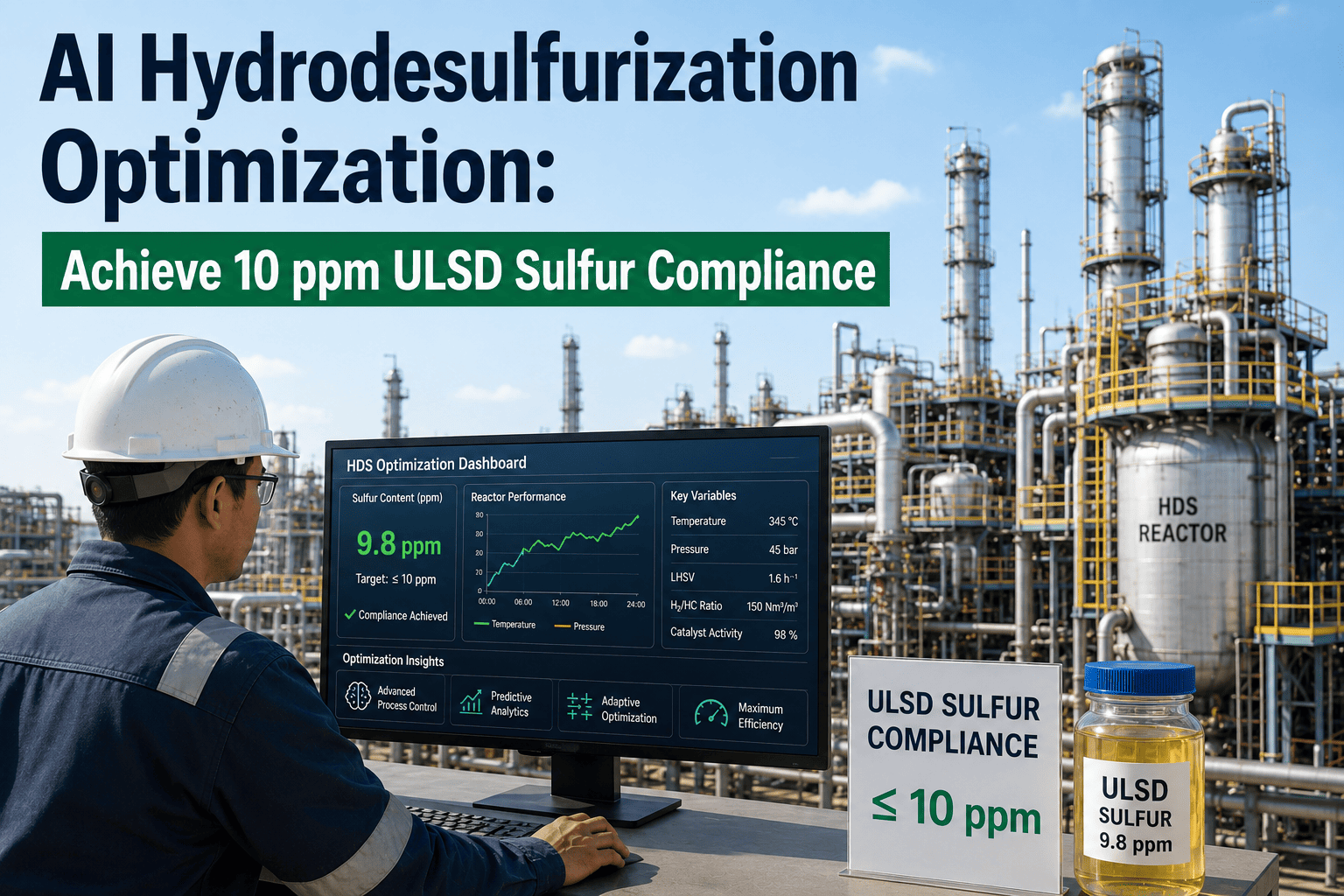
Reactor temperature, hydrogen partial pressure, and liquid hourly space velocity interact to determine how much sulfur actually comes off the diesel, and the margin between current performance and the 10 ppm ULSD limit shifts constantly with feed sulfur content and catalyst activity. iFactory tracks that margin continuously and recommends the setpoint combination that holds compliance while minimizing hydrogen consumption and catalyst deactivation.
PRODUCT SULFUR
6.8 PPM
Limit: 10 ppm ULSD spec
H2 PARTIAL PRESSURE
Optimal
Within efficient consumption band
CATALYST ACTIVITY
Tracking
Deactivation trend within model
WHY THE 10 PPM LIMIT IS HARDER TO HOLD THAN IT LOOKS
Three Variables Determine Your Margin, and Two of Them Are Always Moving
Ultra-low sulfur diesel compliance depends on the HDS reactor removing enough organosulfur compounds to bring product sulfur under 10 ppm, and the three main levers for doing that, reactor temperature, hydrogen partial pressure, and liquid hourly space velocity, all trade off against each other in ways that make a single fixed operating point rarely optimal for very long.
Feed sulfur content varies with crude slate, which is often decided by procurement for margin reasons that have nothing to do with the HDS unit's current operating window. Catalyst activity declines gradually over the run length between turnarounds, requiring temperature increases to maintain conversion, and each of those temperature increases accelerates further catalyst deactivation and increases hydrogen consumption, creating a compounding effect that a fixed setpoint approach handles reactively rather than proactively.
10 PPM
EPA ULSD sulfur specification for on-highway diesel fuel
99.9%+
Sulfur removal efficiency typically required from feed to meet product specification
0.5-1°F
Typical monthly temperature increase needed to offset gradual catalyst deactivation over a run
THE THREE LEVERS AND THEIR TRADE-OFFS
Temperature, Hydrogen Partial Pressure, and Space Velocity Interact
01
Reactor Temperature
Higher temperature increases reaction rate and sulfur conversion, but accelerates catalyst deactivation and coking, shortening effective catalyst life if pushed higher than the current feed and catalyst condition actually require.
02
Hydrogen Partial Pressure
Higher hydrogen partial pressure improves desulfurization and suppresses coking, but increases hydrogen consumption and recycle compressor load, adding operating cost that is often unnecessary once the actual conversion requirement is known.
03
Liquid Hourly Space Velocity
Lower space velocity, meaning more residence time in the reactor, improves conversion but limits throughput, so the unit's ability to hold compliance at higher feed rates depends on how well the other two levers are tuned.
See Your Actual Real-Time Sulfur Margin, Not Just the Last Lab Result
iFactory continuously models the compliance margin your HDS unit is really operating with, given current feed, catalyst condition, and setpoints.
FIXED OPERATING POINTS VERSUS CONTINUOUS OPTIMIZATION
What Changes When the Unit Adjusts to Feed and Catalyst Condition in Real Time
A FOUR-PHASE ROLLOUT
Getting From Reactive Adjustment to Continuous Margin Management
1
Baseline Catalyst Activity and Run History
Historical temperature, feed sulfur, and product sulfur data across the current catalyst run are used to establish the unit's actual deactivation curve.
2
Connect Live Feed and Process Data
Feed sulfur estimates, reactor temperature, hydrogen partial pressure, and space velocity are integrated into one continuously updated operating picture.
3
Model Real-Time Compliance Margin
Product sulfur is estimated continuously between lab samples, giving operators a live view of how much margin actually remains under current conditions.
4
Recommend Setpoint Adjustments That Balance Cost and Compliance
Temperature and hydrogen partial pressure recommendations are surfaced to hold compliance while minimizing hydrogen consumption and unnecessary catalyst deactivation.
COMMON MISTAKES
Where HDS Optimization Efforts Usually Go Wrong
Raising Temperature Reactively Instead of Ahead of the Curve
Waiting for a lab result to show a compliance margin has narrowed before raising temperature means the correction always lags the actual catalyst deactivation trend by at least one sample interval.
Holding Hydrogen Partial Pressure at a Fixed Safety Margin
A partial pressure set conservatively high to cover worst-case feed conditions adds ongoing hydrogen cost during the majority of the run when feed sulfur is actually well within the unit's easier operating range.
Ignoring Feed Slate Changes From Procurement
Crude and blend changes made upstream for margin reasons frequently reach the HDS unit without a corresponding review of whether current setpoints still fit the new feed sulfur profile.
Treating the End of Run Deactivation Curve as Linear
Catalyst deactivation often accelerates non-linearly toward the end of a run, and a temperature ramp plan based on early-run linear extrapolation can underestimate how much margin is left as the turnaround approaches.
A FOURTH VARIABLE THAT RARELY GETS THE SAME ATTENTION
Recycle Gas Purity Quietly Erodes the Same Margin
Temperature, hydrogen partial pressure, and space velocity get most of the attention in HDS optimization discussions, but recycle gas hydrogen purity is a fourth variable that moves in the background and directly affects how much of the nominal partial pressure setpoint is actually available for the reaction. As light hydrocarbons and other impurities build up in the recycle loop between purges, effective hydrogen partial pressure at the reactor can fall well below the value implied by total system pressure alone.
A unit holding total pressure constant while recycle purity slowly declines will see its real compliance margin erode without any setpoint having technically changed, which is part of why purely setpoint-based monitoring can miss a slow drift that a purity-aware model catches early. Tracking recycle purity trend alongside the three primary levers closes this gap and typically extends the interval between purges without risking margin.
WHO OWNS EACH PART OF THE MARGIN
Three Roles Share Responsibility for Holding Compliance
Board Operator
Executes temperature and pressure setpoint changes in real time and is first to see recycle compressor and purity trend data on shift.
Process Engineer
Reviews the catalyst deactivation curve and product sulfur trend against the run plan, and authorizes planned temperature ramp adjustments ahead of need.
Refinery Planning
Sets the feed slate and throughput targets that determine how much margin the HDS unit actually has to work with on any given day.
FREQUENTLY ASKED QUESTIONS
Questions Process Engineers Ask About HDS Optimization
Does this require new HDS unit instrumentation?
Most units already have the reactor temperature, hydrogen partial pressure, and feed rate instrumentation needed, the value comes from connecting that live data into a continuously updated compliance margin model rather than from new sensors. A quick instrumentation review during onboarding confirms what your unit already supports.
Book a demo to walk through your current HDS instrumentation.
How accurate is a continuous sulfur estimate compared to a lab sample?
A continuous model is calibrated against your actual lab sample history and process data, and its role is to fill the gap between scheduled samples with a trend estimate rather than to replace lab analysis entirely. Lab samples remain the reference point the model is validated and recalibrated against on an ongoing basis.
Can this reduce hydrogen consumption without risking compliance?
Yes, in units where hydrogen partial pressure has been held at a fixed conservative margin, matching pressure to the actual real-time conversion requirement typically reduces average hydrogen consumption while holding the same or better compliance margin, since the model is tracking margin continuously rather than relying on a static safety buffer.
Contact our support team to review your current hydrogen consumption against feed sulfur history.
How does this affect catalyst life and turnaround planning?
Because temperature increases are planned ahead of need based on the modeled deactivation trend rather than applied reactively in larger jumps after a margin narrows, catalyst life is often extended modestly and turnaround temperature-limit forecasting becomes more reliable for planning purposes.
Does this work across different feed slates, not just a single crude type?
Yes, the model is built to respond to feed sulfur variation directly, which means it adapts to blend changes rather than requiring a separate model for each crude type the unit processes. This is particularly useful for units processing a variable slate driven by procurement decisions.
Book a demo to see how the model handles your specific feed slate variability.
Stop Discovering Your Sulfur Margin at the Next Lab Sample
iFactory keeps HDS reactor temperature, hydrogen partial pressure, and space velocity tuned to your actual real-time compliance margin.