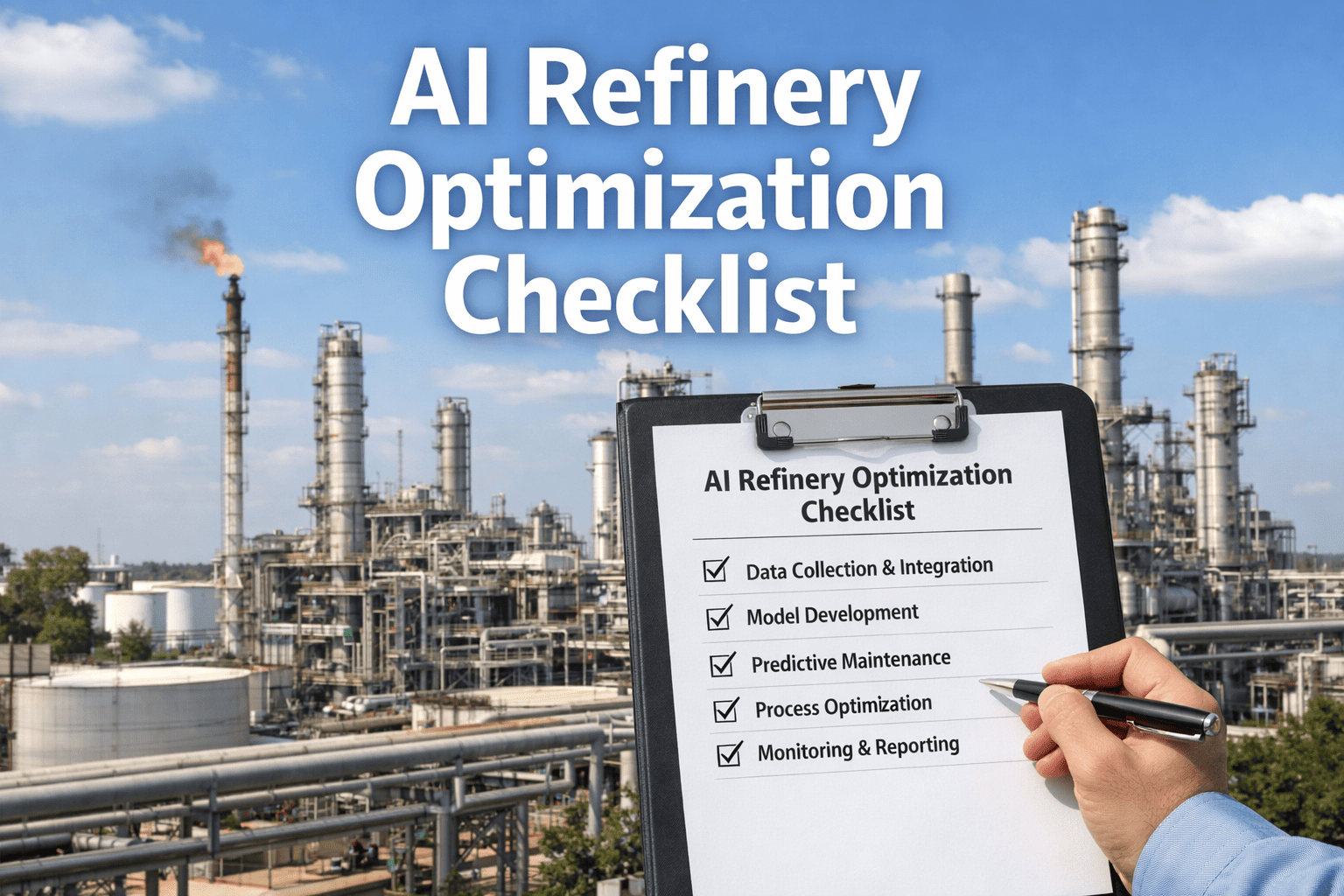
An FCC unit is one of the most tightly coupled processes in a refinery, and the coupling is what makes it so hard to push. Move the riser outlet temperature a couple of degrees to chase gasoline yield and coke make shifts, delta coke shifts, regenerator temperature responds, catalyst circulation adjusts, and the whole heat balance around the reactor-regenerator loop settles at a new operating point that may or may not be where you wanted to land. Experienced FCC engineers navigate that coupling from feel, honed over years of watching the unit react to feed changes, catalyst additions, and weather-driven cooling shifts. AI doesn't replace that experience — but it does something the human operator can't do at 3 a.m. during a feed swing: it holds the multi-variable optimization steady, second by second, across every constraint the unit is running against. That is exactly what the FCC process optimization platform from iFactory is built to deliver.
Refinery Unit AI · FCC Optimization · Process Control
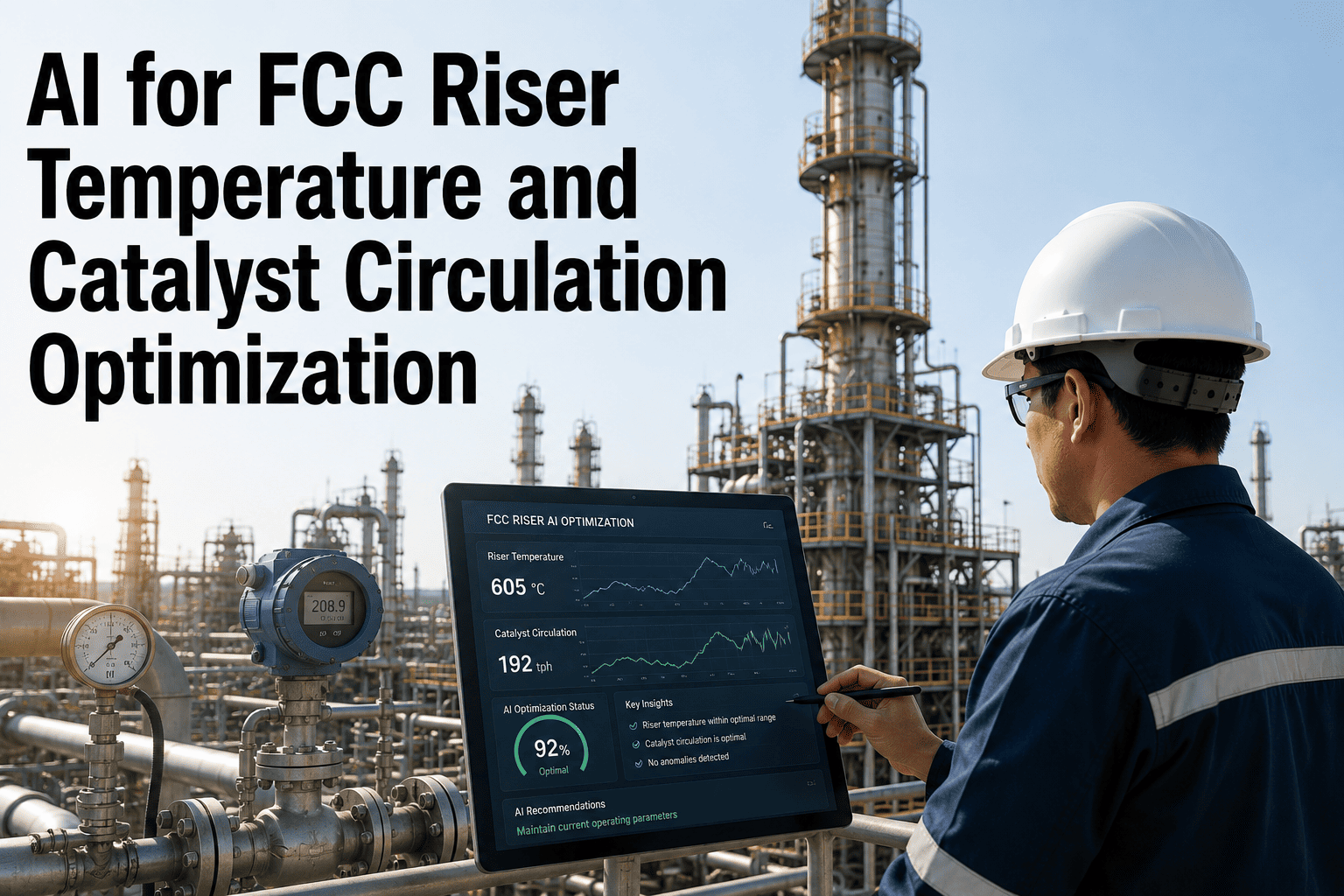
AI for FCC Riser Temperature and Catalyst Circulation Optimization
Every FCC unit sits inside a heat balance that couples riser outlet temperature, catalyst-to-oil ratio, delta coke, and regenerator temperature into one problem you can't solve one variable at a time. iFactory runs a real-time optimization layer on top of your DCS that holds the unit at the sweet spot against your current product slate, feed quality, and constraint set — pushing conversion up without breaking the wet-gas compressor, the regenerator temperature limit, or the catalyst activity you paid for.
Up to 5%
Gasoline + LPG yield lift within ROT window
Second-by-Second
Multi-variable optimization across heat balance
Constraint-Aware
Respects Trg, compressor, and catalyst limits
The Core Coupling
The Heat-Balance Loop AI Has to Solve, Not One Variable at a Time
Node 1
Riser Outlet Temperature (ROT)
Typically 510–545°C. Sets the primary conversion driver at the unit level — but pushing ROT alone raises coke yield and dry-gas make, which loads the regenerator and the wet-gas compressor.
Node 2
Catalyst-to-Oil Ratio
Typically 8–12. Higher ratio drives higher conversion at the same ROT. Controlled indirectly through catalyst circulation and the regenerator-reactor temperature differential.
Node 3
Delta Coke (CSC − CRC)
Coke on spent minus coke on regenerated catalyst. Proportional to (Trg − Trx). Lower delta coke enables higher cat-to-oil at the same overall coke yield, which translates directly into higher conversion.
Node 4
Regenerator Temperature (Trg)
Typically ~700–730°C. Governs catalyst activity retention. Runs into metallurgical and catalyst-deactivation limits at the high end.
The Equation Every FCC Engineer Lives With
Coke yield = Catalyst-to-oil × Delta coke
Delta coke ∝ (Trg − Trx)
To raise conversion, you want higher cat-to-oil. To get higher cat-to-oil at the same coke yield, you need lower delta coke — which usually means lower Trg or better stripper efficiency. AI holds all three simultaneously.
Operating Windows That Actually Move Money
Where the ROT Sweet Spot Sits by Product Objective
510–520°C
Max Gasoline + Diesel
Lower-severity operation preserves LCO (light cycle oil) yield. Documented lift of roughly 0.5% in combined gasoline + diesel yield when held tightly in this window against a feed the unit was already processing.
525–535°C
Balanced Slate, Capacity-Driven
Around 530°C is a common target when the objective is holding gasoline yield while pushing feed rate. Documented feed-rate lifts on the order of 14% at constant gasoline yield when the ROT is held precisely against a moving feed.
535–545°C
Max Gasoline + LPG
Higher-severity operation. Documented lift of up to 5% in combined gasoline + LPG yield when the unit sits reliably in this window without crossing over into over-cracking that spikes dry-gas make.
> 545°C
Over-Cracking Zone
Diesel yield collapses sharply. Combustible light gas rises rapidly, overloading the wet-gas compressor. Coke yield jumps, pushing regenerator temperature toward metallurgical limits. Almost never economic — and where units drift when ROT isn't held tightly.
The lift numbers above are documented in FCC modeling literature at specific unit configurations. The real value of an AI optimizer isn't the peak lift on a good day — it's holding the unit inside the right window every hour, on every shift, across feed and weather changes that would otherwise pull the ROT off target.
Bring Your Own Unit Data
See What an AI Optimizer Would Have Done on Your Last 30 Days of FCC Operation
Send us historian data — ROT, cat-to-oil, regenerator temperature, feed rate, product yields — and we'll run the optimizer offline against the same window and show you where the setpoints would have moved and what the yield delta would have been.
What the AI Actually Sees
The Soft-Sensor Stack Behind FCC Optimization
Measured
Direct DCS Signals
ROT, feed preheat, catalyst slide valve positions, regenerator dense-phase temperature, regenerator O2, flue-gas composition, stripping steam rate, feed flow and quality.
Inferred
Cat-to-Oil Ratio
Computed continuously from regenerator heat balance and feed enthalpy. Traditional lab-only calculations give one number per shift; AI gives one per second, so the setpoint move is based on now, not two hours ago.
Inferred
Delta Coke
Estimated from regenerator-reactor temperature differential and heat-balance closure. Trending delta coke in real time exposes stripper efficiency loss and catalyst deactivation drift before they show up in product yields, which is often the difference between a routine catalyst addition and an emergency response.
Predicted
Coke Yield & Product Slate
Model predicts near-term coke make and product yields given current setpoints, so the optimizer can trade off ROT and cat-to-oil against the wet-gas compressor and regenerator constraints before they bind.
Predicted
Catalyst Activity Trend
Learned degradation curve from historical MAT (microactivity) tests and equilibrium catalyst analyses. Feeds the optimizer's view of how hard the unit can be pushed on the current catalyst inventory.
Constraint
Wet-Gas Compressor Load
The binding constraint at the high end of ROT for most units. Modeled continuously so the optimizer knows how much headroom is available before dry-gas make overloads it.
Where the Optimizer Earns Its Keep
Real Operating Situations That Move Money on an FCC Unit
1
Feed Slate Switch Mid-Shift
A heavier VGO slug enters the unit, coke yield starts climbing, regenerator temperature drifts up. Manual response typically drops feed rate defensively to protect the regenerator temperature limit — which costs throughput for the rest of the shift. The optimizer sees the change in real-time coke make and regenerator heat balance within seconds, pulls cat-to-oil down and shifts ROT before the drift becomes a full 15-minute regenerator excursion, and holds conversion instead of sacrificing throughput. The daylight between those two responses is a real number on the shift report.
2
Product Slate Change on Refining Economics
Distillate crack margin flips overnight versus gasoline on the futures screen. The optimizer moves the ROT target from 535°C toward 515°C over the following hour with coordinated moves on cat-to-oil and regenerator O2, capturing the LCO uplift immediately instead of waiting for the day-shift engineer to walk in, review the pricing shift, and push setpoints manually. The window between the market signal and the unit response used to be six to twelve hours — it collapses to a single controlled transition.
3
Regenerator O2 Optimization
Full-combustion mode leaves O2 headroom on the table because operators keep excess air conservative to avoid afterburn — a rational trade for a human watching the console, but expensive across a full year. The optimizer trims O2 setpoint precisely against real-time flue-gas CO and coke burn rate, recovering fuel value and lifting catalyst regeneration efficiency while staying safely inside the afterburn constraint the operator was manually buffering against.
4
Catalyst Deactivation Compensation
Equilibrium catalyst activity has drifted down over the past two weeks — usually not enough for anyone to notice on a shift-by-shift basis, but enough to erode conversion cumulatively. The optimizer sees the trend in the soft-sensor stack, raises cat-to-oil to hold conversion, and flags the maintenance team that a fresh catalyst addition rate change is warranted — before the yield report at end of month shows the loss and before the process engineer has to reconstruct what happened from historian archives.
5
Weather-Driven Air Density Shift
Cold-front air-mass change lifts regenerator combustion efficiency overnight. Operator running to a fixed O2 setpoint doesn't capture it — the extra combustion capacity just sits idle until the day shift notices the flue-gas trend. The optimizer trims combustion air and repositions the heat balance to lift cat-to-oil for the remaining shift, converting the free combustion headroom into extra conversion. A small daily win that compounds over the year into a number the plant manager takes seriously.
Two Ways to Run the Unit
Manual Setpoint Management vs Continuous AI Optimization
| Aspect | Manual / Day-Shift Setpoint Moves | iFactory Continuous AI Optimization |
| Setpoint update cadence |
Per shift, sometimes per day |
Every second, bounded by unit response time |
| Variables handled together |
ROT primarily, cat-to-oil watched |
ROT + cat-to-oil + regen O2 + air + feed preheat |
| Response to feed swings |
Reactive, often defensive throughput cut |
Preemptive, holds conversion at reduced margin loss |
| Wet-gas compressor headroom |
Conservative buffer to avoid trip |
Explicit constraint, headroom used fully |
| Regenerator O2 |
Fixed setpoint with safety cushion |
Trimmed against real-time coke burn rate |
| Product slate switch |
Hours to reach new steady state |
Coordinated move within one hour |
| Catalyst deactivation |
Detected at monthly yield review |
Detected in soft-sensor drift, days earlier |
| Shift-to-shift consistency |
Varies by operator experience |
Same optimization logic every hour |
How It Deploys
Sitting on Top of the DCS — Advisory First, Closed-Loop When Trusted
Phase 1
Historian Baseline
Ingest 12+ months of unit historian data. Build the yield model, the constraint model, and the catalyst activity trend. Baseline current setpoint discipline and quantify the closable gap.
Phase 2
Advisory Mode
Optimizer runs live but only recommends setpoint moves — operator accepts or overrides each one. Trust builds as the team compares recommendations against their own judgment on real shift decisions.
Phase 3
Bounded Closed Loop
Once acceptance rate on advisory recommendations is consistently high, the optimizer writes setpoint moves directly to the DCS within pre-agreed bounds, with the operator retaining full override and stop authority at all times.
On-prem deployment · No cloud dependency · DCS-agnostic (Honeywell, Yokogawa, Emerson)
The optimizer runs on-prem hardware inside the plant network. Setpoint writes happen through the same control-network path the DCS already governs, with the same safety interlocks and operator authority. Nothing bypasses the console — the optimizer works as a co-pilot the console operator supervises.
Non-Negotiables Built Into the Optimizer
Constraint Guardrails That Never Get Traded Against Yield
Regenerator Temperature Ceiling
Hard upper bound on Trg to protect refractory, cyclones, and catalyst thermal stability. Optimizer will always sacrifice yield to stay below it.
Wet-Gas Compressor Amperage
Configurable ceiling on compressor load. Optimizer trades ROT downward before the compressor approaches trip, never runs toward it.
Afterburn Prevention
CO breakthrough into cyclone freeboard is an immediate stop signal. Regenerator O2 trimming respects a real-time CO threshold, not a static setpoint.
Slide Valve Differentials
Minimum pressure drop across regenerated and spent catalyst slide valves is preserved to prevent flow reversal — a hardware protection the optimizer does not override.
Catalyst Circulation Rate Bounds
Upper and lower bounds on catalyst circulation to keep the regenerator dense phase within stable fluidization limits and protect the stripper hydraulics.
Operator Stop Authority
Console operator retains one-touch authority to revert to prior setpoints or drop the optimizer to advisory-only mode at any moment, no reason required.
Common Questions
FCC AI Optimization — FAQ
How is this different from the APC (Advanced Process Control) we already have on the unit?
APC does linear model-predictive control against a static model built at commissioning and re-identified during turnarounds. It's genuinely valuable, and iFactory doesn't replace it — the optimizer sits above APC, feeding it moving setpoints instead of the fixed ones the console operator hands down today. The difference is that the AI layer learns continuously from actual unit behavior, adapts to catalyst aging and feed drift between APC model re-identifications, and optimizes across the full economic objective rather than holding a fixed set of setpoints. Most sites see the biggest lift from the coordination between the two layers, not from choosing one over the other.
What does "advisory-first" actually mean in practice for the operating team?
In advisory mode, the optimizer displays recommended setpoint moves on the operator HMI with a short explanation — "cat-to-oil up 0.3, ROT down 1.2°C, expected LCO yield +0.4%, expected compressor load headroom preserved." The operator reviews and accepts or overrides. Nothing writes to the DCS without a human hand in the loop during this phase, and it typically runs for weeks to months while the team calibrates their trust against real recommendations under real feed and product slate conditions. Closed-loop mode is a decision the site makes once the acceptance rate is consistently high — not a default.
How does the optimizer handle a catalyst change or a major maintenance event?
Both are treated as change events with a defined re-baselining window. On a catalyst change, the optimizer moves to advisory mode automatically while the equilibrium activity of the new catalyst is characterized against actual unit response — typically a few days. On a major maintenance event such as a stripper internal replacement, the optimizer is re-baselined against post-startup data before returning to closed-loop. The operator team controls when the transition back to closed-loop happens; the optimizer doesn't self-authorize.
Our team can walk through the specific change-management protocol.
Does this work on partial-combustion regenerators or only full-combustion mode?
Both, with different constraint structures. Full-combustion units have the O2 trimming and afterburn constraint as the primary regenerator-side optimization variable. Partial-combustion units have CO boiler heat balance and CO/O2 ratio management on top of catalyst residual carbon control. The optimizer is configured to the specific regenerator mode and hardware at commissioning, and the constraint set reflects that. There's no assumption that one mode is being pushed toward the other — the optimizer respects the unit as designed and finds the yield inside the design envelope.
What kind of yield lift should we expect, honestly?
Modeling literature documents up to 5% gasoline + LPG yield in the high-severity window and around 0.5% gasoline + diesel in the balanced-slate window at specific unit configurations. Real-world results depend heavily on how tightly the unit runs today — a well-run unit with disciplined APC and skilled operators sees a smaller optimization lift than a unit that swings widely between shifts, but the disciplined unit also captures its lift with less operational disruption. The best answer specific to your site comes from running the offline analysis on your historian data.
Book a demo to scope that analysis.
Hold the Sweet Spot, Every Hour
Run the FCC Unit at Its Optimum, Not at the Setpoints From Last Wednesday's Day Shift
iFactory delivers FCC optimization as a co-pilot for the console operator — soft-sensor stack, multi-variable optimizer, hard constraint guardrails, advisory-first deployment, on-prem hardware, and full override authority preserved for the operating team at all times.