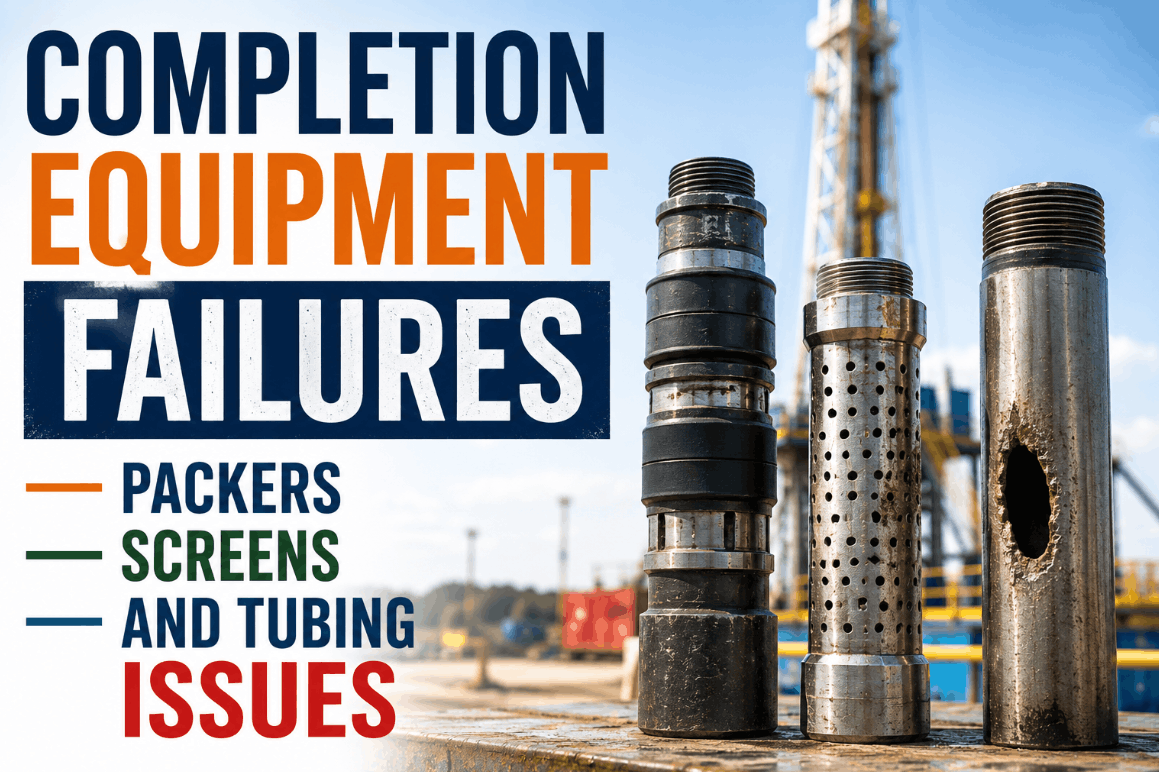
Every well completion is designed for a specific set of downhole conditions — pressure, temperature, fluid chemistry, sand production potential, and stimulation requirements — but when those conditions exceed what the completion equipment can withstand, the result is a failure that costs months of deferred production and millions in intervention expense. Production packers that leak under differential pressure, sand screens that erode or plug within the first year of production, tubing strings that develop pinhole leaks from corrosion or erosion — each of these failure modes represents a breakdown at a specific point in the completion architecture that was supposed to isolate, filter, or conduct flow for the life of the well. The failure is never random: packer seal failures follow predictable pressure and temperature cycling patterns, screen erosion follows known sand production velocity thresholds, and tubing leaks follow corrosion rate curves that can be modeled and managed. Understanding exactly how each completion component fails, what the diagnostic indicators are, and which design parameters control reliability is the prerequisite for building completions that deliver the full producing life the well was designed for. iFactory's AI-driven analytics platform supports this engineering workflow directly — with condition monitoring baselines calibrated for completion equipment degradation patterns, predictive models that identify failure precursors before the component reaches the point of functional failure, and the cross-system analytics that connect completion performance data to production and intervention records.
The True Cost of Completion Equipment Failures in Well Lifecycle
Completion equipment failures represent one of the highest-cost, lowest-visibility categories of well integrity events in the oil and gas industry. Unlike a drilling problem that is recognized and addressed within days, a completion failure often unfolds over weeks or months — a tubing leak that starts as a minor pressure anomaly and progresses to a full-bore hole, a packer that loses seal integrity gradually under thermal cycling, a sand screen that erodes one opening at a time until the formation breaks through. The cumulative cost of these failures — deferred production, intervention spread costs, lost reserves from zones that cannot be selectively isolated, and in extreme cases, well abandonment — runs into millions of dollars per event across onshore and offshore wells worldwide. Engineering teams using iFactory's completion analytics platform can Book a Demo to see how integrated failure data analysis identifies the highest-impact failure modes in their specific well stock.
Production Packer Failure Modes: Diagnosis and Prevention
Production packers are the primary isolation devices in a well completion, and their failure represents one of the highest-consequence events in well integrity management. The packer must maintain a pressure-tight seal between the tubing-casing annulus across a range of operating conditions — during stimulation, production, shut-in, and thermal cycling — while also supporting the tubing weight and withstanding the differential pressures that develop across the seal element. Understanding the specific failure modes that affect production packers is essential for designing completions that deliver reliable zonal isolation. Completion engineers evaluating packer selection and deployment strategies can Book a Demo of iFactory's completion analytics module to see how historical failure data improves packer selection decisions.
Sand Screen Selection and Erosion Management for Long-Term Reliability
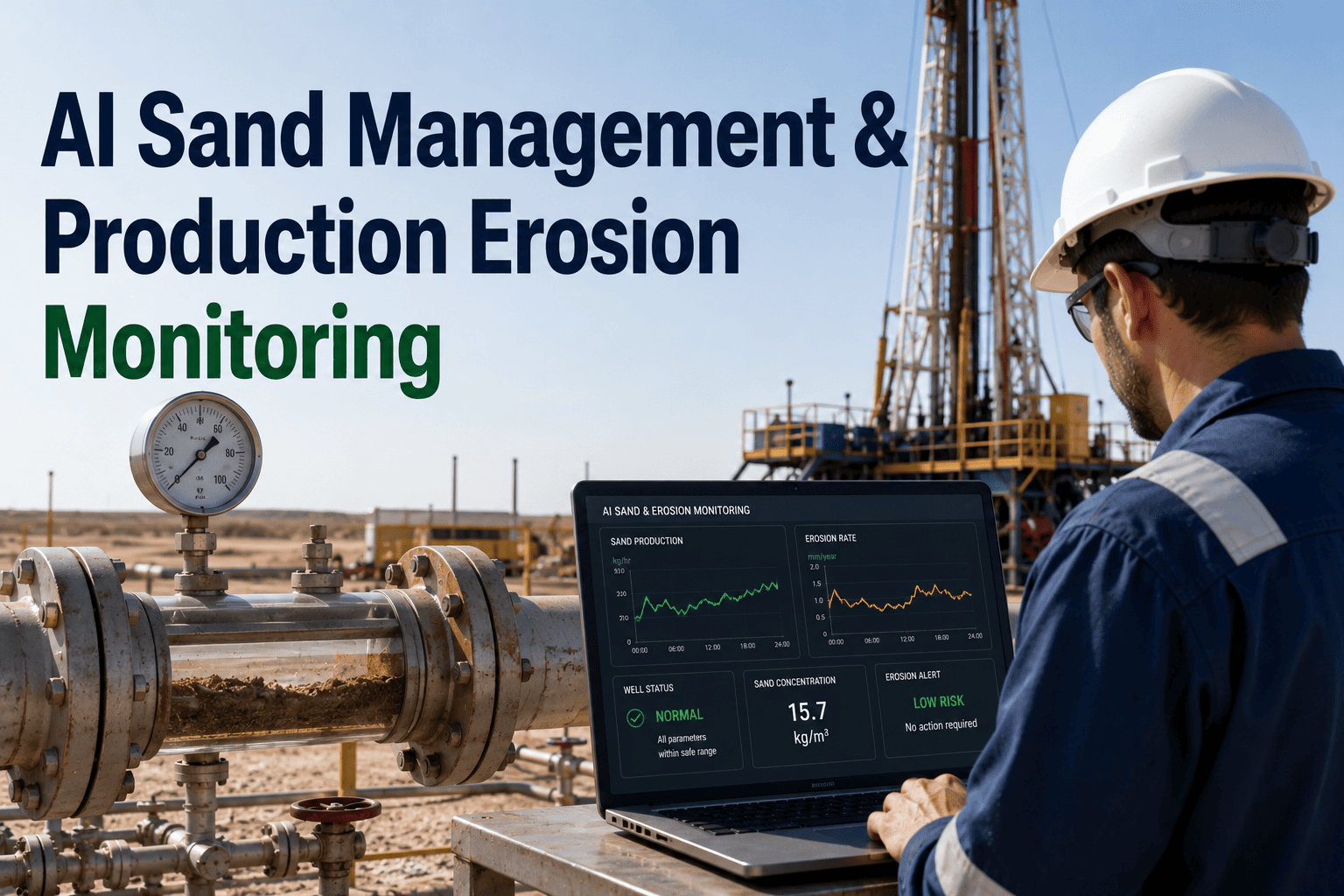
Sand screen failure is the most common completion equipment failure in unconsolidated or weakly consolidated formations — and the most expensive to remediate because the failure often results in formation sand production that damages downstream equipment and fills the wellbore with solids that must be cleaned out before the screen can be replaced. Screen selection must balance sand retention capability against plugging resistance and erosion resistance for the specific sand size distribution, production rate, and fluid chemistry of each well. Operators evaluating screen types and erosion management strategies can Book a Demo to see how iFactory's completion analytics integrates screen performance data with production history to optimize future screen selections.
| Screen Type | Sand Retention Mechanism | Erosion Resistance | Plugging Susceptibility | Best Application |
|---|---|---|---|---|
| Wire-Wrapped Screen | Gap between wire wraps sized to bridge sand particles | High — wire profile resists direct sand impact | Low — open flow area resists plugging | High-rate wells, uniform sand, cased-hole gravel packs |
| Premium Mesh Screen | Multi-layer woven mesh with controlled pore size | Moderate — mesh layers vulnerable to erosion cascade | Moderate — fines and scale can bridge across mesh openings | Open-hole completions, non-uniform sand, high-fines formations |
| Particle-Packed Screen | Resin-coated sand or ceramic particles bonded to screen jacket | Moderate-High — particle layer absorbs erosional energy | High — particle pack can be plugged by asphaltenes or scale | Heavy oil, thermal applications, formations with narrow PSD |
| Slotted Liner | Rectangular slots cut through base pipe — gap sized for sand bridging | Very High — no delicate filtration media to erode | Very Low — large open flow area per foot | Consolidated sandstones, multi-zone selective completions, low sand production risk |
Tubing and Connection Integrity: Managing the Flow Conduit
The tubing string is the primary flow conduit for produced fluids and the most maintenance-intensive component of the well completion. Tubing failures — leaks, parted connections, corrosion holes, erosion wear — account for a significant percentage of well intervention events across all well types. The failure mechanisms are well understood and predictable when the correct diagnostic data is monitored, but most operators lack the systematic data collection and analysis workflow that transforms tubing failure from reactive repair into managed risk. Engineering teams developing tubing integrity programs can Book a Demo to examine how iFactory's corrosion and erosion analytics models predict tubing remaining life from production and surveillance data.
Expert Review: Common Blind Spots in Completion Equipment Reliability
The most persistent gap I see across well completion programs is that operators treat completion equipment selection as a procurement exercise rather than a reliability engineering problem. They specify a packer based on the maximum differential pressure rating without considering the number of thermal cycles the seal element must survive. They select a sand screen based on the sand control laboratory test without verifying that the screen erosion velocity is compatible with the well's production profile over its life. They design the tubing string to API minimum wall thickness without modeling the corrosion rate that the actual produced fluid chemistry will generate over 10 or 15 years of production. The completion engineering discipline has the technical tools to address all of these failure modes — material selection models, erosion velocity correlations, corrosion rate prediction software, reliability-based design methods — but these tools are applied inconsistently. The operators who consistently get 15-plus years of failure-free completion life are the ones who treat every completion as a reliability engineering problem, not a catalog selection exercise.
Integrated Digital Engineering for Completion Equipment Reliability
The industry's completion equipment failure data, design standards, and reliability prediction methods are well established. What is often missing is the digital infrastructure that connects failure data from existing wells to the design decisions being made for new completions — creating a continuous learning loop that improves reliability with every well completed. iFactory's completion analytics platform provides a unified digital environment where packer selection, screen specification, tubing design, and flow control equipment choices are informed by the actual failure history and operating conditions of analogous completions. The platform enables engineering teams to run pre-design reliability analysis, compare equipment failure rates across operators and basins, and build a completion knowledge base that improves reliability with every well. Well engineering teams evaluating completion reliability solutions should Book a Demo to see how integrated digital engineering transforms completion equipment reliability outcomes. Visit iFactory AI to learn more about digital engineering solutions for well construction and production operations.
Conclusion: Completion Reliability Is Engineered, Not Procured
The evidence from thousands of completion failure investigations across every producing basin is consistent: the wells that achieve 15-plus years of failure-free completion life are not the wells that specified the highest-rated equipment from the catalog. They are the wells where the completion was designed as a reliability engineering problem — where packer seal cycling was modeled against the expected production and shut-in schedule, where screen erosion velocity was checked against the life-of-well production profile, where tubing corrosion allowance was calculated from the actual produced fluid chemistry rather than a rule-of-thumb corrosion rate. The technology to model, predict, and prevent completion equipment failures exists and is deployable today. The gap between the completions that fail within the first five years and those that deliver full well life without intervention is almost never a technology gap — it is an engineering workflow gap that digital integration is specifically designed to close.