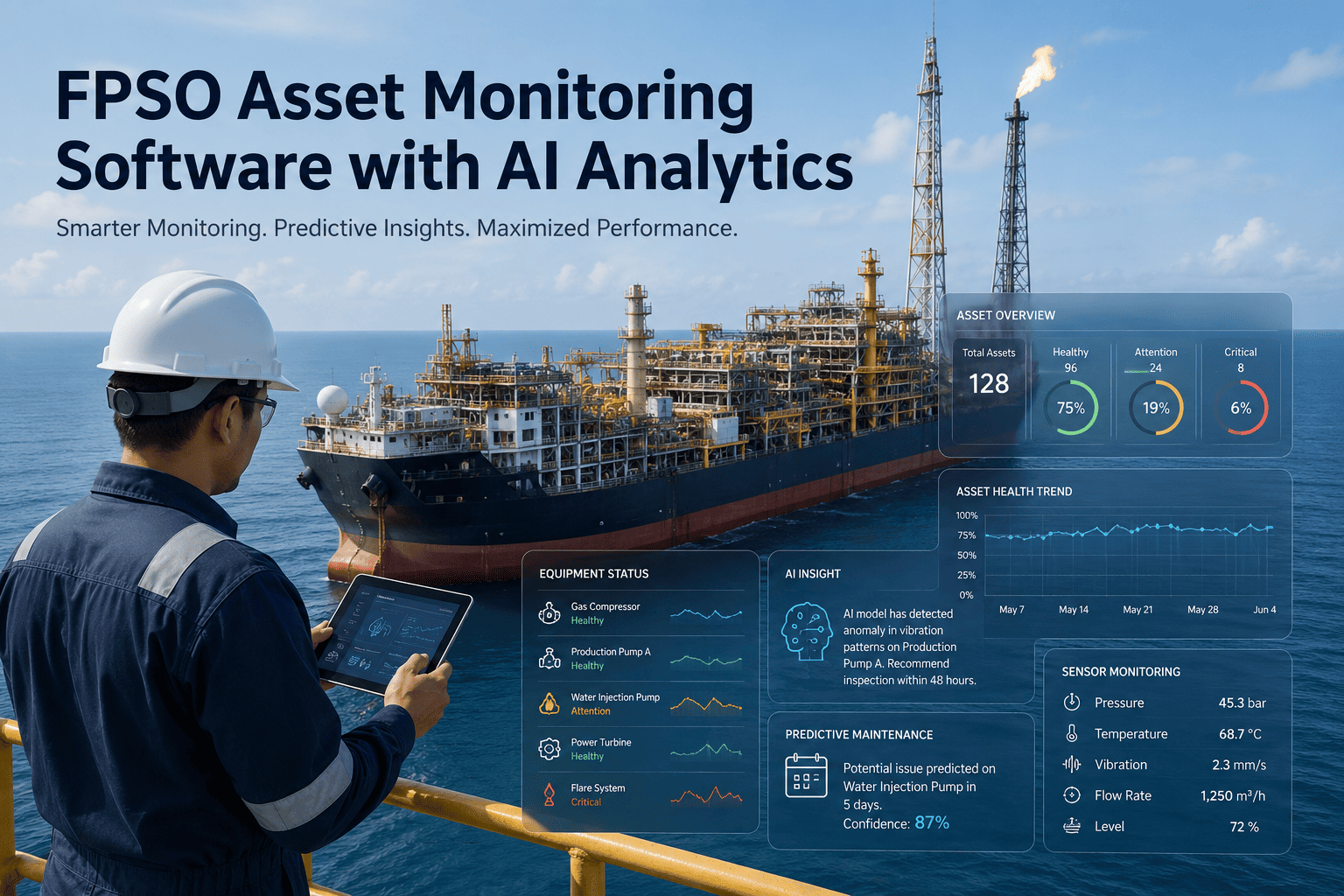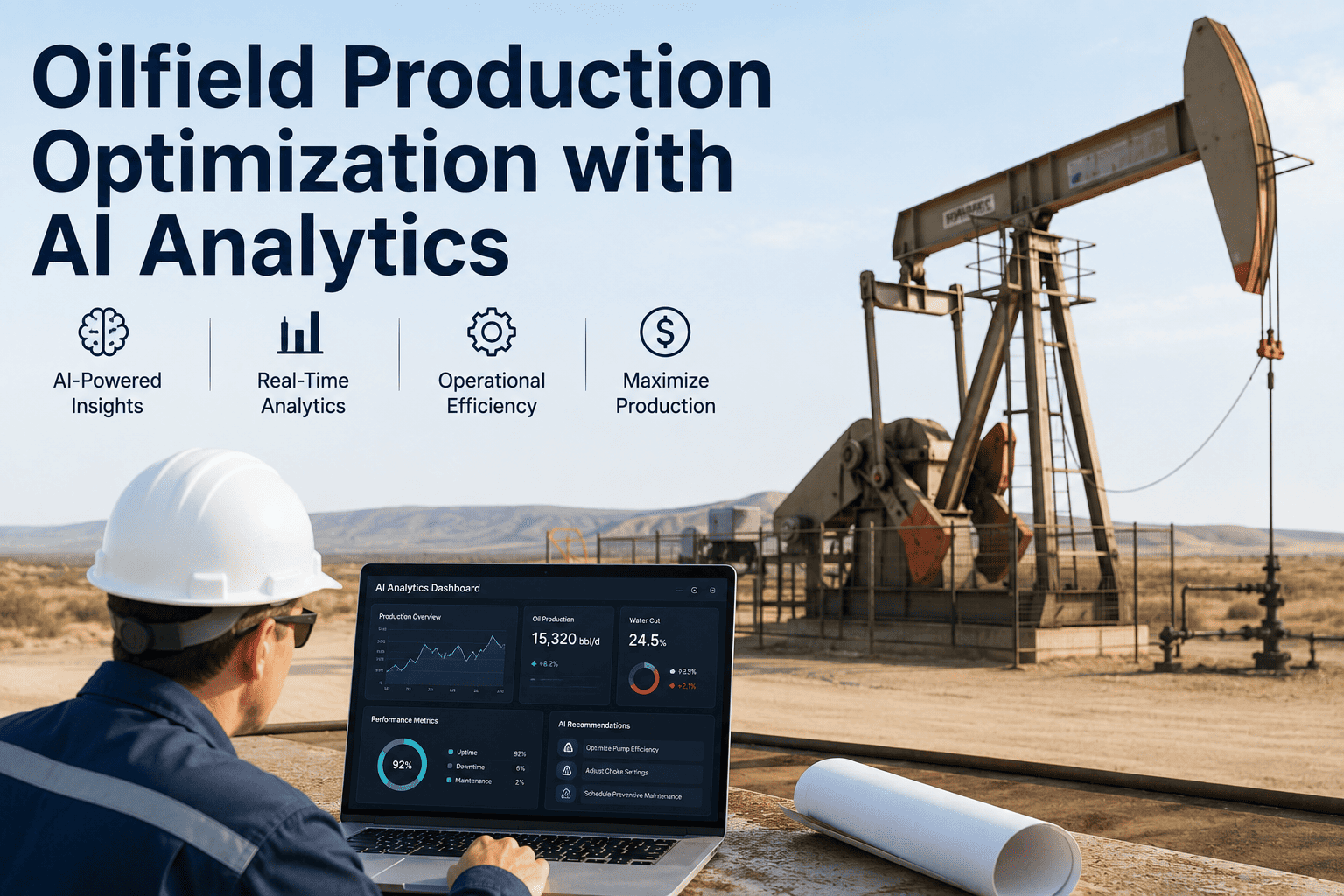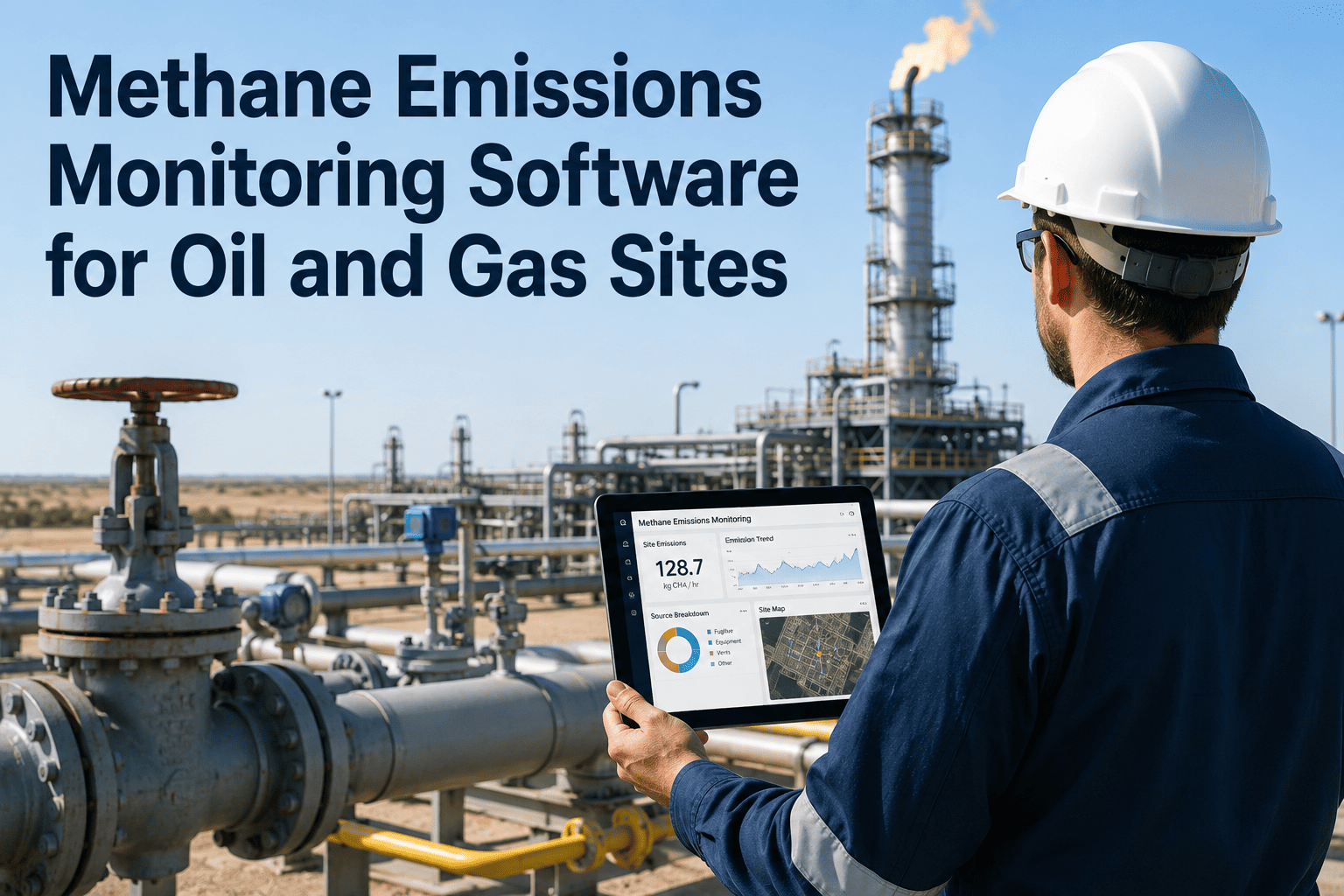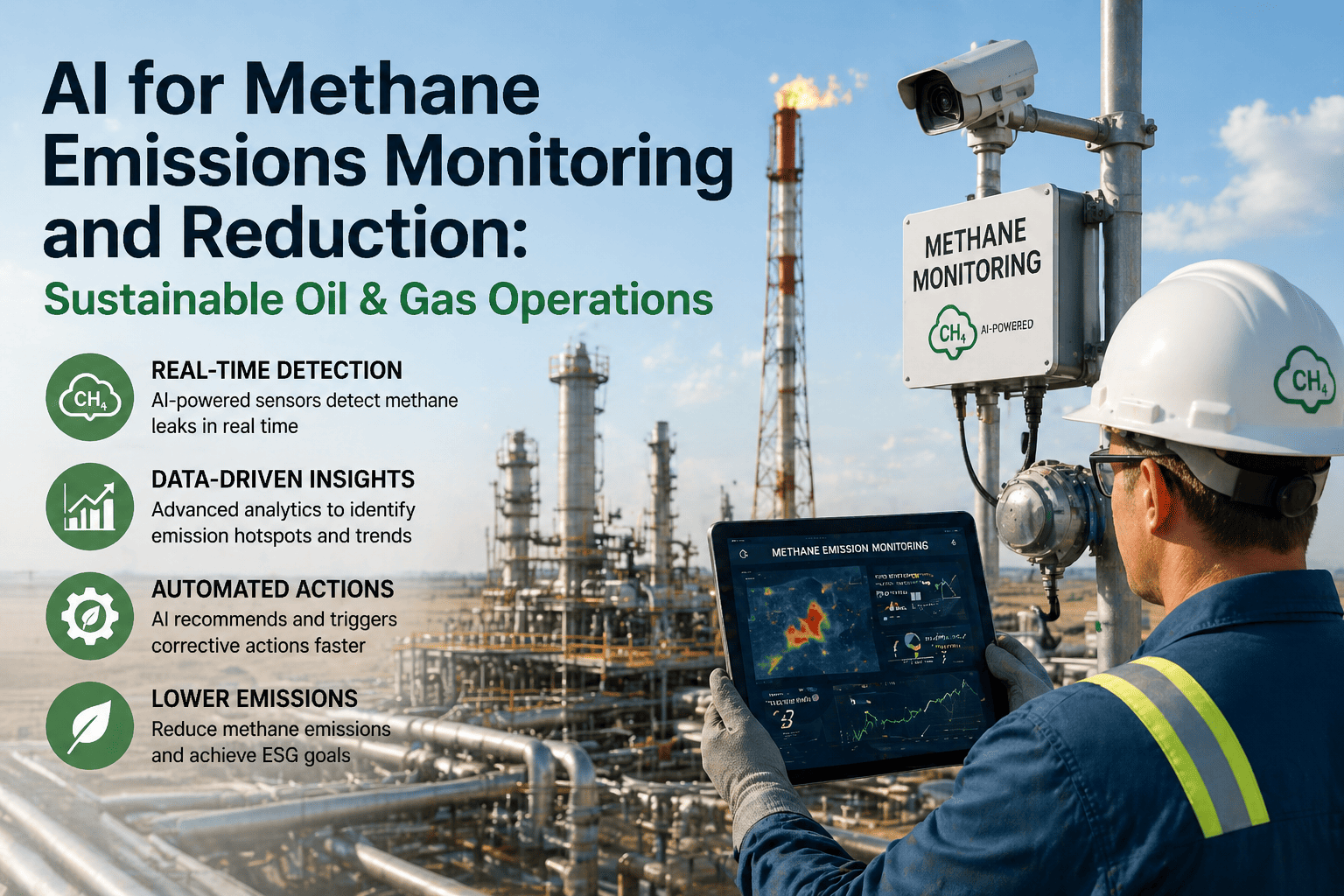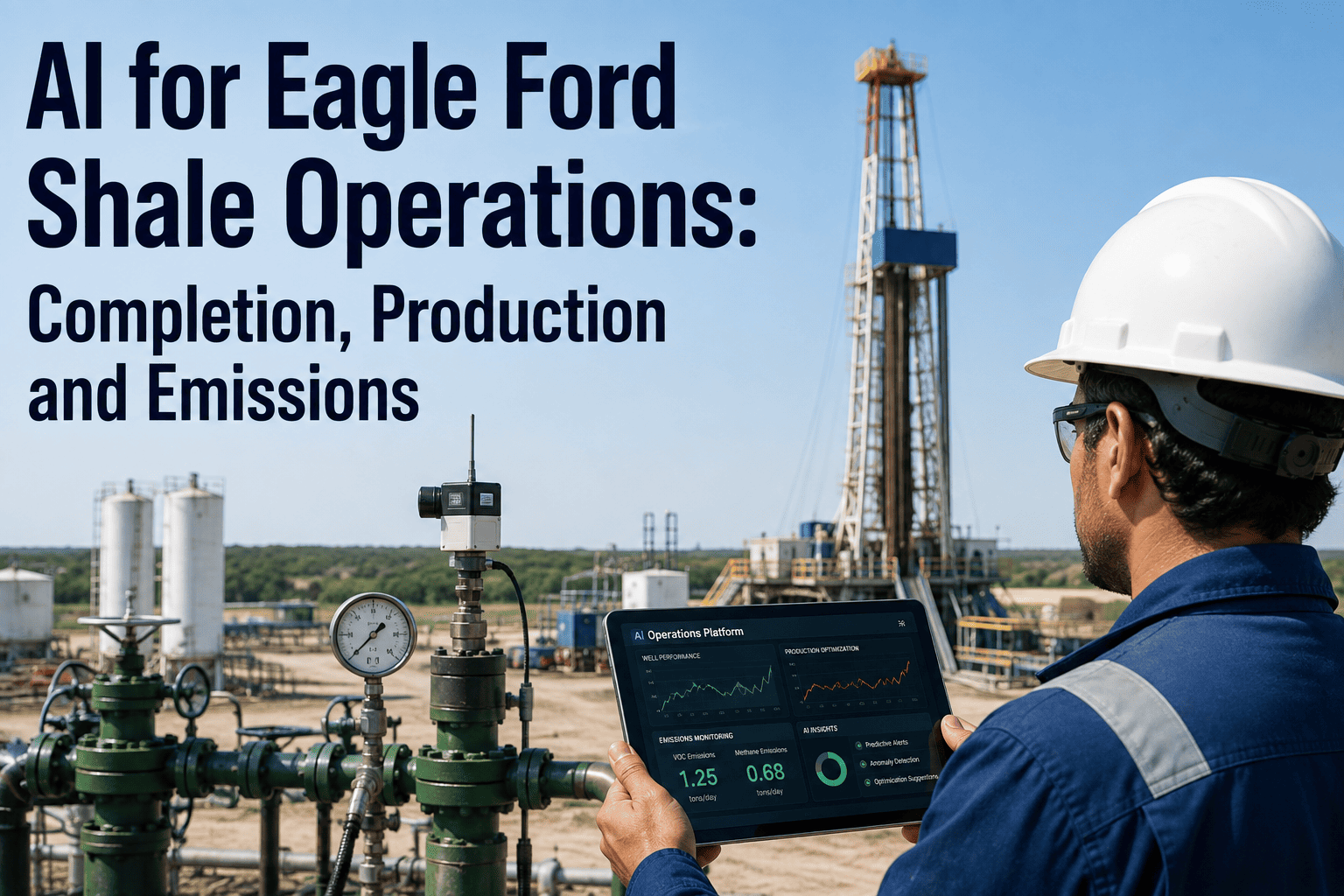
Eagle Ford operators run three different plays inside one shale trend. A well in the oil window behaves nothing like a well thirty miles south in the condensate window, and a dry gas well in Webb County has its own decline curve, its own artificial lift plan, and its own emissions profile entirely. That variability is exactly what makes the Eagle Ford hard to standardize, and why so many completion designs and production strategies that worked on offset pads quietly underperform once rock quality or fluid phase shifts even slightly. AI models trained on windowed reservoir behavior, real-time production data, and continuous emissions monitoring are how operators are closing that gap without adding headcount. Talk to support about what that looks like on your acreage.
One Shale Play, Three Windows, and a Rock Quality Map That Changes Every Few Miles
The Eagle Ford's oil, condensate, and dry gas windows sit close enough together that a single pad can straddle two of them, yet each window demands a different completion design, a different lift strategy, and a different emissions posture. iFactory applies AI across completion design, production optimization, and LDAR monitoring so every well gets treated like the window it is actually in, not the type curve it was assigned on paper.
Three Hydrocarbon Windows, One Set of Type Curves That Rarely Fits All Three
Most shale plays are described by a single dominant phase. The Eagle Ford is not. Thermal maturity increases from northwest to southeast across the trend, which means a black oil well, a volatile oil well, a condensate well, and a dry gas well can all exist within a handful of counties, sometimes on the same lease. Operators frequently apply a regional or field-level type curve to acreage that actually spans two or three windows, and the result is a completion design calibrated for the wrong fluid system on a meaningful share of wells. A frac that is sized correctly for a black oil well in the western oil window can leave gas-rich condensate wells under-stimulated, while a design tuned for condensate can waste proppant and fluid on drier acreage where the reservoir simply cannot support it.
The practical consequence is that Eagle Ford operators cannot run one optimization model across the whole position and expect it to hold up. A model needs to know which window a well sits in, how close it is to the window boundary, and how the local rock quality departs from the field average, before it can make a reliable completion or production recommendation. This is precisely the kind of high-dimensional, location-specific pattern recognition that machine learning models handle well and manual type-curve grouping does not.
Why Two Wells 1,500 Feet Apart Can Produce Completely Different Results
Rock quality across the Eagle Ford is not a smooth gradient. Total organic carbon, carbonate content, clay fraction, and natural fracture density all shift across relatively short distances, and those shifts drive real differences in frac response even between offset wells on the same pad. Operators who have drilled the play for over a decade still see wells that underperform their nearest neighbor by a wide margin with no obvious explanation from the completion design alone, because the explanation sits in the rock itself, in data that traditional geosteering logs only partially capture.
AI models built on integrated petrophysical, geomechanical, and historical completion data can resolve rock quality at a resolution that manual mapping cannot match economically. Instead of relying on a handful of offset wells to represent an entire section, the model learns the relationship between measurable rock properties and actual production outcomes across the full dataset, then applies that relationship to every new location being planned. The result is a completion recommendation that reflects the specific rock in front of the bit rather than a regional average that happens to be close enough most of the time.
Matching Frac Design to the Window and the Rock, Not the Nearest Type Curve
Completion optimization in the Eagle Ford has to account for at least four variables simultaneously: hydrocarbon window, rock quality, well spacing against existing parent wells, and whether the target zone sits close enough to the Austin Chalk to risk communication. Getting any one of these wrong shows up in the first ninety days of production, and by then the capital is already spent. AI models built for completion design in mature, multi-window plays like the Eagle Ford ingest the following inputs together rather than in isolation.
The output is not a single generic frac design applied field-wide but a proppant loading, fluid volume, and cluster spacing recommendation calibrated to the specific well being planned. Operators running this kind of AI-assisted design report meaningfully tighter variance between predicted and actual early production, which matters more in a mature play where every new location has to compete against refrac and infill economics for the same capital dollar.
Stop Applying One Type Curve to a Three-Window Play
iFactory's AI models classify every well by window, rock quality, and offset depletion before recommending a completion design, so capital goes toward wells that will actually perform instead of wells that fit the average.
Gas Lift, Choke Management, and the High-GOR Reality of Eagle Ford Wells
Eagle Ford wells typically flow naturally for six to eighteen months before declining rates require artificial lift, and gas lift is the dominant method across the play because of the formation's high gas-to-oil ratios and strong early rates. The transition window from natural flow to gas lift, and the ongoing tuning of injection volumes once a well is on lift, is where a large share of avoidable production loss happens. Under-injecting leaves oil in the wellbore, over-injecting wastes lift gas and can destabilize flow, and the correct setpoint shifts constantly as reservoir pressure declines and the fluid mix changes.
| Production Variable | Manual / Fixed-Schedule Approach | AI-Driven Optimization |
|---|---|---|
| Gas lift injection rate | Set on a periodic schedule, adjusted during field visits | Adjusted continuously against live pressure and flow data |
| Choke management | Static setpoint until a problem is noticed | Dynamic adjustment tuned to separator and flowline conditions |
| Slug flow response | Identified after separator upsets or carryover | Flagged from pattern changes before a visible upset occurs |
| Well transition timing | Based on general field experience and rule of thumb | Modeled per well from declining pressure trend data |
| Underperformance detection | Surfaces during monthly production review | Surfaces within days as the well drifts off its expected curve |
Condensate window wells deserve particular attention here, because separator pressure and choke management directly affect how much of the produced stream is captured as high-value liquid versus lost to the gas phase. A model that continuously reconciles wellhead, flowline, and separator data can catch the kind of slow setpoint drift that a periodic field visit will always miss, and in a window where condensate carries a real price premium, that difference compounds across every well on a pad every single month.
Leak Detection and Repair Under OOOOb and OOOOc: What Eagle Ford Sites Actually Have to Do
Emissions compliance is not optional overhead in the Eagle Ford, it is a standing operational requirement, and the federal framework has gotten more demanding with each successive rule. Facilities are also dealing with real safety exposure from H2S in parts of the oil window, which means monitoring programs have to cover both regulatory leak detection and worker safety at the same time. The table below summarizes how the current federal framework applies across new and existing sources.
| Rule | Applies To | Core Requirement |
|---|---|---|
| OOOOa | Sources built or modified after September 2015 | Periodic OGI surveys, generally semiannual, with defined repair timelines |
| OOOOb | Sources built, modified, or reconstructed after December 2022 | At least two OGI surveys per year, zero-emission standard for controllers |
| OOOOc | Existing sources under state implementation plans | State-directed compliance timelines reaching equipment already in the field |
| Advanced Monitoring | Any site opting into performance-based alternatives | Continuous sensors or aerial and satellite screening in place of periodic OGI |
The compliance detail that trips up a lot of programs is the repair clock. First-attempt repair windows and final verified repair deadlines run in parallel with survey frequency requirements, and a site that is current on surveys but slow on repair documentation is still out of compliance. AI-supported LDAR programs help on both sides of that equation: continuous or high-frequency monitoring surfaces leaks faster than a semiannual survey ever could, and automated repair-tracking closes the documentation gap that regulators actually audit. For sites in the western oil window with elevated H2S, the same sensor network doing methane and VOC detection can carry electrochemical H2S monitoring feeding into the site's emergency shutdown logic, so emissions compliance and worker safety run off one integrated data stream instead of two disconnected systems.
How an Eagle Ford AI Deployment Typically Rolls Out Across a Position
Deployment in a mature, multi-operator play like the Eagle Ford works best when it starts narrow and expands with proven results, rather than attempting a field-wide rollout on day one. The phased approach below reflects how most operators sequence the work across completion design, production optimization, and emissions monitoring.
Where Eagle Ford AI Deployments Go Wrong
The failure pattern in most stalled deployments is not a bad model, it is a mismatch between the model's assumptions and the reality of a mature, geologically split play. A few recurring mistakes account for most of the underperformance operators report.
Common Questions on AI for Eagle Ford Operations
Why do Eagle Ford wells need window-specific AI models instead of one field-wide model?
The Eagle Ford's oil, condensate, and dry gas windows behave differently across nearly every variable that matters for completion and production planning, from fluid phase and reservoir pressure to the ideal frac design and lift strategy. A single model trained across all three windows tends to regress toward an average behavior that does not accurately represent any one window, which shows up as systematic over- or under-prediction depending on where a given well actually sits. Window-specific models, trained on data segmented by hydrocarbon phase and rock quality, capture the local relationships that actually drive well performance. Book a demo to see how window classification works against your own well data.
How does AI improve gas lift optimization on Eagle Ford wells specifically?
Because gas lift is the dominant artificial lift method across the play due to its high gas-to-oil ratios, the injection rate on any given well needs to track declining reservoir pressure and shifting fluid composition closely to avoid leaving oil in the wellbore or wasting lift gas. AI models that continuously ingest wellhead pressure, flow, and separator data can recommend injection adjustments in near real time rather than waiting for the next scheduled field visit, which is particularly valuable during the natural-flow-to-lift transition period when conditions change fastest. Contact support to discuss integration with your existing gas lift infrastructure.
Does OOOOb or OOOOc require continuous emissions monitoring at every Eagle Ford site?
No, the baseline compliance pathway under both rules remains periodic leak detection and repair using approved methods such as optical gas imaging, with survey frequency and repair timelines depending on facility type and construction date. Continuous or advanced monitoring is available as an alternative compliance pathway that operators can choose rather than a universal mandate, and it tends to make the most sense at higher-emitting or higher-risk sites where the early-warning value outweighs the additional sensor investment. Book a demo to see which monitoring pathway fits your site mix.
How does H2S risk in the western oil window affect AI deployment decisions?
Gas in parts of Dimmit, La Salle, and Webb counties can carry H2S concentrations ranging from background levels up into the thousands of parts per million, which means any automation or AI-driven control logic deployed in those areas has to be designed alongside, not separately from, the site's safety instrumentation. Electrochemical H2S sensors and safety-rated emergency shutdown systems typically feed into the same data platform as the production optimization model, so a safety event automatically overrides any production-tuning recommendation the model would otherwise make. Contact support to review safety integration requirements for your acreage.
Is AI-driven completion design useful in a mature play where most locations are infill or refrac candidates?
It is arguably more useful in a mature play than in a fresh one, because infill and refrac wells carry parent-child depletion effects that fresh-rock type curves do not account for at all. AI models that map depletion around existing wellbores can flag frac-hit risk and recommend stage sequencing or fluid volume adjustments that reduce the performance gap infill wells typically show against their parent wells, which directly affects whether a refrac or infill location clears the economic hurdle for the capital being requested. Book a demo to see depletion-aware planning applied to your infill inventory.
Your Eagle Ford Position Already Behaves Like Three Different Plays. Your Optimization Approach Should Too.
iFactory brings window-aware completion design, real-time gas lift and choke optimization, and integrated LDAR monitoring into one platform built for the actual variability of South Texas operations, not a single type curve stretched across three windows.