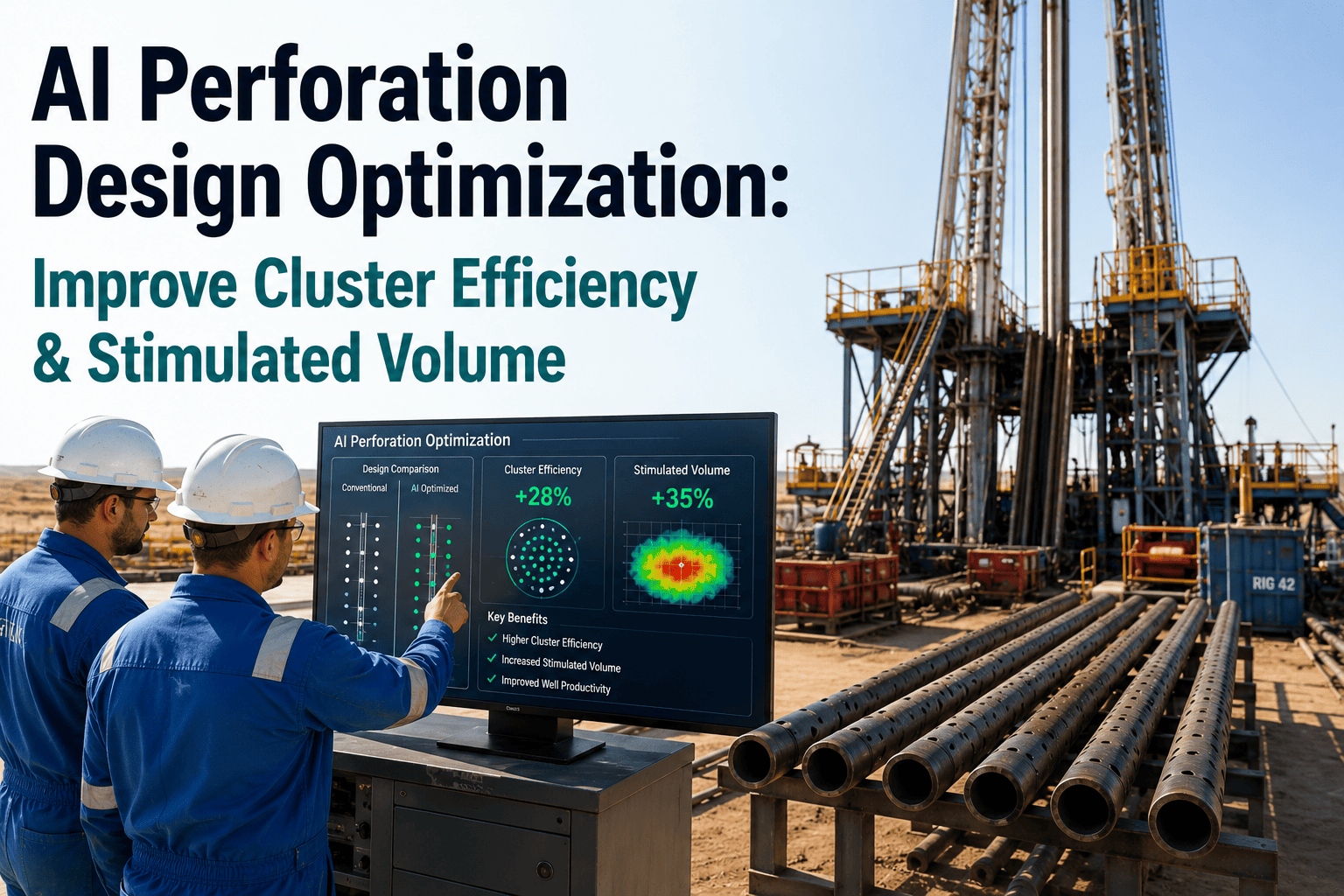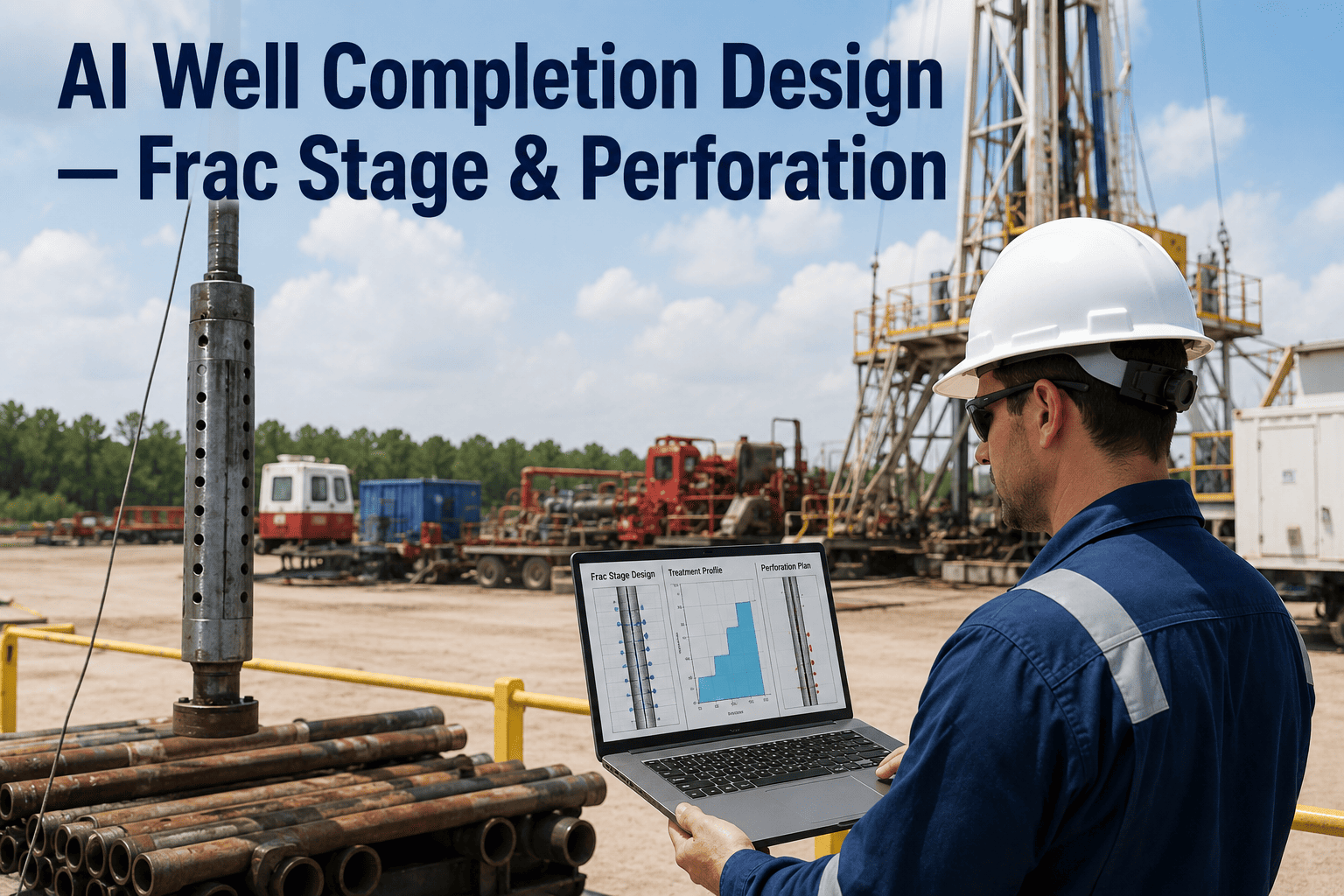
Post-fracturing production logs consistently show that a large share of perforation clusters in a multi-stage completion never contribute meaningfully to production, with published field studies putting the non-contributing share as high as 30 percent of all clusters along a horizontal well. That gap between planned stimulation and actual reservoir contact represents real capital spent on proppant, fluid, and pumping time that generates little return, and it is largely a design problem rather than a reservoir problem. Machine learning models trained on thousands of historical fracturing jobs are now closing that gap by predicting which stage spacing, cluster placement, and proppant loading combinations will actually produce before the completion is pumped. Completion engineers refining stage designs for an upcoming pad can book a demo to see how this applies to their own formation and well spacing.
Design Completions Around What Will Actually Produce, Not Just What Fits the Wellbore
iFactory applies machine learning to your historical fracturing database to predict optimal stage spacing, cluster placement, and proppant loading before pumping begins.
Why So Many Perforation Clusters Never Produce
The gap between designed stimulation and actual production is not random. It traces back to a handful of recurring design decisions that get repeated across a development program because they are convenient, not because they have been validated against production logging data on the specific lateral being completed.
Uniform stage and cluster spacing is applied across a lateral even where geomechanical properties vary significantly from heel to toe, leaving some clusters starved of stimulation energy.
Stress shadowing between closely spaced clusters causes fracture growth to concentrate in a subset of perforations while neighboring clusters barely open at all.
Proppant distribution within a stage is rarely even, so some clusters receive a fraction of the design loading while others receive a disproportionate share.
Completion designs are frequently copied from an offset well template rather than adjusted for the specific rock mechanical properties measured on the current lateral.
A Data-Driven Framework for Completion Design Optimization
iFactory's completion optimization workflow couples a machine learning production-forecast model with an optimization routine that searches the design space for the stage and cluster configuration most likely to maximize recovered volume per dollar spent. Each stage below builds directly on the last, so a weak historical database or a poorly validated forecast model will limit what the optimization search can responsibly recommend.
Digital Database of Historical Completions
Stage count, cluster spacing, proppant intensity, fluid volume, and well spacing are compiled alongside production outcomes from thousands of historical fracturing jobs across the operator's basin, creating the training foundation for every model that follows.
Machine Learning Production Forecast
Gradient-boosted and deep learning models trained on the historical database predict expected cumulative production for a candidate completion design, validated against wells the model never saw during training.
Design Optimization Search
Particle swarm and related optimization algorithms search across stage spacing, cluster count, and proppant loading combinations, using the forecast model as the evaluation function to converge on the design with the highest expected return.
Field Validation and Recommendation
The top candidate designs are checked against geomechanical constraints and completion equipment limits before being handed to the completions engineer as a ranked shortlist rather than a single black-box answer.
What the Research Shows About Completion Design Today
Published research across shale plays gives a consistent picture of both the size of the design gap and how well machine learning models can close it once enough historical completion and production data is available to train on.
Find Out How Many of Your Clusters Are Actually Producing
iFactory benchmarks your historical completion designs against production logs to show exactly where stage spacing and cluster placement are leaving recovery on the table.
Template-Based Design vs. AI-Optimized Completion Design
Most completion programs still start from an offset well template and adjust only when a problem shows up in the production logs. AI-optimized design flips that sequence, starting from the production outcome the operator wants and working backward to the stage design most likely to deliver it.
| Design Stage | Template-Based Approach | AI-Optimized Design (iFactory) | Impact |
|---|---|---|---|
| Stage Spacing | Fixed interval copied from offset wells | Adjusted per lateral based on geomechanical variation | More uniform cluster contribution |
| Cluster Placement | Evenly spaced regardless of stress shadowing | Optimized to reduce stress-shadow competition between clusters | Fewer non-producing clusters |
| Proppant Loading | Uniform design volume per stage | Stage-specific loading based on predicted response | Improved proppant placement efficiency |
| Design Validation | Confirmed only after production logging | Forecast validated against model before pumping | Fewer costly design surprises |
| Design Iteration Speed | One offset comparison at a time | Thousands of candidate designs evaluated per well | Better designs, same planning timeline |
What Changes for the Completions Team
We had always assumed our stage spacing was close to optimal because it matched what offset operators in the play were doing. Once we ran our own production logs and historical fracturing data through the model, it became clear a meaningful share of our clusters were barely contributing, and the recommended spacing adjustments on our next pad closed a real part of that gap without changing our total proppant spend.
Building Optimization Into the Existing Completion Planning Cycle
Completion design optimization delivers the most value when it is introduced early enough in the planning cycle to actually change the pump schedule, not as a post-mortem exercise after a pad has already been completed. The typical entry point is during pad-level planning, once well spacing and lateral placement are set but before the stage and cluster design is finalized with the pumping service company, giving the optimization search room to influence decisions that still have flexibility.
For operators running continuous development programs, the model improves with every pad completed, since new production logs and fiber-optic monitoring data feed directly back into the training set. This creates a compounding advantage over time: the tenth pad in a program benefits from lessons the model extracted from the first nine, something a template-based design process structurally cannot do. Operators planning an upcoming multi-well pad can book a demo to see where in their current planning cycle this analysis would fit best.
AI Well Completion Design — Frequently Asked Questions
How much historical completion data is needed to train a basin-specific model?
Research databases used for this kind of modeling have compiled several thousand historical fracturing jobs per basin, though useful models can be built with a few hundred completions if production logging data is available to validate cluster-level contribution. iFactory works with whatever historical dataset an operator already has and identifies gaps before committing to a model timeline.
Can this account for parent-child well interference in existing development areas?
Yes, well spacing and offset production history are included as model inputs specifically to capture depletion effects and frac hit risk between parent and child wells, which is one of the more common reasons a completion design that worked on an early well underperforms on infill locations. Teams navigating active infill programs can book a demo to review how this is handled for their spacing pattern.
Does the model recommend a single design or a range of options?
The optimization search typically returns a ranked shortlist of candidate designs rather than a single answer, so the completions engineer can weigh the top options against operational constraints like pump schedule, proppant availability, and cost before finalizing the program.
How does this integrate with our existing frac design and simulation software?
Model outputs are exported in standard formats compatible with common fracture simulation and completion design platforms, so the recommended stage and cluster configuration can be checked against your existing geomechanical and fracture propagation models before it is finalized for the field. Completions teams can talk to our engineer about specific software compatibility.
What data do we need to have on hand before starting a completion optimization project?
The most valuable inputs are historical stage and cluster designs, corresponding production logs or distributed fiber optic data showing cluster-level contribution, and basic rock mechanical properties from logging or core data along the lateral. Wells without production logging can still be included using surface production allocation as a lower-resolution substitute.
Stop Designing Completions Around Guesswork From Offset Wells
iFactory turns your historical fracturing database into a design engine that predicts which stage spacing and cluster configuration will actually produce before you pump.