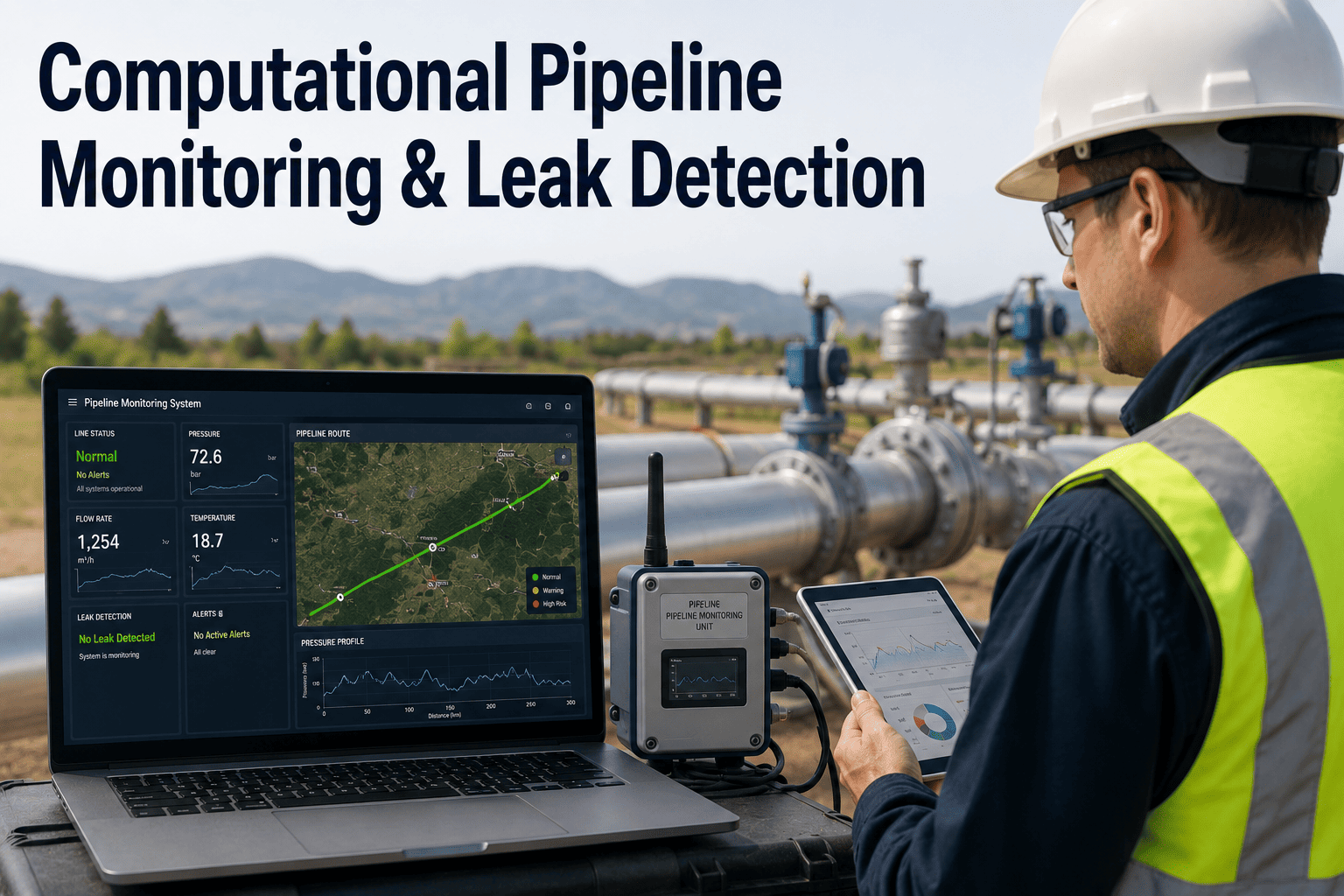
A control room dispatcher watching a CPM alarm fire for the fourth time in a shift, only to trace it back to a routine pump start again, learns something dangerous over time — to expect the next alarm to be nothing too. That learned hesitation is the real cost of a high false alarm rate: it is not the nuisance of the alarm itself, it is the seconds or minutes of doubt it buys before someone reacts to the one alarm that is not routine. Conventional CPM systems built on fixed thresholds routinely sit around a 30 percent false alarm rate, and closing that gap without losing sensitivity to real leaks is exactly the problem AI-enhanced monitoring from iFactory's pipeline surveillance platform was built to solve.
PIPELINE SURVEILLANCE · CPM · FALSE ALARM REDUCTION
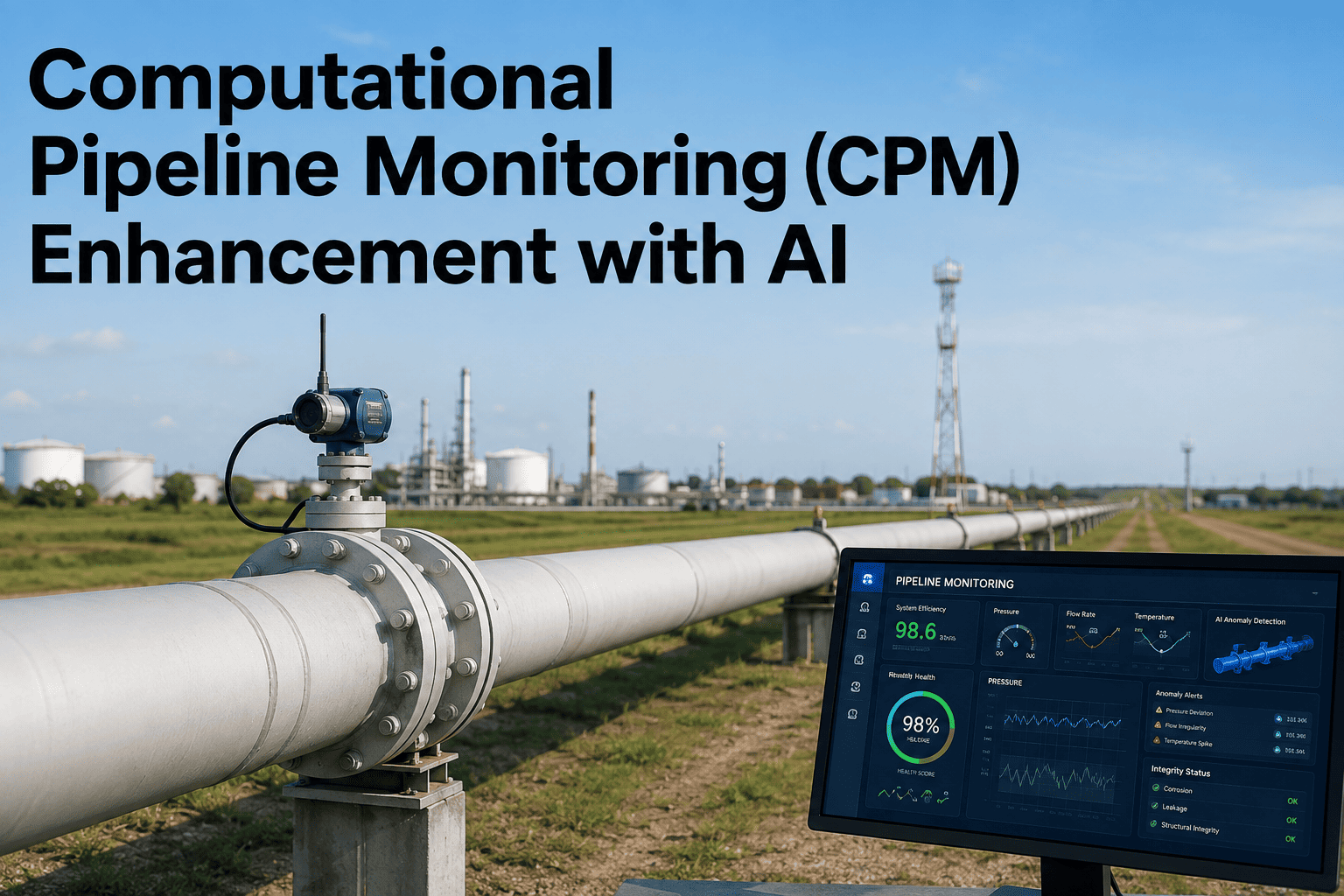
Computational Pipeline Monitoring (CPM) Enhancement with AI
Machine learning separates real leak signatures from operational transients and meter drift, cutting false alarm rates from around 30 percent to under 5 percent without sacrificing leak sensitivity.
Why CPM Systems Cry Wolf So Often
API 1130 requires operators of hazardous liquid pipelines to run a computational pipeline monitoring program, and API 1149 defines the methodology for estimating how much measurement uncertainty limits a given CPM system's ability to detect a leak with confidence. That uncertainty is the root of the false alarm problem: pressure, flow, and temperature measurements always carry some noise, and every operational event — a pump starting, a batch interface passing a meter, a valve throttling — creates a hydraulic imbalance that looks, mathematically, a great deal like the imbalance a small leak would create.
A fixed-threshold CPM system cannot tell the difference between those two imbalances without either missing real leaks or alarming on every transient. Set the threshold tight enough to catch a small leak quickly, and the system floods the control room with alarms every time normal operations shift the line's hydraulic balance. Set it loose enough to ride through transients quietly, and a genuine leak has to grow larger, and run longer, before the system will confirm it — which is precisely the outcome the 8 percent of flow in 15 minutes regulatory benchmark exists to prevent.
The consequence of that trade-off compounds over time in a way that a single false alarm rate figure doesn't fully capture. Every dismissed alarm quietly recalibrates how quickly a dispatcher moves on the next one — a phenomenon alarm management literature calls alarm fatigue, and it is well documented across process industries, not unique to pipelines. A control room that is conditioned to treat CPM alarms as noise is a control room where the response time to the one alarm that matters most has already been degraded long before that alarm ever fires. Reducing the false alarm rate is therefore not just a comfort improvement for dispatchers — it is a direct lever on how fast a real leak actually gets a response.
The Gap Between Standard and AI-Enhanced CPM
~30%
typical false alarm rate on fixed-threshold CPM systems running mass balance alone
<5%
false alarm rate achievable when machine learning classifies transients before they reach the control room
1–2%
of flow rate — the typical detection floor for mass-balance-only CPM, especially through transient conditions
8% / 15 min
the commonly referenced regulatory leak-detection benchmark for liquid hydrocarbon pipelines
Where False Alarms Actually Come From
Most CPM false alarms trace back to a handful of recurring operational and instrumentation conditions. Understanding which one is driving a given alarm is exactly the classification problem AI models are trained to solve. Individually, none of these six causes is exotic or hard to explain after the fact — a controller can usually look at a pump log and confirm what triggered a given alarm within a few minutes. The problem is scale: a busy transmission line can see dozens of these events in a single day, and a fixed-threshold system has no way to apply that same after-the-fact context automatically, in real time, before the alarm ever reaches the dispatcher.
Cause 01
Pump Starts and Stops
Starting or stopping a pump changes flow rate and pressure across the line almost instantly, producing a hydraulic imbalance that a mass balance calculation can register as a leak signature before the line settles back into steady state. On lines with frequent pump cycling, this single cause alone can account for a large share of a system's total alarm volume.
Cause 02
Batch Interface and Product Changes
When a batch interface between two products passes a meter, the change in density and compressibility temporarily disrupts the volume balance calculation, mimicking the imbalance signature a leak would create at that same point in the line — an effect that is especially pronounced on multi-product batched pipelines running frequent product changeovers.
Cause 03
Meter Drift and Calibration Error
Flow meters drift slowly out of calibration between maintenance cycles, introducing a small, persistent bias into the mass balance that a fixed-threshold system reads as a low-level ongoing leak rather than an instrumentation issue, often prompting an unnecessary and costly field inspection before the real cause is identified.
Cause 04
Thermal Expansion and Line Pack Shifts
Temperature swings change fluid volume without any actual product loss, and line pack redistributes during throttling or valve operations — both effects that a steady-state mass balance model was never designed to fully absorb, particularly on long-distance lines that see substantial diurnal or seasonal temperature variation along the right-of-way.
Cause 05
Slack Line and Two-Phase Flow Conditions
Elevation changes that create slack line or intermittent two-phase flow generate hydraulic signatures that standard mass balance algorithms struggle to model accurately, producing chronic false alarms in exactly the segments where terrain already complicates detection — often the same segments where reliable leak detection matters most because of limited right-of-way visibility.
Cause 06
Valve Throttling and Set-Point Changes
Routine valve adjustments made by a controller to manage downstream pressure create momentary flow disturbances upstream and downstream of the valve, disturbances that a fixed threshold cannot distinguish from the earliest signature of a developing leak — a distinction that matters most in the first few minutes after the change, when a genuine leak signature would still look ambiguous too.
See How Many of Your Past Alarms Were Actually Transients
iFactory runs your historical alarm log against a trained transient classifier to show exactly how many false alarms an AI-enhanced CPM layer would have filtered out, without changing your existing SCADA instrumentation.
How AI Tells a Real Leak From an Operational Transient
AI-enhanced CPM does not replace the underlying mass balance or real-time transient model — it sits alongside it, adding a classification layer that decides whether a hydraulic imbalance is a real leak signature or one of the known operational patterns that produce a similar reading. This is an important distinction for pipeline integrity teams: the leak-detection capability analysis and sensitivity estimates already validated for the base CPM method under API 1149 remain intact, since the underlying hydraulic model itself is unchanged. What changes is how confidently the system decides whether to escalate a given imbalance to a human.
Step 01
Continuous Signal Ingestion
Pressure, flow, temperature, and density data stream in from existing SCADA instrumentation at the same resolution the base CPM system already uses — no new field hardware required to start.
Step 02
Event Context Correlation
The model cross-references the imbalance signal against known operational events — scheduled pump starts, batch schedules, valve set-point changes — logged elsewhere in the SCADA and operations system, giving it context a threshold alarm never has.
Step 03
Transient Pattern Classification
A model trained on historical imbalance signatures learns the specific shape, duration, and decay pattern that each transient type produces, distinguishing them from the sustained, non-decaying imbalance pattern a genuine leak produces.
Step 04
Confidence-Scored Alarm Decision
Instead of a binary alarm, the system outputs a confidence score reflecting how closely the signature matches known transient patterns versus a genuine leak profile, letting the control room triage rapidly instead of treating every alarm identically.
Step 05
Meter Drift Tracking
Slow instrumentation bias is tracked separately from transient event patterns, flagging a meter for recalibration before its drift accumulates into a chronic low-confidence alarm pattern that erodes trust in the system.
Step 06
Continuous Retraining on Confirmed Outcomes
Every alarm that operators confirm or dismiss feeds back into the model, sharpening its transient classification accuracy specifically for that pipeline's operating pattern rather than a generic industry profile.
Standard CPM vs. AI-Enhanced CPM
The table below reflects the practical difference between a fixed-threshold CPM configuration and the same underlying hydraulic model with an AI transient-classification layer added on top, based on documented false alarm reduction outcomes across liquid pipeline monitoring programs. Each row represents a specific point of friction operators report most often when a CPM program runs threshold-only for an extended period.
CPM Enhancement Comparison
| Capability | Standard CPM | AI-Enhanced CPM |
|---|---|---|
| Typical false alarm rate | Approximately 30 percent | Under 5 percent |
| Transient handling | Fixed threshold, no differentiation | Classified by pattern and operational context |
| Meter drift detection | Manual calibration schedule only | Continuously tracked and flagged |
| Alarm presentation | Binary alarm, equal priority | Confidence-scored for rapid triage |
| Operator trust over time | Erodes as false alarms accumulate | Sustained through fewer, more credible alarms |
Where the Reliability Gains Actually Show Up
The improvements below reflect what changes operationally once an AI transient-classification layer is running alongside the existing CPM system, not a one-time tuning exercise that drifts back to baseline within a few months. Because the classifier keeps learning from confirmed and dismissed alarms as operations continue, the gains tend to hold — and often improve slightly further — well past the initial deployment window, in contrast to a manually re-tuned threshold that gradually drifts out of calibration again as pipeline operating patterns shift.
False Alarm Rate Reduction
Classifying operational transients before they reach the control room cuts the false alarm rate from roughly 30 percent down toward the single digits, without loosening the threshold that protects real leak sensitivity.
Faster Confirmed-Leak Response
When most alarms carry high confidence, dispatchers respond faster because they are no longer conditioned to expect another false positive, closing the response-time gap that alarm fatigue quietly creates.
Reduced Manual Alarm Investigation
Fewer nuisance alarms means less time spent by control room and pipeline integrity staff manually tracing each alarm back to a pump log or batch schedule to rule it out.
Stronger API 1130/1149 Documentation
A transient-classification layer with a documented confidence-scoring methodology strengthens the leak-detection capability analysis operators are required to maintain under API 1130 and API 1149.
What an AI-Enhanced CPM Rollout Needs
An AI transient-classification layer performs only as well as the historical alarm and operational data it is trained on. These are the readiness items that determine whether a deployment starts cutting false alarms quickly or spends its first months waiting on missing context data. None of these require new field instrumentation — most are data and process items that already exist somewhere in an operator's systems and simply need to be pulled together for the classifier's initial training pass.
Historical Alarm Log With Outcomes
A record of past CPM alarms along with whether each was confirmed as a real leak, a transient, or a meter issue gives the model labeled examples to learn the difference from day one.
Operational Event Logs
Pump start/stop schedules, batch interface timing, and valve set-point change logs let the model correlate imbalance events against known operational activity instead of guessing at context.
Meter Calibration History
Records of past calibration dates and drift corrections help the model separate genuine slow drift from the sudden imbalance pattern that signals an actual leak event.
Documented API 1149 Uncertainty Analysis
An existing pipeline variable uncertainty analysis gives the model a baseline for how much of the current false alarm rate is attributable to known measurement uncertainty versus classifiable transient patterns.
Control Room Sign-Off on Confidence Thresholds
Dispatchers and pipeline controllers should agree in advance on what confidence score triggers an immediate response versus a lower-priority review, so the new alarm presentation fits existing shift procedures.
A Named Owner for Model Feedback
Programs that sustain their false alarm gains have someone accountable for confirming or dismissing alarms consistently, since that feedback is what keeps the classifier accurate as pipeline operations evolve.
CPM Enhancement With AI — Common Questions
Does adding AI change our API 1130 compliance obligations?
No. API 1130 remains the governing standard for how a CPM program must be designed, evaluated, and operated, and an AI transient-classification layer sits alongside the existing mass balance or real-time transient model rather than replacing it. If anything, the added confidence-scoring methodology and improved false alarm documentation typically strengthen the leak-detection capability analysis operators maintain to demonstrate compliance, since it gives a clearer statistical basis for how alarms are being evaluated. Pipeline integrity teams generally find that regulators and auditors respond well to a documented, quantitative approach to alarm classification, since it demonstrates active management of the false alarm problem rather than passive tolerance of it.
Will reducing false alarms make the system less sensitive to real leaks?
No — that is precisely the trade-off AI classification is designed to avoid. A fixed-threshold system reduces false alarms only by loosening the threshold, which does reduce sensitivity. An AI classification layer instead learns to distinguish transient signatures from leak signatures at the existing threshold, so genuine leak sensitivity is preserved or improved while nuisance alarms are filtered out before they reach the dispatcher. In practice, many operators find their effective sensitivity actually improves, because a control room that trusts its alarms responds faster and more consistently to the ones that matter.
Do we need new field instrumentation to get these results?
In most cases, no. AI-enhanced CPM works with the pressure, flow, temperature, and density data your existing SCADA and CPM system already collects — the enhancement is a classification layer applied to that existing data stream, not a new sensor network. Teams unsure whether their current instrumentation is sufficient can review their SCADA data scope directly with iFactory's support team before committing to a deployment, and in most cases the assessment itself takes only a short data review rather than a full field survey.
How long does it take to see the false alarm rate come down?
A historical alarm log can be run against a trained classifier almost immediately to show how many past alarms would have been filtered, giving an early read on the opportunity before live deployment. In live operation, most sites see a substantial reduction within the first one to two months, with the classifier continuing to sharpen as it accumulates confirmed outcomes specific to that pipeline's operating pattern.
What happens when the model encounters a transient pattern it hasn't seen before?
An unfamiliar signature that doesn't closely match a known transient pattern is scored with lower confidence rather than automatically dismissed, which routes it to the control room for review rather than silently suppressing it. This conservative handling of unfamiliar patterns is a deliberate design choice — the system is built to err toward flagging uncertainty rather than risk missing a genuine anomaly it hasn't learned to recognize yet.
PIPELINE SURVEILLANCE · CPM · LEAK DETECTION CONFIDENCE
Give Every CPM Alarm a Reason to Be Trusted
iFactory layers AI transient classification onto your existing CPM system, cutting nuisance alarms without loosening the threshold that catches real leaks.