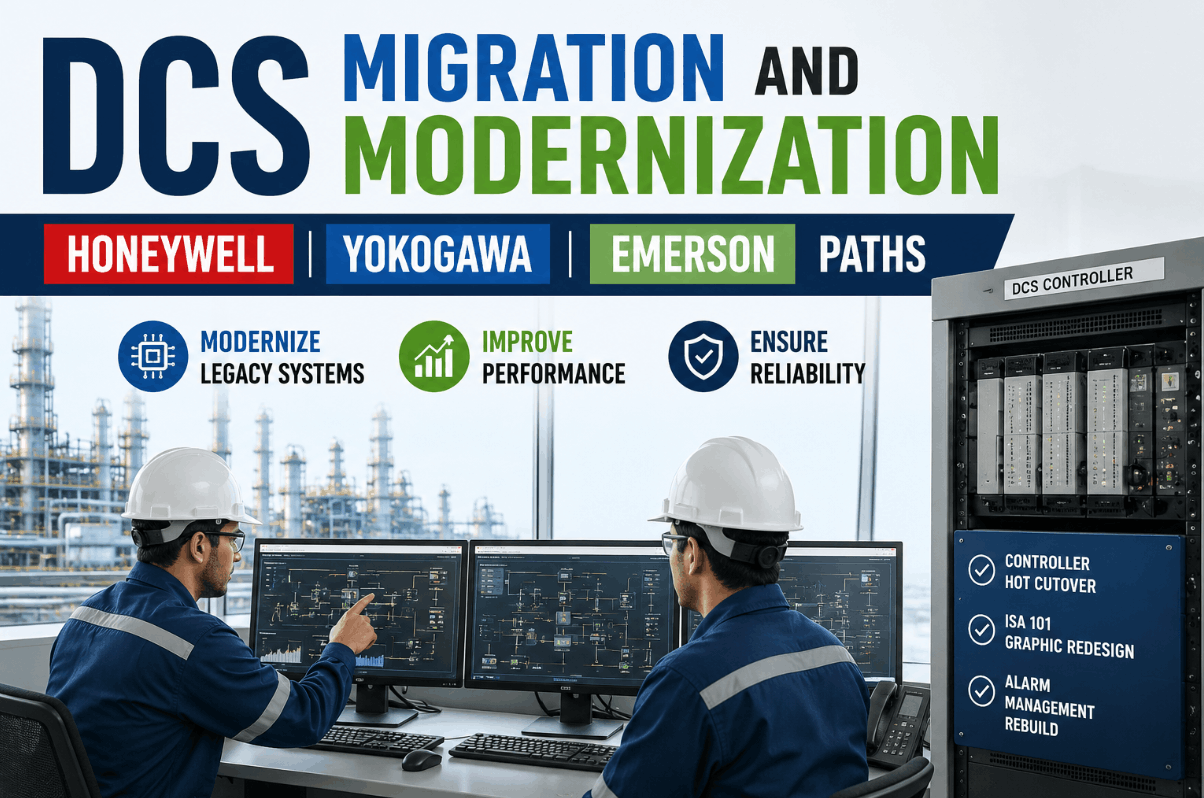
A DCS rarely fails all at once. It fails by attrition — spare controller cards that no longer ship, an operating system the vendor stopped patching years ago, an engineer who understood the legacy logic retiring without a replacement trained behind them. By the time a plant manager treats migration as urgent, the system has usually been running on borrowed time for a decade. Honeywell, Yokogawa, and Emerson each publish hardware and software end-of-life schedules for their legacy platforms — TDC3000, CENTUM CS 3000, PROVOX, RS3 — and every year a plant defers migration past that schedule, the project gets riskier and the available cutover options narrow. The technical core of a DCS migration is not the new controller hardware; it's the cutover strategy, the I/O termination approach, the alarm rebuild, and the graphics redesign that determine whether the plant goes down for a weekend or for three weeks. iFactory AI's DCS modernization framework is built around getting that planning right before the turnaround calendar forces a decision under worse conditions.
Why "End of Life" Is a Schedule, Not a Single Event
Honeywell, Yokogawa, and Emerson all phase out support for legacy DCS generations on a published timeline that moves through stages — full support, then limited support with rising spare-parts cost, then end of life where the vendor stops manufacturing replacement hardware entirely. Honeywell's TDC2000 and TDC3000 platforms followed exactly this pattern, with the company continuing support for years past the platform's practical retirement while spare parts pricing climbed steadily. A plant running on hardware in that limited-support window is not in immediate crisis, but it is accumulating risk every quarter: fewer working spares in the market, fewer engineers trained on the legacy configuration tools, and a shrinking window to plan a controlled migration instead of an emergency one. Book a Demo to map your current platform against its actual support timeline.
The Five Stages of a Controlled DCS Migration
Across Honeywell, Yokogawa, and Emerson migration paths, the same five-stage structure shows up because the underlying engineering problem is the same: preserve field wiring wherever possible, validate the new control logic before it ever touches a live process, and choose the cutover strategy that fits the plant's tolerance for downtime.
Legacy System Audit and Data Extraction
Engineering data — tag numbers, units, control schemes, alarm settings, and tuning parameters — is downloaded from the existing DCS so it can be fed into a conversion tool rather than rebuilt manually point by point.
I/O Termination Strategy Selection
Vendor-specific marshaling solutions — Yokogawa's adapter cabling for legacy termination units, Emerson's FlexConnect for Foxboro and Honeywell I/O — allow the new controller to connect to existing field wiring without re-terminating every cable, which is consistently the single largest driver of cutover duration.
Offline Logic Validation in a Virtual Environment
Control logic is built and tested in a virtual or simulated environment before it ever reaches the live system, so the configuration is proven correct ahead of the shutdown rather than debugged during it.
ISA 101 Graphics and ISA 18.2 Alarm Rebuild
Legacy graphics and alarm configurations are rebuilt against current human factors and alarm management standards rather than copied forward unchanged, since simply replicating decades-old screen layouts and alarm setpoints carries the original system's usability and alarm-flood problems into the new platform.
Cutover Execution and Post-Startup Stabilization
The chosen cutover strategy executes against the validated configuration, followed by a stabilization period where operators and engineers confirm the new system performs as expected under live conditions. Book a Demo to walk through this sequence against your platform.
Hot Cutover vs. Cold Cutover: Choosing the Right Strategy
Not every unit can tolerate the same migration approach, and the choice has direct consequences for project cost, risk, and schedule. The matrix below outlines how the two primary cutover strategies compare across the factors that actually drive the decision. Book a Demo for a custom cutover assessment of your unit.
| Factor | Hot Cutover | Cold Cutover |
|---|---|---|
| Process Continuity | Unit remains in continuous operation throughout | Unit is shut down for the duration of the cutover |
| Best Fit | Continuous processes that cannot tolerate planned downtime | Units already scheduled for a turnaround or outage |
| Risk Profile | Higher technical risk; live transition between control systems | Lower live-process risk; full visibility before restart |
| Typical Duration | Hours to a few days for the live transition window | Several days to two weeks within the turnaround window |
| Validation Approach | Extensive offline simulation required before the live switch | Can validate hardware physically before restart, not just virtually |
Why Graphics and Alarms Get Rebuilt, Not Just Migrated
The most common mistake in a DCS migration project is treating the graphics and alarm configuration as data to be copied forward rather than systems to be redesigned. Legacy displays built decades ago typically predate ISA 101 entirely, and legacy alarm databases accumulate years of unrationalized nuisance alarms that desensitize operators long before a migration project ever begins.
ISA 101 organizes the operator interface into a defined hierarchy — an overview level showing the whole unit at a glance, down through unit, group, and detail levels — replacing the ad hoc screen sprawl common in legacy systems. Alongside this, ISA 18.2 and EEMUA 191 govern the alarm rationalization process: every alarm carried into the new system is reviewed for validity, assigned a priority based on actual consequence, and documented with its cause and corrective action rather than inherited from a configuration nobody has revisited since commissioning. Skipping this step during migration means a brand-new DCS inherits the exact alarm flood and screen clutter problems the old one had — just on newer hardware. Book a Demo to see how the rationalization process fits into your project timeline.
Vendor-Specific Migration Paths: Honeywell, Yokogawa, and Emerson
Each major DCS vendor has built specific tools to reduce the friction of migrating from legacy platforms, whether the target system is their own newer generation or a competitor's platform. These tools materially change the cost and duration of a migration project.
TDC2000/TDC3000 to Experion PKS
Legacy TDC2000 and TDC3000 systems typically move to Experion PKS or Experion Orion, with engineering data conversion tools reducing the manual rebuild burden for tag and logic configuration.
Legacy CENTUM to CENTUM VP
CENTUM VP can monitor and control plants still running CENTUM V, CENTUM-XL, CENTUM CS, or CENTUM CS 3000 over a control network, and Yokogawa's virtual test function validates control logic before any hardware touches the live process.
PROVOX, RS3, and Third-Party Systems to DeltaV
Emerson's FlexConnect technology allows migration from legacy I/O — including Foxboro and Honeywell systems — to DeltaV without re-terminating field wiring, directly reducing cutover time.
Migrating Between Vendors
All three vendors support migrating from a competitor's legacy platform, using adapter cabling and termination-preserving hardware to avoid disturbing existing field wiring during the transition.
Where DCS Migration Projects Lose Time and Money
When auditing a planned or in-progress DCS migration, the recurring sources of schedule slip and budget overrun fall into a predictable set of categories. These are the specific risks that turn a planned cutover into an extended outage.
"We waited too long on our TDC3000, and by the time we finally scoped the migration, finding spare controller cards had become a genuine problem. The project that saved us wasn't the new hardware — it was the termination-preserving cutover approach that let us avoid re-pulling thousands of field wires. We also used the migration as the trigger to finally rationalize an alarm database that had grown out of control over twenty years. The new system isn't just newer hardware; it's the first time in two decades our operators have had an alarm system they can actually trust." — Senior Control Systems Engineer, U.S. Refining Operations
Conclusion: Plan the Cutover Before End of Life Forces the Timeline
A DCS migration succeeds or fails on decisions made months before the shutdown, not during it: which cutover strategy fits the unit's tolerance for downtime, whether field wiring can be preserved through adapter hardware, whether control logic gets validated offline before it ever reaches a live process, and whether the graphics and alarm configuration get rebuilt to current standards instead of copied forward unchanged. Honeywell, Yokogawa, and Emerson have each built tools to reduce the friction of these decisions, but the tools only help a project that has already done the planning work to use them well.
iFactory AI's DCS modernization framework is built to get that planning sequence right — auditing the legacy system, mapping the realistic end-of-life timeline, and structuring the cutover, graphics, and alarm rebuild before a forced outage removes the option to plan at all.
Frequently Asked Questions: DCS Migration and Modernization
What's the difference between hot cutover and cold cutover?
Hot cutover transitions control systems while the process keeps running, while cold cutover takes place during a scheduled shutdown — the right choice depends on the unit's tolerance for planned downtime.
Do we have to re-terminate all our field wiring during a migration?
Not necessarily — vendor-specific adapter and marshaling solutions can connect new controllers to existing field termination units, often cutting cutover time substantially compared to full rewiring.
Why rebuild alarms and graphics instead of copying them to the new system?
Legacy graphics and alarm databases usually predate ISA 101 and ISA 18.2 standards entirely, and copying them forward carries the original system's alarm-flood and usability problems into otherwise new hardware.
Can we migrate to a different DCS vendor than the one we currently have?
Yes — all three major vendors support cross-vendor migration with tools designed to convert engineering data and preserve field wiring regardless of the originating platform.
How early should migration planning start before a platform reaches end of life?
Planning should begin while the platform is still in its limited-support phase, since waiting until full end of life narrows available cutover options and increases spare-parts risk during the transition.