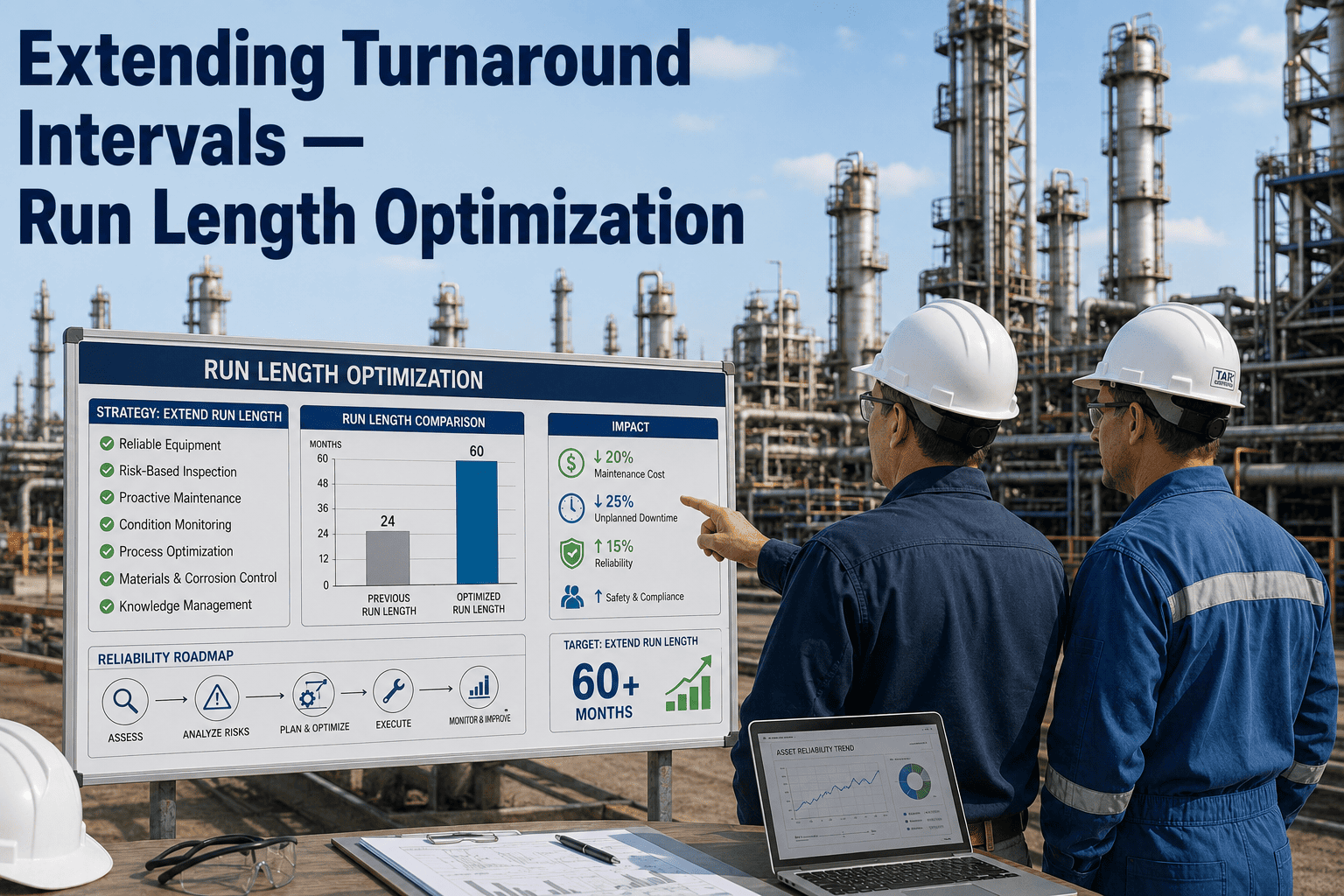
Extending a turnaround interval from four years to six or more is not simply a decision to defer maintenance. It is a fundamental shift in how a plant manages degradation, monitors equipment health, and allocates capital between scheduled events. The financial incentive is clear when a single avoided turnaround can save thirty to eighty million dollars in direct costs and another fifty to two hundred million in lost production, but the technical requirements for safely extending that interval are frequently underestimated by management teams focused on the savings number rather than the engineering work that makes it achievable. Reliability engineers evaluating whether their equipment base can support an extended run can book a demo to see how condition-based tracking replaces calendar-based shutdown triggers.
RUN LENGTH OPTIMIZATION · TURNAROUND INTERVAL EXTENSION · OIL & GAS
Extending Turnaround Intervals: The Engineering Behind 6+ Year Run Lengths
Moving from a four-year to a six-year or longer turnaround cycle requires more than a management directive. It requires a documented technical basis, upgraded materials, continuous monitoring, and a risk framework that identifies exactly which equipment limits the interval and what must change to push that limit further.
The Industry Shift from Calendar-Based to Condition-Based Intervals
For decades, refinery and upstream turnarounds were scheduled on fixed four-year or five-year cycles driven by insurance requirements, industry convention, and the limitations of inspection technology that made it impossible to reliably assess equipment condition while online. That model is being replaced by condition-based interval setting, where the actual degradation rate of critical equipment determines when a shutdown is required rather than an arbitrary calendar date. The progression below shows how plants typically move through this transition.
Era 1
Fixed 4-Year Cycle
Turnaround scheduled every four years regardless of equipment condition. Inspection data collected during the shutdown is used to plan the next shutdown four years later. No online monitoring informs the interval decision. This model is still common in plants without digital reliability infrastructure.
Calendar-Driven
Era 2
Extended 5-6 Year Cycle
Plant extends to five or six years based on a one-time engineering study that identifies equipment upgrades and monitoring additions needed to support the longer run. The study is often commissioned for a single extension cycle and may not be updated for the next one, creating a knowledge gap that compounds with each subsequent extension.
Study-Driven
Era 3
Dynamic 6-8 Year Cycle
Continuous condition monitoring feeds a living risk model that reassesses the interval boundary every quarter. Equipment degradation rates are tracked against predicted curves, and the turnaround date is set or adjusted based on when the highest-risk component is projected to reach its replacement threshold rather than a fixed future date.
Condition-Driven
The Financial Case for Interval Extension
The direct cost avoidance of skipping a turnaround is straightforward to calculate, but the full financial picture includes production revenue retention, contractor mobilization savings, material procurement savings, and the opportunity cost of the engineering and management hours that would have been consumed by a shutdown that did not happen. The following breakdown quantifies the financial impact for a typical mid-size refinery turnaround.
$30-80M
Direct Turnaround Cost Avoided
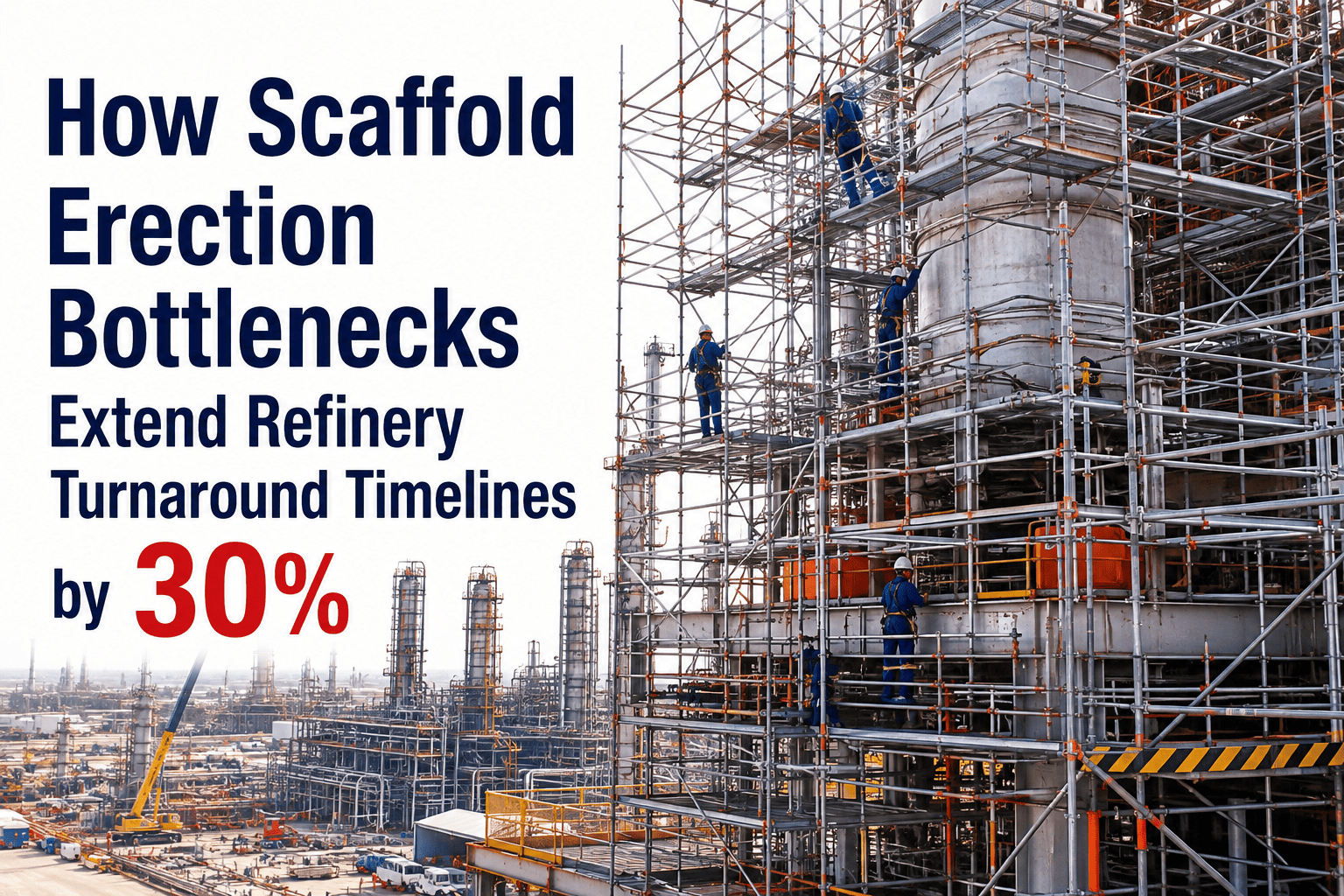
Contractor labor, scaffolding, cranes, consumables, and project management costs that are entirely eliminated when a turnaround event is removed from the calendar
$50-200M
Production Revenue Retained
Gross margin lost during the shutdown window, typically twenty-one to forty-five days of offline time depending on unit configuration and turnaround scope
$5-12M
Procurement & Mobilization Savings
Long-lead material orders, contractor pre-mobilization costs, scaffold pre-build, and temporary facility setup that do not need to be repeated for the deferred event
$3-8M
Indirect Cost Avoidance
Engineering hours for scope development, planning team labor, training costs for new contractor personnel, and insurance premium adjustments associated with the turnaround window
Four Technical Pillars of Run Length Extension
Every successful interval extension program is built on four technical pillars that must be addressed simultaneously. Skipping any one of them creates a vulnerability that will eventually manifest as an unplanned shutdown, which costs significantly more than the turnaround that was deferred. The pillars below represent the minimum engineering investment required to support a credible extension from four years to six years or beyond.
Pillar 1
Materials Upgrades
Carbon steel components in corrosive service are replaced with upgraded alloys that have documented degradation rates supporting the target interval. This includes replacing carbon steel exchanger tubes with stainless or duplex alloys in high-corrosion circuits, upgrading vessel internals to corrosion-resistant alloys, and substituting higher-grade gasket and packing materials that maintain seal integrity beyond the original four-year design life. The materials upgrade scope is determined by correlating inspection findings from previous turnarounds with process conditions to identify which components are degrading at rates that would limit a longer run.
Pillar 2
Online Monitoring Deployment
Continuous corrosion monitoring, vibration monitoring, acoustic emission testing, and online thickness measurement systems are installed at equipment locations identified as interval-limiting by the engineering study. These systems replace the periodic thickness readings that were previously only available during turnarounds with real-time degradation data that allows the reliability team to track whether actual corrosion rates match the predictions used to justify the extension. Without this monitoring, the extension is based on assumptions that cannot be verified until the next shutdown, which defeats the purpose of condition-based interval setting.
Pillar 3
Process Condition Management
Operating parameters that drive accelerated degradation are identified and controlled within tighter limits during the extended run period. This may include reducing sulfur content in feedstock to slow corrosion in sulfur-laden circuits, managing chloride levels to prevent stress corrosion cracking in stainless steel systems, controlling temperature excursions that accelerate creep in high-temperature piping, and adjusting acid gas loading to stay within the corrosion allowance budget established by the extension study. Process engineers must understand that operating flexibility is reduced during an extended run because the degradation margin is thinner.
Pillar 4
Risk-Based Inspection Enhancement
The risk-based inspection program is updated to reflect the extended interval, with inspection frequencies increased for equipment whose risk ranking changes when the exposure time lengthens. Equipment that was low-risk over a four-year cycle may become medium or high-risk over a six-year cycle, requiring additional online inspection techniques such as phased array ultrasonic testing, guided wave testing, or digital radiography during the run. The RBI reassessment is not a one-time activity but a continuous process that adjusts inspection plans as monitoring data reveals whether degradation rates are following predicted trends or deviating from them.
Equipment-Specific Extension Strategies
Not all equipment in a refinery or upstream facility can be extended by the same amount. Some components reach their degradation limit at four years regardless of materials upgrades, while others can reliably run for eight to ten years with proper monitoring. The table below maps common equipment categories to their typical extension constraints and the strategies required to push each one beyond the standard four-year interval.
| Equipment Category |
Standard Interval |
Extension Constraint |
Strategy to Extend |
| Atmospheric Distillation Columns |
4-5 years |
Tray corrosion and shell thinning in wash zones |
Upgrade tray materials to duplex stainless, install online thickness monitoring at wash zone elevations |
| Heat Exchangers (Corrosive Service) |
4-6 years |
Tube bundle thinning and pitting in cooling water and process sides |
Upgrade to duplex or super duplex tubes, install corrosion coupons and ER probes on process side |
| Hydroprocessing Reactors |
4-6 years |
Internal component degradation and catalyst deactivation |
Upgrade internals to higher-alloy materials, optimize catalyst cycle to align with target interval |
| High-Temperature Piping Systems |
4-5 years |
Creep damage accumulation and graphitization in carbon steel |
Replace carbon steel with Cr-Mo alloy piping, install creep monitoring points at high-risk locations |
| Fired Heaters |
4-5 years |
Tube creep and fireside corrosion in convection sections |
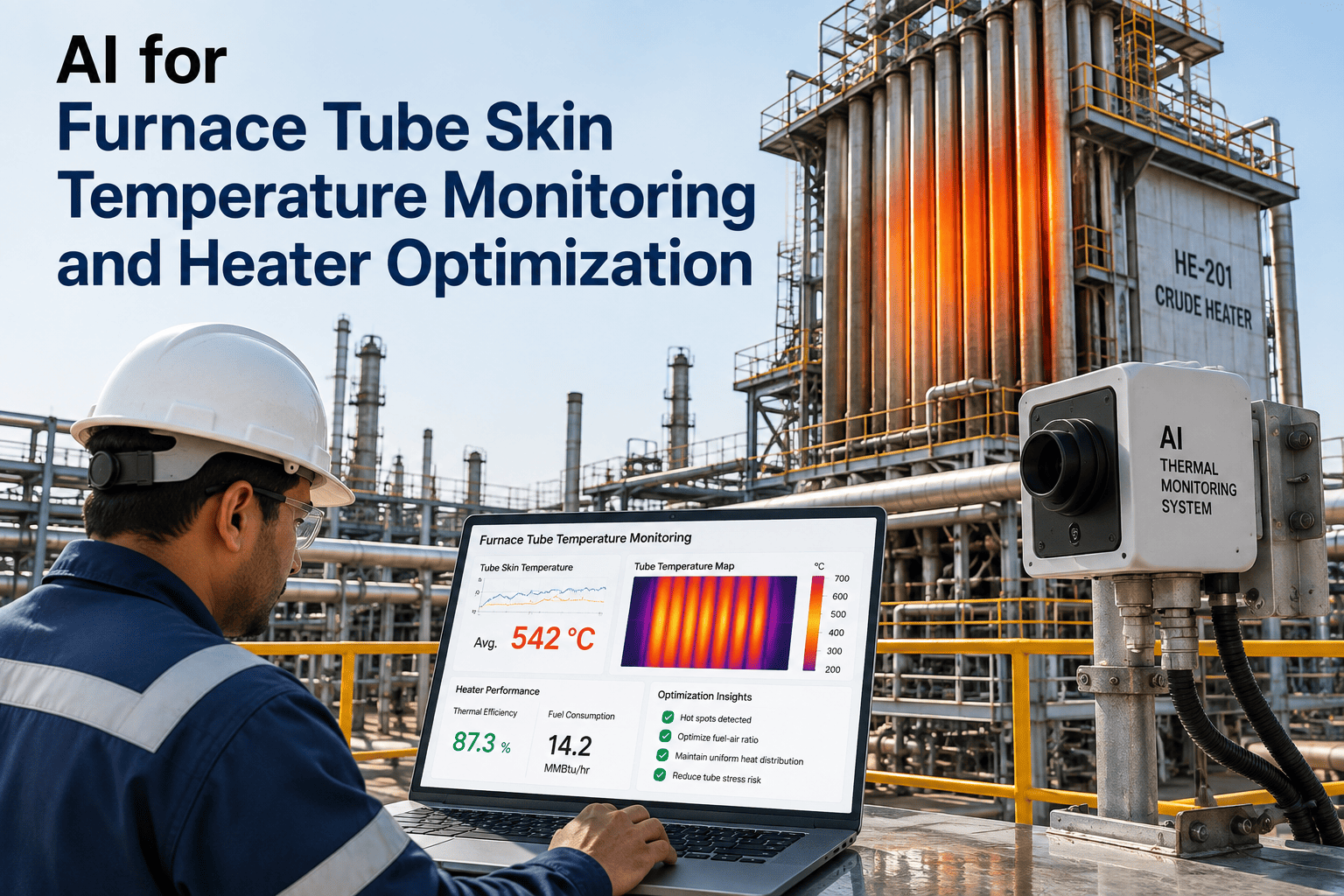
Upgrade convection tube materials, install tube skin thermocouples and online flux monitoring |
| Compressors and Turbines |
4-6 years |
Rotor fatigue life, bearing wear, and seal degradation |
Upgrade to magnetic bearings, install continuous vibration and performance monitoring |
| Storage Tanks and Spheres |
10-20 years |
Bottom plate corrosion and shell floor weld degradation |
Already long intervals, focus on enhanced bottom mapping and cathodic protection during extended run |
| Relief Valves and Safety Systems |
4-6 years |
Seat leakage, spring relaxation, and corrosion of internal parts |
Upgrade to pilot-operated valves with extended test intervals, install online monitoring where applicable |
RUN LENGTH OPTIMIZATION · INTERVAL EXTENSION
See Which Equipment Is Limiting Your Turnaround Interval
A condition-based assessment of your fleet against degradation curves will identify the specific components dictating your current cycle length.
Risk Escalation at Each Interval Extension Stage
Extending a turnaround interval does not increase risk uniformly across all equipment. Risk escalates non-linearly because certain degradation mechanisms accelerate as equipment ages, and the probability of multiple independent failures occurring within the same extended run period increases combinatorially. The risk matrix below maps how the failure probability and consequence profile change at each extension stage, and what must be done at each stage to maintain the risk within acceptable bounds.
4-Year Baseline
5-6 Year Extension
7-8 Year Extension
Corrosion-Driven Failure
Low probability, managed by existing corrosion allowance and inspection during turnaround
Moderate probability, requires online monitoring to verify corrosion rate assumptions hold true
Elevated probability, corrosion allowance may be consumed, requires material upgrades and continuous monitoring
Creep-Driven Failure
Low probability, creep damage accumulation is minimal within four-year window for most materials
Moderate probability, creep monitoring points needed at highest-temperature locations
Elevated probability, creep life fraction may exceed 50% at some locations, requiring alloy upgrades
Fatigue-Driven Failure
Low probability, cycle count is well within design fatigue life for standard cycling frequency
Low to moderate, fatigue life fraction increases but typically remains within design limits
Moderate probability at high-cycle locations, requires fatigue screening of critical welds
Mechanical Degradation
Low probability, seals, bearings, and wear components are replaced during turnaround
Moderate probability, some components may reach end of life before next scheduled shutdown
Elevated probability, requires mid-run intervention or upgraded components with longer rated life
Catalyst and Process Performance
Low risk, catalyst cycles are typically designed to match four-year turnaround intervals
Moderate risk, catalyst may require mid-run regeneration or feedstock limitation to extend life
Elevated risk, catalyst end-of-life likely before shutdown, requires online regeneration or early replacement
Low Risk: Standard practices sufficient
Moderate Risk: Additional monitoring or upgrades required
Elevated Risk: Material upgrades and continuous monitoring mandatory
Monitoring Requirements During Extended Runs
The monitoring program for an extended run is fundamentally different from the monitoring program for a standard four-year cycle. During a standard cycle, monitoring primarily provides confirmation that equipment is performing as expected between known inspection points. During an extended run, monitoring must provide early warning of degradation that exceeds the predicted rate used to justify the extension, because there is no upcoming turnaround to catch deviations. The following grid maps each monitoring type to its application in an extended run program.
Corrosion ER Probes
Electrical resistance probes installed at critical circuit locations to provide continuous metal loss rate data. During an extended run, ER probe data is compared against the corrosion rate assumptions in the extension study at least monthly. Any sustained deviation above the predicted rate triggers a reassessment of the remaining corrosion allowance and may require a mid-run inspection or operating condition change to bring the rate back within the predicted band.
Online Ultrasonic Thickness
Permanent ultrasonic thickness transducers installed at fixed locations on piping and vessel shells to provide periodic thickness readings without requiring shutdown access. These systems typically take readings on a daily or weekly cycle and trend the data to detect thinning that is accelerating beyond the linear rate assumed in the extension study. The data is most valuable when it covers multiple locations across the same circuit so that localized corrosion patterns can be identified and investigated.
Vibration Monitoring Systems
Continuous vibration monitoring on rotating equipment including compressors, pumps, and turbines to detect bearing degradation, rotor imbalance, and alignment changes that develop over the extended run period. Vibration trends are analyzed against baseline signatures established at the start of the run, and any change in the trend slope that suggests accelerating degradation triggers a diagnostic investigation before the failure threshold is reached.
Acoustic Emission Monitoring
Acoustic emission sensors applied to pressure vessels and piping at locations susceptible to stress corrosion cracking or hydrogen-induced cracking to detect active crack growth in real time. This technology is particularly valuable during extended runs because cracking mechanisms are difficult to predict with corrosion rate models alone and can progress rapidly once initiated. Acoustic emission monitoring provides the early warning that cracking is active before it reaches a critical size.
Process Condition Monitoring
Continuous monitoring of process parameters that drive degradation, including sulfur content, chloride content, naphthenic acid number, pH, temperature profiles, and flow velocities. During an extended run, the allowable operating window for these parameters is typically narrower than during a standard cycle, and the monitoring system must flag excursions in real time so that operators can correct them before cumulative damage accumulates beyond the extension study assumptions.
Creep Monitoring Systems
Creep strain gauges or replica testing at high-temperature piping and heater tube locations to track creep damage accumulation against the predicted life fraction in the extension study. Creep damage is irreversible and accelerates with time, making it one of the most important monitoring inputs for extensions beyond six years where the creep life fraction may exceed fifty percent at some locations.
Investment Required vs Value Recovered
Interval extension is not free. The materials upgrades, monitoring systems, engineering studies, and enhanced inspection programs required to support a credible extension represent a significant upfront investment that must be weighed against the avoided turnaround cost. The following comparison shows the typical investment profile for extending a mid-size refinery turnaround from four years to six years, and the payback calculation that makes the business case.
Investment Required for 4-to-6 Year Extension
Materials upgrades during current turnaround
$8-15M
Online monitoring system procurement and installation
$2-5M
Engineering study and risk assessment
$1-3M
Enhanced online inspection during extended run
$1-2M
Process control modifications and operating limits
$0.5-1M
Total Extension Investment
$12.5-26M
Value Recovered from One Avoided Turnaround
Direct turnaround cost avoidance
$30-80M
Production revenue retention during shutdown window
$50-200M
Procurement and mobilization savings
$5-12M
Indirect cost avoidance
$3-8M
Monitoring system residual value for future extensions
$1-2M
Total Value Recovered
$89-302M
Typical Return on Extension Investment: 4x to 12x depending on plant size, turnaround complexity, and production margin during the deferred shutdown window.
Readiness Assessment: Can Your Plant Extend?
Before committing to an interval extension program, the reliability team must honestly assess whether the current equipment condition, data quality, and organizational capability support the technical requirements of a longer run. The following readiness criteria represent the minimum thresholds that must be met before an extension study can produce a credible result. Plants that do not meet these thresholds should invest in closing the gaps before attempting an extension, because a study based on insufficient data will either overstate the safe interval or require such conservative assumptions that the extension is too small to justify the investment.
Requirement Met
Complete inspection records from at least two previous turnarounds with thickness data mapped to specific circuit locations and process conditions at the time of inspection
Requirement Met
Process data historian with at least four years of continuous operating data including compositions, temperatures, pressures, and flow rates at the circuit level
Requirement Met
Risk-based inspection program current and up to date with all equipment ranked and inspection plans aligned with current operating conditions
Requirement Met
Corrosion circuits documented with corrosion rate data from previous turnarounds and any online monitoring that is currently installed
Requirement Met
Failure mode and effects analysis or similar systematic review completed for all equipment that would be interval-limiting in an extended run scenario
Requirement Met
Management commitment to fund materials upgrades identified by the extension study during the current turnaround rather than deferring them to a future event
Reliability Engineers Ask
How do we identify which equipment limits our turnaround interval?
The interval-limiting equipment is identified by correlating degradation rates from previous turnaround inspection data with the remaining corrosion allowance or creep life fraction for each component. The component that will reach its minimum acceptable thickness or maximum allowable creep damage soonest is the interval limiter. This analysis must be done at the circuit level rather than the unit level because degradation rates vary significantly within a single process unit depending on local temperature, composition, and flow conditions. Digital condition tracking platforms accelerate this analysis by maintaining degradation trends for every monitored location and calculating the projected remaining life at each point, making the interval-limiting equipment visible without manual spreadsheet calculations. Teams can
book a demo to see how this analysis is automated.
What happens if monitoring data shows degradation is faster than predicted during the extended run?
When monitoring data deviates from the predicted degradation rate, the extension program must have a pre-defined response protocol that specifies the threshold for triggering a reassessment, the data required for the reassessment, and the decision options available ranging from adjusting operating conditions to scheduling a mid-run inspection to bringing the turnaround forward. The critical requirement is that this protocol exists before the extended run begins, because attempting to develop a response plan while degradation is accelerating inevitably results in delayed decisions and increased risk. The response protocol should be documented in the extension study and approved by the same authority that approved the extension itself, so that the turnaround manager has clear authority to act without requiring a new management approval cycle.
Can we extend the interval for some equipment but not others within the same unit?
Yes, and in practice this is the most common approach because the degradation rates across equipment in a single unit vary widely. A distillation column may have six years of remaining corrosion allowance while an associated heat exchanger in a high-corrosion circuit may only have four years. The solution is to plan a targeted intervention for the interval-limiting equipment during the extended run, such as a hot-tap bypass and exchanger bundle swap during a short planned outage, while leaving the rest of the unit online. This approach captures most of the financial benefit of a full turnaround deferral while addressing the specific equipment that cannot survive the longer interval. The logistics and cost of the targeted intervention must be included in the extension ROI calculation to produce an honest business case.
How does insurance and regulatory compliance affect interval extension?
Insurance carriers and regulatory bodies do not inherently oppose interval extensions, but they require a documented technical basis that demonstrates the extended run is as safe as the standard cycle. This means the extension study, materials upgrade records, monitoring plan, and risk assessment must be compiled into a package that can be submitted to the insurer and the relevant regulatory authority for review and acceptance. Plants that attempt to extend intervals without engaging their insurer and regulator early in the process frequently encounter resistance that delays approval or forces a last-minute turnaround that was supposed to have been deferred. The engagement should begin during the extension study phase, not after the study is complete. Reach out to
support for guidance on structuring extension documentation for regulatory review.
What is the most common reason interval extension programs fail?
The most common failure mode is not technical but organizational: the extension study identifies materials upgrades and monitoring systems as prerequisites, management approves the extension based on the projected savings, but the materials upgrades are value-engineered out of the turnaround scope during cost cutting and the monitoring systems are deprioritized during budget allocation. The plant enters the extended run without the technical foundation that the extension study said was required, and the degradation data that would have revealed this gap is not being collected because the monitoring systems were never installed. By the time the gap is discovered, usually through an unplanned leak or failure, the option to correct it without a shutdown has passed. The single most effective safeguard against this failure mode is tying the materials upgrade and monitoring installation to the extension approval as mandatory prerequisites rather than recommended actions.
TURNAROUND INTERVAL EXTENSION · RUN LENGTH OPTIMIZATION
Stop Scheduling Turnarounds on Calendar Dates
See how condition-based interval setting replaces fixed-cycle shutdowns with data-driven decisions that save millions per avoided event.